Paco Rabanne For Walborg
Recent Sales
1960s Hong Kong Evening Bags and Minaudières
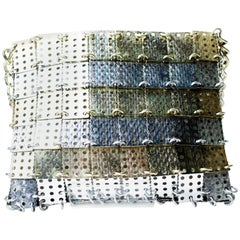

Paco Rabanne for sale on 1stDibs
Visionary designer Paco Rabanne first made a name for himself in the 1960s when he introduced dresses, handbags and other clothing and accessories that went against the common sensibilities of the time and challenged the public's perception of what fashion should be. By working with unlikely materials such as paper and Rhodoid — a cellulose acetate plastic often used to line baking pans — Rabanne forced the fashion world to reconsider materials and form.
Rabanne was born Francisco Rabaneda y Cuervo in Spain’s Basque region. His mother was the head seamstress at Balenciaga when she relocated herself and her son to France in 1939 to escape the Spanish Civil War. Once in France, he took on the name Paco Rabanne.
Rabanne studied architecture at the Ecole Nationale Supérieure des Beaux-Arts in Paris but pivoted toward fashion and began to design accessories and costume jewelry. Rabanne collaborated with many acclaimed luxury houses — his early clients included Charles Jourdan, Givenchy, Pierre Cardin and Dior.
By 1966, Rabanne was working on avant-garde designs in his own newly-opened studio. He introduced a couture collection titled “Twelve Unwearable Dresses in Contemporary Materials.” The garments — made of aluminum, plastic and eco-friendly paper and fastened with wire — were unveiled at a show that featured music and models of color (both uncommon characteristics for such an event). Sculptural, sexy and solidly Space Age in appearance, Rabanne’s experiments turned heads. Pop star-actresses Brigitte Bardot and Françoise Hardy would soon be seen in the designer’s iconic metallic dresses, and Rabanne found enthusiasts in the likes of revolutionary couturier Elsa Schiaparelli and art collector Peggy Guggenheim. In 1968 Rabanne designed leather boots and erotically charged dresses made of molded plastic and chain-mail mesh for the science fiction film Barbarella.
Rabanne called Salvador Dalí a close friend and drew on the Surrealist movement in his designs. He continued to use unconventional materials in his work. From aluminum jersey and fur to ostrich feathers and Velcro, everything was suitable for his pioneering garments. And Rabanne’s talents are diverse — his prolific output even includes stylish furniture.
In 1999 Rabanne retired from the fashion business. In 2010 he was named Officer of the Legion d’Honneur by the French culture minister. Today, under the creative direction of French designer Julien Dossena, the Paco Rabanne brand continues to innovate and offer looks that nod to the past as well as the future.
Find vintage Paco Rabanne clothing and accessories on 1stDibs.
Finding the Right Clutches for You
Vintage and designer clutches are the perfect size to hold exactly what you need. While they’re typically small purses, Chanel clutches, Gucci clutches and other kinds of clutches can make a big impact on an outfit. They also have a fascinating history.
Clutches are handbags without handles that are carried by hand. One of the oldest known clutches was made in Mosul, Iraq, in the 14th century. It was made of brass and inlaid with gold and silver in geometric patterns. Although the loops on the side indicate it likely had handles to wear as a shoulder bag, manuscripts show a similar example being carried by hand.
Fashion designers often made clutches to reflect the wealth of the holder. In Medieval Europe, men and women securely carried items in small bags hidden inside their clothing as tie-on pockets. Women carried their possessions, scented and secreted, in the folds of their voluminous skirts. Pockets eventually became integral to garment design, but bigger sacks were needed to carry books and documents. When women’s clothing became lighter, consisting of fewer layers, it could no longer easily hide their handbags or pockets.
Changes in fashion led to handbags becoming a popular fashion accessory, and today, even as we’re overwhelmed by options from a variety of high-end brands, iconic luxury handbags still rule. The highly decorative bags of the 19th century faded from popularity when women entered the workforce and the clutch became the dominant business accessory. Flappers in the 1920s, clad in the dazzling Art Deco jewelry of the era, also loved the freedom of carrying clutches as they didn’t get in the way of dancing.
The simplicity of the clutch remains stylish today. Once made to be carried on special occasions, they are now an accessory for everyday use. Find a collection of vintage and designer clutches from Dior, Hermès, Louis Vuitton and more on 1stDibs.