Philippine Mahogany Nightstands
Recent Sales
Vintage 1950s American Mid-Century Modern Night Stands
Mahogany
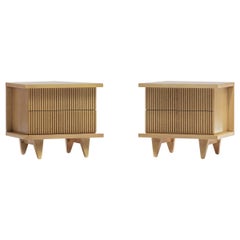

American of Martinsville for sale on 1stDibs
American of Martinsville is today revered as one of the finest manufacturers of mid-century modern furniture in the United States, but its beginnings were unexpectedly humble.
Well ahead of the Civil War, tobacco was a cash crop in places such as Virginia, and the plant was grown with frequency on farms in Martinsville and elsewhere. In the early 1900s, the business around tobacco was changing and the R.J. Reynolds Tobacco Company was expanding nationally, buying any Virginia factories in reach. Former tobacco producers Ancil Witten and Charles Keesee turned away from the business in 1906 and, with merely $30,000 in capital (and the support of local business leaders), began to manufacture bedroom furniture under the name American Furniture Company.
In the 1920s, American Furniture Company expanded its offerings from bedroom furnishings. Alongside tallboy dressers and nightstands, Witten and Keesee’s outfit began to offer a range of dining-room sets to the discerning customer. By the 1950s, the name had been changed to American of Martinsville and the brand had gained a reputation for exquisite craftsmanship as well as its variety of furniture styles (Hollywood Regency, chinoiserie).
Mass-marketed furniture meant big business in the postwar years and throughout the 20th century in Virginia, and factories owned by companies like Bassett Furniture and American of Martinsville remained busy as suburbanites bought furniture to fill the homes they were moving into.
It isn’t difficult to spot American of Martinsville’s sturdy, solid designs — the lacquered walnut nightstands, mahogany coffee tables and more have long earned the admiration of mid-century modernism enthusiasts. The company’s high profile also owes to prominent attributes that distinguish its well-made vintage furniture, such as the use of wooden slats — inspired by Scandinavian modernism — on hutches and cabinet doors, the famous brass x’s inlaid on the tops of tables and dressers and the stately stacked type of the American of Martinsville logo, which usually appears in drawer interiors. The stamp prominently features an eagle perched atop the lettering, its broad wings spread across the “American” portion.
Besides quality manufacturing, American of Martinsville is additionally recognized for having incorporated the trends of the day.
Inspired by designers like George Nakashima and Paul Laszlo, the brand was also known for innovations with wood. Merton Gershun was one of the company’s most prolific designers, and he was responsible for some of its most successful modern furniture lines using the richer, darker woods that would become emblematic of mid-century furniture. Gershun’s most popular line was reportedly Dania, with its sleek walnut credenzas fitted with stylish brass accents and large drawers. Today, American of Martinsville specializes in furniture for the healthcare and hospitality industries.
Shop a wide selection of vintage American of Martinsville mid-century modern sideboards, side tables and more on 1stDibs.
A Close Look at Mid-century-modern Furniture
Organically shaped, clean-lined and elegantly simple are three terms that well describe vintage mid-century modern furniture. The style, which emerged primarily in the years following World War II, is characterized by pieces that were conceived and made in an energetic, optimistic spirit by creators who believed that good design was an essential part of good living.
ORIGINS OF MID-CENTURY MODERN FURNITURE DESIGN
- Emerged during the mid-20th century
- Informed by European modernism, Bauhaus, International style, Scandinavian modernism and Frank Lloyd Wright’s architecture
- A heyday of innovation in postwar America
- Experimentation with new ideas, new materials and new forms flourished in Scandinavia, Italy, the former Czechoslovakia and elsewhere in Europe
CHARACTERISTICS OF MID-CENTURY MODERN FURNITURE DESIGN
- Simplicity, organic forms, clean lines
- A blend of neutral and bold Pop art colors
- Use of natural and man-made materials — alluring woods such as teak, rosewood and oak; steel, fiberglass and molded plywood
- Light-filled spaces with colorful upholstery
- Glass walls and an emphasis on the outdoors
- Promotion of functionality
MID-CENTURY MODERN FURNITURE DESIGNERS TO KNOW
- Charles and Ray Eames
- Eero Saarinen
- Milo Baughman
- Florence Knoll
- Harry Bertoia
- Isamu Noguchi
- George Nelson
- Danish modernists Hans Wegner and Arne Jacobsen, whose emphasis on natural materials and craftsmanship influenced American designers and vice versa
ICONIC MID-CENTURY MODERN FURNITURE DESIGNS
- Eames lounge chair
- Nelson daybed
- Florence Knoll sofa
- Egg chair
- Womb chair
- Noguchi coffee table
- Barcelona chair
VINTAGE MID-CENTURY MODERN FURNITURE ON 1STDIBS
The mid-century modern era saw leagues of postwar American architects and designers animated by new ideas and new technology. The lean, functionalist International-style architecture of Le Corbusier and Bauhaus eminences Ludwig Mies van der Rohe and Walter Gropius had been promoted in the United States during the 1930s by Philip Johnson and others. New building techniques, such as “post-and-beam” construction, allowed the International-style schemes to be realized on a small scale in open-plan houses with long walls of glass.
Materials developed for wartime use became available for domestic goods and were incorporated into mid-century modern furniture designs. Charles and Ray Eames and Eero Saarinen, who had experimented extensively with molded plywood, eagerly embraced fiberglass for pieces such as the La Chaise and the Womb chair, respectively.
Architect, writer and designer George Nelson created with his team shades for the Bubble lamp using a new translucent polymer skin and, as design director at Herman Miller, recruited the Eameses, Alexander Girard and others for projects at the legendary Michigan furniture manufacturer.
Harry Bertoia and Isamu Noguchi devised chairs and tables built of wire mesh and wire struts. Materials were repurposed too: The Danish-born designer Jens Risom created a line of chairs using surplus parachute straps for webbed seats and backrests.
The Risom lounge chair was among the first pieces of furniture commissioned and produced by celebrated manufacturer Knoll, a chief influencer in the rise of modern design in the United States, thanks to the work of Florence Knoll, the pioneering architect and designer who made the firm a leader in its field. The seating that Knoll created for office spaces — as well as pieces designed by Florence initially for commercial clients — soon became desirable for the home.
As the demand for casual, uncluttered furnishings grew, more mid-century furniture designers caught the spirit.
Classically oriented creators such as Edward Wormley, house designer for Dunbar Inc., offered such pieces as the sinuous Listen to Me chaise; the British expatriate T.H. Robsjohn-Gibbings switched gears, creating items such as the tiered, biomorphic Mesa table. There were Young Turks such as Paul McCobb, who designed holistic groups of sleek, blond wood furniture, and Milo Baughman, who espoused a West Coast aesthetic in minimalist teak dining tables and lushly upholstered chairs and sofas with angular steel frames.
Generations turn over, and mid-century modern remains arguably the most popular style going. As the collection of vintage mid-century modern chairs, dressers, coffee tables and other furniture for the living room, dining room, bedroom and elsewhere on 1stDibs demonstrates, this period saw one of the most delightful and dramatic flowerings of creativity in design history.
Finding the Right Commodes-chests-of-drawers for You
Shopping for a commode or a chest of drawers?
Commode is the French term for a low chest of drawers, but it is also sometimes used to denote any case piece with a particularly intricate design. The commode dates to circa 1700 France, where it was used as an alternative to a taller cabinet piece so as to not obscure paneled, mirrored or tapestried walls. Coffers, or chests, which were large wooden boxes with hinged lids and sometimes stood on ball feet, preceded chests of drawers, a fashionable cabinet furnishing that garnered acclaim for its obvious storage potential and versatility. The term commode was also used to refer to a piece of bedroom furniture — a washstand or nightstand that contained a chamber pot.
As time passed, French and British furniture makers led the way in the production of chests of drawers, and features like the integration of bronze and ornamental pulls became commonplace. Antique French commodes in the Louis XV style were sometimes crafted in mahogany or walnut, while an Italian marble top added a sophisticated decorative flourish. This specific type of case piece grew in popularity in the years that followed.
So, what makes a chest of drawers different from a common dresser? Dressers are short, and chests of drawers are overall taller pieces of furniture that typically do not have room on the top for a mirror as most dressers do. Tallboys and highboys are variations of the dresser form. Some chests of drawers have one column of four to six long drawers or three long drawers in their bottom section that are topped by a cluster of small side-by-side drawers on the top. To further complicate things, we sometimes refer to particularly short chests of drawers as nightstands.
Even though chests of drawers are commonly thought of as bedroom furniture to store clothing, these are adaptable pieces. A chest of drawers can house important documents — think of your walnut Art Deco commode as an upgrade to your filing cabinet. Nestle your chest near your home’s front door to store coats and other outerwear, while the top can be a place to drop your handbag. Add some flair to your kitchen, where this lovable case piece can hold pots, pans and even cookbooks.
When shopping for the right chest of drawers for your home, there are a few key things to consider: What will you be storing in it? How big a chest will you need?
Speaking of size, don’t dream too big. If your space is on the smaller side, a more streamlined vintage mid-century modern chest of drawers, perhaps one designed by Paul McCobb or T.H. Robsjohn-Gibbings, may best suit your needs.
At 1stDibs, we make it easy to add style and storage to your home. Browse our collection of antique and vintage commodes and chests of drawers today.
- 1stDibs ExpertFebruary 22, 2021American of Martinsville, which was founded in 1906, is still in business. The company now manufactures furniture for hotel and healthcare industries.