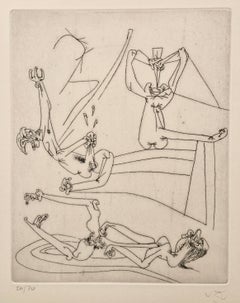
Roberto Matta Erotic
1940s Surrealist Figurative Prints
Etching

People Also Browsed
20th Century Polish Mid-Century Modern Chairs
Velvet, Beech
1970s Surrealist Figurative Prints
Rag Paper, Etching
1920s Surrealist Abstract Prints
Lithograph
Vintage 1950s Corsican Mid-Century Modern Lounge Chairs
Wool, Teak

1930s American Modern Landscape Prints
Woodcut
1930s American Impressionist Landscape Prints
Woodcut
1920s American Impressionist Landscape Prints
Etching
1940s American Modern Figurative Prints
Screen
1940s Modern Abstract Prints
Lithograph, Stencil
1960s Expressionist Figurative Prints
Lithograph
1970s Surrealist Figurative Prints
Paper, Lithograph
1950s Surrealist Figurative Prints
Lithograph
1910s Modern Figurative Prints
Paper, Engraving
21st Century and Contemporary Contemporary Landscape Paintings
Canvas, Oil, Acrylic
1990s Modern Figurative Prints
Etching
Roberto Matta Erotic For Sale on 1stDibs
How Much is a Roberto Matta Erotic?
Roberto Matta for sale on 1stDibs
“The function of art,” the Surrealist Roberto Matta once stated, “is to unveil the enormous economic, cultural and emotional forces that materially interact in our lives and that constitute the real space in which we live.” In his paintings, Matta sought to expose those forces through the Surrealist practice of automatism, creating work in a free-associative state intended to conjure the unconscious.
After studying architecture in his native Chile, Matta, then 22, chose to pursue the field in Paris, where he mingled with stars of the avant-garde like Gertrude Stein, Salvador Dalí and Walter Gropius. In the late 1930s, he abandoned Paris, together with his job at Le Corbusier’s studio and (for a time) his career, for modern art’s new epicenter, New York City. There, he became a colleague of art legends like Marcel Duchamp and Arshile Gorky.
Although celebrated primarily for his work as a painter, Matta was an equally talented furniture designer. His furniture pieces, like his artworks, are the stuff of dreams. The back of his totem chair, for example, is composed of smiling, cartoonish creatures stacked on top of each other. In his MAgriTTA armchair, the top half of a plush green apple sticks out of large black bowler in homage to its namesake, the Belgian Surrealist René Magritte.
But perhaps the piece that most truly embodies his artistic philosophy is his 1966 Mallite modular system: a collection of spongy, undulating sofas and lounges that can be fitted together to form a puzzle-like room divider. The work, an original edition of which is in MoMA’s permanent collection, has in recent decades been a hard-to-find collectors’ item — until 2019, when Italian design brand Paradisoterrestre issued a reedition, available through Duplex.
Browse Roberto Matta's paintings and furniture designs on 1stDibs.
A Close Look at Surrealist Art
In the wake of World War I’s ravaging of Europe, artists delved into the unconscious mind to confront and grapple with this reality. Poet and critic André Breton, a leader of the Surrealist movement who authored the 1924 Surrealist Manifesto, called this approach “a violent reaction against the impoverishment and sterility of thought processes that resulted from centuries of rationalism.” Surrealist art emerged in the 1920s with dreamlike and uncanny imagery guided by a variety of techniques such as automatic drawing, which can be likened to a stream of consciousness, to channel psychological experiences.
Although Surrealism was a groundbreaking approach for European art, its practitioners were inspired by Indigenous art and ancient mysticism for reenvisioning how sculptures, paintings, prints, performance art and more could respond to the unsettled world around them.
Surrealist artists were also informed by the Dada movement, which originated in 1916 Zurich and embraced absurdity over the logic that had propelled modernity into violence. Some of the Surrealists had witnessed this firsthand, such as Max Ernst, who served in the trenches during World War I, and Salvador Dalí, whose otherworldly paintings and other work responded to the dawning civil war in Spain.
Other key artists associated with the revolutionary art and literary movement included Man Ray, Joan Miró, René Magritte, Yves Tanguy, Frida Kahlo and Meret Oppenheim, all of whom had a distinct perspective on reimagining reality and freeing the unconscious mind from the conventions and restrictions of rational thought. Pablo Picasso showed some of his works in “La Peinture Surréaliste” — the first collective exhibition of Surrealist painting — which opened at Paris’s Galerie Pierre in November of 1925. (Although Magritte is best known as one of the visual Surrealist movement’s most talented practitioners, his famous 1943 painting, The Fifth Season, can be interpreted as a formal break from Surrealism.)
The outbreak of World War II led many in the movement to flee Europe for the Americas, further spreading Surrealism abroad. Generations of modern and contemporary artists were subsequently influenced by the richly symbolic and unearthly imagery of Surrealism, from Joseph Cornell to Arshile Gorky.
Find a collection of original Surrealist paintings, sculptures, prints and multiples and more art on 1stDibs.
Finding the Right Figurative-prints-works-on-paper for You
Bring energy and an array of welcome colors and textures into your space by decorating with figurative fine-art prints and works on paper.
Figurative art stands in contrast to abstract art, which is more expressive than representational. The oldest-known work of figurative art is a figurative painting — specifically, a rock painting of an animal made over 40,000 years ago in Borneo. This remnant of a remote past has long faded, but its depiction of a cattle-like creature in elegant ocher markings endures.
Since then, figurative art has evolved significantly as it continues to represent the world, including a breadth of works on paper, including printmaking. This includes woodcuts, which are a type of relief print with perennial popularity among collectors. The artist carves into a block and applies ink to the raised surface, which is then pressed onto paper. There are also planographic prints, which use metal plates, stones or other flat surfaces as their base. The artist will often draw on the surface with grease crayon and then apply ink to those markings. Lithographs are a common version of planographic prints.
Figurative art printmaking was especially popular during the height of the Pop art movement, and this kind of work can be seen in artist Andy Warhol’s extensive use of photographic silkscreen printing. Everyday objects, logos and scenes were given a unique twist, whether in the style of a comic strip or in the use of neon colors.
Explore an impressive collection of figurative art prints for sale on 1stDibs and read about how to arrange your wall art.