Saint Laurent Knitwear
Recent Sales
1990s Vests
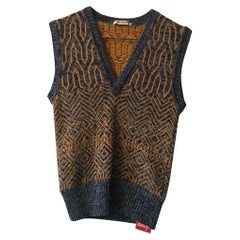

Yves Saint Laurent for sale on 1stDibs
French designer Yves Saint Laurent pioneered “cross-design” in fashion, taking inspiration from street trends to modernize haute couture.
Saint Laurent was the first to launch a ready-to-wear label, YSL Rive Gauche Prêt-à-Porter. He was the first couturier to open boutiques for both men and women. Using traditional menswear fabrics and designs for women, Saint Laurent also literally cross-dressed, giving men and women alike chic pant suits, elegant tuxedo jackets and urban safari gear.
By blurring gender-specific design, Saint Laurent empowered individual style while creating a scissor-sharp fashion aesthetic of sensual ease and beauty. Many of his designs are today considered timeless classics. Saint Laurent also consistently used Black models, like Mounia, Iman and Naomi Campbell, and he drew endless inspiration from different ethnicities and cultures, in no small part because of his Algerian roots.
Born to French parents in Oran, Algeria, in 1936, Saint Laurent went to Paris at age 17 to study fashion at the Chambre Syndicale de la Haute Couture. Just two years later, in 1955, his remarkable sketches were shown to Christian Dior, then the world’s reigning couturier, who hired him immediately.
Surprisingly soon thereafter, Dior publicly chose Saint Laurent as his successor, which sadly proved prescient when the fashion legend died unexpectedly, in 1957. A mere slip of a youth, the 21-year-old Saint Laurent was nevertheless up to the challenge. He shook the traditional couture clientele to its core with youthful silhouettes and styles like the A-line trapeze dress that hung with seeming effortlessness from the shoulders, the antithesis of the pinched waists and molded skirts that had been all the rage after the deprivations of World War II.
After a mandated spell in the torturous French military, Saint Laurent suffered a nervous breakdown and was dismissed by Dior in 1962. Out of the ashes rose the Age of Yves. With Pierre Bergé, his then-lover who became his lifelong business partner and friend, the designer founded Yves Saint Laurent YSL to encompass prêt-à-porter, or ready-to-wear. In 1966, they opened the first YSL Rive Gauche women’s boutique in Paris, followed soon thereafter by YSL Rive Gauche for men. Saint Laurent had given birth to a global brand.
His revolutionary Mondrian mini dress from 1965 is a core element of his fashion biography. It is a prime example of how Saint Laurent, an avid art lover and collector, looked to painters, from Goya to Picasso, Ingres to Matisse, for inspiration.
With its pure lines and hues, Mondrian’s ground-breaking 1935 color-block painting Composition C transmutes beautifully into a dress that is highly valued by collectors of contemporary fashion and widely copied commercially to this day. The design is the epitome of Saint Laurent’s aesthetic, requiring a meticulous hand-piecing of each color block so that, despite the body’s curves, the visual plane is as flat as a canvas when the garment is worn. Mondrian’s purity met its match in Saint Laurent.
“I am no longer concerned with sensation and innovation, but with the perfection of my style,” Saint Laurent said four years before retiring, in 2002. After a long period of ill health, he died at his home in Paris on June 1, 2008.
Browse an extraordinary collection of vintage Yves Saint Laurent evening dresses, shirts, handbags and other clothing and accessories today on 1stDibs.
Fashion of the 1990s
For fashion lovers, the 1990s have become associated with styles adopted by today’s supermodels and influencers, who never wear the same thing twice. And because fast fashion didn’t yet exist, the design associated with 1990s fashion — vintage '90s handbags, clothing and accessories — has a quality appreciated by the millennial generation: authenticity.
If there was one concept unifying fashion in the 1990s, it was the lean silhouette. “Fashion is a game of proportion,” Alexander Fury wrote in the New York Times in 2016. “Narrow-shouldered and narrow-hipped, the ’90s were skinny.”
If it takes a practiced eye to identify that single concept, that’s because in truth, ’90s fashion was many things to many people. After the 1980s era of strong-shouldered working women, glossy aerobicized bodies and Madonna, fashion branched out.
The industry gained momentum from big-money relaunches of the great Paris houses Dior, Givenchy and Balenciaga, rescued at long last from the constraints of licensing. Japan and Belgium gave fashion new avant-garde ideas to play with. From America came denim, minimalism, '90s grunge fashion and hip-hop. From Italy came sex appeal. And Prada.
For the colorful corsets of her 1990 Portrait collection, audacious British designer Dame Vivienne Westwood drew on 18th-century oil paintings — her models donned the pearl choker necklaces that have become a social media star and a favorite of influencers and fashion lovers all over the world. For a jacket-and-shorts suit from her Fall/Winter 1996–97 Storm in a Teacup line, the designer used the extreme asymmetry of a tartan mash-up to confront, according to Westwood, “the horror of uniformity and minimalism.”
“The ethos of the time was, you could have style, you could be into all kinds of cool stuff. It wasn’t about money, it wasn’t about status,” says Katy Rodriguez, cofounder of Resurrection. In contrast, “our last 10 years have seen the domination of nonstop luxury, money and status.”
Vintage 1990s Chanel bags, for example, are among the most prized of the brand’s offerings — at Newfound Luxury, proprietor L. Kiyana Macon has "clients who only buy ’90s Chanel because they recognize that it is the best quality.”
Things were different in the ’90s, and the difference is reflected in the clothes. Pull up any recent “How to Do the 1990s” fashion article (or look at photos of current supermodels Gigi, Kendall and Bella), and you’ll see iconic '90s outfits — knee socks, cardigans, fanny packs, fishnet stockings, slip dresses, flannel shirts and combat boots.
Rodriguez has recently noticed something similar happening. Before COVID, customers searched 1990s stock “for very sexy Galliano, Dior, Cavalli — that kind of thing,” she explains, noting that just a few months ago, “people were posting [on social media] the poshest things they could.” Now, in the age of shutdown, “that would just look out of touch.”
Instead, people are looking for “things that are cool but also easy and comfortable, not necessarily super-luxe,” Rodriguez continues. They’re “heading back to the more avant-garde, anti-fashion designers, like Helmut Lang, [Martin] Margiela and [Ann] Demeulemeester.”
Late designer Franco Moschino shocked and titillated the ’80s fashion elite with his whimsical, irreverent parodies of bourgeois finery. Whether emblazoning a sober blazer with smiley faces or embellishing a skirt suit with cutlery, Moschino rendered high style with a hearty wink. He famously said, “If you can’t be elegant, at least be extravagant” — words that, with all due respect to Susan Sontag, epitomize the essence of camp.
Vintage Moschino pants, jackets and other '90s Moschino garments remain so bold and fresh today that even the house's former creative director, Jeremy Scott, drew on the brand's past and the pop culture of the decade for his debut collection in 2014.
Find vintage 90s dresses, skirts, sweaters and other clothing and accessories on 1stDibs — shop Thierry Mugler, Miuccia Prada, Jean Paul Gaultier and more today.
Finding the Right Jackets for You
No matter if you’re preparing for a fashion event or a weather event — you’re going to need a good jacket.
What would become the modern jacket as we know it began as a strictly professional item. A lot of the vintage and designer jackets (and coat styles such as the Navy-inspired peacoat) in our closets were likely popularized by soldiers who battled aggressive climes with their regulation field jackets, bombers and parkas buttoned or zipped to the chin. Indeed, keeping troopers comfortable guided the design of the military surplus garments that have often become buzzy fashion trends. But now, jackets add far more than warmth to our wardrobe, and we hunt down outer layers branded with peerless fashion labels.
Fashion’s most iconic creations, despite their age, remain modern: Biker jackets originated in the 1920s, Balenciaga’s celebrated puffers are steeped in a tradition of down coats that began in the 1930s and your vintage denim jacket has come an even longer way, from California Gold Rush to wardrobe staple. Jeans bequeathed jean jackets during the 1880s, thanks to Levi Strauss, who crafted the former as a durable garment to be worn by miners and railroad workers. Later, jeans and jean jackets became synonymous with nonconformity and rebelliousness — with fashion legends such as actor James Dean in the 1950s and model Veruschka in the 1960s and ’70s leading the indigo-toned charge.
Another fashion rebel, Coco Chanel, used the classic tweed jacket to introduce more comfort and mobility into women’s daily lives. Debuting in 1954 and based on a cardigan, the groundbreaking Chanel jacket forever changed what women wear. The garment reacted against the fitted, constricting styles of Christian Dior’s New Look, which, as Chanel saw it, was making women dress like decorative objects.
On 1stDibs, find bold collections from cutting-edge contemporary designers who’ve taken the classic silhouette of the jacket to new heights or build out your array of vintage treasures (denim or otherwise) with dazzlers from Yves Saint Laurent, Gianni Versace, Moschino and more.