Spode Famille Rose
Recent Sales
Antique 1820s English Chinoiserie Porcelain
Porcelain
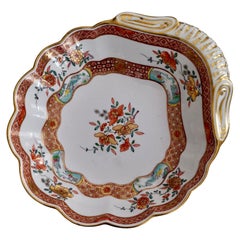

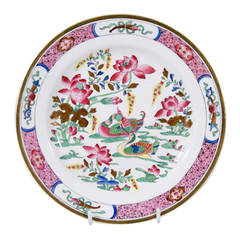
Antique 19th Century English Chinoiserie Dinner Plates
Porcelain
Spode for sale on 1stDibs
Spode is one of the oldest and most distinguished of the great pottery companies of Staffordshire, the time-honored home of English ceramics. The firm’s blue and white bone china transferware is a timeless classic. Spode dishes compose the sort of elegant dinner service that most of us envision on a traditional holiday table.
The company was established in 1770 in Stoke-on-Trent by Josiah Spode, a friend and neighbor of another estimable English ceramist, Josiah Wedgwood. The Wedgwood firm first came to prominence for its tableware, which quickly gained favor in aristocratic households throughout Britain and Europe.
Spode was particularly known for two technical achievements in the firm’s early decades. The first was to develop a standard formula for the making of bone china — a type of porcelain (made with a mixture of bone ash, minerals and clay) that is dazzlingly white and so strong it can be used to create very thin translucent plates and vessels.
The other advancement was to perfect the making of transferware. That process involves the transfer of pictorial images inked on tissue paper — such as the garden scenery in the famous Willow dish patterns — onto ceramics that are then sealed with a glaze.
From the 1820s onward, Spode enjoyed tremendous success both in Britain and elsewhere owing to the beauty and vitality of its decorative imagery. By some counts, Spode created more than 40,000 patterns in the 19th century.
In 1833, following the sudden death of Josiah Spode III, business partner W. T. Copeland took over the company and changed its name to Copeland Spode (it later changed again, this time to W. T. Copeland and Sons). Collectors regard Copeland-marked pieces as Spode china. The Spode brand was revived in 1970.
Many favorite Spode patterns — among them Blue Italian, Indian Tree, Greek and Woodland — date to the company’s early years. Spode’s most popular pattern, Christmas Tree, was introduced in 1938.
Prices for antique and vintage Spode china vary widely, based on the size of the service, its condition and the pattern. An antique dinner service for 12 people or more, in good repair and complete with cups and serving dishes, will generally cost between $10,000 and $20,000. Such Spode services become heirlooms — a proud and timeless addition to a family’s table. And as you will see on these pages, Spode’s rich and varied wares offer a visual feast in and of themselves.
Find Spode serveware, ceramics and decorative objects on 1stDibs.
A Close Look at Chinoiserie Furniture
Emerging in the 17th century, chinoiserie appropriated the aesthetics and imagery of popular East Asian design for European-made versions. Reflecting the exoticization of China, Japan and other countries in this era, the word directly translates from French to “Chinese-esque,” which reveals its shortcomings as a style of furniture and decor that often stereotypically and reductively mimics Asian culture rather than showcasing and paying tribute to its artistic traditions.
The enthusiastically decorative chinoiserie style was propelled by influential tastemakers including French King Louis XIV, whose Trianon de Porcelaine in 1670 was inspired by Chinese architecture. Expanded trade between the East and West led to a demand for porcelain, lacquer objects, silk and other goods, which further informed the fanciful furniture being crafted in Europe.
Artisans working in the chinoiserie style used materials and elements like pagoda shapes, bamboo, lacquer surfaces, bird and flower motifs and other interpretations of Asian design on pieces that were frequently set against vibrant wallcoverings. This whimsical approach yielded chinoiserie furniture that boasted dramatic flourishes drawing on the natural world and reflected the dominance of Rococo during the 18th century.
As chinoiserie was shaped by approximations of Asian design by European creators, it had regional variations, such as Chinese Chippendale in England where cabinets, chairs and tea tables had wooden fretwork designs and “japanned” surfaces intended to resemble lacquer work that was created in East Asia. In North America, furniture makers in Boston and New York integrated chinoiserie-painted scenes into Queen Anne furniture.
Antique chinoiserie furniture has continued to be fashionable, from its popularity with decorators of the Hollywood Regency era — James Mont, Tommi Parzinger, William Haines and Samuel Marx favored the style — to contemporary interior designers, although it brings with it a complex history.
Find a collection of chinoiserie bedroom furniture, cabinets, decorative objects and more on 1stDibs.
Finding the Right Porcelain for You
Today you’re likely to bring out your antique and vintage porcelain in order to dress up your dining table for a special meal.
Porcelain, a durable and nonporous kind of pottery made from clay and stone, was first made in China and spread across the world owing to the trade routes to the Far East established by Dutch and Portuguese merchants. Given its origin, English speakers called porcelain “fine china,” an expression you still might hear today. "Fine" indeed — for over a thousand years, it has been a highly sought-after material.
Meissen Porcelain, one of the first factories to create real porcelain outside Asia, popularized figurine centerpieces during the 18th century in Germany, while works by Capodimonte, a porcelain factory in Italy, are synonymous with flowers and notoriously hard to come by. Modern porcelain houses such as Maison Fragile of Limoges, France — long a hub of private porcelain manufacturing — keep the city’s long tradition alive while collaborating with venturesome contemporary artists such as illustrator Jean-Michel Tixier.
Porcelain is not totally clumsy-guest-proof, but it is surprisingly durable and easy to clean. Its low permeability and hardness have rendered porcelain wares a staple in kitchens and dining rooms as well as a common material for bathroom sinks and dental veneers. While it is tempting to store your porcelain behind closed glass cabinet doors and reserve it only for display, your porcelain dinner plates and serving platters can safely weather the “dangers” of the dining room and be used during meals.
Add different textures and colors to your table with dinner plates and pitchers of ceramic and silver or a porcelain lidded tureen, a serving dish with side handles that is often used for soups. Although porcelain and ceramic are both made in a kiln, porcelain is made with more refined clay and is stronger than ceramic because it is denser.
On 1stDibs, browse an expansive collection of antique and vintage porcelain made in a variety of styles, including Regency, Scandinavian modern and other examples produced during the mid-century era, plus Rococo, which found its inspiration in nature and saw potters crafting animal figurines and integrating organic motifs such as floral patterns in their work.
- 1stDibs ExpertAugust 15, 2024Whether Spode is made in England or China depends on the piece. Spode continues to manufacture some of its iconic china at its workshop in Stoke-on-Trent, England, which has been in continuous operation for more than 250 years. However, some lines now originate from factories in China that adhere to the brand's strict quality standards. On 1stDibs, shop a wide variety of Spode pieces.