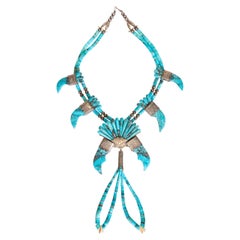
Squash Blossom Bear Claws
Vintage 1960s American Native American Beaded Necklaces
Turquoise, Sterling Silver

People Also Browsed
Mid-20th Century American Modernist Drop Necklaces
Early 20th Century American Native American Beaded Necklaces
Turquoise
2010s American Native American Solitaire Rings
Turquoise, Sterling Silver
Vintage 1920s American Native American Cuff Bracelets
Turquoise, Sterling Silver
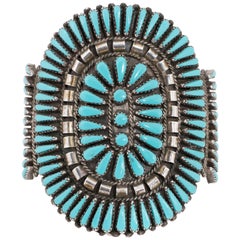
Vintage 1950s American Native American Cuff Bracelets
Turquoise, Sterling Silver
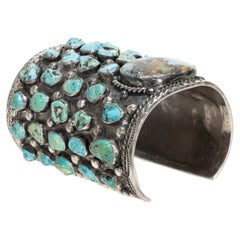
Vintage 1940s American Native American Beaded Necklaces
Coral, Turquoise, Sterling Silver
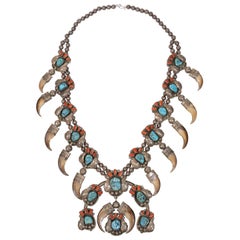
Mid-20th Century American Native American Pendant Necklaces
Turquoise, Sterling Silver
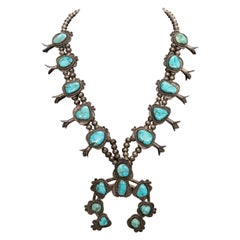
Vintage 1920s American Native American Beaded Necklaces
Turquoise, Sterling Silver
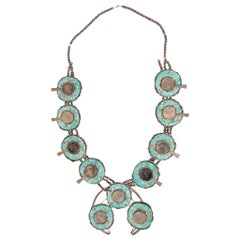
Antique 1860s British High Victorian More Necklaces
Natural Pearl, Turquoise, Silver, 14k Gold, 18k Gold, 10k Gold

Vintage 1950s American Native American Beaded Necklaces
Turquoise, Sterling Silver
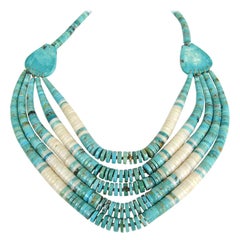
Vintage 1960s American Native American Beaded Necklaces
Turquoise, Sterling Silver
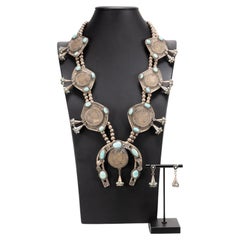
Antique 1890s American Native American Beaded Necklaces
Silver, Sterling Silver
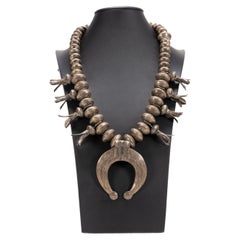
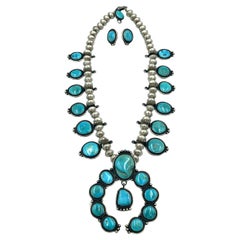
Late 20th Century Native American Pendant Necklaces
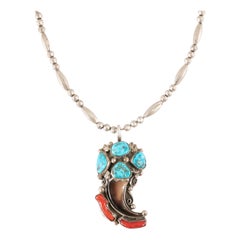
Vintage 1980s American Native American Pendant Necklaces
Coral, Turquoise, Sterling Silver
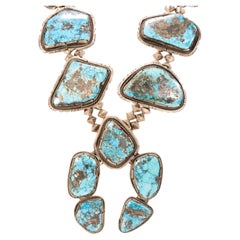
Late 20th Century American Native American Pendant Necklaces
Turquoise, Sterling Silver
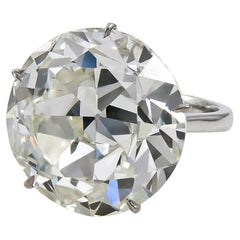
21st Century and Contemporary American Romantic Engagement Rings
Diamond, 18k Gold, White Gold
The Legacy of Turquoise in Jewelry Design
The thought of vintage and antique turquoise jewelry often conjures up images of striking Navajo bracelets and necklaces worn with a denim shirt and cowboy boots. This all-American look has been celebrated by fashion designers like Ralph Lauren and Tommy Hilfiger on their runways and in ad campaigns. In the October 2016 issue of Vogue magazine, Tom Ford said he only wears turquoise jewelry at his Santa Fe ranch. So what is it about this gorgeous blue-green stone that makes us wish that we were born in December?
It’s not surprising that turquoise is abundant in New Mexico and Arizona because, according to the Gemological Institute of America (GIA), it needs to be in “dry and barren regions where acidic, copper-rich groundwater seeps downward and reacts with minerals that contain phosphorus and aluminum.
Turquoise is not found in a single crystal but is a combination of microcrystals. Its appearance, waxy and opaque, is attributed to its structure and composition. “It’s an aggregate of microscopic crystals that form a solid mass. If the crystals are packed closely together, the material is less porous, so it has a finer texture. Fine-textured turquoise has an attractive, waxy luster when it’s polished. Turquoise with a less-dense crystal structure has higher porosity and coarser texture, resulting in a dull luster when it’s polished,” notes the GIA. Since no one wants to set a dull piece of turquoise, porous turquoise is often treated to make the stone more attractive.
In the United States, there have been discoveries of turquoise from 200 B.C. It is not just loose turquoise stones that have been found, but entire suites of jewelry from prehistoric times. In the late 19th-century, the Navajo Indians, who learned silversmithing from the Spanish, started to make beads out of turquoise and eventually combined it with silver around the 1880s. Initially this jewelry was for ceremonial purposes, but it became fashionable once the tourism in the Southwest picked up in the beginning of the 20th century.
Find antique and vintage turquoise rings, necklaces, bracelets and other accessories on 1stDibs.
Finding the Right Beaded-necklaces for You
Whether they’re chunky, statement-making accessories or a single strand of the understated sort, antique and vintage beaded necklaces are versatile pieces of jewelry. Indeed, the unique beaded necklaces in your jewelry box likely go with everything, from casual summer tops and shorts to dazzling evening gowns.
From the fish-bone and seashell jewelry of the prehistoric era to the breathtaking amulets and pendants of ancient Egypt to modern sapphire beads, people have been accessorizing with beaded necklaces for eternity.
Beaded necklaces — as well as other kinds of necklaces — were common in prehistoric times. Personal adornment was important, and jewelry was made for every part of the body. Beadwork is among the best known art forms attributed to Native Americans, and just as they had for saddlery and clothing, early populations would fashion beads for necklaces with stone tools or instruments made of wood. The making of colorful glass beads for beaded necklaces likely originated in Venice, Italy, during the 14th century, particularly given the growth of the decorative glass industry on the series of Venetian islands called Murano. During the Neolithic period, humans were buried with coral beaded necklaces from the Mediterranean, even as far north as the Alps.
Whether you’re seeking the pop of color you’ll get in a double-row jade beaded necklace from the Art Deco era — which encompasses the 1920s and ’30s and ushered in a very distinct look in jewelry design — or perhaps a simple strand of pearls for a blouse that leaves your neck bare, remember that different necklines call for different pieces of jewelry.
When accessorizing with a beaded necklace, a long piece with a pendant will likely pair best with your favorite vintage V-neck dress or V-neck tee, while beaded chokers and collar necklaces are a stylish fit for strapless tops. Bigger beads will hit your neckline in a different way than a more minimalist necklace might, so you’ll want to keep that in mind. Choose colors you like and pick items that will go with what is in your closet. When the occasion calls for it, don’t be afraid to stack. “More is more” for some, so pairing a delicate strand with a bolder piece might be the move for you.
On 1stDibs, find a collection of pearl beaded necklaces, antique emerald beaded necklaces, diamond beaded necklaces and more.
- 1stDibs ExpertFebruary 22, 2021Navajo rugs are so expensive due to their exemplary craftsmanship and use of high quality wool. The tightness of the weaving, size of the rug, dyes used and condition all affect a Navajo rug's price. Prices for Navajo rugs typically range anywhere from $100 to a few thousand dollars. Find Navajo rugs and carpets now on 1stDibs.