Stickley Corner Cabinet
Recent Sales
21st Century and Contemporary American Arts and Crafts Corner Cupboards
Glass, Oak
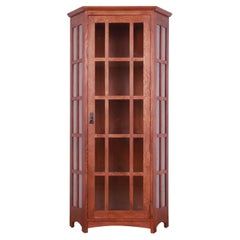

21st Century and Contemporary American Arts and Crafts Corner Cupboards
Glass, Oak
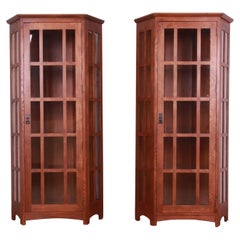
Late 20th Century American Arts and Crafts Corner Cupboards
Copper
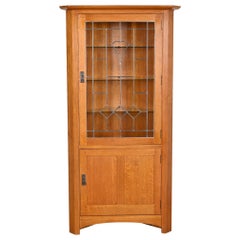
1990s American Federal Corner Cupboards
Mahogany
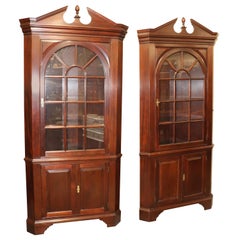
Late 20th Century American Arts and Crafts Cabinets
Copper
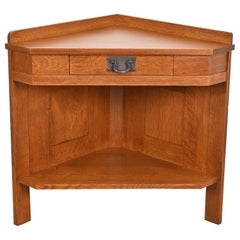
Late 20th Century American Georgian Corner Cupboards
Brass
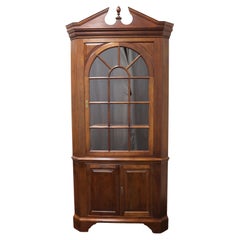
L. J.G. Stickley Inc. for sale on 1stDibs
Gustav Stickley was one of the principal figures in the American Arts and Crafts movement and the creator of the Craftsman style. In 1883, Stickley established a furniture company called Stickley Brothers with two of his brothers, Albert and Charles. Gustav’s other siblings, Leopold and John George, would later form L J.G. Stickley Inc. in Fayetteville, New York, in 1905.
As a furniture designer and publisher of the magazine The Craftsman, Gustav adopted many of the ideals of the British design reform movement and popularized both its philosophy and its aesthetics in the United States.
Born in Wisconsin, Stickley moved with his family to Pennsylvania when he was a teenager and began working in his uncle’s chair factory in the town of Brandt. There, he learned the techniques of late-19th-century furniture making at a time when the vogue was for Victorian revival furniture, which was characterized by extensive ornamentation.
When Stickley Brothers foundered, Gustav partnered five years later with salesman Elgin Simonds to form a new firm, Stickley Simonds, which produced traditional furniture that appealed to the burgeoning American middle class. The success of this venture enabled Stickley to travel to Europe, where he discovered the writings of John Ruskin and William Morris, the two preeminent thinkers of the British Arts and Crafts movement. Stickley also traveled to France, where the Art Nouveau movement impressed him with its imaginative designs and skilled craftsmanship.
Stickley parted ways with Simonds at the turn of the 20th century and decided to focus his creative energies on producing furniture in what became known as the Craftsman style, incorporating some of the elements of the designs and movements he had encountered in Europe.
The pieces Stickley created, which he stamped with the logo of a joiner’s compass, were rectilinear, largely free of ornament, made of oak, and built in such a way that the nature of their construction was plainly visible — all reflections of the tenets of the Arts and Crafts movement. While some people referred to Stickley’s furniture as Mission furniture — a term that references the furnishings of the Spanish missions in California — Gustav commonly called his work “Craftsman” owing to the inspiration he found in the British Arts and Crafts movement.
Stickley benches and rocking chairs were popular, and his leather-upholstered armchairs combine practicality, comfort and an understated silhouette. In 1901, Stickley launched The Craftsman magazine, which contained articles on all manner of domestic topics, from gardening and cooking to art and design, as well as poetry and fiction. In addition to popularizing Stickely’s own designs, the magazine acquainted Americans with the Arts and Crafts style in all its forms through its graphic design and the bungalows, art pottery, and hammered-copper lamps pictured in its pages. When Gustav Stickley died, in 1942, Arts and Crafts had been replaced by modernism as the favored aesthetic.
The work of L J.G. Stickley flourished even as the Arts and Crafts style fell out of fashion because Leopold and John George adapted to the changing times.
L J.G. Stickley changed their brand name and maker’s mark to Handcraft in 1906, and rather than continue to produce Arts Crafts-inspired designs, their bedroom furnishings, dining room chairs and other items of the era reflected the influence of Frank Lloyd Wright and the Prairie School style as well as the work of the Wiener Werkstätte. Later, Leopold’s Cherry Valley collection appealed to enthusiasts of American Colonial furniture.
Find antique L J.G. Stickley tables, seating, case pieces and more on 1stDibs.
Finding the Right Corner-cupboards for You
Storage space is crucial in any home and proper antique, new and vintage corner cupboards can make all the difference.
Corner cupboards are different from standard cupboards in that they are tall, spacious cupboards with curved or diagonal fronts and triangular backs that are designed specifically to fit into a room’s corner, or they’re not freestanding and have been built directly into the room. This kind of case piece — one of the offerings in what was deemed “corner furniture” — rose to popularity during the 18th century in England and America, occupying a prominent position in dining rooms before they were later moved into kitchens. Overhanging tops and urn-shaped finials adorned Chippendale-style corner cupboards in the mid- to late 1700s, while Victorian corner cupboards were made in woods such as walnut and mahogany and featured decoratively hand-carved cabinet doors.
There is a case piece for every storage conundrum, and in dining rooms it was helpful to have items for meals on hand in a tall corner cupboard. Smaller corner cupboards were built to hang from ceilings while larger versions stretched from floor to ceiling to make the most of the area.
Behind cabinet doors with curved glass, the top section of a corner cupboard might house several shelves on which a family’s silver or dishware would be displayed, while the bottom half’s doors concealed whatever home goods were stored below. While corner cupboards are roomy and robust — and an antique freestanding piece is going to be heavy to move — it was the ideal way to keep serveware on hand while taking advantage of little-used corner space. Not unlike a stylish credenza or buffet, a corner cupboard isn’t merely a storage solution.
Crafted in a range of woods and embellished with brass or bronze accents, corner cupboards were striking furnishings of a certain era and will surely command attention in your home.
On 1stDibs, find antique and vintage corner cupboards in a number of styles, including mid-century modern corner cupboards, Georgian versions and more.