Svenskt Tenn Pewter Tray
Vintage 1950s Swedish Scandinavian Modern Decorative Dishes and Vide-Poche
Pewter
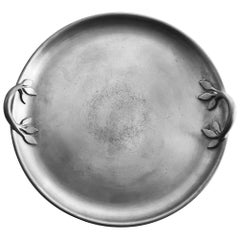

Vintage 1930s Swedish Art Deco Platters and Serveware
Pewter
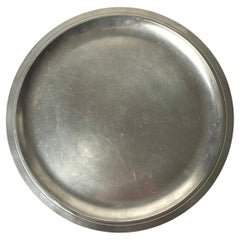
Vintage 1930s Swedish Scandinavian Modern Serving Pieces
Pewter
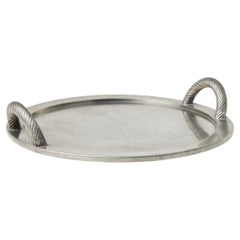
Vintage 1920s Swedish Scandinavian Modern Tableware
Pewter
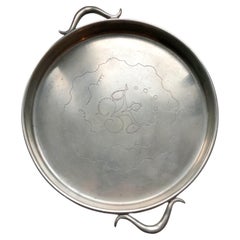
Recent Sales
Mid-20th Century Swedish Scandinavian Modern Tray Tables
Brass, Pewter
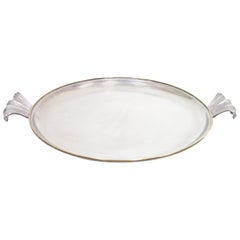
Vintage 1920s Swedish Scandinavian Modern Platters and Serveware
Brass, Pewter
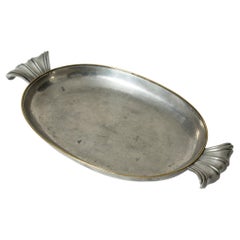
Vintage 1940s Swedish Scandinavian Modern Decorative Dishes and Vide-Poche
Brass, Pewter
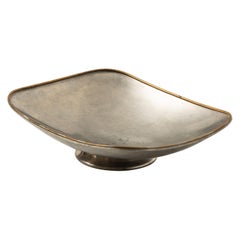
Vintage 1940s Swedish Scandinavian Modern Decorative Baskets
Brass, Pewter
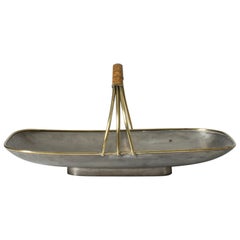
People Also Browsed
Antique Mid-19th Century American Victorian Fountains
Concrete
Vintage 1950s French Neoclassical Wall Lights and Sconces
Enamel
Mid-20th Century French Mid-Century Modern Screens and Room Dividers
Pine
21st Century and Contemporary British Jacobean Console Tables
Oak, Yew
Vintage 1930s French Art Deco Desks and Writing Tables
Chrome
Early 2000s American Mid-Century Modern Books
Paper
Vintage 1960s Danish Scandinavian Modern Lounge Chairs
Wool, Cane, Oak
2010s Scandinavian Modern Vitrines
Natural Fiber
Vintage 1930s French Art Deco Office Chairs and Desk Chairs
Leather, Oak
2010s Nepalese Modern Chinese and East Asian Rugs
Silk
Vintage 1920s Dutch Art Deco Vitrines
Glass, Macassar
Antique 1830s Austrian Biedermeier Corner Cupboards
Ebony, Ash
Antique Early 19th Century Swedish Folk Art Corner Cupboards
Pine, Paint
Antique 1860s English Gothic Revival Fireplaces and Mantels
Stained Glass, Oak
Vintage 1910s Swedish Gustavian Cupboards
Birch
Early 20th Century French Brutalist Tables
Beech
Svenskt Tenn for sale on 1stDibs
Today, the name Svenskt Tenn is associated around the world with the vibrant, modernist textiles and furniture of Josef Frank, who was the Swedish company’s chief designer in the mid-20th century. But the term “svenskt tenn” actually means “Swedish pewter,” and the very first goods the company sold were stylish pewter objects, such as an elegant 1927 candelabra found in the collection of the Saint Louis Art Museum, or a sleek, understated mirror in the collection of the National Museum of Fine Arts. These pieces were designed to appeal to discerning but price-conscious shoppers in 1920s-era Stockholm.
Art teacher and interior designer Estrid Ericson (1894–1981) partnered with pewter artisan Nils Fougstedt (1881–1954) to establish Svenskt Tenn in 1924, and their creations quickly gained a reputation for high quality and affordability, winning a gold medal at the International Exhibition of Modern Decorative and Industrial Arts in Paris in 1925 — the design fair that brought global attention to the Art Deco style.
The experience of renovating her own apartment in the 1920s exposed Ericson to Swedish functionalism — or funkis, as it was known in Sweden — a branch of modernism that advocated uncomplicated forms, subdued colors and utility. She was inspired to open an interior design department at Svenskt Tenn, and in 1930 the firm introduced its first line of furniture.
Selections included items produced by the companies Gemla and Bodafors, as well as original designs by Ericson and the architects Uno Åhrén and Björn Trägårdh, who had worked together on the redesign and expansion of the showroom. The trio’s furniture was displayed at Stockholm’s Galleri Modern in 1931, where it was met with praise from critic Gotthard Johansson, a leading proponent of Swedish functionalism. Johansson admired the “pure lines” and “modern austerity” of the furniture, establishing Svenskt Tenn as an important voice in Swedish design.
But the signature partnership that would come to define the look of Svenskt Tenn was in part the result of political turmoil and the emergence of Nazism in Europe. When Josef Frank fled Vienna for Stockholm in 1933, he was already an accomplished architect who questioned modernist orthodoxy in design. He disliked tubular steel furniture and believed that monochromatic surfaces were distressing to viewers, while pattern and ornament gave interiors a sense of warmth and calm. Ericson was an admirer of Frank’s work, and offered him the chance to design products for Svenskt Tenn. Their professional partnership, particularly in textile design, would eventually become one of the hallmarks of Swedish modernism.
Frank and Ericson collaborated from 1934 until Frank’s death in 1967, with Frank creating unmistakable, bold designs and Ericson employing her flair for interiors, merchandising and display. The pair called their shared approach “Accidentism” or “The Happy Chances Philosophy,” mixing and matching the new and antique, the serious with the playful and pattern with solid colors to find eclectic new combinations in their showroom.
Frank’s textiles are like a visual catalogue of exotic plants and flowers, geological formations and maps, inspired in part by Ericson’s world travels and by Frank’s love of folk art. Svenskt Tenn continues to sell fabric, wallpaper and household goods, many of which sport variations of Frank's signature botanical motifs. Antique and vintage Svenskt Tenn pewter, lighting, furniture, textiles and decorative objects are generally priced anywhere from $2,500 to $25,000 depending on scale and condition.
The tenets of Scandinavian modernism are as fresh and relevant now as they were in the 1950s — light-filled and airy rooms with white walls are perfect settings for comfortable furniture upholstered in one of Josef Frank’s indelible patterns, and nearly a century since its founding, the signature aesthetic of Svenskt Tenn remains as distinctive and timeless as ever.
Find antique and vintage Svenskt Tenn mirrors, seating, tables and other furniture on 1stDibs.
A Close Look at Scandinavian-modern Furniture
Scandinavian modernism is perhaps the warmest and most organic iteration of modernist design. The work of the designers associated with vintage Scandinavian modern furniture was founded on centuries-old beliefs in both quality craftsmanship and the ideal that beauty should enhance even the humblest accessories of daily life.
ORIGINS OF SCANDINAVIAN MODERN FURNITURE DESIGN
- Emerged in the 1930s
- Scandinavian design and Nordic design originated primarily in Denmark, Sweden, Finland, Iceland and Norway
- Introduced in the United States in mid-20th century
- Informed by the Bauhaus; influenced American mid-century modernism
CHARACTERISTICS OF SCANDINAVIAN MODERN FURNITURE DESIGN
- Bold, clean lines and simple, sturdy symmetries
- Use of natural materials — native woods such as pine, ash and beech
- Open, airy spaces
- Promotion of functionality
- Emphasis on craftsmanship; rooted in cabinetry profession and traditional construction techniques
- Minimal ornamentation (little to no embellishment)
- A neutral or light color palette owing to prominence of light woods
SCANDINAVIAN MODERN FURNITURE DESIGNERS TO KNOW
- Alvar Aalto
- Hans Wegner
- Kaare Klint
- Arne Jacobsen
- Greta Magnusson Grossman
- Finn Juhl
- Arne Vodder
- Verner Panton
ICONIC SCANDINAVIAN MODERN FURNITURE DESIGNS
VINTAGE SCANDINAVIAN MODERN FURNITURE ON 1STDIBS
The gentle, organic contours that are typical of Scandinavian design appear in the furnishings and decor created by Danish, Finnish and Swedish designers not as a stylistic gesture, but rather as a practical, ergonomic — and, as importantly, elegant — response to the human form.
Each nation produced exceptional talents in all areas of the applied arts, yet each had its forté. Sweden was home to Greta Magnusson Grossman and Bruno Mathsson — creators of the classic Grasshopper lighting series and Berlin daybed, respectively — but the country excelled most notably at ceramics. In the 1920s at the great Gustavsberg porcelain manufactory, Wilhelm Kåge introduced pieces in the Scandinavian style based on influences from folklore to Cubism; his skills were passed on to his versatile and inspired pupils Berndt Friberg and Stig Lindberg.
Likewise, Finland produced a truly ingenious Scandinavian modern furniture designer in the architect Alvar Aalto, a master at melding function and artistic form in works like the Paimio chair, created in collaboration with his first wife, Aino. Yet Finnish glassware was pre-eminent, crafted in expressive, sculptural designs by Tapio Wirkkala and Timo Sarpaneva.
The Danes excelled at chairs. Hans Wegner and Arne Jacobsen were exemplars of the country’s facility with wood, particularly teak.
Wegner created such iconic pieces as the Round chair and the Wishbone chair; Jacobsen — while the revolutionary architect and furniture innovator produced the best-selling plywood Ant chair — designed two classic upholstered pieces of the 1950s: the Swan chair and Egg chair. The list of great Danes could go on and on, including Finn Juhl, a stylistic maverick and maker of the bold Chieftain chair; Poul Kjaerholm, with his lean metal-and-rattan aesthetic; and Verner Panton, who introduced a vibrant Pop note into international design.
Today, decades after their heyday, the prolific, ever-evolving Scandinavian modernists continue to amaze and delight, and interior designers all over the world use their pieces to bring warmth to any given space.
On 1stDibs, you will note both instantly recognizable vintage Scandinavian modern chairs, sofas, rugs and tables — those that have earned iconic status over time — and many new discoveries.