Swedish Gustavian Corner
Antique 19th Century Commodes and Chests of Drawers
Brass
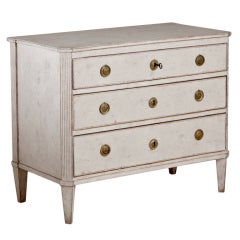
Antique 19th Century Swedish Gustavian Console Tables


Antique 18th Century and Earlier Swedish Gustavian Corner Chairs
Wood, Upholstery
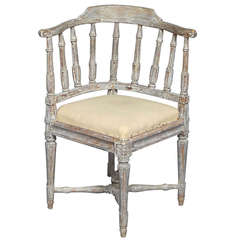
Antique Early 1900s Swedish Gustavian Corner Cupboards
Wood
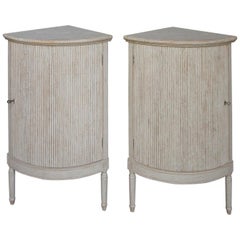
Antique 1890s Swedish Gustavian Corner Cupboards
Pine

Early 20th Century Swedish Gustavian Corner Cupboards
Hardwood, Paint
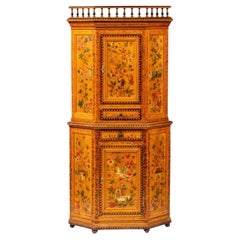
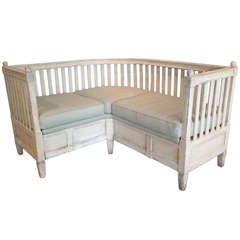
Antique 18th Century and Earlier Swedish Gustavian Sofas
Wood
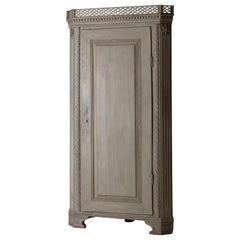
Antique Early 19th Century Swedish Gustavian Corner Cupboards
Wood
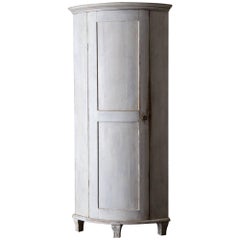
Antique Early 19th Century Swedish Gustavian Cabinets
- 1
Swedish Gustavian Corner For Sale on 1stDibs
How Much is a Swedish Gustavian Corner?
A Close Look at Gustavian Furniture
With clean lines and muted colors, antique Gustavian furniture is understated and elegant. It represents a more restrained version of the transition from Rococo to neoclassicism that was happening in France under Louis XVI. The style developed under Swedish King Gustav III, who reigned from 1771 until his assassination in 1792, and his son Gustav IV, who ruled until 1809. Although Gustavian furniture is mostly used to refer to pale painted cabinets, commodes, armchairs and other items, it involved a range of influences.
Gustavian-style furniture was inspired by discoveries at Pompeii and Herculaneum as well as the grandeur of European palaces like Versailles, with local softwoods such as pine and birch. There was also an emphasis on natural light; crystal chandeliers and large mirrors played a role in radiating the fleeting daylight of winter, giving it a distinctive aesthetic.
Where earlier furniture was curvy and florid, this new era was more architectural, with tapered and fluted legs and rectangular and oval shapes. Luminous gilt contrasted with the palette of soft blues on upholstery and painted surfaces. Leading furniture builders included Gottlieb Iwersson, Louis Masreliez and Erik Öhrmark. The latter, a French-born Swedish decorator, designed the Sulla chair, a seat that was demonstrative of technical skill and precise craftsmanship and drew on Greek klismos chairs. Masreliez’s Sulla chair was made by Öhrmark and featured decorative ornamentation produced by Jean-Baptiste Masreliez, Louis’s younger brother.
While the wealthy had furniture carved with neoclassical details like scallops and rosettes, more affordable options were adorned with faux finishes that mimicked marble and stenciled patterns. The simple elegance of Gustavian furniture would have a long impact on Swedish design, informing the 20th-century appreciation for function and form. In the 1950s, IKEA mass-produced copies of a Gustavian commode designed by cabinetmaker Georg Haupt, who created pieces for the Royal Palace, making the furniture a fixture of everyday Swedish life.
Find a collection of antique Gustavian seating, tables, decorative objects and other furniture on 1stDibs.
Finding the Right Case Pieces And Storage Cabinets for You
Of all the vintage storage cabinets and antique case pieces that have become popular in modern interiors over the years, dressers, credenzas and cabinets have long been home staples, perfect for routine storage or protection of personal items.
In the mid-19th century, cabinetmakers would mimic styles originating in the Louis XIV, Louis XV and Louis XVI eras for their dressers, bookshelves and other structures, and, later, simpler, streamlined wood designs allowed these “case pieces” or “case goods” — any furnishing that is unupholstered and has some semblance of a storage component — to blend into the background of any interior.
Mid-century modern furniture enthusiasts will cite the tall modular wall units crafted in teak and other sought-after woods of the era by the likes of George Nelson, Poul Cadovius and Finn Juhl. For these highly customizable furnishings, designers of the day delivered an alternative to big, heavy bookcases by considering the use of space — and, in particular, walls — in new and innovative ways. Mid-century modern credenzas, which, long and low, evolved from tables that were built as early as the 14th century in Italy, typically have no legs or very short legs and have grown in popularity as an alluring storage option over time.
Although the name immediately invokes images of clothing, dressers were initially created in Europe for a much different purpose. This furnishing was initially a flat-surfaced, low-profile side table equipped with a few drawers — a common fixture used to dress and prepare meats in English kitchens throughout the Tudor period. The drawers served as perfect utensil storage. It wasn’t until the design made its way to North America that it became enlarged and equipped with enough space to hold clothing and cosmetics. The very history of case pieces is a testament to their versatility and well-earned place in any room.
In the spirit of positioning your case goods center stage, decluttering can now be design-minded.
A contemporary case piece with open shelving and painted wood details can prove functional as a storage unit as easily as it can a room divider. Alternatively, apothecary cabinets are charming case goods similar in size to early dressers or commodes but with uniquely sized shelving and (often numerous) drawers.
Whether you’re seeking a playful sideboard that features colored glass and metal details, an antique Italian hand-carved storage cabinet or a glass-door vitrine to store and show off your collectibles, there are options for you on 1stDibs.