Tiffany Audubon China
Recent Sales
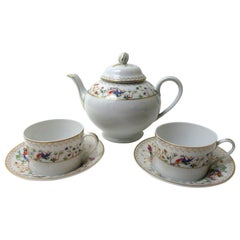
Vintage 1960s French Chinoiserie Tea Sets
Porcelain

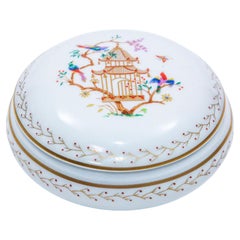
Mid-20th Century French Chinoiserie Decorative Boxes
Porcelain
Limoges for sale on 1stDibs
Limoges porcelain has withstood the test of time for centuries. The widely cherished ceramics named for the French city and commune in which they are made are synonymous with sophistication, elegance and refinement. Today, antique Limoges dinnerware, serveware, decorative objects and other porcelain products are coveted and collected all over the world.
The story of Limoges porcelain, which refers to porcelain made in the Limoges region of France — not by a specific factory — begins in 1768. The region is a rich source of kaolin, feldspar and quartz — vital ingredients to the production of this type of pottery.
Porcelain was first made in China and spread all over the world owing to the trade routes to the Far East established by Dutch and Portuguese merchants. Given its origin, English speakers called porcelain “fine china,” an expression you still might hear today. "Fine" indeed — for over a thousand years, it has been a highly sought-after material. Meissen Porcelain (Staatliche Porzellan-Manufaktur Meissen), which was founded in the Electorate of Saxony (now Germany), is one of the preeminent porcelain factories in Europe and was the first to produce true porcelain outside of Asia.
Limoges porcelain refers to porcelain produced in and near the city of Limoges — it does not refer to a specific manufacturer — and it’s distinctive for its luminous hue and bright white qualities, providing an ideal canvas for intricately detailed hand-painted decorations. (Revered Impressionist painter Pierre-Auguste Renoir began his career painting plates in Limoges.)
It wasn’t long before Limoges porcelain captured the attention of King Louis XVI — the region’s first manufactory, established toward the close of the 18th century, was placed under the protection of the King’s brother, the Comte d’Artois. It was later purchased by the King and became Manufacture Royale de Limoges. The facility produced a variety of pieces, including delicate, gold-embellished trinket boxes, ornamental vessels, Rococo-style figurines and elaborate dinnerware service sets.
Following the end of the French Revolution in 1794, Limoges porcelain was no longer restricted, and the commercial porcelain industry ballooned.
By 1819, Limoges had four porcelain factories, and as demand for porcelain grew during the 19th century, the industry expanded in the French city. In 1853, American businessman David Haviland opened the Haviland Co. factory in Limoges to export porcelain to the United States. The company produced several iconic serveware collections for many American presidents, including Abraham Lincoln, Ulysses S. Grant and Rutherford B. Hayes. Bernardaud opened in the early 1860s.
By 1900, Limoges had 35 factories, which employed close to 8,000 workers. In 1925, Limoges porcelain was shown at the International Exhibition of Modern Decorative and Industrial Arts — the design fair in Paris that brought global attention to the Art Deco style — where it garnered international acclaim.
During the 20th century, Limoges factories such as Bernardaud collaborated with a range of notable artists and designers, including Franz Bischoff, Joan Miró, Raymond Loewy, Alexander Calder and Julian Schnabel, to name a few.
Today, authentic Limoges porcelain tableware, vases and objets d’art continue to gain renown with collectors and design lovers all over the world.
Find an extensive collection of antique Limoges porcelain on 1stDibs.
A Close Look at Chinoiserie Furniture
Emerging in the 17th century, chinoiserie appropriated the aesthetics and imagery of popular East Asian design for European-made versions. Reflecting the exoticization of China, Japan and other countries in this era, the word directly translates from French to “Chinese-esque,” which reveals its shortcomings as a style of furniture and decor that often stereotypically and reductively mimics Asian culture rather than showcasing and paying tribute to its artistic traditions.
The enthusiastically decorative chinoiserie style was propelled by influential tastemakers including French King Louis XIV, whose Trianon de Porcelaine in 1670 was inspired by Chinese architecture. Expanded trade between the East and West led to a demand for porcelain, lacquer objects, silk and other goods, which further informed the fanciful furniture being crafted in Europe.
Artisans working in the chinoiserie style used materials and elements like pagoda shapes, bamboo, lacquer surfaces, bird and flower motifs and other interpretations of Asian design on pieces that were frequently set against vibrant wallcoverings. This whimsical approach yielded chinoiserie furniture that boasted dramatic flourishes drawing on the natural world and reflected the dominance of Rococo during the 18th century.
As chinoiserie was shaped by approximations of Asian design by European creators, it had regional variations, such as Chinese Chippendale in England where cabinets, chairs and tea tables had wooden fretwork designs and “japanned” surfaces intended to resemble lacquer work that was created in East Asia. In North America, furniture makers in Boston and New York integrated chinoiserie-painted scenes into Queen Anne furniture.
Antique chinoiserie furniture has continued to be fashionable, from its popularity with decorators of the Hollywood Regency era — James Mont, Tommi Parzinger, William Haines and Samuel Marx favored the style — to contemporary interior designers, although it brings with it a complex history.
Find a collection of chinoiserie bedroom furniture, cabinets, decorative objects and more on 1stDibs.
- 1stDibs ExpertSeptember 28, 2021Haviland Limoges China could cost you at least $100 - $200, it can go much higher, depending on the style, its condition and much more. They are used as serving pieces like platters, soup tureens, pitchers in various shapes and gravy boats along with tea sets. Find a range of vintage and antique Haviland Limoges china on 1stDibs today.