Tiffany Back To Glamour
Recent Sales
Vintage 1980s American Art Deco Brooches
Sapphire, Gold, Silver
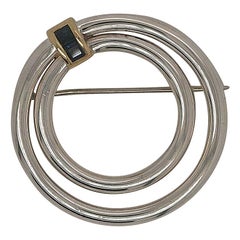

Tiffany Back To Glamour For Sale on 1stDibs
How Much is a Tiffany Back To Glamour?
Tiffany Co. for sale on 1stDibs
Tiffany Co. is one of the most prominent purveyors of luxury goods in the United States, and has long been an important arbiter of style in the design of diamond engagement rings. A young Franklin Delano Roosevelt proposed to his future wife, Eleanor, with a Tiffany ring in 1904. Vanderbilts, Whitneys, Astors and members of the Russian imperial family all wore Tiffany Co. jewelry. And Jacqueline Kennedy Onassis preferred Tiffany china for state dinners at the White House.
Although synonymous with luxury today, the firm started out rather modestly. Charles Lewis Tiffany and John B. Young founded it in Connecticut as a “stationery and fancy goods emporium” in 1837, at a time when European imports still dominated the nascent American luxury market. In 1853, Charles Tiffany — who in 1845 had launched the company’s famed catalog, the Blue Book, and with it, the firm’s signature robin’s-egg blue, which he chose for the cover — shifted the focus to fine jewelry.
In 1868, Tiffany Co. gained international recognition when it became the first U.S. firm to win an award for excellence in silverware at the Exposition Universelle in Paris. From then on, it belonged to the pantheon of American luxury brands.
At the start of the Gilded Age, in 1870, Tiffany Co. opened its flagship store, described as a "palace of jewels" by the New York Times, at 15 Union Square West in Manhattan. Throughout this period, its designs for silver tableware, ceremonial silver, flatware and jewelry were highly sought-after indicators of status and taste. They also won the firm numerous accolades, including the grand prize for silverware at the Paris Exposition of 1878. Among the firm’s glittering creations from this time are masterworks of Art Nouveau jewelry, such as this delicate aquamarine necklace and this lavish plique-à-jour peridot and gold necklace, both circa 1900.
When Charles Lewis Tiffany died, in 1902, his son Louis Comfort Tiffany became the firm’s design director. Under his leadership, the Tiffany silver studio was a de facto design school for apprentice silversmiths, who worked alongside head artisan Edward C. Moore. The firm produced distinctive objects inspired by Japanese art and design, North American plants and flowers, and Native American patterns and crafts, adding aesthetic diversity to Tiffany Co.’s distinguished repertoire.
Tiffany is also closely associated with diamonds, even lending its name to one particularly rare and exceptional yellow stone. The firm bought the Tiffany diamond in its raw state from the Kimberley mines of South Africa in 1878. Cut to create a 128.54-carat gem with an unprecedented 82 facets, it is one of the most spectacular examples of a yellow diamond in the world.
In a broader sense, Tiffany Co. helped put diamonds on the map in 1886 by introducing the American marketplace to the solitaire diamond design, which is still among the most popular engagement-ring styles. The trademark Tiffany® Setting raises the stone above the band on six prongs, allowing its facets to catch the light. A lovely recent example is this circa-2000 platinum engagement ring. Displaying a different design and aesthetic (but equally chic) is this exquisite diamond and ruby ring from the 1930s.
Find Tiffany Co. jewelry, serveware and decorative objects for sale on 1stDibs.
A Close Look at Art-deco Jewelry
Fascination with the Jazz Age is endless, and even today jewelry designers continue to be inspired by authentic Art Deco jewelry and watches.
The Art Deco period, encompassing the 1920s and ’30s, ushered in a very distinct look in the design of jewelry. There were many influences on the jewelry of the era that actually began to take shape prior to the 1920s. In 1909, Serge Diaghilev brought the Ballet Russes to Paris, and women went wild for the company’s exotic and vibrant costumes It’s no wonder, then, that jade, lapis lazuli, coral, turquoise and other bright gemstones became all the rage. There already existed a fascination with the East, particularly China and Japan, and motifs consisting of fans and masks started to show up in Art Deco jewelry.
However, the event that had the greatest influence on Deco was the excavation of the tomb of King Tut in 1922. When the world saw what was hidden in Tut’s burial chamber, it sent just about everyone into a frenzy. Pierre Cartier wrote in 1923 that “the discovery of the tomb will bring some sweeping changes in fashion jewelry.” And he couldn’t have been more right. “Egyptomania” left an indelible mark on all of the major jewelry houses, from Cartier to Van Cleef Arpels, Boucheron and Georges Fouquet. (Cartier created some of the most iconic jewelry designs that defined this era.)
While a lot of Art Deco jewelry was black and white — the black coming from the use of onyx or black enamel and the white from rock crystal and diamonds — there is plenty of color in jewelry of the era. A perfect accent to diamonds in platinum settings were blue sapphires, emeralds and rubies, and these stones were also used in combination with each other.
Many designers employed coral, jade and lapis lazuli, too. In fact, some of the most important avant-garde jewelers of the period, like Jean Després and Jean Fouquet (son of Georges), would combine white gold with ebony and malachite for a jolt of color.
A lot of the jewelry produced during this time nodded to current fashion trends, and women often accessorized their accessories. The cloche hat was often accented with geometric diamond brooches or double-clip brooches. Backless evening dresses looked fabulous with sautoir necklaces, and long pearl necklaces that ended with tassels, popular during the Edwardian period, were favored by women everywhere, including Coco Chanel.
Find unique Art Deco necklaces, earrings, bracelets and other jewelry on 1stDibs.
Why Gold Shines in Jewelry Craftsmanship
Gold is the feel-good metal, the serotonin of jewelry. Wear vintage and antique gold necklaces, watches, gold bracelets or gold rings and you feel happy, you feel dressed, you feel, well, yourself.
Gold, especially yellow gold, with its rich patina and ancient pedigree going back thousands of years, is the steady standby, the well-mannered metal of choice. Any discussion of this lustrous metal comes down to a basic truth: Gold is elementary, my dear. Gold jewelry that couples the mystique of the metal with superb design and craftsmanship achieves the status of an enduring classic. Many luxury houses have given us some of our most treasured and lasting examples of gold jewelry over the years.
Since its founding, in 1837, Tiffany Co. has built its reputation on its company jewelry as well as its coterie of boutique designers, which has included Jean Schlumberger, Donald Claflin, Angela Cummings and Elsa Peretti. There are numerous gold Tiffany classics worth citing. Some are accented with gemstones, but all stand out for their design and the workmanship displayed.
For the woman who prefers a minimalist look, the Tiffany Co. twist bangle (thin, slightly ovoid) is stylishly simple. For Cummings devotees, signature pieces feature hard stone inlay, such as her pairs of gold ear clips inlaid with black jade (a play on the classic Chanel black and tan), or bangles whose design recalls ocean waves, with undulating lines of lapis lazuli and mother-of-pearl. And just about any design by the great Jean Schlumberger is by definition a classic.
Even had he eschewed stones and diamonds, Southern-born David Webb would be hailed for the vast arsenal of heavy gold jewelry he designed. Gold, usually hammered or textured in some manner, defines great David Webb jewelry. The self-taught jeweler made very au courant pieces while drawing inspiration from ancient and out-of-the-way sources — East meets West in the commanding gold necklaces made by Webb in the early 1970s. The same could be said for his endlessly varied gold cuffs.
In Europe, many houses have given us gold jewelry that sets the highest standard for excellence, pieces that were highly sought after when they were made and continue to be so.
Numerous designs from Cartier are homages to gold. There are the classic Trinity rings, necklaces and bracelets — trifectas of yellow, white and rose gold. As a testament to the power of love, consider the endurance of the Cartier Love bracelet.
Aldo Cipullo, Cartier’s top in-house designer from the late 1960s into the early ’70s, made history in 1969 with the Love bracelet. Cipullo frequently said that the Love bracelet was born of a sleepless night contemplating a love affair gone wrong and his realization that “the only remnants he possessed of the romance were memories.” He distilled the urge to keep a loved one close into a slim 18-karat gold bangle.
BVLGARI and its coin jewelry, gemme nummarie, hit the jackpot when the line launched in the 1960s. The line has been perennially popular. BVLGARI coin jewelry features ancient Greek and Roman coins embedded in striking gold mounts, usually hung on thick link necklaces of varying lengths. In the 1970s, BVLGARI introduced the Tubogas line, most often made in yellow gold. The Tubogas watches are classics, and then there is the Serpenti, the house's outstanding snake-themed watches and bracelets.
A collection called Monete that incorporated the gold coins is one of several iconic BVLGARI lines that debuted in the 1970s and ’80s, catering to a new generation of empowered women. Just as designers like Halston and Yves Saint Laurent were popularizing fuss-free ready-to-wear fashion for women on the go, BVLGARI offered jewels to be lived in.
Since Van Cleef Arpels opened its Place Vendôme doors in 1906, collection after collection of jewelry classics have enchanted the public. As predominantly expressed in a honeycomb of gold, there is the Ludo watch and accessories, circa the 1920s, and the golden Zip necklace, 1951, whose ingenious transformation of the traditional zipper was originally proposed by the Duchess of Windsor. Van Cleef's Alhambra, with its Moroccan motif, was introduced in 1968 and from the start its popularity pivoted on royalty and celebrity status. It remains one of VCA’s most popular and collected styles.
Mention must be made of Buccellati, whose name is synonymous with gold so finely spun that it suggests tapestry. The house’s many gold bracelets, typically embellished with a few or many diamonds, signified taste and distinction and are always in favor on the secondary market. Other important mid-20th-century houses known for their gold-themed jewelry include Hermès and Ilias Lalaounis.
Find a stunning collection of vintage and antique gold jewelry on 1stDibs.
The Legacy of Sapphire in Jewelry Design
On 1stDibs, shop the bright blue gems that star in sapphire rings, sapphire necklaces and other vintage and antique sapphire jewelry.
Sapphires — the stone of choice for Napoleon, Princess Diana and Elizabeth Taylor — have been a favorite of aristocrats and the well-to-do since the time of the Ancient Greeks.
Picture a sapphire. If the stone you conjure is a deep cornflower blue, you’re seeing only part of the picture. Although blue Kashmirs are considered the most valuable, sapphires come in every color except red. No matter the hue, this very special gem is rich in history and beloved by royals (FYI, Princess Diana and Kate Middleton share an 11-carat sapphire engagement ring), so September babies are in very noble company.
America’s version of royalty — old money and celebrities — have also shown a predilection for the blue stones. In 1940, John D. Rockefeller Jr. had Cartier mount a 62-carat sapphire he had bought from an Indian maharajah in a brooch for his first wife, Abby Aldrich Rockefeller; in 2001, the piece sold for a then-record of $3,031,000 at Christie’s New York.
The grand dame of jewelry, Elizabeth Taylor had a passion for the gems that her lovers were happy to indulge. Second husband Michael Wilding gave her an engagement ring set with a cabochon sapphire, while Richard Burton famously presented her with a BVLGARI sautoir set with diamonds and sapphires, including at its center a cabochon Burmese weighing 52.72 carats. One of the star lots in the sale of Taylor’s jewels at the Christie’s New York in 2011, it sold for $5,906,500.
You don’t have to have blue blood or a bulging bank account, however, to get an eyeful of this much-coveted gem. A number of outstanding examples reside in public collections.
The Smithsonian Museum of Natural History owns the 423-carat Logan sapphire, a gift from the Guggenheim family, and the Hall sapphire and diamond necklace, designed by Harry Winston and featuring 36 fine, well-matched cushion-cut Sri Lankan sapphires weighing a combined 195 carats. Also in the collection is the Bismarck sapphire necklace, designed by Cartier and sporting a central sapphire weighing 98.6 carats, which Mona Von Bismarck donated to the museum.
Sapphires are composed of corundum. Their color derives from trace elements, such as iron, titanium, chromium, copper or magnesium. When the trace element produces a ruby hue, the stone is called, what else, a ruby. (which is, as mentioned above, why sapphires cannot be red by definition).
The allure of large gemstones endures throughout the periods characterized as vintage, and sapphire features frequently in vintage engagement rings. (On 1stDibs, a range of buying guides can be found for those in the market for antique engagement rings, vintage engagement rings or Art Deco engagement rings.)
Find an exquisite collection of vintage and antique sapphire jewelry on 1stDibs.
Finding the Right Brooches for You
Vintage brooches, which refer to decorative jewelry traditionally pinned to garments and used to fasten pieces of clothing together where needed, have seen increasing popularity in recent years.
While jewelry trends come and go, brooches are indeed back on the radar thanks to fashion houses like Gucci, Versace, Dior and Saint Laurent, all of which feature fun pinnable designs in their current collections. Whether a dazzlingly naturalistic Art Nouveau dragonfly, a whimsical David Webb animal, a gem-studded bloom or a streamlined abstract design, these jewels add color and sparkle to your look and a spring to your step.
Given their long history, brooches have expectedly taken on a variety of different shapes and forms over time, with jewelers turning to assorted methods of ornamentation for these accessories, including enameling and the integration of pearls and gemstones. Cameo brooches that originated during the Victorian age are characterized by a shell carved in raised relief that feature portraits of a woman’s profile, while 19th-century micromosaic brooches, comprising innumerable individually placed glass fragments, sometimes feature miniature depictions of a pastoral scene in daily Roman life.
At one time, brooches were symbols of wealth, made primarily from the finest metals and showcasing exquisite precious gemstones. Today, these jewels are inclusive and universal, and you don’t have to travel very far to find an admirer of brooches. They can be richly geometric in form, such as the ornate diamond pins dating from the Art Deco era, or designer-specific, such as the celebrated naturalistic works created by Tiffany Co., the milk glass and gold confections crafted by Trifari or handmade vintage Chanel brooches of silk or laminated sheer fabric. Chanel, of course, has never abandoned this style, producing gorgeously baroque CC examples since the 1980s.
Brooches are versatile and adaptable. These decorative accessories can be worn in your hair, on hats, scarves and on the lower point of V-neck clothing. Pin a dazzling brooch to the lapel of your blazer-and-tee combo or add a cluster of smaller pins to your overcoat. And while brooches have their place in “mourning jewelry,” in that a mourning brooch is representative of your connection to a lost loved one, they’re widely seen as romantic and symbolic of love, so much so that a hardcore brooch enthusiast might advocate for brooches to be worn over the heart.
Today, find a wide variety of antique and vintage brooches for sale on 1stDibs, including gold brooches, sapphire brooches and more.
- 1stDibs ExpertAugust 17, 2021A Tiffany Co. engagement ring can cost as little as $13,000 or as much as $500,000 depending on the center stone’s carat weight, the band material and whether or not there are any side stones. The smaller the stone, the cheaper the ring will be. Find engagement rings designed by Tiffany Co. on 1stDibs.