Tiffany Cigarette Lighter
Recent Sales
French More Objets d Art and Vertu
Sapphire, Emerald
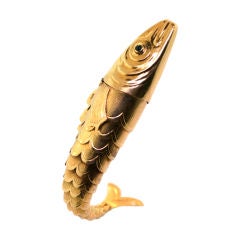

Jean Schlumberger for Tiffany Co. for sale on 1stDibs
Jewelry designer Jean Schlumberger once said that he strived to “make everything look as if it were growing, uneven, at random, organic, in motion.” His jewels interpreted the vitality of the natural world with lively designs that included a moonstone-topped jellyfish brooch with sapphire tentacles exuding a watery shimmer and a ring encrusted with a burst of diamonds that “bloomed” like a flower bud.
A self-taught jeweler, Schlumberger’s mastery of color as well as his expertise as a draftsman brought his fantastic ideas to life. Born to a leading textile manufacturing family in Alsace, France, Schlumberger took to drawing as a child and showed promise as an artist, but his parents instead sent him to study banking in Berlin in the 1930s. Uninspired, he departed for Paris and began creating buttons for Italian fashion designer Elsa Schiaparelli, who also commissioned him for costume jewelry.
One of Schlumberger’s early pieces — a cigarette lighter in the form of a fish whose head opened to reveal the flame — demonstrated his skill for capturing the vivacity of nature in precious metal. The designer’s imaginative jewelry was in contrast to popular geometric lines of Art Deco, an independent vision he affirmed in the extravagant 1941 Trophée de Vaillance brooch created for fashion editor Diana Vreeland. An extravagant confection of diamonds, amethyst, rubies and gold, the brooch featured gemstones adorning an intricate intersection of tiny spears and a breastplate over a glittering shield.
After serving in the French army and the Free French forces during World War II — and surviving the Battle of Dunkirk — Schlumberger left war-torn Europe for New York and in 1946 established a jewelry salon with Nicolas Bongard. There, his vibrant work caught the eye of Tiffany Co. After joining the American luxury jewelry house in 1956, he soon had his own studio on the mezzanine of Tiffany’s Fifth Avenue store that he accessed by a private elevator. In his workshop, Schlumberger used a rainbow of gemstones, gold and diamonds to create some of the company’s most beguiling designs.
From striking earrings shaped like soaring wings to diamond birds perched on glittering gemstones, each of Schlumberger’s Tiffany designs dazzled. His supporters included Bunny Mellon, whose love for horticulture inspired commissions such as the Jasmine necklace with diamond blossoms flowering from a garland of colored sapphires, and Jacqueline Kennedy, who wore his Croisillon bracelets so often they became known as “Jackie bracelets.” Schlumberger retired from Tiffany in the late 1970s, but decades after his designs were introduced many of his popular pieces remain in production.
On 1stDibs, find an extraordinary range of vintage Jean Schlumberger jewelry designed for Tiffany Co.
The Legacy of Emerald in Jewelry Design
No one liked emeralds and emerald jewelry more than Elizabeth Taylor (or her alter ego, Cleopatra). Emeralds were first discovered in Egypt around 330 BC. The stone’s name originated from the ancient Greek word for green, “smaragdus.” According to the Gemological Institute of America, “Emeralds from what is now Colombia were part of the plunder when 16th-century Spanish explorers invaded the New World. The Incas had already been using emeralds in their jewelry and religious ceremonies for 500 years. The Spaniards, who treasured gold and silver far more than gems, traded emeralds for precious metals. Their trades opened the eyes of European and Asian royalty to emerald’s majesty.”
There are numerous myths attributed to the emerald’s spiritual powers, like placing an emerald under your tongue will allow you to see the future. But be careful not to swallow the birthstone for May, or that future won’t be so bright!
There are many important (read: large) emeralds in museum collections around the world. The Patricia Emerald, named after the miner’s daughter, is a 632-carat dihexagonal (or 12-sided) crystal that was discovered in Colombia in 1920 and now resides at the American Museum of Natural History in New York. The Smithsonian Museum of Natural History in Washington has in its possession the Hooker Emerald, a 75.47-carat Colombian stone. That emerald had been acquired in the 16th or 17th century by Spanish conquistadores and shipped to Europe. It later belonged to Abdul Hamid II, Sultan of the Ottoman Empire (1876–1909), who wore it on his belt buckle. Purchased at auction by Tiffany Co. in 1911, the Hooker Emerald was set into a tiara and featured in the New York World’s Fair “House of Jewels” exhibit in 1940. Today, it is part of a brooch, also designed by the jewelry house.
On 1stDibs, find a range of antique and vintage emerald jewelry and watches that includes emerald rings, emerald necklaces and other accessories.