Trifari Leaf And Pearls
Recent Sales
Vintage 1960s American Modern Choker Necklaces
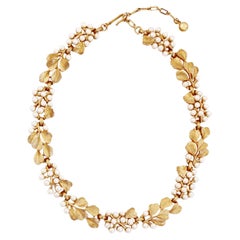

Vintage 1960s American Modern Choker Necklaces
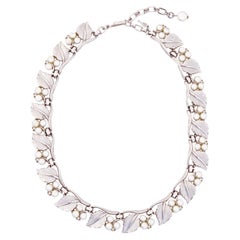
Vintage 1960s American Modern Link Bracelets
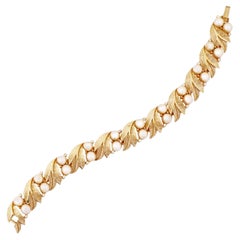
Vintage 1950s American Modern Clip-on Earrings
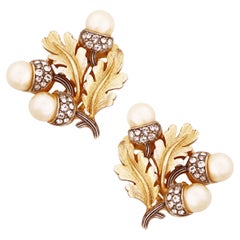
Vintage 1950s American More Necklaces
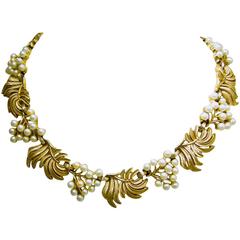
Trifari Leaf And Pearls For Sale on 1stDibs
How Much are Trifari Leaf And Pearls?
Trifari for sale on 1stDibs
Costume jewelry maker Trifari is widely loved for its fine craftsmanship and complex designs for necklaces, brooches and other jewelry and accessories.
The company was formed in New York during the early 1920s, when its partners Gustavo Trifari (who descended from a family of jewelers), Leo Krussman and Carl Fishel (business associates in hair-ornament manufacturing) recognized, as other designers during the Art Deco era such as Gabrielle “Coco” Chanel had, that fashion trends for affordable jewelry for everyday wear represented an opportunity (and that the popularity of shorter hairstyles didn’t bode well for their haircomb business).
Initially called Trifari, Krussman and Fishel Jewelry (T.K.F.), the trio eventually shortened their brand’s name, at the suggestion of an advertising professional, to Trifari in order to evoke the romance of Gustavo’s native Italy.
The hiring of French designer Alfred Philippe as head designer in 1930 was pivotal to Trifari’s success. A master craftsman who had worked with both Cartier and Van Cleef Arpels, Philippe set about establishing the same high-quality standards of materials and craftsmanship in the design of fashion jewelry and trained other Trifari artisans to do the same. Settings were delicate; crystals were hand set; designs, which sometimes featured dazzling floral motifs or exquisite depictions of marine life, were sophisticated and elegant, having both the look and feel of fine jewelry. First Lady Mamie Eisenhower wore a Trifari parure of faux pearls to her husband’s presidential inauguration in 1953 and Trifari glass pearls to his inaugural ball in 1957.
Before retiring in 1968, Philippe created Trifari’s most recognizable designs. In the 1930s, when the company was custom-making accessories for the stars of Broadway musicals, it was the crown motif: These brooches became so often identified with the brand that a crown was eventually incorporated into the trademark. In the 1940s, the “Jelly Bellies” inspired affection as well as knockoffs; these were animals, birds and insects sporting a “belly” of clear Lucite. Clip-Mates were another favorite and a technical marvel — two dress clips that, joined together, created a brooch.
Find a wide range of vintage Trifari jewelry on 1stDibs.
A Close Look at Modern Jewelry
Rooted in centuries of history of adornment dating back to the ancient world, modern jewelry reimagines traditional techniques, forms and materials for expressive new pieces. As opposed to contemporary jewelry, which responds to the moment in which it was created, modern jewelry often describes designs from the 20th to 21st centuries that reflect movements and trends in visual culture.
Modern jewelry emerged from the 19th-century shift away from jewelry indicating rank or social status. The Industrial Revolution allowed machine-made jewelry using electric gold plating, metal alloys and imitation stones, making beautiful jewelry widely accessible. Although mass production deemphasized the materials of the jewelry, the vision of the designer remained important, something that would be furthered in the 1960s with what’s known as the “critique of preciousness.”
A design fair called the “Exposition Internationale des Arts Décoratifs et Industriels Modernes” brought global attention to the Art Deco style in 1925 and gathered a mix of jewelry artists alongside master jewelers like Van Cleef Arpels, Mauboussin and Boucheron. Art Deco designs from Cartier and Van Cleef Arpels unconventionally mixed gemstones like placing rock crystals next to diamonds while borrowing motifs from eclectic sources including Asian lacquer and Persian carpets. Among Cartier’s foremost design preoccupations at the time were high-contrast color combinations and crisp, geometric forms and patterns. In the early 20th century, modernist jewelers like Margaret De Patta and artists such as Alexander Calder — who is better known for his kinetic sculptures than his provocative jewelry — explored sculptural metalwork in which geometric shapes and lines were preferred over elaborate ornamentation.
Many of the innovations in modern jewelry were propelled by women designers such as Wendy Ramshaw, who used paper to craft her accessories in the 1960s. During the 1970s, Elsa Peretti created day-to-night pieces for Tiffany Co. while designers like Lea Stein experimented with layering plastic, a material that had been employed in jewelry since the mid-19th century and had expanded into Bakelite, acrylics and other unique materials.
Find a collection of modern watches, bracelets, engagement rings, necklaces, earrings and other jewelry on 1stDibs.