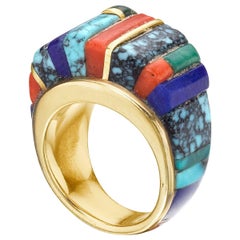
Turquoise Ring 1970
Vintage 1970s American Cocktail Rings
Coral, Lapis Lazuli, Malachite, Turquoise, Gold, 18k Gold

- 1
Turquoise Ring 1970 For Sale on 1stDibs
How Much is a Turquoise Ring 1970?
The Legacy of Turquoise in Jewelry Design
The thought of vintage and antique turquoise jewelry often conjures up images of striking Navajo bracelets and necklaces worn with a denim shirt and cowboy boots. This all-American look has been celebrated by fashion designers like Ralph Lauren and Tommy Hilfiger on their runways and in ad campaigns. In the October 2016 issue of Vogue magazine, Tom Ford said he only wears turquoise jewelry at his Santa Fe ranch. So what is it about this gorgeous blue-green stone that makes us wish that we were born in December?
It’s not surprising that turquoise is abundant in New Mexico and Arizona because, according to the Gemological Institute of America (GIA), it needs to be in “dry and barren regions where acidic, copper-rich groundwater seeps downward and reacts with minerals that contain phosphorus and aluminum.
Turquoise is not found in a single crystal but is a combination of microcrystals. Its appearance, waxy and opaque, is attributed to its structure and composition. “It’s an aggregate of microscopic crystals that form a solid mass. If the crystals are packed closely together, the material is less porous, so it has a finer texture. Fine-textured turquoise has an attractive, waxy luster when it’s polished. Turquoise with a less-dense crystal structure has higher porosity and coarser texture, resulting in a dull luster when it’s polished,” notes the GIA. Since no one wants to set a dull piece of turquoise, porous turquoise is often treated to make the stone more attractive.
In the United States, there have been discoveries of turquoise from 200 B.C. It is not just loose turquoise stones that have been found, but entire suites of jewelry from prehistoric times. In the late 19th-century, the Navajo Indians, who learned silversmithing from the Spanish, started to make beads out of turquoise and eventually combined it with silver around the 1880s. Initially this jewelry was for ceremonial purposes, but it became fashionable once the tourism in the Southwest picked up in the beginning of the 20th century.
Find antique and vintage turquoise rings, necklaces, bracelets and other accessories on 1stDibs.
Finding the Right Rings for You
Antique and vintage rings have long held a special place in the hearts of fine jewelry lovers all over the world.
No matter their origin or specific characteristics, rings are timeless, versatile accessories. They’ve carried deep meaning since at least the Middle Ages, when diamond rings symbolized strength and other kinds of rings were worn to signify romantic feelings or to denote an affiliation with a religious order. Rings have also forever been emblematic of eternity.
Over time, rings have frequently taken the form of serpents, which have long been associated with eternal life, health and renewal. Italian luxury jewelry house Bulgari has become famous for its widely loved Serpenti motif, for example, and its Serpenti ring, like the other accessories in the collection, began as an homage to jewelry of the Roman and Hellenistic eras. The serpent is now a popular motif in fine jewelry. Jewelry devotees have long pined for rings adorned with reptiles, thanks to antique Victorian rings — well, specifically, Queen Victoria’s illustrious engagement ring, which took the form of a gold snake set with rubies, diamonds and an emerald (her birthstone). Designs for Victorian-era engagement rings often featured repoussé work and chasing, in which patterns are hammered into the metal.
Engagement rings, which are reliably intimidating to shop for, are still widely recognized as symbols of love and commitment. On 1stDibs, a range of buying guides can be found for those in the market for antique engagement rings, vintage engagement rings or Art Deco engagement rings.
The most collectible antique engagement rings and vintage engagement rings are those from the Victorian, Edwardian and Art Deco eras. Named for the monarchies of the four King Georges, who in succession ruled England starting in 1714 (plus King William’s reign), antique Georgian rings, be they engagement rings or otherwise, are also coveted by collectors. Pearls, along with colored gemstones like garnets, rubies and sapphires, were widely used in Georgian jewelry. The late-1700s paste jewelry was a predecessor to what we now call fashion or costume jewelry.
The Art Nouveau movement (1880–1910) brought with it rings inspired by the natural world. Antique Art Nouveau rings might feature depictions of winged insects and fauna as well as women, who were simultaneously eroticized and romanticized, frequently with long flowing hair. Art Deco jewelry, on the other hand, which originated during the 1920s and ’30s, is by and large “white jewelry.” White metals, primarily platinum, were favored over yellow gold in the design of antique Art Deco rings and other accessories as well as geometric motifs, with women drawn to the era’s dazzling cocktail rings in particular.
Whether you’re hunting down a chunky classic for a Prohibition-themed cocktail party or seeking a clean contemporary design to complement your casual ensemble, find an exquisite collection of antique, new and vintage rings on 1stDibs.
- Can I get my turquoise ring wet?1 Answer1stDibs ExpertApril 5, 2022No, you should avoid getting your turquoise ring wet. Turquoise is porous so water, especially warm water, could potentially cause damage and alter the color of your stone. Shop a collection of expertly vetted gems from some of the world’s top sellers on 1stDibs.
Read More
This Absinthe-Hued Peridot Cocktail Ring Is Positively Intoxicating
Ancient Egyptians referred to the vibrant stone as the “gem of the sun.”
Our Guide to Engagement Ring Settings – And How to Choose One
There are many ways to showcase a diamond, from traditional prongs to a smooth, streamlined bezel. Here’s everything you need to consider.
Nothing Says Summer Heat Like This Ruby-Red Cartier Stunner
The vintage bombé ring is bursting with color and timeless style.
Zircon Rings: Our Guide to a Uniquely Colorful Natural Gemstone
Zircon is a magnificent and underrated natural gemstone that has been worn and adored for centuries.
[Survey] Two-Thirds of Jewelry Gift Recipients Don’t Want to Be Surprised
Givers of fine gems enjoy surprise more than receivers, and women more than men. Find out what else our survey of 3,000 Americans revealed.
Colorful Gemstones Are a Brilliant Choice for Engagement Rings
If diamonds don’t seem right, what about a magnificent sapphire, ruby or emerald?
Our Guide to Fancy-Colored Diamond Engagement Rings
Accounting for just 1 percent of all diamonds, these marvels of nature are exceedingly rare and gorgeously complex.
Our Guide to Victorian, Edwardian and Art Deco Engagement Rings
Learn about these antique jewelry styles, then choose a design that speaks to you.