Vintage Charles Rennie Mackintosh Jewellery
Recent Sales
20th Century Scottish Arts and Crafts Vintage Charles Rennie Mackintosh Jewellery
Pewter
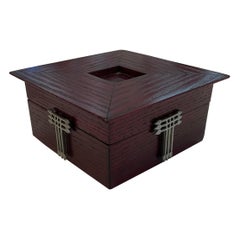

Charles Rennie Mackintosh for sale on 1stDibs
At the turn of the 20th century, the Scottish architect Charles Rennie Mackintosh created a singular, wholly original design style that was both lyrical and sleekly modern. Within his architectural schemes for schools, private homes and restaurants, Mackintosh — frequently working in collaboration with his wife, the artist Margaret Macdonald — invented an aesthetic that blends the organic flow of the Art Nouveau style and the honest simplicity of the English Arts Crafts movement.
Mackintosh was born into a working-class Glasgow family, the fourth of the 11 children of a police clerk and his wife. At age 15, Mackintosh began to take night classes at the Glasgow School of Art — where he would study until 1894 — and the following year started an apprenticeship with local architect John Hutchison.
At the GSA, Mackintosh befriended Macdonald, her sister, Frances, and fellow architecture student Herbert McNair. Together they formed a graphic design team known as the Four, and were admired for their illustrations featuring sinuous botanical forms and sylph-like women. Around the same time, Mackintosh was hired by the architectural firm Honeyman and Keppie. where he drafted the company’s winning design for a new GSA building. The structure, with its brooding, asymmetrical facade punctuated by soaring studio windows, would be his architectural masterwork. By 1900, Mackintosh was designing houses and began the interiors for a group of Glasgow tea parlors in which he and Macdonald would produce some of the most alluring, lushly graphic decors of the era. Mackintosh’s work became widely influential on the continent, particularly among Josef Hoffmann, Koloman Moser and other members of the Vienna Secession movement.
His work on private homes and tearooms generated the furniture designs for which Mackintosh is best known today. These include the Hill House chair, with its latticed back; the Argyle Street Tea Room chair, which features an oval head rail with a cutout that resembles a bird in flight; and several others — all instantly recognizable for their stunning tall backs.
Mackintosh’s furniture works well in both traditional and modern interiors, though by virtue of both its familiarity and striking lines it tends to stand out. Because he was much more esteemed in Europe than in Britain, relatively few antique Mackintosh works survive, and those that have are museum pieces. Recently produced examples of his designs are widely available — notably, the Italian firm Cassina has been making fine Mackintosh pieces since the early 1970s. As you will see on 1stDibs, the furniture of Charles Rennie Mackintosh is ever intriguing and engaging. His work is a historical touchstone that would be welcome in the home of any modern design aficionado.
A Close Look at Arts-and-crafts Furniture
Emerging in reaction to industrialization and mass production, the Arts and Crafts movement celebrated handcrafted design as a part of daily life. The history of Arts and Crafts furniture has roots in 1860s England with an emphasis on natural motifs and simple flourishes like mosaics and carvings. This work is characterized by plain construction that showcases the hand of the artisan.
The earliest American Arts and Crafts furniture dates back to the start of the 20th century. Designers working in this style in the United States initially looked to ideas put forth by The Craftsman, a magazine published by Wisconsin native Gustav Stickley, a furniture maker and founder of the Craftsman style. Stickley’s furniture was practical and largely free of ornament. His Craftsman style drew on French Art Nouveau as well as the work he encountered on his travels in England. There, the leading designers of the Arts and Crafts movement included William Morris, who revived historical techniques such as embroidery and printed fabrics in his furnishings, and Charles Voysey, whose minimal approach was in contrast to the ornamentation favored in the Victorian era.
American Arts and Crafts work would come to involve a range of influences unified by an elevation of traditional craftsmanship. The furniture was often built from sturdy woods like oak and mahogany while featuring details such as inlaid metal, tooled leather and ceramic tiles. The style in the United States was led by Stickley, whose clean-lined chairs and benches showcased the grain of the wood, and furniture maker Charles Rohlfs, who was informed by international influences like East Asian and French Art Nouveau design.
Hubs in America included several utopian communities such as Rose Valley in Pennsylvania and the Byrdcliffe Arts and Crafts Colony in New York, where craftspeople made furniture that prioritized function over any decoration. Their work would influence designers and architects including Frank Lloyd Wright, who built some of the most elegant and iconic structures in the United States and likewise embraced a thoughtful use of materials in his furniture.
Find antique Arts and Crafts chairs, tables, cabinets and other authentic period furniture on 1stDibs.
Finding the Right Jewelry-boxes for You
If you have jewelry, chances are you have an antique or vintage jewelry box. This simple item was born from a simple need. It offers jewelry lovers a place to store their most cherished treasures. The idea behind a good jewelry box is that precious items deserve a place of honor.
It’s no surprise, then, that jewelry boxes (also called jewelry caskets or trinket boxes) have existed for as long as we’ve worn jewelry. It’s among the most popular decorative boxes we have in our homes, and we can find early versions that date at least as far back as Ancient Egypt. All Egyptians adorned themselves with necklaces, rings, earrings and other accessories, and the era’s jewelry boxes resembled small treasure chests. Later, fine jewelry became cost prohibitive and the only people with jewelry boxes were those who could afford jewelry.
Following the Industrial Revolution, jewelry was no longer made by hand. Mass production and the demand of the growing middle class rendered jewelry more accessible. Jewelry of the Romantic period, which refers to early Victorian jewelry, is reflective of these economic shifts. Jewelry from this time tends to be feminine and ornate, and embellished with seed pearls, coral and turquoise. Naturally, it was stored in elaborate, decorative Victorian-era jewelry boxes that were sometimes crafted from hand-painted porcelain or sterling silver.
Nowadays, jewelry boxes do more than keep jewelry safe and organized. They’re popular collector’s items that have become as treasured as the contents themselves.
Designer jewelry boxes — Chanel jewelry boxes, Hermès jewelry boxes and others created by celebrated fashion labels — are widely sought by jewelry lovers who covet a chic case for their jewelry essentials. An eye-catching vintage jewelry box, which is at least 20 but less than 100 years old, is a valuable decorative object, a sign of luxury and elegance that adds character and texture to any bedroom. Some jewelry boxes are even embellished with a few jewels of their own.
If you’re not tucking your jewelry into a drawer or shallow tray atop your vanity, perhaps an Art Deco trinket box with charming brass hardware or a sculptural, hand-carved rosewood mid-century modern jewelry box lined with linen and velvet will do?
Today’s jewelry boxes come in a variety of styles and sizes and are made of metal, wood, plastic and other materials. Give your cherished jewelry the good home it deserves — find an extensive collection of antique and vintage jewelry boxes today on 1stDibs.