Vintage Letter K Necklace
Recent Sales
Mid-20th Century Unknown Modern Pendant Necklaces
Diamond, White Diamond, 14k Gold, White Gold
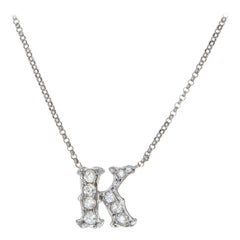

Vintage Letter K Necklace For Sale on 1stDibs
How Much is a Vintage Letter K Necklace?
A Close Look at Modern Jewelry
Rooted in centuries of history of adornment dating back to the ancient world, modern jewelry reimagines traditional techniques, forms and materials for expressive new pieces. As opposed to contemporary jewelry, which responds to the moment in which it was created, modern jewelry often describes designs from the 20th to 21st centuries that reflect movements and trends in visual culture.
Modern jewelry emerged from the 19th-century shift away from jewelry indicating rank or social status. The Industrial Revolution allowed machine-made jewelry using electric gold plating, metal alloys and imitation stones, making beautiful jewelry widely accessible. Although mass production deemphasized the materials of the jewelry, the vision of the designer remained important, something that would be furthered in the 1960s with what’s known as the “critique of preciousness.”
A design fair called the “Exposition Internationale des Arts Décoratifs et Industriels Modernes” brought global attention to the Art Deco style in 1925 and gathered a mix of jewelry artists alongside master jewelers like Van Cleef Arpels, Mauboussin and Boucheron. Art Deco designs from Cartier and Van Cleef Arpels unconventionally mixed gemstones like placing rock crystals next to diamonds while borrowing motifs from eclectic sources including Asian lacquer and Persian carpets. Among Cartier’s foremost design preoccupations at the time were high-contrast color combinations and crisp, geometric forms and patterns. In the early 20th century, modernist jewelers like Margaret De Patta and artists such as Alexander Calder — who is better known for his kinetic sculptures than his provocative jewelry — explored sculptural metalwork in which geometric shapes and lines were preferred over elaborate ornamentation.
Many of the innovations in modern jewelry were propelled by women designers such as Wendy Ramshaw, who used paper to craft her accessories in the 1960s. During the 1970s, Elsa Peretti created day-to-night pieces for Tiffany Co. while designers like Lea Stein experimented with layering plastic, a material that had been employed in jewelry since the mid-19th century and had expanded into Bakelite, acrylics and other unique materials.
Find a collection of modern watches, bracelets, engagement rings, necklaces, earrings and other jewelry on 1stDibs.
The Legacy of Diamond in Jewelry Design
Antique diamond rings, diamond tiaras and dazzling vintage diamond earrings are on the wish lists of every lover of fine jewelry. And diamonds and diamond jewelry are primarily associated with storybook engagements and red-carpet grand entrances — indeed, this ultra-cherished gemstone has a dramatic history on its hands.
From “A Diamond Is Forever” to “Diamonds Are a Girl’s Best Friend,” pop culture has ingrained in our minds that diamonds are the most desired, the most lasting and the most valuable gemstone. But what makes the diamond so special? Each stone — whether it’s rubies, sapphires or another stone — is unique and important in its own right. April babies might claim diamonds for themselves, but just about everyone wants this kind of sparkle in their lives!
There are several factors that set diamonds apart from other stones, and these points are important to our gem education.
Diamonds are minerals. They are made up of almost entirely of carbon (carbon comprises 99.95 percent; the remainder consists of various trace elements). Diamonds are the hardest gemstones, ranking number 10 on the Mohs Hardness Scale. Even its name, diamond, is rooted in the Greek adamas, or unconquerable. The only object that can scratch a diamond is another diamond. Diamonds are formed deep within the earth at very high temperatures (1,652–2,372 degrees Fahrenheit at depths between 90 and 120 miles beneath the earth’s surface) and are carried up by volcanic activity. Diamonds are quite rare, according to the Gemological Institute of America, and only 30 percent of all the diamonds mined in the world are gem quality.
In the 1950s, the Gemological Institute of America developed the 4Cs grading system to classify diamonds: clarity, color, cut and carat weight. Not all diamonds are created equal (there are diamonds, and then there are diamonds). The value of the diamond depends on the clarity (flawless diamonds are very rare but a diamond's value decreases if there are many blemishes or inclusions), color (the less color the higher the grade), cut (how the diamond’s facets catch the light, certain cuts of diamonds show off the stone better than others) and carat weight (the bigger, the better).
When you start shopping for a diamond engagement ring, always prioritize the cut, which plays the largest role in the diamond's beauty (taking the time to clean your diamond ring at least every six months or so plays a role in maintaining said beauty). And on 1stDibs, a range of buying guides can be found for those in the market for antique engagement rings, vintage engagement rings or Art Deco engagement rings.
Shop antique and vintage diamond rings, diamond necklaces and other extraordinary diamond jewelry on 1stDibs.
Finding the Right Pendant-necklaces for You
Whether you’re layering multiple jewelry pieces or opting for a single strand, vintage pendant necklaces are versatile accessories that can elevate your casual wear as easily as they can add a creative flourish to your formal attire.
The earliest jewelry was less about accessorizing than it was about wearers arming themselves with amulets. In Ancient Egypt, some amulets featured a loop so that they could be strung around one’s neck. While rubies have long been one of the few gemstones that can give diamonds a run for their money, members of some ancient civilizations valued the stones from the get-go, donning ruby pendants as well as other stones with the belief that these adornments would bring protection, healing powers or strength. Today, we still wear our charm bracelets and charm pendants around our necks for good luck.
Later, pendant necklaces, like most fine jewelry, were worn strictly by royalty or the upper class and conferred wealth and prestige. This changed over time, thankfully, as wearing jewelry became more widespread, a democratized means of personal expression.
During the 18th and 19th centuries, pendant necklaces evolved from their status as spiritual amulets, but the jewels still carried deep personal significance. Victorian pendants, in particular, were part of the “mourning jewelry” tradition. Wearers would embed their pendants with locks of hair from a deceased loved one as a way of grieving in the wake of a loss. In the case of cameo jewelry, some pendants were even decorated with miniature hand-carved portraits in a detailed raised relief. Today, portraiture is still a characteristic of many of the hand-carved pendant necklaces offered by Italian jewelry house Scala Gioielli.
Luxury fine jewelry brands such as Cartier, BVLGARI and David Yurman offer their own unique interpretations of the cherished accessory, embellishing platinum or gold pendant necklaces with diamonds, sapphires and other stones.
On 1stDibs, find an extraordinary range of vintage pendant necklaces and other necklaces today.