Vintage Mediterranean Lounge Chairs
Vintage 1930s French Bauhaus Lounge Chairs
Rope, Wood

People Also Browsed
21st Century and Contemporary Chandeliers and Pendants
Rattan
2010s North American Mid-Century Modern Lounge Chairs
Hardwood
2010s Unknown Mid-Century Modern Wall Lights and Sconces
Rattan
21st Century and Contemporary American Mid-Century Modern Table Lamps
Brass
Antique Mid-19th Century English Aesthetic Movement Dinner Plates
Earthenware, Majolica, Pottery

20th Century French Hollywood Regency Wall Lights and Sconces
Bronze
2010s Italian Mid-Century Modern Wall Lights and Sconces
Brass
2010s American Wall Lights and Sconces
Brass
Mid-20th Century American Mid-Century Modern Pedestals
Ceramic, Stoneware
Vintage 1950s Belgian Mid-Century Modern Armchairs
Fabric, Cherry
21st Century and Contemporary American Lanterns
Copper
2010s Austrian Jugendstil Table Lamps
Brass
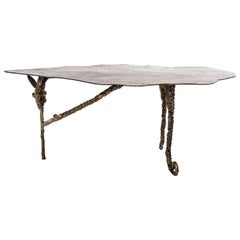
2010s American Coffee and Cocktail Tables
Bronze
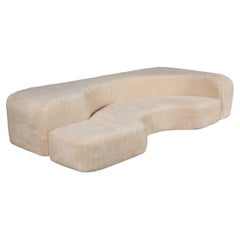
Vintage 1970s Italian Mid-Century Modern Sofas
Wool
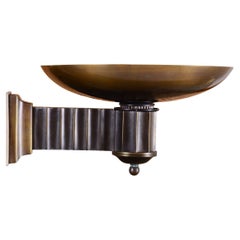
2010s Austrian Art Deco Wall Lights and Sconces
Brass
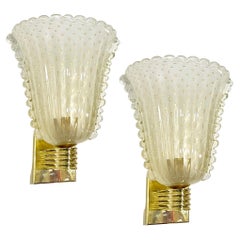
2010s Italian Mid-Century Modern Wall Lights and Sconces
Brass, Gold Leaf
Vintage Mediterranean Lounge Chairs For Sale on 1stDibs
How Much are Vintage Mediterranean Lounge Chairs?
Adrien Audoux and Frida Minnet for sale on 1stDibs
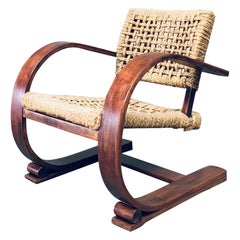
While little is known about audacious modernist designers Adrien Audoux and Frida Minnet, the French-Swiss husband-and-wife duo created playful and unique decorative objects, dining chairs, sconces and other furniture during the mid-20th century. Rejecting Art Deco lavishness and the concept that seating, tables and other furnishings should be made with luxurious and exotic materials, Minnet and Audoux adopted a rustic style in their work, integrating abaca hemp cord and other organic materials such as beech and bamboo in their provocative designs.
Audoux and Minnet were active in Côte d'Azur, France — they are believed to have established a workshop there in the late 1920s. The designers were members of the Union des Artistes Modernes, a collective of like-minded artists founded in 1929. The raison d'être of the Union was to design household furnishings and decorative pieces for a wider demographic of people, not merely affluent Parisians — a target kind of buyer for many creators of the day. They promoted simplicity and prioritized functionalism. The collective’s membership boasted other celebrated furniture designers, including Jean Prouvé, Charlotte Perriand, Francis Jourdain and Louis Sognot.
Minnet and Audoux spent much of their time in the Provence region, a hub of creativity where other artists such as Pablo Picasso found endless inspiration. They created everything from lighting to lounge chairs and end tables that reflected a nautical theme and coastal living. Minnet and Audoux’s imaginative works — table lamps with shades covered in raffia, oak benches with seat backs of woven rope — were made available to passers-by in the duo’s retail outlet in the seaside resort town of Golfe-Juan. The pair also incorporated woven rope into larger pieces such as armchairs and side tables. These furnishings are often compared to the work of similarly adventurous Union des Artistes Modernes member Charlotte Perriand. Several of Audoux and Minnet’s seating pieces are on display at the Maison Dumas in St. Tropez, France.
Find vintage Adrien Audoux and Frida Minnet furniture on 1stDibs.
A Close Look at Bauhaus Furniture
The Bauhaus was a progressive German art and design school founded by the architect Walter Gropius that operated from 1919 to 1933. Authentic Bauhaus furniture — sofas, dining chairs, tables and more — and the school’s followers married industrial and natural materials in simple, geometric forms. The goal of the Bauhaus was to erase the distinction between art and craft while embracing the use of new technologies and materials.
ORIGINS OF BAUHAUS FURNITURE DESIGN
- Art and design school established in Germany in 1919
- Promotion of a union of art, craft and technology
- Design intended for mass production
- School’s workshops focused on cabinetry, metalworking, typography, textiles and more
- Informed by De Stijl, Constructivism, Art Nouveau, Arts and Crafts, and modernism; influenced mid-century modernism, Scandinavian modernism
CHARACTERISTICS OF BAUHAUS FURNITURE DESIGN
- Emphasis on craft
- Simplicity, order, clarity and a prioritization of functionalism
- Incorporation of geometric shapes
- Minimalist and refined, little to no ornamentation
- Use of industrial materials such as tubular chrome, steel and plastic as well as leather, cane and molded plywood in furniture and other products
BAUHAUS FURNITURE DESIGNERS YOU SHOULD KNOW
- László Moholy-Nagy
- Ludwig Mies van der Rohe
- Anni Albers
- Josef Hoffmann
- Marcel Breuer
- Marianne Brandt
AUTHENTIC BAUHAUS FURNITURE ON 1STDIBS
The name Bauhaus is derived from the German verb bauen, “to build.” Under the school’s innovative curriculum, students were taught the fine arts, such as painting and sculpture, as well as practical skills like carpentry and metalworking.
The school moved from Weimar in 1925 to the city of Dessau, where it enjoyed its heyday under Gropius, then Hannes Meyer and Ludwig Mies van der Rohe. The period from 1932 to 1933 when it operated in Berlin under Mies was its final chapter. Despite its brief existence, the Bauhaus has had an enduring impact on art and design in the United States and elsewhere, and is regarded by many as the 20th century’s chief crucible of modernism.
The faculty roster at the Bauhaus reads like a who’s who of modernist creative genius — it included such artists as Paul Klee, Wassily Kandinsky and László Moholy-Nagy along with architects and designers like Mies and Marcel Breuer, who became known for his muscular brutalist-style concrete buildings in the postwar years. In 1925, while he was head of the Bauhaus carpentry workshop, Breuer gave form to his signature innovation: the use of lightweight tubular-steel frames for chairs, side tables and sofas — a technique soon adopted by Mies and others. Breuer’s Cesca chair was the first-ever tubular steel frame chair with a caned seat to be mass produced, while the inspiration for his legendary Wassily chair, a timeless design and part of the collection crafted to furnish the Dessau school, was the bike he rode around campus.
Bauhaus design style reflects the tenets by which these creators worked: simplicity, clarity and function. They disdained superfluous ornament in favor of precise construction. Seating pieces such as side chairs, armchairs or club chairs for example, were made with tubular metal or molded plywood frames, and upholstery was made from leather or cane. Above all, designs in the Bauhaus style offer aesthetic flexibility. They can be the elements of a wholly spare, minimalist space, the quiet foundation of an environment in which color and pattern come from one’s own collection of art and artifacts.
Today, from textiles to typefaces, architecture, furniture and decorative objects for the home, Bauhaus creations continue to have an outsize influence on modern design.
Find a collection of authentic Bauhaus furniture on 1stDibs.
Finding the Right Lounge-chairs for You
While this specific seating is known to all for its comfort and familiar form, the history of how your favorite antique or vintage lounge chair came to be is slightly more ambiguous.
Although there are rare armchairs dating back as far as the 17th century, some believe that the origins of the first official “lounge chair” are tied to Hungarian modernist designer-architect Marcel Breuer. Sure, Breuer wasn’t exactly reinventing the wheel when he introduced the Wassily lounge chair in 1925, but his seat was indeed revolutionary for its integration of bent tubular steel.
Officially, a lounge chair is simply defined as a “comfortable armchair,” which allows for the shape and material of the furnishings to be extremely diverse. Whether or not chaise longues make the cut for this category is a matter of frequent debate.
The Eames lounge chair, on the other hand, has come to define somewhat of a universal perception of what a lounge chair can be. Introduced in 1956, the Eames lounger (and its partner in cozy, the ottoman) quickly became staples in television shows, prestigious office buildings and sumptuous living rooms. Venerable American mid-century modern designers Charles and Ray Eames intended for it to be the peak of luxury, which they knew meant taking furniture to the next level of style and comfort. Their chair inspired many modern interpretations of the lounge — as well as numerous copies.
On 1stDibs, find a broad range of unique lounge chairs that includes everything from antique Victorian-era seating to vintage mid-century modern lounge chairs by craftspersons such as Hans Wegner to contemporary choices from today’s innovative designers.