Vintage Paris Map Poster
Recent Sales
1960s Realist Vintage Paris Map Poster
Lithograph
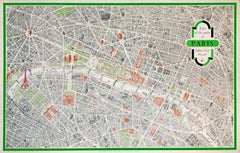
1950s Land Vintage Paris Map Poster
Lithograph
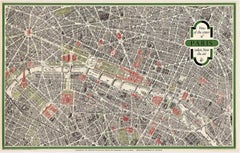

Vintage Paris Map Poster For Sale on 1stDibs
How Much is a Vintage Paris Map Poster?
Finding the Right Prints-works-on-paper for You
Decorating with fine art prints — whether they’re figurative prints, abstract prints or another variety — has always been a practical way of bringing a space to life as well as bringing works by an artist you love into your home.
Pursued in the 1960s and ’70s, largely by Pop artists drawn to its associations with mass production, advertising, packaging and seriality, as well as those challenging the primacy of the Abstract Expressionist brushstroke, printmaking was embraced in the 1980s by painters and conceptual artists ranging from David Salle and Elizabeth Murray to Adrian Piper and Sherrie Levine.
Printmaking is the transfer of an image from one surface to another. An artist takes a material like stone, metal, wood or wax, carves, incises, draws or otherwise marks it with an image, inks or paints it and then transfers the image to a piece of paper or other material.
Fine art prints are frequently confused with their more commercial counterparts. After all, our closest connection to the printed image is through mass-produced newspapers, magazines and books, and many people don’t realize that even though prints are editions, they start with an original image created by an artist with the intent of reproducing it in a small batch. Fine art prints are created in strictly limited editions — 20 or 30 or maybe 50 — and are always based on an image created specifically to be made into an edition.
Many people think of revered Dutch artist Rembrandt as a painter but may not know that he was a printmaker as well. His prints have been preserved in time along with the work of other celebrated printmakers such as Pablo Picasso, Salvador Dalí and Andy Warhol. These fine art prints are still highly sought after by collectors.
“It’s another tool in the artist’s toolbox, just like painting or sculpture or anything else that an artist uses in the service of mark making or expressing him- or herself,” says International Fine Print Dealers Association (IFPDA) vice president Betsy Senior, of New York’s Betsy Senior Fine Art, Inc.
Because artist’s editions tend to be more affordable and available than his or her unique works, they’re more accessible and can be a great opportunity to bring a variety of colors, textures and shapes into a space.
For tight corners, select small fine art prints as opposed to the oversized bold piece you’ll hang as a focal point in the dining area. But be careful not to choose something that is too big for your space. And feel free to lean into it if need be — not every work needs picture-hanging hooks. Leaning a larger fine art print against the wall behind a bookcase can add a stylish installation-type dynamic to your living room. (Read more about how to arrange wall art here.)
Find fine art prints for sale on 1stDibs today.
Read More
Revisiting Robert Rauschenberg’s Creative Rebellion on His 100th Birthday
A planet-wide celebration feels fitting for an artist who saw connections everywhere: between paint and photography, art and life, self and surroundings.
Red Grooms’s 3D Tugboat Is a Chaotic, Comic Take on New York Life
The sculptural lithograph is part of the inimitable artist’s “Ruckus” series, now on view at the Brooklyn Museum.
Joan Mitchell’s Rare, Late-Career Diptych Buzzes with Life
Beneath the inky blackness, the painter’s irrepressible energy electrifies this pair of intaglio prints.
The 1stDibs Guide to Types of Abstract Art
Get to know the key movements and artists who have influenced visual culture for more than a century.
Romare Bearden’s Humanity Infuses His Bright, Bold Art
Through collage, painting and printmaking, the artist foregrounded Black life in America in revolutionary new ways.
Andy Warhol and Suzie Frankfurt’s ‘Wild Raspberries’ Cookbook Is an Artful, Fanciful Delight
This set of recipes and original prints might not make you a better chef. But it will make you smile.
Art Brings the Drama in These Intriguing 1stDibs 50 Spaces
The world’s top designers explain how they display art to elicit the natural (and supernatural) energy of home interiors.
Welcome (Back) to the Wild, Wonderful World of Walasse Ting
Americans are rediscovering the globe-trotting painter and poet, who was connected to all sorts of art movements across a long and varied career.