Vintage Patio Umbrella
Recent Sales
Mid-20th Century French Mid-Century Modern Vintage Patio Umbrella
Metal
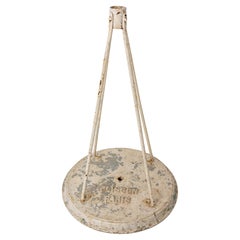

1970s American Mid-Century Modern Vintage Patio Umbrella
Metal
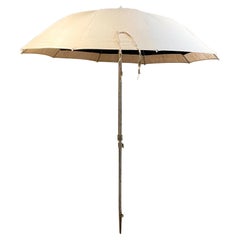
Vintage Patio Umbrella For Sale on 1stDibs
How Much is a Vintage Patio Umbrella?
A Close Look at Mid-century-modern Furniture
Organically shaped, clean-lined and elegantly simple are three terms that well describe vintage mid-century modern furniture. The style, which emerged primarily in the years following World War II, is characterized by pieces that were conceived and made in an energetic, optimistic spirit by creators who believed that good design was an essential part of good living.
ORIGINS OF MID-CENTURY MODERN FURNITURE DESIGN
- Emerged during the mid-20th century
- Informed by European modernism, Bauhaus, International style, Scandinavian modernism and Frank Lloyd Wright’s architecture
- A heyday of innovation in postwar America
- Experimentation with new ideas, new materials and new forms flourished in Scandinavia, Italy, the former Czechoslovakia and elsewhere in Europe
CHARACTERISTICS OF MID-CENTURY MODERN FURNITURE DESIGN
- Simplicity, organic forms, clean lines
- A blend of neutral and bold Pop art colors
- Use of natural and man-made materials — alluring woods such as teak, rosewood and oak; steel, fiberglass and molded plywood
- Light-filled spaces with colorful upholstery
- Glass walls and an emphasis on the outdoors
- Promotion of functionality
MID-CENTURY MODERN FURNITURE DESIGNERS TO KNOW
- Charles and Ray Eames
- Eero Saarinen
- Milo Baughman
- Florence Knoll
- Harry Bertoia
- Isamu Noguchi
- George Nelson
- Danish modernists Hans Wegner and Arne Jacobsen, whose emphasis on natural materials and craftsmanship influenced American designers and vice versa
ICONIC MID-CENTURY MODERN FURNITURE DESIGNS
- Eames lounge chair
- Nelson daybed
- Florence Knoll sofa
- Egg chair
- Womb chair
- Noguchi coffee table
- Barcelona chair
VINTAGE MID-CENTURY MODERN FURNITURE ON 1STDIBS
The mid-century modern era saw leagues of postwar American architects and designers animated by new ideas and new technology. The lean, functionalist International-style architecture of Le Corbusier and Bauhaus eminences Ludwig Mies van der Rohe and Walter Gropius had been promoted in the United States during the 1930s by Philip Johnson and others. New building techniques, such as “post-and-beam” construction, allowed the International-style schemes to be realized on a small scale in open-plan houses with long walls of glass.
Materials developed for wartime use became available for domestic goods and were incorporated into mid-century modern furniture designs. Charles and Ray Eames and Eero Saarinen, who had experimented extensively with molded plywood, eagerly embraced fiberglass for pieces such as the La Chaise and the Womb chair, respectively.
Architect, writer and designer George Nelson created with his team shades for the Bubble lamp using a new translucent polymer skin and, as design director at Herman Miller, recruited the Eameses, Alexander Girard and others for projects at the legendary Michigan furniture manufacturer.
Harry Bertoia and Isamu Noguchi devised chairs and tables built of wire mesh and wire struts. Materials were repurposed too: The Danish-born designer Jens Risom created a line of chairs using surplus parachute straps for webbed seats and backrests.
The Risom lounge chair was among the first pieces of furniture commissioned and produced by celebrated manufacturer Knoll, a chief influencer in the rise of modern design in the United States, thanks to the work of Florence Knoll, the pioneering architect and designer who made the firm a leader in its field. The seating that Knoll created for office spaces — as well as pieces designed by Florence initially for commercial clients — soon became desirable for the home.
As the demand for casual, uncluttered furnishings grew, more mid-century furniture designers caught the spirit.
Classically oriented creators such as Edward Wormley, house designer for Dunbar Inc., offered such pieces as the sinuous Listen to Me chaise; the British expatriate T.H. Robsjohn-Gibbings switched gears, creating items such as the tiered, biomorphic Mesa table. There were Young Turks such as Paul McCobb, who designed holistic groups of sleek, blond wood furniture, and Milo Baughman, who espoused a West Coast aesthetic in minimalist teak dining tables and lushly upholstered chairs and sofas with angular steel frames.
Generations turn over, and mid-century modern remains arguably the most popular style going. As the collection of vintage mid-century modern chairs, dressers, coffee tables and other furniture for the living room, dining room, bedroom and elsewhere on 1stDibs demonstrates, this period saw one of the most delightful and dramatic flowerings of creativity in design history.
Finding the Right Garden-furniture for You
Whether you're sitting around a firepit, playing games or enjoying a meal, outdoor furniture is crucial for a successful social gathering.
We’ve come a long way from the rudimentary patio and garden furniture of yore, which, in the Ancient Roman and Greek eras, meant stone slabs. Back then, your grandiose patch of outdoor greenery was a place to relax and admire the manicured hedges and fruit orchards. Fortunately, advancements in the design of outdoor furniture as well as the burgeoning of artisan landscape designers have made it easier to do so since then.
The need for outdoor chairs, tables and benches to withstand varying weather conditions means that many contemporary offerings prioritize durability over form. For a touch of glamour in your garden, antique and vintage pieces from France or Italy, which have already proven they can stand the test of time, can introduce an elegant sensibility to your outdoor space.
In the late 1940s, Hawaii-based architect Walter Lamb began fashioning outdoor furniture from nautical rope and metal tubing rescued from sunken Pearl Harbor ships. Although his designs were originally intended as gifts for returning GIs, his creations gained such popularity that they were picked up by the then-new Brown Jordan furniture company of California.
Lamb’s adventurous creations inspired many designers who followed. The seating and tables crafted by other mid-century furniture makers noted for their seminal patio and garden works — a list that includes Hendrik Van Keppel and Taylor Green, Russell Woodard and Woodard Furniture, Maurizio Tempestini and Richard Schultz — remain highly sought after by collectors today.
Whether it’s wicker couches for your screened porch or wrought-iron armchairs for fireside drinks, find the antique and vintage patio and garden furniture you need to wind down the day or welcome the morning sun on 1stDibs.
- 1stDibs ExpertAugust 20, 2024The difference between a patio umbrella and a market umbrella comes down to function. People typically use patio umbrellas to provide shade in outdoor living spaces, such as patios, pool areas and decks. Less likely to be found outside of homes, market umbrellas are for shielding outdoor vendors, their wares and their customers from the sun. As a result, market umbrellas tend to be thicker and larger than patio umbrellas, and they often feature weighted bases to keep them upright. Find a variety of outdoor furniture on 1stDibs.
- 1stDibs ExpertAugust 20, 2024To identify vintage patio furniture, start with the maker's markings. You will usually find stamps, tags or labels with the maker's name in hidden places, such as under seats and tabletops. By comparing the marking with images shared by trusted online resources, you can learn who produced your patio furniture. Then, you can continue your research to find out more about the style name, year of production and other characteristics. Typically, patio furniture must be at least 20 years old and no more than 99 years old to be categorized as vintage. For help with the identification process, turn to a certified appraiser or knowledgeable antique dealer. Find a large collection of vintage patio furniture on 1stDibs.
- 1stDibs ExpertMay 3, 2024To identify vintage Woodard patio furniture, look for the maker's markings. On three-piece sets, you'll typically find paper labels that bear the brand name underneath the cushions. Sofa and chair frames may also feature welded-on metal labels bearing the brand name. For wrought iron pieces, check the frame for an embossed "Woodard" mark. Once you find the markings, you can use trusted online resources to determine a rough idea of the age of your piece. Anything produced more than 20 years ago, but less than a century ago, is vintage. Pieces more than 100 years old are antique, while those made within the last two decades are contemporary. If you're unable to locate any markings, a certified appraiser or knowledgeable antiques dealer can assist you with identification and dating. On 1stDibs, explore an assortment of Woodard furniture.
Read More
39 Incredible Swimming Pools
It's hard to resist the allure of a beautiful pool. So, go ahead and daydream about whiling away your summer in paradise.
May’s Most Popular Interiors on Instagram
Our feed is filled with the world's most beautiful spaces. See the rooms our followers have deemed the best of the best this month.
April’s Most-Liked Interiors on Instagram
Our feed is filled with the world's most beautiful spaces. See the 10 our followers have deemed the best of the best this month.