William Peabody
Mid-19th Century Romantic Figurative Prints
Watercolor, Lithograph
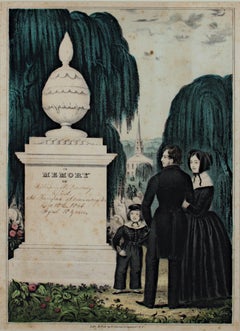
People Also Browsed
20th Century Animal Sculptures
Bronze

Mid-20th Century Sterling Silver
Silver
18th Century Old Masters Paintings
Oil
21st Century and Contemporary French Art Deco Decorative Art
Resin
Early 20th Century Italian Rococo Bird Cages
Metal
1850s Hudson River School Landscape Paintings
Canvas, Oil
Vintage 1930s French Art Deco Coffee and Cocktail Tables
Walnut
Vintage 1930s Swedish Art Deco Vases
Gold
19th Century Victorian Animal Paintings
Canvas, Oil
Early 1900s Art Nouveau Prints and Multiples
Paper, Lithograph
Vintage 1910s Italian Art Nouveau Cabinets
Mirror, Walnut
Early 1900s Art Nouveau Prints and Multiples
Paper, Lithograph
Vintage 1920s French Art Deco Bookends
Marble, Metal
1910s Art Deco More Prints
Lithograph
19th Century Romantic Figurative Paintings
Oil, Board
Early 20th Century French Art Nouveau Picture Frames
Zinc
William Peabody For Sale on 1stDibs
How Much is a William Peabody?
Nathaniel Currier for sale on 1stDibs
Nathaniel Currier was a tall introspective man with a melancholy nature. He could captivate people with his piercing stare or charm them with his sparkling blue eyes. Nathaniel was born in Roxbury, Massachusetts on March 27, 1813, the second of four children. His parents, Nathaniel and Hannah Currier, were distant cousins who lived a humble yet spartan life. When Nathaniel was eight years old, tragedy struck. Nathaniel’s father unexpectedly passed away leaving Nathaniel and his eleven-year-old brother Lorenzo to provide for the family. In addition to their mother, Nathaniel and Lorenzo had to care for six-year-old sister Elizabeth and two-year-old brother Charles. Nathaniel worked a series of odd jobs to support the family, and at 15, he started what would become a life-long career when he apprenticed in the Boston lithography shop of William and John Pendleton. A Bavarian gentleman named Alois Senefelder invented lithography just 30 years before young Nat Currier’s apprenticeship. While under the employ of the brothers Pendleton, Nat was taught the art of lithography by the firm’s chief printer, a French national named Dubois, who brought the lithography trade to America.
In 1833, now 20-years old and an accomplished lithographer, Nat Currier left Boston and moved to Philadelphia to do contract work for M.E.D. Brown, a noted engraver and printer. With the promise of good money, Currier hired on to help Brown prepare lithographic stones of scientific images for the American Journal of Sciences and Arts. When Nat completed the contract work in 1834, he traveled to New York City to work once again for his mentor John Pendleton, who was now operating his shop located at 137 Broadway. Soon after the reunion, Pendleton expressed an interest in returning to Boston and offered to sell his print shop to Currier. Young Nat did not have the financial resources to buy the shop, but being the resourceful type he found another local printer by the name of Stodart. Together they bought Pendleton’s business. The firm Currier Stodart specialized in job printing. They produced many different types of printed items, most notably music manuscripts for local publishers. By 1835, Stodart was frustrated that the business was not making enough money and he ended the partnership, taking his investment with him. With little more than some lithographic stones and a talent for his trade, 22-year old Nat Currier set up shop in a temporary office at 1 Wall Street in New York City. He named his new enterprise N. Currier, and continued as a job printer and duplicated everything from music sheets to architectural plans. He experimented with portraits, disaster scenes and memorial prints, and anything that he could sell to the public from tables in front of his shop. During 1835, he produced a disaster print Ruins of the Planter's Hotel, New Orleans, which fell at two O’clock on the morning of the 15th of May 1835. The public had a thirst for newsworthy events, and newspapers of the day did not include pictures. By producing this print, Nat gave the public a new way to see the news. The print sold reasonably well, an important fact that was not lost on Currier.
A Close Look at Romantic Art
In emphasizing emotion and imagination, romantic art shifted away from the restraint of classicism and neoclassicism that had dominated art in Europe since the Renaissance. Romanticism achieved its greatest popularity in art, literature, music and philosophy between 1780 and 1830, although its expression of individual experiences ranging from awe to passion informed culture in the decades after.
Landscape painting was especially popular during the romantic period, as were nature studies of wild animals and fantasies of exotic lands. Romanticism varied across Europe as it reacted to the rise of industrialization, a more personal relationship with faith that was distanced from the church and the rationalist thinking of the Enlightenment.
British painters such as John Constable and J.M.W. Turner responded dramatically to the light and atmosphere of the natural world, while William Blake conveyed humanity’s connection to the divine in his visionary art. In Germany, the late-18th-century Sturm und Drang, or Storm and Drive, movement, with its probing of the unconscious, inspired a sense of mystery in work by romantic artists such as Caspar David Friedrich and Philipp Otto Runge. In France, where the French Revolution had turned tradition upside down, Théodore Géricault and Eugène Delacroix used lush brushwork to paint monumental canvases with tumultuous scenes of nature and history.
The romantic movement and its subject matter were a significant influence on the Pre-Raphaelites, Symbolists and the American painters of the Hudson River School, as well as on other cultural movements in the 19th and 20th centuries that saw artists build on this perspective in which art was guided by emotion rather than reason.
Find a collection of romantic paintings, sculptures, prints and multiples and more art on 1stDibs.
Finding the Right Figurative-prints-works-on-paper for You
Bring energy and an array of welcome colors and textures into your space by decorating with figurative fine-art prints and works on paper.
Figurative art stands in contrast to abstract art, which is more expressive than representational. The oldest-known work of figurative art is a figurative painting — specifically, a rock painting of an animal made over 40,000 years ago in Borneo. This remnant of a remote past has long faded, but its depiction of a cattle-like creature in elegant ocher markings endures.
Since then, figurative art has evolved significantly as it continues to represent the world, including a breadth of works on paper, including printmaking. This includes woodcuts, which are a type of relief print with perennial popularity among collectors. The artist carves into a block and applies ink to the raised surface, which is then pressed onto paper. There are also planographic prints, which use metal plates, stones or other flat surfaces as their base. The artist will often draw on the surface with grease crayon and then apply ink to those markings. Lithographs are a common version of planographic prints.
Figurative art printmaking was especially popular during the height of the Pop art movement, and this kind of work can be seen in artist Andy Warhol’s extensive use of photographic silkscreen printing. Everyday objects, logos and scenes were given a unique twist, whether in the style of a comic strip or in the use of neon colors.
Explore an impressive collection of figurative art prints for sale on 1stDibs and read about how to arrange your wall art.