William S Coleman
Recent Sales
Antique 1870s English Neoclassical Ceramics
Majolica
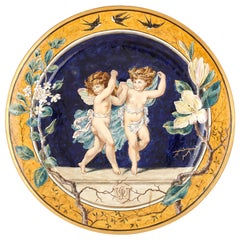

William S Coleman For Sale on 1stDibs
How Much is a William S Coleman?
Minton for sale on 1stDibs
Pottery is one of the oldest decorative art forms, and Minton is one of its historical masters. For more than 250 years, the English company was a premier producer of porcelain and ceramic wares. Its factory was known for detailed and brightly colored Victorian tableware, including dinner plates and serving pieces.
Thomas Minton founded the Minton factory in 1793 in Stoke-upon-Trent, England. It initially made earthenware but introduced bone china in 1798. When Minton died in 1836, the company passed to his son, Herbert Minton. The younger Minton was a savvy businessman with an eye for design. He introduced glossy majolica earthenware to the factory’s repertoire and hired skilled artists and designers like Augustus Welby Northmore Pugin and Albert-Ernest Carrier-Belleuse, boosting the company’s reputation.
In 1851, Minton debuted its majolica at the Great Exhibition in London. It became a royal family favorite and was even used to tile the Royal Dairy at Windsor Home Park. Minton majolica was also displayed on the monumental Saint George and the dragon fountain at the 1862 London International Exhibition.
Colin Minton Campbell, a nephew of Herbert Minton, took over the family business in 1858. He led the company to the head of the 1870s English art pottery movement. In the 1890s, French porcelain artist Marc-Louis Solon helped modernize Minton with his Art Nouveau designs.
Minton ceased operating as an independent company when it merged with Royal Doulton Tableware Ltd. in 1968. It was the end of an era, but not the end of widespread appreciation for Minton ceramics.
In 1982, the ”English Majolica” exhibition at the Cooper Hewitt, Smithsonian Design Museum featured 75 Minton pieces. When the Metropolitan Museum of Art reopened its British Galleries in 2020, it included a display of three colorful Minton majolica bird sculptures. Minton pottery was also on display from September 2021 to January 2022, along with other English pottery, at the Bard Graduate Center’s ”Majolica Mania” exhibition.
On 1stDibs, find exquisite Minton serveware, decorative objects, wall decorations and more.
A Close Look at Neoclassical Furniture
Neoclassical design emerged in Europe in the 1750s, as the Age of Enlightenment reached full flower. Neoclassical furniture took its cues from the styles of ancient Rome and Athens: symmetrical, ordered, dignified forms with such details as tapered and fluted chair and table legs, backrest finials and scrolled arms.
Over a period of some 20 years, first in France and later in Britain, neoclassical design — also known as Louis XVI, or Louis Seize — would supersede the lithe and curvaceous Rococo or Louis XV style.
The first half of the 18th century had seen a rebirth of interest in classical antiquity. The "Grand Tour" of Europe, codified as a part of the proper education of a patrician gentleman, included an extended visit to Rome. Some ventured further, to sketch the ruins of ancient Greece. These drawings and others — particularly those derived from the surprising and rich archaeological discoveries in the 1730s and ’40s at the sites of the Roman cities of Pompeii and Herculaneum — caused great excitement among intellectuals and aesthetes alike.
Neoclassical furniture is meant to reflect both grace and power. The overall appearance of neoclassical chairs, tables and cabinetry is strong and rectilinear. These pieces are, in effect, classical architecture in miniature: chair and table legs are shaped like columns; cabinets are constructed with elements that mirror friezes and pediments.
Yet neoclassicism is enlivened by gilt and silver leaf, marquetry, and carved and applied ornamental motifs based on Greek and Roman sculpture: acanthus leaves, garlands, laurel wreaths, sheaves of arrow, medallions and chair splats are carved in the shapes of lyres and urns. Ormolu — or elaborate bronze gilding — was essential to French design in the 18th and 19th centuries as a cornerstone of the neoclassical and Empire styles.
As you can see from the furniture on these pages, there is a bit of whimsy in such stately pieces — a touch of lightness that will always keep neoclassicism fresh.
Find antique neoclassical furniture today on 1stDibs.
Finding the Right Ceramics for You
Whether you’re adding an eye-catching mid-century modern glazed stoneware bowl to your dining table or grouping a collection of decorative plates by color for the shelving in your living room, decorating and entertaining with antique and vintage ceramics is a great way to introduce provocative pops of colors and textures to a space or family meals.
Ceramics, which includes pottery such as earthenware and stoneware, has had meaningful functional value in civilizations all over the world for thousands of years. When people began to populate permanent settlements during the Neolithic era, which saw the rapid growth of agriculture and farming, clay-based ceramics were fired in underground kilns and played a greater role as important containers for dry goods, water, art objects and more.
Today, if an Art Deco floor vase, adorned in bright polychrome glazed colors with flowers and geometric patterns, isn’t your speed, maybe minimalist ceramics can help you design a room that’s both timeless and of the moment. Mixing and matching can invite conversation and bring spirited contrasts to your outdoor dining area. The natural-world details enameled on an Art Nouveau vase might pair well with the sleek simplicity of a modern serving bowl, for example.
In your kitchen, your cabinets are likely filled with ceramic dinner plates. You’re probably serving daily meals on stoneware dishes or durable sets of porcelain or bone china, while decorative ceramic dishes may be on display in your dining room. Perhaps you’ve anchored a group of smaller pottery pieces on your mantelpiece with some taller vases and vessels, or a console table in your living room is home to an earthenware bowl with a decorative seasonal collection of leaves, greenery and acorns.
Regardless of your tastes, however, it’s possible that ceramics are already in use all over your home and outdoor space. If not, why? Whatever your needs may be, find a wide range of antique and vintage ceramics on 1stDibs.