A. Toussaint - G. Chaudoir More Lighting
to
1
1
Height
to
Width
to
1
1
1
1
1
1
1
1
1
1
695
371
331
289
Creator: A. Toussaint - G. Chaudoir
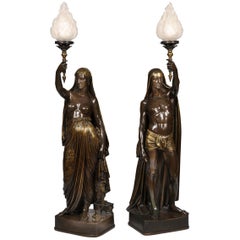
Large 19th Century Pair of Bronze Figural Torcheres
By Ferdinand Barbedienne, A. Toussaint - G. Chaudoir
Located in London, GB
A pair of Figural Porte-Lumières, cast by Barbedienne from the celebrated Armand Toussaint Models
Constructed in bronze, and having a patinated natural, and a highlighted gilt patin...
Category
Mid-19th Century French Romantic Antique A. Toussaint - G. Chaudoir More Lighting
Materials
Bronze

$188,028 / set
Related Items
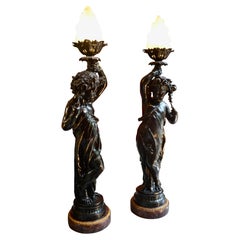
Matching Pair of Figural Patinated Bronze Flame Torcheres after Clodion
By Claude Michel Clodion
Located in Vancouver, British Columbia
A beautifully cast matching pair of patinated bronze figural torcheres in the manner of Clodion modeled as classically draped young girls with garlands of flowers in their hair and h...
Category
Late 19th Century French Napoleon III Antique A. Toussaint - G. Chaudoir More Lighting
Materials
Bronze
An Italian 19th Century Patinated Bronze Torchere, After Niccolò Roccatagliata
By Niccolo Roccatagliata
Located in Los Angeles, CA
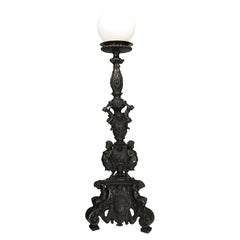
A Large and Impressive Italian 19th Century Patinated Bronze Figural Torchere, after a model by Niccolò Roccatagliata (Genoa 1593 - Venice 1636). The triangular foot base with projecting putti supporting the stem and oval reserves within cartouche motifs, one containing the initials "S.D" with an olive tree in-between and a bull-head below. The stem knot with figures of winged caryatids and festoons and upper part with cherub heads, acanthus leaves and egg and bead patterns and topped with a later white glass globe. The decorative system refers to the documented artistic production of the Venetian workshop of Niccolò Roccatagliata and takes inspirational model from the base of the Renaissance bronze of the Scuola Grande di San Teodoro in Venice, a work signed by Andrea del Bartolomeo di Alessandri known as Brescianino. Electrified. Circa: Venice, 1850-1880.
RELATED LITERATURE
L. Planiscig, Venezianische Bildhauer der Renaissance, Vienna, 1921, figs. 661-664; C. Avery, 'Andrea del Bartolomeo di Alessandri detto il Bresciano" lavator di gettar di Bronzo": candelabri, satiri e battenti', M. Ceriana and V. Avery (eds.), L'Industria artistica del Bronzo del Rinascimento a venezia e nell'Italia settentrionale, Venice, 2008, pp. 233-252.
Similar models of this torchere were part of the interior decor collection at the Vanderbilt Mansion in New York (see black and white photo). The Cornelius Vanderbilt II House was a large mansion built in 1883 at 1 West 57th Street in Manhattan, New York City. It occupied the frontage along the west side of Fifth Avenue from West 57th Street up to West 58th Street at Grand Army...
Category
19th Century Italian Baroque Antique A. Toussaint - G. Chaudoir More Lighting
Materials
Bronze
$14,850 Sale Price
69% Off
H 66.5 in W 19.25 in D 18 in
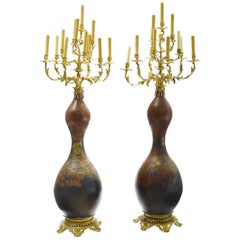
Pair 19th Century Japanese Porcelain and Gilt Bronze Mounted Torchere Floor Lamp
By Imari Porcelain
Located in Los Angeles, CA
A fine pair of 19th century Japanese porcelain and French gilt bronze mounted thirteen-light celadon torchiere, floor lamp candelabra. Wired for ...
Category
19th Century Japanese Rococo Antique A. Toussaint - G. Chaudoir More Lighting
Materials
Bronze
$29,850 / set
H 64.25 in Dm 25 in
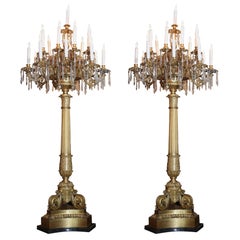
Large 19th c. French Bronze Doré and Crystal 19-Light Torchieres/candelabrum
Located in Houston, TX
These Palace size French 19-light torchieres are electrified and have new wiring; this exceptional pair is a rare find with the
original gilding in beautiful condition. They are pho...
Category
Mid-19th Century French Antique A. Toussaint - G. Chaudoir More Lighting
Materials
Bronze
$60,000 Sale Price / set
20% Off
H 78 in W 32 in D 32 in
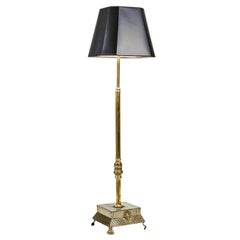
Late 19th Century Aesthetic Movement Brass Standing Floor Lamp
Located in Long Island City, NY
Late 19th Century Aesthetic Movement Brass Standing Floor Lamp.
Category
Late 19th Century European Aesthetic Movement Antique A. Toussaint - G. Chaudoir More Lighting
Materials
Brass
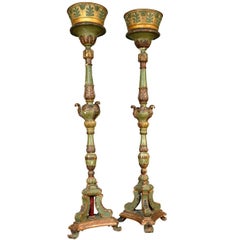
Monumental Pair of Italian 18th Century torchère in Painted and Giltwood
Located in Round Top, TX
A truly exquisite pair of 18th century Northern Italian torchère in painted and giltwood. The shades are pierced metal and polychromed. They are lined in a white silk.
Category
Late 18th Century Antique A. Toussaint - G. Chaudoir More Lighting
Materials
Wood
$15,000 / set
H 85.5 in W 20 in D 20 in
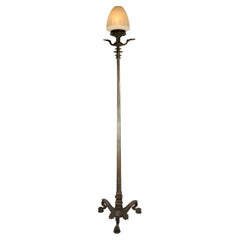
Pompeiian Style 19th-20th Century Bronze Tripod Torchere, Attr. E.F. Caldwell
By Edward F. Caldwell
Co.
Located in Los Angeles, CA
A Rare Tall Pompeiian Style 19th-20th century gilt patinated bronze tripod torchere Floor Lamp fitted with a molded glass shade. The tall fluted center column, topped with decorated ...
Category
Early 1900s American Empire Revival Antique A. Toussaint - G. Chaudoir More Lighting
Materials
Bronze
$9,850 Sale Price
60% Off
H 93.75 in W 19 in D 19 in
Pair of French 19th-20th Century Neoclassical Style Cast Iron Figural Torchères
Located in Los Angeles, CA
A very fine pair of French 19th-20th century neoclassical style patinated cast iron figural torchères by A. Durenne, Paris, each representing a figure of a standing young maiden, her arms raised forward while holding a a flaming urn gas light (Now electrified) with a frosted glass flame, each raised on a veined grey marble column stand, both cast-signed 'A. Durenne, Paris'. Antoine Durenne was an internationally renowned French art founder. He attended École Nationale Supérieure des Beaux-Arts in 1842. Durenne purchased a small foundry in Sommevoire, near the Val d'Osne, Haute-Marne, France and established The Durenne firm, circa Paris, 1900.
Cast-iron had been in production during the 18th century but its inferior status to the more fashionable and delicate wrought iron had generally confined its use to architectural work. By the early 19th century, however, rapid developments of the Industrial Revolution combined with the simultaneous burgeoning of a new middle class provided the impetus for a dramatic Expansion in its application and in a short space of time a proliferation of iron foundries across Europe and America thrived on the production of everything from inkstands to railway stations. The use of cast-iron for garden ornament became particularly widespread at this time, as the possibilities for its mass-production at a fraction of the cost of bronze made it the material of choice for outdoor statuary...
Category
Early 1900s French Neoclassical Revival Antique A. Toussaint - G. Chaudoir More Lighting
Materials
Marble, Iron
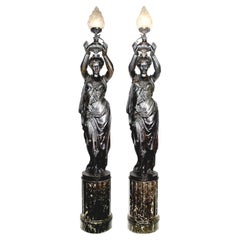
$49,875 Sale Price / set
41% Off
H 71 in W 29 in D 27.5 in
Pair of Italian Torcheres in Silver Wood Early 19th Century
Located in Brussels, Brussels
A rare pair of early 19th century silver wood torchieres from Italy.
Superb Italian Louis XV style work in carved wood.
Very good quality of carving and in magnificent condition T
...
Category
Early 19th Century Italian Louis XV Antique A. Toussaint - G. Chaudoir More Lighting
Materials
Giltwood
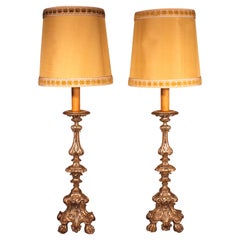
$5,624 / set
H 62.21 in W 11.42 in D 11.42 in
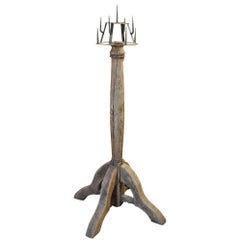
Spanish 18th Century Iron Torchere
Located in Round Top, TX
A wonderful primitive 18th century torchere from the Catalan region of Spain. Soundly constructed from sturdy oak and iron.
Category
18th Century Spanish Antique A. Toussaint - G. Chaudoir More Lighting
Materials
Iron
Late 19th Century Gilt Bronze and Japanese Satsuma Porcelain Floor Lamp
By Satsuma
Located in Long Island City, NY
Late 19th Century Gilt Bronze and Japanese Satsuma Porcelain Floor Lamp
The round lamp with painted scenes of men, women and children in landscape scenes and at leisure...
Category
Late 19th Century Japanese Belle Époque Antique A. Toussaint - G. Chaudoir More Lighting
Materials
Bronze, Ormolu
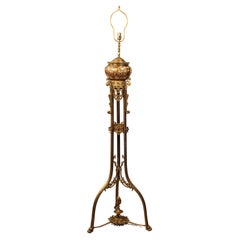
$7,600
H 73 in W 21 in D 21 in
Pair 19th Century Japanese Imari Porcelain
Gilt-Bronze Torchere Candelabra
By Imari Porcelain
Located in Los Angeles, CA
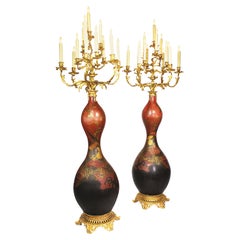
A fine Pair of 19th century Japanese Imari Porcelain and French Gilt-Bronze Mounted Thirteen-Light Celadon Torchere Candelabra. The bottle-shaped Japonisme vases with a Royal red background, decorated with parcel-gilt and black soaring eagles in the hunt within a forestall scene. Each Vase fitted and surmounted with a French 19th century Louis XV Style 13-Light scrolled candelabrum and all raised on a circular pierced gilt-bronze plinth. circa: 1880.
Imari Porcelain (????) is the name for Japanese porcelain wares made in the town of Arita, in the former Hizen Province, northwestern Kyushu. They were exported to Europe extensively from the port of Imari, Saga, between the second half of the 17th century and the first half of the 18th century. The Japanese as well as Europeans called them Imari. In Japanese, these porcelains are also known as Arita-yaki (???). Imari or Arita porcelain has been continously produced up through the present day.
Characteristics
Though there are many types of Imari, Westerners' conception of Imari in the popular sense is associated only with a type of Imari produced and exported in large quantity in mid-17th century. This type is called Kinrande. Kinrande Imari is colored porcelain with cobalt blue underglaze and red and gold overglaze. The color combination was not seen in China at that time. Traditional Ming dynasty color porcelain used dominantly red and green, probably due to scarcity of gold in China, whereas gold was abundant in Japan in those days. The subject matter of Imari is diverse, ranging from foliage and flowers to people, scenery and abstractions. Some Imari design structures such as kraak style were adopted from China, but most designs were uniquely Japanese owing to the rich Japanese tradition of paintings and costume design. The porcelain has a gritty texture on the bases, where it is not covered by glaze. There is also blue and white Imari. Kakiemon style Imari is another type of Imari, but it tends to be categorized separately in Europe.
History
"Imari" was simply the trans-shipment port for Arita wares. It was the kilns at Arita which formed the heart of the Japanese porcelain industry.
Arita's kilns were set up in the 17th century, when kaolin was discovered in 1616 by the immigrant Korean potter, Yi Sam-pyeong (1579–1655). (He may also be known by the name, "Kanage Sambei".) Yi Sam-Pyeong, along with his extended family of 180 persons, left Korea on the offer of a privileged position in Japan. This decision was made after the occurrence of certain Japanese invasions of Korea. After Yi Sam-Pyeong's discovery, his kilns began to produce revised Korean-style blue and white porcelains, known as "Shoki-Imari".
In the mid-17th century there were also a lot of Chinese refugees in Northern Kyushu due to the turmoil on Chinese continent, and it is said one of them brought coloring technique to Arita. Thus Shoki-Imari developed into Ko-KutaniImari. Ko-Kutani was produced around 1650 for both export and domestic market. Blue and white porcelain continued to be produced and they are called Ai-Kutani. Ko-Kutani Imari for the export market usually adopted Chinese design structure such as kraak style, whereas Ai-Kutani for the domestic market were highly unique in design and are accordingly valued very much among collectors.
Ko-Kutani style evolved into Kakiemon style Imari, which was produced for about 50 years around 1700. Imari achieved its technical and aesthetic peak in Kakiemon style, and it dominated European market. Blue and white Kakiemon is called Ai-Kakiemon. Kakiemon style transformed into Kinrande in the 18th century. Kinrande used blue underglaze and red and gold overglaze, and later some other colors.
Imari began to be exported to Europe because the Chinese kilns at Ching-te-Chen were damaged in the political chaos and the new Qing dynasty government stopped trade in 1656–1684. Exports to Europe were made through the Dutch East India Company, but the designation "Imari Porcelain" in Europe connotes Arita wares of mostly Kinrande Imari.
Export of Imari to Europe stopped in mid-18th century when China began export to Europe again, since Imari was not able to compete against China due to high labor cost. By that time, however, both Imari and Kakiemon style were already so popular among Europeans, Chinese export porcelain copied both Imari and Kakiemon style, which is called Chinese Imari. At the same time, European kilns, such as Meisen also tried to copy Imari and Kakiemon.
Export of Imari surged again in late 19th century (Meiji era) when Japonism flourished in Europe. Thus in western world today, two kinds of Imari can...
Category
19th Century Japanese Japonisme Antique A. Toussaint - G. Chaudoir More Lighting
Materials
Bronze, Ormolu
$18,950 Sale Price / set
61% Off
H 72.25 in Dm 24.25 in
A. Toussaint - G. Chaudoir more lighting for sale on 1stDibs.
A. Toussaint - G. Chaudoir more lighting are available for sale on 1stDibs. These distinctive items are frequently made of metal and are designed with extraordinary care. There are many options to choose from in our collection of A. Toussaint - G. Chaudoir more lighting, although gold editions of this piece are particularly popular. Prices for A. Toussaint - G. Chaudoir more lighting can differ depending upon size, time period and other attributes — on 1stDibs, these items begin at $154,843 and can go as high as $154,843, while a piece like these, on average, fetch $154,843.