Adolphe Willette Prints and Multiples

French, 1857-1926

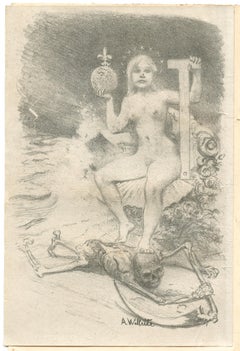
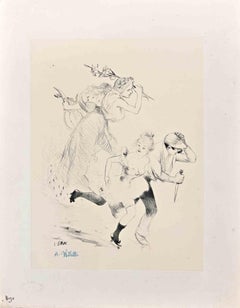
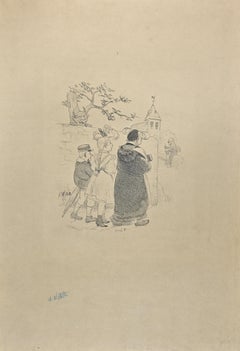
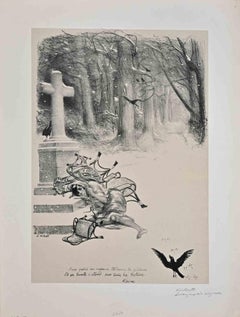
Adolphe Léon Willette was born in Châlons-sur-Marne on July 30, 1857. He studied for four years at the École des Beaux-Arts under Alexandre Cabanel. It gave him a unique position among the graphic humorists of France. Whether comedy or tragedy, trivial or political satire, his work is instinct with the profound sincerity of the artist. He set Pierrot upon a lofty pedestal among the imaginary heroes of France and established Mimi Pinson, frail, lovable and essentially good-hearted, in the affections of the nation. Willette is at once the modern Watteau of the pencil and the exponent of sentiments that move the more emotional section of the public. Always a poet and usually gay, fresh and delicate, in his presentation of idylls exquisitely dainty and characteristically Gallic, illustrating the more charming side of love, often pure and sometimes extremely materialistic. Willette frequently revealed himself as bitter and fierce, even ferocious, in his hatreds, being violent though at the same time a generous partisan of political ideas. He was furiously compassionate with love and pity for the people whether they are ground down under the heel of political oppression or merely the victims of unrequited love, suffering all the pangs of graceful anguish that are born of scornful treatment. There is charm even in his thrilling apotheosis of the guillotine and in the introduction into his caricatures of the figure of death itself. The artist was a prolific contributor to the French illustrated press under the pseudonyms, Cemoi, Pierrot, Louison, Bebe and Nox, but more often under his own name. He illustrated Melandri's Les Pierrots and Les Giboulées d'avril, Le Courrier français and published his own Pauvre Pierrot and other works, in which he tells his stories in scenes. He decorated several brasseries artistiques with wall-paintings, stained glass, notably Le Chat Noir and La Palette d'or and he painted the highly imaginative ceiling for La Cigale music hall. His characteristically fantastic Parce Domine was shown in the Franco-British Exhibition in 1908. A remarkable collection of his works was exhibited in 1888. His V'almy is in Luxembourg, Paris. He passed away on February 4, 1926, in Paris, France.

to
3
15
3
3
1
2
Overall Width
to
Overall Height
to
25
1,195
954
938
829
13
11
2
1
22
2
21
16
14
12
6
4
3
2
2
1
1
1
1
1
1
1
1
15
8
3
2
2
1
16
5
4
Artist: Adolphe Willette
French Revolution, the Battle of Valmy - Original Lithograph 1899
By Adolphe Willette
Located in Paris, IDF
Adolphe WILLETTE (1857-1926) French Revolution, the Battle of Valmy, 1899 Original lithograph (Champenois workshop) Printed signature in the plate On ...
Category

1890s Art Nouveau Adolphe Willette Prints and Multiples

Materials

Lithograph

original lithograph
By Adolphe Willette
Located in Henderson, NV
Medium: original lithograph. This impression on thin wove paper was printed in 1903 for Gustave Geffroy's "La Vie Artistique". Sheet size: 6 1/2 x 4 3/8 inches (165 x 112 mm). Signed...
Category

Early 1900s Adolphe Willette Prints and Multiples

Materials

Lithograph

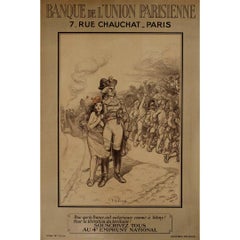
1918 original poster by Adolphe Willette, for the Banque de l Union Parisienne
By Adolphe Willette
Located in PARIS, FR
The 1918 original poster by Adolphe Willette, created for the Banque de l'Union Parisienne, is a compelling piece of wartime propaganda, urging citizens to contribute to the fourth national loan (4e Emprunt National). This poster, titled Pour que la France soit victorieuse comme à Valmy! (So that France may be victorious like at Valmy!), is a poignant call to action, blending historical reference with patriotic fervor to inspire public support during the final year of World War I. Adolphe Willette, a prominent French painter, illustrator, and political cartoonist, was known for his evocative and often satirical works. During the war, artists like Willette played a crucial role in shaping public sentiment and encouraging national unity through their art. This particular poster exemplifies his ability to harness the power of visual storytelling to evoke a sense of duty and pride in the French populace. The poster references the Battle of Valmy...
Category

1910s Adolphe Willette Prints and Multiples

Materials

Paper, Lithograph

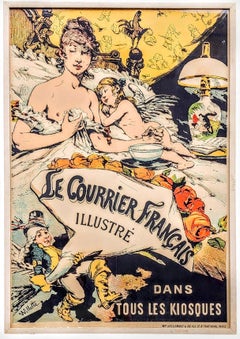
Le Courrier Français Illustré / Dans Tous Les Kiosques, Art Nouveau Lithograph
By Adolphe Willette
Located in Grand Rapids, MI
Adolphe Leon Willette (French, 1857-1926) "Le Courrier Français Illustré / Dans Tous Les Kiosques" English translation: "The Illustrated French Courier / In All Newsstands" Le Cou...
Category

Late 19th Century Art Nouveau Adolphe Willette Prints and Multiples

Materials

Lithograph

Dangerous Jokes - Lithograph by Adolphe Willette - Early 20th Century
By Adolphe Willette
Located in Roma, IT
Dangerous Jokes is an Original Lithograph realized by Willette (Adolphe Léon). Good condition on a yellowed paper. Hand signed with blue pencil on the lower left corner. Adolphe ...
Category

Early 20th Century Art Nouveau Adolphe Willette Prints and Multiples

Materials

Lithograph

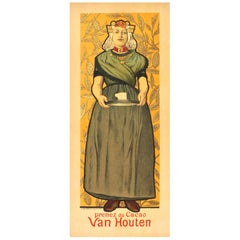
Adolph Willette “Cacao Van Houten” Original 1896 Poster Chaix
By Adolphe Willette
Located in Dallas, TX
Willette- Maitres de L'affiche: Cacao Van Houten, original lithograph 1896, Impremie CHAIX. PL. 43 France, 1890-1919, paper Willette: Cacao Van Houten Original stone Lithograph on vélin paper 1896 Sheet Size: 15.75 x 11.4 in. / 39.5 x 29 cm Printed by: Imprimerie Chaix 1896 In very good condition (A) unbacked, This plate is from the famous set "Les Maitres de l'affiche" The "Les Maitres de l'Affiche" series was offered as a subscription series to collectors. Every month for 60 months, from December 1895 through November 1900, subscribers received by mail, 4 loose sheets (Maitres) with a cover sheet. Willette's elegant vertical poster...
Category

1890s Art Nouveau Adolphe Willette Prints and Multiples

Materials

Paper

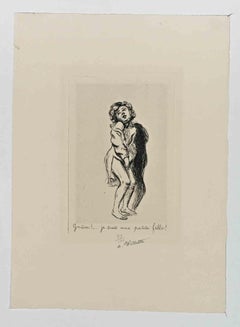
Grace - Etching by Adolphe Willette - Early 20th Century
By Adolphe Willette
Located in Roma, IT
Grace is an Original Etching and Drypoint realized by Willette (Adolphe Léon). Good condition included a white cardboard passpartout (49x32 cm). Titled "Grace!...Je suis une petite...
Category

Early 20th Century Art Nouveau Adolphe Willette Prints and Multiples

Materials

Etching

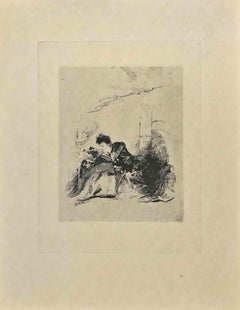
Il Ressemble à Ernest - Etching by Adolphe Willett - Late-19th century
By Adolphe Willette
Located in Roma, IT
Il Ressemble à Ernest is an Original Etching and Drypoint realized by Willette (Adolphe Leon). Good condition on a yellowed paper. signed on plate on the lower left corner and titl...
Category

19th Century Art Nouveau Adolphe Willette Prints and Multiples

Materials

Etching

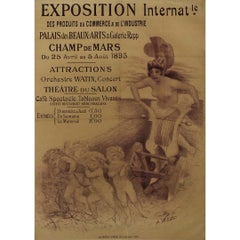
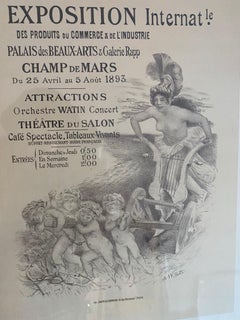
1893 Exposition Internationale des Produits du Commerce et de l Industrie
By Adolphe Willette
Located in PARIS, FR
In the realm of vintage poster art, Adolphe Willette's 1893 masterpiece for the Exposition Internationale des Produits du Commerce et de l'Industrie offers a captivating window into ...
Category

1890s Adolphe Willette Prints and Multiples

Materials

Linen, Paper, Lithograph

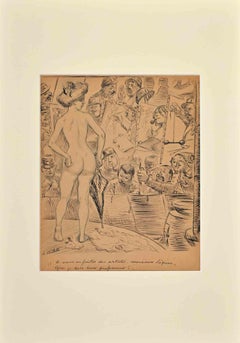
Ecole de Peinture - Drawing by Adolphe Willette - Late-19th century
By Adolphe Willette
Located in Roma, IT
Ecole de Peinture is a drawing in China Ink on paper realized by Adolphe Willette in the Late 19th Century . Good conditions. Hand-signed. The artwork is depicted through soft st...
Category

19th Century Art Nouveau Adolphe Willette Prints and Multiples

Materials

Paper, Ink

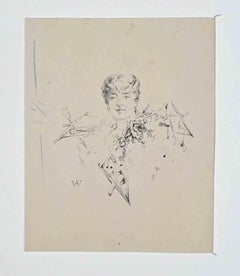
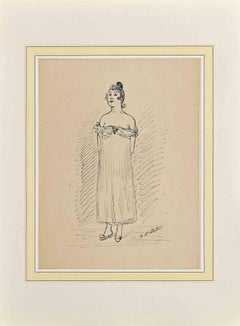
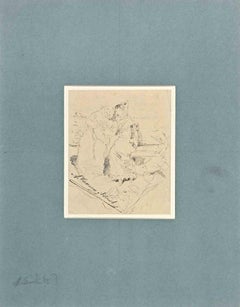
The Lady - Drawing by Adolphe Willette - Late-19th century
By Adolphe Willette
Located in Roma, IT
The Lady is a drawing in China Ink on paper realized by Adolphe Willette in the Late 19th Century. Very Good conditions. Monogrammed. Including a Greyish cardboard Passepartout (6...
Category

19th Century Art Nouveau Adolphe Willette Prints and Multiples

Materials

Paper, Ink

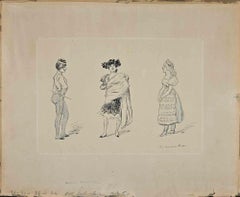
Characters - Drawing by Adolphe Willette - Late-19th century
By Adolphe Willette
Located in Roma, IT
Characters is a Drawing in pen realized by the artist Willette (Adolphe Léon). Signature on the lower right margin. Adolphe Léon Willette (30 July 1857, Châlons-sur-Marne – 4 Febru...
Category

19th Century Art Nouveau Adolphe Willette Prints and Multiples

Materials

Paper, Pencil

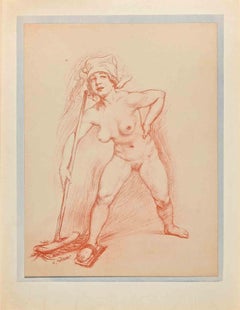
Cleaning Nude - Lithograph by Adolphe Willette - Early 20th Century
By Adolphe Willette
Located in Roma, IT
Cleaning Nude is an Original Lithograph realized by Willette (Adolphe Léon). Good condition on a yellowed paper included a cardboard passpartout (33x25 cm). Hand signed with sangui...
Category

Early 20th Century Art Nouveau Adolphe Willette Prints and Multiples

Materials

Lithograph

The Lady - Drawing by Adolphe Willette - Late-19th century
By Adolphe Willette
Located in Roma, IT
The Lady is a Drawing realized by the artist Willette (Adolphe Léon). Good condition included a white cardboard passpartout 34.5x26 cm. Signature on the lower right margin. Adolphe Léon Willette (30 July 1857, Châlons-sur-Marne – 4 February 1926, Paris) was a French painter, illustrator, caricaturist, and lithographer, as well as an architect of the famous Moulin Rouge cabaret. Willette ran as an "anti...
Category

19th Century Art Nouveau Adolphe Willette Prints and Multiples

Materials

Paper, Pencil

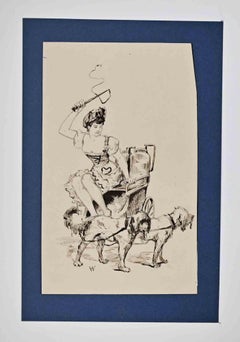
The Woman On Chariot - Drawing by Adolphe Willette - Late-19th century
By Adolphe Willette
Located in Roma, IT
The Woman On Chariot By Dogs is a drawing in China Ink and pen on paper realized by Adolphe Willette in the Late 19th Century. Very Good conditions. Monogrammed. Including a cardb...
Category

19th Century Art Nouveau Adolphe Willette Prints and Multiples

Materials

Paper, Ink

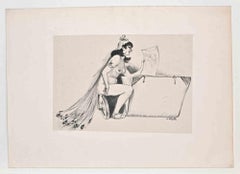
Nude of Woman - Lithograph by Adolphe Willette - Early 20th Century
By Adolphe Willette
Located in Roma, IT
Nude of Woman is an Original Lithograph realized by Willette (Adolphe Léon). Good condition on a grey paper included a white cardboard passpartout (32.5x48 cm). Address card for Sa...
Category

Early 20th Century Art Nouveau Adolphe Willette Prints and Multiples

Materials

Lithograph

Praying Mucha - Lithograph by Adolphe Willette - Early 20th Century
By Adolphe Willette
Located in Roma, IT
Praying Macha is an Original Lithograph realized by Willette (Adolphe Léon). Good condition on a yellowed paper. Hand signed withpencil on the lower left corner. Adolphe Léon Wil...
Category

Early 20th Century Art Nouveau Adolphe Willette Prints and Multiples

Materials

Lithograph

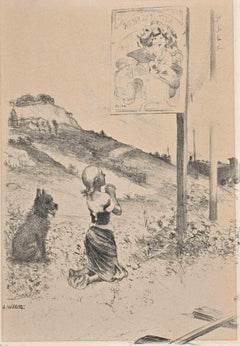
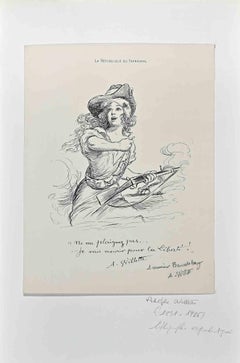
The Republic of the Transvaal-Lithograph by Adolphe Willett - 19th century
By Adolphe Willette
Located in Roma, IT
The Republic of the Transvaal is an original lithograph realized by Adolphe Willette (1857-1926) during the 19th century. The original work is united to ...
Category

19th Century Art Nouveau Adolphe Willette Prints and Multiples

Materials

Lithograph

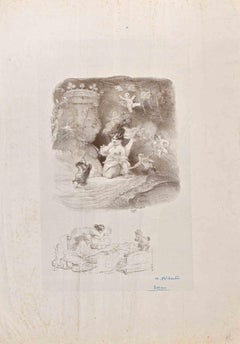
Lady with Cupids and Dwarf - Lithograph by Adolphe Willette - 1906
By Adolphe Willette
Located in Roma, IT
Lady with Cupids and Dwarf is a Lithograph realized in 1906 by Willette (Adolphe Léon). Hand-signed with pencil on the lower right corner. Good condition with folding and consumed ...
Category

Early 1900s Art Nouveau Adolphe Willette Prints and Multiples

Materials

Lithograph

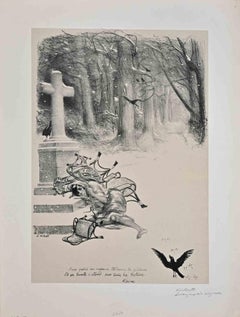
Risks and Temptations - Lithograph by Adolphe Willette - Early 20th Century
By Adolphe Willette
Located in Roma, IT
Risks and Temptations is an Original Lithograph realized by Willette (Adolphe Léon). Good condition on a yellowed paper. Hand signed with blue pencil on the lower left corner. Ad...
Category

Early 20th Century Art Nouveau Adolphe Willette Prints and Multiples

Materials

Lithograph

The Ballerina - Lithograph by Adolphe Willette - Late 19th century
By Adolphe Willette
Located in Roma, IT
The Ballerina is an original lithograph realized by Adolphe Willette (1857-1926) in the late 19th century. Good condition. Adolphe-Léon Willette (Châlons-sur-Marne, 1857 - Parigi, ...
Category

Late 19th Century Art Nouveau Adolphe Willette Prints and Multiples

Materials

Lithograph

A Little Poor Woman - Lithograph by Adolphe Willette - 20th Century
By Adolphe Willette
Located in Roma, IT
A Little Poor Woman is an Original Lithograph realized by Adolphe Léon Willette ( 1857-1926). Good condition included a cardboard passpartout (65x50 cm). Hand-signed by the artist ...
Category

Early 20th Century Art Nouveau Adolphe Willette Prints and Multiples

Materials

Lithograph

A Little Poor Woman - Lithograph by Adolphe Willette - 20th Century
By Adolphe Willette
Located in Roma, IT
A Little Poor Woman is a Lithograph realized by Adolphe Léon Willette ( 1857-1926). Good condition included a cardboard passpartout (65x50 cm). Hand-signed by the artist on the low...
Category

Early 20th Century Art Nouveau Adolphe Willette Prints and Multiples

Materials

Lithograph

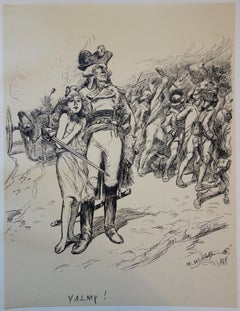
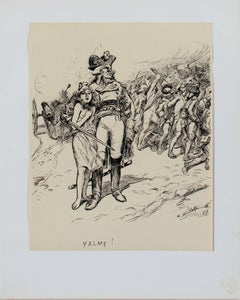
"VALMY! (L Estampe Moderne), " Lithograph after Drawing by Adolphe Willette
By Adolphe Willette
Located in Milwaukee, WI
"VALMY! (L'Estampe Moderne)" is a print watermarked PL BAS after a drawing by Adolphe Willette. It depicts a general with his army and a young girl. 15 3/4" x 12" art 23" x 19 1/4" frame Adolphe Léon Willette (30 July 1857 – 4 February 1926) was a French painter, illustrator, caricaturist, and lithographer, as well as an architect of the famous Moulin Rouge cabaret. Willette ran as an "anti-semitic" candidate in the 9th arrondisement of Paris for the September 1889 legislative elections. Biography Willette was born in Châlons-sur-Marne. He studied for four years at the École des Beaux-Arts under Cabanel, training which gave him a unique position among the graphic humorists of France. Whether comedy or tragedy, dainty triviality or political satire, his work is instinct with the profound sincerity of the artist. He set Pierrot upon a lofty pedestal among the imaginary heroes of France, and established Mimi Pinson, frail, lovable, and essentially good-hearted, in the affections of the nation. Willette is at once the modern Watteau of the pencil, and the exponent of sentiments that move the more emotional section of the public. Always a poet, and usually gay, fresh, and delicate, in his presentation of idylls exquisitely dainty and characteristically Gallic, illustrating the more "charming" side of love, often pure and sometimes extremely materialistic. Willette frequently reveals himself bitter and fierce, even ferocious, in his hatreds, being a violent though at the same time a generous partisan of political ideas, furiously compassionate with love and pity for the people whether they be ground down under the heel of political oppression, or are merely the victims ot unrequited love, suffering all the pangs of graceful anguish that are born of scornful treatment. There is charm even in his thrilling apotheosis of the guillotine, and in the introduction into his caricatures of the figure of Death itself. The artist was a prolific contributor to the French illustrated press under the pseudonyms "Cemoi", "Pierrot", "Louison", "Bebe", and "Nox", but more often under his own name. He illustrated Melandri's Les Pierrots and Les Giboulles d'avril, Le Courrier français, and published his own Pauvre Pierrot and other works, in which he tells his stories in scenes in the manner of Busch. He decorated several "brasseries artistiques" with wall-paintings, stained glass, &c., notably Le Chat noir and La Palette d'or, and he painted the highly imaginative ceiling for La Cigale...
Category

1890s Academic Adolphe Willette Prints and Multiples

Materials

Black and White

Related Items
St. Stephen s Cathedral in Vienna - Hand Colored Cityscape Lithograph
By Luigi Kasimir
Located in Soquel, CA
Detailed and dramatic hand-colored etching by Luigi Kasimir (Austrian, 1881-1962). St. Stephen's cathedral towers above the streets of Vienna, with people going about their daily bus...
Category

1920s Photorealist Adolphe Willette Prints and Multiples

Materials

Paper, Watercolor, Lithograph

19th century color lithograph figures cemetery willow tree memorial headstone
By Nathaniel Currier
Located in Milwaukee, WI
The present hand-colored lithograph was produced as part of the funeral and mourning culture in the United States during the 19th century. Images like this were popular as ways of remembering loved ones, an alternative to portraiture of the deceased. This lithograph shows a man, woman and child in morning clothes next to an urn-topped stone monument. Behind are additional putto-topped headstones beneath weeping willows, with a steepled church beyond. The monument contains a space where a family could inscribe the name and death dates of a deceased loved one. In this case, it has been inscribed to a young Civil War soldier: William W. Peabody Died at Fairfax Seminary, VA December 18th, 1864 Aged 18 years The young Mr. Peabody probably died in service for the Union during the American Civil War. Farifax Seminary was a Union hospital and military headquarters in Alexandria, Virginia. The hospital served nearly two thousand soldiers during the war time. Five hundred were also buried on the Seminary's grounds. 13.75 x 9.5 inches, artwork 23 x 19 inches, frame Published before 1864 Inscribed bottom center "Lith. & Pub. by N. Currier. 2 Spruce St. N.Y." Framed to conservation standards using 100 percent rag matting and TruVue Conservation Clear glass, housed in a gold gilded moulding. Nathaniel Currier was a tall introspective man with a melancholy nature. He could captivate people with his piercing stare or charm them with his sparkling blue eyes. Nathaniel was born in Roxbury, Massachusetts on March 27th, 1813, the second of four children. His parents, Nathaniel and Hannah Currier, were distant cousins who lived a humble yet spartan life. When Nathaniel was eight years old, tragedy struck. Nathaniel’s father unexpectedly passed away leaving Nathaniel and his eleven-year-old brother Lorenzo to provide for the family. In addition to their mother, Nathaniel and Lorenzo had to care for six-year-old sister Elizabeth and two-year-old brother Charles. Nathaniel worked a series of odd jobs to support the family, and at fifteen, he started what would become a life-long career when he apprenticed in the Boston lithography shop of William and John Pendleton. A Bavarian gentleman named Alois Senefelder invented lithography just 30 years prior to young Nat Currier’s apprenticeship. While under the employ of the brothers Pendleton, Nat was taught the art of lithography by the firm’s chief printer, a French national named Dubois, who brought the lithography trade to America. Lithography involves grinding a piece of limestone flat and smooth then drawing in mirror image on the stone with a special grease pencil. After the image is completed, the stone is etched with a solution of aqua fortis leaving the greased areas in slight relief. Water is then used to wet the stone and greased-ink is rolled onto the raised areas. Since grease and water do not mix, the greased-ink is repelled by the moisture on the stone and clings to the original grease pencil lines. The stone is then placed in a press and used as a printing block to impart black on white images to paper. In 1833, now twenty-years old and an accomplished lithographer, Nat Currier left Boston and moved to Philadelphia to do contract work for M.E.D. Brown, a noted engraver and printer. With the promise of good money, Currier hired on to help Brown prepare lithographic stones of scientific images for the American Journal of Sciences and Arts. When Nat completed the contract work in 1834, he traveled to New York City to work once again for his mentor John Pendleton, who was now operating his own shop located at 137 Broadway. Soon after the reunion, Pendleton expressed an interest in returning to Boston and offered to sell his print shop to Currier. Young Nat did not have the financial resources to buy the shop, but being the resourceful type he found another local printer by the name of Stodart. Together they bought Pendleton’s business. The firm ‘Currier & Stodart’ specialized in "job" printing. They produced many different types of printed items, most notably music manuscripts for local publishers. By 1835, Stodart was frustrated that the business was not making enough money and he ended the partnership, taking his investment with him. With little more than some lithographic stones, and a talent for his trade, twenty-two year old Nat Currier set up shop in a temporary office at 1 Wall Street in New York City. He named his new enterprise ‘N. Currier, Lithographer’ Nathaniel continued as a job printer and duplicated everything from music sheets to architectural plans. He experimented with portraits, disaster scenes and memorial prints, and any thing that he could sell to the public from tables in front of his shop. During 1835 he produced a disaster print Ruins of the Planter's Hotel, New Orleans, which fell at two O’clock on the Morning of the 15th of May 1835, burying 50 persons, 40 of whom Escaped with their Lives. The public had a thirst for newsworthy events, and newspapers of the day did not include pictures. By producing this print, Nat gave the public a new way to “see” the news. The print sold reasonably well, an important fact that was not lost on Currier. Nat met and married Eliza Farnsworth in 1840. He also produced a print that same year titled Awful Conflagration of the Steamboat Lexington in Long Island Sound on Monday Evening, January 18, 1840, by which melancholy occurrence over One Hundred Persons Perished. This print sold out very quickly, and Currier was approached by an enterprising publication who contracted him to print a single sheet addition of their paper, the New York Sun. This single page paper is presumed to be the first illustrated newspaper ever published. The success of the Lexington print launched his career nationally and put him in a position to finally lift his family up. In 1841, Nat and Eliza had their first child, a son they named Edward West Currier. That same year Nat hired his twenty-one year old brother Charles and taught him the lithography trade, he also hired his artistically inclined brother Lorenzo to travel out west and make sketches of the new frontier as material for future prints. Charles worked for the firm on and off over the years, and invented a new type of lithographic crayon which he patented and named the Crayola. Lorenzo continued selling sketches to Nat for the next few years. In 1843, Nat and Eliza had a daughter, Eliza West Currier, but tragedy struck in early 1847 when their young daughter died from a prolonged illness. Nat and Eliza were grief stricken, and Eliza, driven by despair, gave up on life and passed away just four months after her daughter’s death. The subject of Nat Currier’s artwork changed following the death of his wife and daughter, and he produced many memorial prints and sentimental prints during the late 1840s. The memorial prints generally depicted grief stricken families posed by gravestones (the stones were left blank so the purchasers could fill in the names of the dearly departed). The sentimental prints usually depicted idealized portraits of women and children, titled with popular Christian names of the day. Late in 1847, Nat Currier married Lura Ormsbee, a friend of the family. Lura was a self-sufficient woman, and she immediately set out to help Nat raise six-year-old Edward and get their house in order. In 1849, Lura delivered a son, Walter Black Currier, but fate dealt them a blow when young Walter died one year later. While Nat and Lura were grieving the loss of their new son, word came from San Francisco that Nat’s brother Lorenzo had also passed away from a brief illness. Nat sank deeper into his natural quiet melancholy. Friends stopped by to console the couple, and Lura began to set an extra place at their table for these unexpected guests. She continued this tradition throughout their lives. In 1852, Charles introduced a friend, James Merritt Ives, to Nat and suggested he hire him as a bookkeeper. Jim Ives was a native New Yorker born in 1824 and raised on the grounds of Bellevue Hospital where his father was employed as superintendent. Jim was a self-trained artist and professional bookkeeper. He was also a plump and jovial man, presenting the exact opposite image of his new boss. Jim Ives met Charles Currier through Caroline Clark, the object of Jim’s affection. Caroline’s sister Elizabeth was married to Charles, and Caroline was a close friend of the Currier family. Jim eventually proposed marriage to Caroline and solicited an introduction to Nat Currier, through Charles, in hopes of securing a more stable income to support his future wife. Ives quickly set out to improve and modernize his new employer’s bookkeeping methods. He reorganized the firm’s sizable inventory, and used his artistic skills to streamline the firm’s production methods. By 1857, Nathaniel had become so dependent on Jims’ skills and initiative that he offered him a full partnership in the firm and appointed him general manager. The two men chose the name ‘Currier & Ives’ for the new partnership, and became close friends. Currier & Ives produced their prints in a building at 33 Spruce Street where they occupied the third, fourth and fifth floors. The third floor was devoted to the hand operated printing presses that were built by Nat's cousin, Cyrus Currier, at his shop Cyrus Currier & Sons in Newark, NJ. The fourth floor found the artists, lithographers and the stone grinders at work. The fifth floor housed the coloring department, and was one of the earliest production lines in the country. The colorists were generally immigrant girls, mostly German, who came to America with some formal artistic training. Each colorist was responsible for adding a single color to a print. As a colorist finished applying their color, the print was passed down the line to the next colorist to add their color. The colorists worked from a master print displayed above their table, which showed where the proper colors were to be placed. At the end of the table was a touch up artist who checked the prints for quality, touching-in areas that may have been missed as it passed down the line. During the Civil War, demand for prints became so great that coloring stencils were developed to speed up production. Although most Currier & Ives prints were colored in house, some were sent out to contract artists. The rate Currier & Ives paid these artists for coloring work was one dollar per one hundred small folios (a penny a print) and one dollar per one dozen large folios. Currier & Ives also offered uncolored prints to dealers, with instructions (included on the price list) on how to 'prepare the prints for coloring.' In addition, schools could order uncolored prints from the firm’s catalogue to use in their painting classes. Nathaniel Currier and James Merritt Ives attracted a wide circle of friends during their years in business. Some of their more famous acquaintances included Horace Greeley, Phineas T. Barnum, and the outspoken abolitionists Rev. Henry Ward, and John Greenleaf Whittier (the latter being a cousin of Mr. Currier). Nat Currier and Jim Ives described their business as "Publishers of Cheap and Popular Pictures" and produced many categories of prints. These included Disaster Scenes, Sentimental Images, Sports, Humor, Hunting Scenes, Politics, Religion, City and Rural Scenes, Trains, Ships, Fire Fighters, Famous Race Horses, Historical Portraits, and just about any other topic that satisfied the general public's taste. In all, the firm produced in excess of 7500 different titles, totaling over one million prints produced from 1835 to 1907. Nat Currier retired in 1880, and signed over his share of the firm to his son Edward. Nat died eight years later at his summer home 'Lion’s Gate' in Amesbury, Massachusetts. Jim Ives remained active in the firm until his death in 1895, when his share of the firm passed to his eldest son, Chauncey. In 1902, faced will failing health from the ravages of Tuberculosis, Edward Currier sold his share of the firm to Chauncey Ives...
Category

Mid-19th Century Romantic Adolphe Willette Prints and Multiples

Materials

Watercolor, Lithograph

Original Antique French Poster, "Angelus Liquer", Leonetto Cappiello, Lithograph
By Leonetto Cappiello
Located in Dallas, TX
Antar, artist: Leonetto Cappiello. Size: 25 x 20. Year: 1907. Archival linen backed in very good condition; ready to frame. Original linen backed stone lithograph: Original vintage ...
Category

Early 1900s Art Nouveau Adolphe Willette Prints and Multiples

Materials

Lithograph

"Brotherhood" lithograph by Käthe Kollwitz
By Käthe Kollwitz
Located in Soquel, CA
Bold print of "Brotherhood" by Kathe Kollwitz (German, 1867-1945). This piece is one of the Lithographic reproductions of the original lithographs, plate 3 from a series of 10, print...
Category

1940s Expressionist Adolphe Willette Prints and Multiples

Materials

Paper, Ink, Lithograph

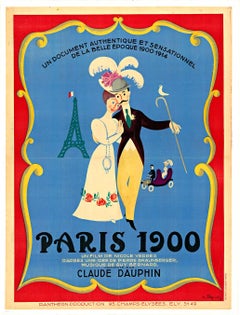
Original Paris 1900 de la Belle Epoque 1900-1914 vintage French movie poster
By Raymond Peynet
Located in Spokane, WA
Original 1947 Paris 1900 lithographic movie poster by the artist Raymond Peynet. The poster had originally been folded, and there is some wrinkling at the bottom edge of the poste...
Category

1940s Art Nouveau Adolphe Willette Prints and Multiples

Materials

Lithograph

Blue Wind : Mother Child - Original handsigned lithograph - 199ex
By Jean-Baptiste Valadie
Located in Paris, IDF
Jean-Baptiste VALADIE Flowers Blue, White & Red Original lithograph Handsigned in pencil Limited /199 copies On vellum 56 x 76 cm (c. 22 x 30 in) Excellent condition
Category

Late 20th Century Modern Adolphe Willette Prints and Multiples

Materials

Lithograph

Realist Skyscape Triptych in Blue Tones of Serene Cloudy Sky, Handmade Cyanotype
By Kind of Cyan
Located in Barcelona, ES
This series of cyanotype triptychs showcases the beauty of nature scenes, including stunning beaches and oceans, as well as the intricate textures of water, forests, and skies. These...
Category

2010s Realist Adolphe Willette Prints and Multiples

Materials

Paper, Emulsion, Lithograph

Miami Art Deco Pool, Blue Cyanotype on Paper, Abstract Shapes Water Reflections
By Kind of Cyan
Located in Barcelona, ES
This is an exclusive handprinted limited edition cyanotype. "Miami Art Deco Pool" shows the movements of water over a tiled swimming pool floor. Details: + Title: Miami Art Deco Poo...
Category

2010s Abstract Geometric Adolphe Willette Prints and Multiples

Materials

Emulsion, Watercolor, Photographic Paper, C Print, Lithograph, Other Medium

Act III with Portrait /// Contemporary Female Artist Cat Figurative Art Modern
By Dagmar Mezricky
Located in Saint Augustine, FL
Artist: Dagmar Mezricky (Czech, 1944-) Title: "Act III with Portrait" *Signed by Mezricky in pencil lower right Circa: 1988 Medium: Original Lithograph on unbranded heavy white wove ...
Category

1980s Contemporary Adolphe Willette Prints and Multiples

Materials

Lithograph

Performance by members of the Deutsches Theater zu Berlin / - Ornamental Flow -
By Emil Orlik
Located in Berlin, DE
Emil Orlik (1870 Prague - 1932 Berlin), Ensemble guest performance by members of the Deutsches Theater zu Berlin, 1899. Color lithograph on wove paper, 20 cm x 13.3 cm (image), 29.5 ...
Category

1890s Jugendstil Adolphe Willette Prints and Multiples

Materials

Paper

Leon Bakst Three Costume designs from Le Dieu Bleu Ballet 1911
By Leon Bakst
Located in Paonia, CO
Three iconic Leon Bakst costume designs for Le Dieu Bleu ( The Blue God ) a ballet choreographed by Michel Fokine and written by Cocteau. The ballet premiered in Paris in 1912. It tells the story of a girl who tries to dissuade her fiancé from becoming a priest and is thereafter tormented by demons; but she is eventually saved by the Blue God, a part performed by Vaslaw Nijinsky, the greatest male dancer of his time. Fokine’s choreography and Bakst’s costumes drew upon Siamese dance and Hindu sculpture. These three prints are vintage reproductions quite unlike the reproductions of today. They each have the look of original watercolors and are backed on heavy grey rag paper with a hand painted gold border. Properly framed they will definitely look like the original drawing. The size of the actual prints varies slightly but the background paper size is consistently 10.5 x 15.5. Born in Russia in 1866, Léon Bakst belonged to a young generation of European artists who rebelled against 19th-century stage realism, sparking a revolution in theatre design. His fame lay in the sets and costumes he designed for Serge Diaghilev’s (1872 – 1929) legendary dance company the Ballets Russes, and his huge pageant spectaculars for the dancer and patron of the performing arts, Ida Rubinstein...
Category

20th Century Art Nouveau Adolphe Willette Prints and Multiples

Materials

Color

Yvette Guilbert, SCALA — Fin de Siècle, Paris
Located in Myrtle Beach, SC
BAC (Ferdinand Bach), 'Yvette Guilbert, Tous les Soirs SCALA', vintage color lithograph, 1893. Signed, dated, and titled in the stone. A superb, richl...
Category

1890s Art Nouveau Adolphe Willette Prints and Multiples

Materials

Lithograph

Previously Available Items
Figures - Drawing by Antonio Casanova - Late-19th century
By Adolphe Willette
Located in Roma, IT
Figures is an original drawing in China ink realized by Antonio Casanova y Estorach in the Late 19th Century. Hand-signed. Very good conditions.
Category

19th Century Art Nouveau Adolphe Willette Prints and Multiples

Materials

Paper, Ink

"Exposition Internationale des Produits du Commerce et de l Industrie" Maitre
By Adolphe Willette
Located in Hinsdale, IL
WILLETTE, ADOLPHE E. (1857 -1926) "Exposition Internationale des Produits du Commerce et de l'Industrie" Original lithograph from "Les Maitres de L'Affiche" series Printed by Imprimerie Chaix, Paris Bearing MDL stamp lower right, from issue #36, 1898. Plate #142 Unframed Size: 11 3/8 x 15 3/4”The "Les Maitres de l'Affiche" series was offered as a subscription series to collectors every month for 60 months, from December 1895 through November 1900. The "Maitres de l'Affiche," were issued as separate numbered sheets, referred to as "plates". They were numbered, with the printers name "Imprimerie Chaix," in the margin at the bottom left hand corner, "PL.1" to "PL.240." In the margin at the bottom right hand corner of each, is a blind embossed stampfrom a design of Cheret's. The smaller format and the fact the "Maitres" were a paid subscription series, allowed Imprimerie Chaix to use the latest state of the art printing techniques, not normally used in the large format posters due to cost. A very high quality of paper was used, where as the large format posters were printed on lesser quality newsprint, due to cost and a short expected life span. This explains why the quality of the printing, in the "Maitres de l'Affiche," usually far exceeds that of their larger counterparts. Willette's exceptional drawing skill is demonstrated her in his fanciful rendering of four delightful cherubs pulling a whimsical harp like plow, driven by an angelic creature, clad in only headdress, a flowing slight wrap around her waist and sandals. A fanciful working scene...
Category

1890s Art Nouveau Adolphe Willette Prints and Multiples

Materials

Lithograph

Adolphe Willette prints and multiples for sale on 1stDibs.

Find a wide variety of authentic Adolphe Willette prints and multiples available for sale on 1stDibs. You can also browse by medium to find art by Adolphe Willette in lithograph, paper, ink and more. Not every interior allows for large Adolphe Willette prints and multiples, so small editions measuring 5 inches across are available. Customers who are interested in this artist might also find the work of Charles Paul Renouard, Paul César Helleu, and Georges Meunier. Adolphe Willette prints and multiples prices can differ depending upon medium, time period and other attributes. On 1stDibs, the price for these items starts at $100 and tops out at $2,225, while the average work can sell for $368.

Recently Viewed

View All