Alex Katz More Prints

American, b. 1927

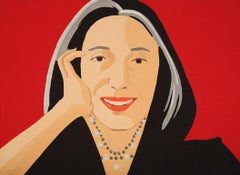
Flat color and minimal forms contrast the often monumental scales of the paintings by Alex Katz through which he creates portraits and landscapes of deceptive simplicity. Although the signature stark style that defines his prints and other work is now recognizable at a glance, it took him a decade to develop. During that time, he has said he destroyed hundreds of paintings.

Born in Brooklyn, New York, to Russian émigré parents, Katz’s family moved to Queens when he was a baby and that is where his family’s passion for the arts supported his early creative interests. In 1946, he enrolled at the Cooper Union in Manhattan where he studied painting under Morris Kantor. While he was influenced by the bold colors and hard edges of modernism, he shifted away from the then-dominant Abstract Expressionism movement to figurative scenes of life that have an inherent cool in their pared-down approach. Especially impactful were Katz’s summer studies between 1949 and 1950 at the Skowhegan School of Painting and Sculpture in Maine, a place where, as he later wrote: “I tried plein air painting and found my subject matter and a reason to devote my life to painting.”

Katz’s first solo show was in 1954 at Roko Gallery in New York. He experimented over the course of the following years with collage and painting on aluminum sheets, with his work in the 1960s drawing inspiration from film and advertising. In the 1970s, Katz expanded into portrait groups that regularly depicted the cultural scene of New York; in the 1980s, he extended his focus to fashion and its supermodels. Since the late 1950s, an enduring muse for his portraits has been his wife, Ada, while others have painted friends and famous figures. The intimate closeness of the frequently cropped faces in Katz’s portraits exudes a sense of tension with the subjects’ enigmatic expressions and planes of color.

In the 1960s, Katz collaborated with American dancer and choreographer Paul Taylor on sets and costumes. His concentration on landscapes emerged in the late 1980s, with atmospheric night views joining his practice, which had previously been defined by bright colors. Always finding new perspectives on his work, he has explored using iPhone photographs as the basis for large-scale compositions in recent years.

Katz’s prolific career has spanned sculpture, prints and public art along with his paintings and drawings, and his works can be found in the collections of leading museums such as the Metropolitan Museum of Art, Whitney Museum of American Art and Museum of Modern Art. He has had over 250 solo exhibitions around the world and continues to be acclaimed. In 2022, the Solomon R. Guggenheim Museum opened a major retrospective of his art.

Find Alex Katz art today on 1stDibs.

to
2
3
Overall Width
to
Overall Height
to
2
1
1
284
702
453
236
169
1
4
1
5
3
2
3
1
Artist: Alex Katz
Flowers in the Wind
By Alex Katz
Located in New York, NY
Created by Alex Katz in 2024, Flowers in the Wind is a 4-color woodcut print on Somerset White paper. Hand-signed in pencil and numbered from the edition of just 35 (the edition numb...
Category

21st Century and Contemporary Alex Katz More Prints

Materials

Woodcut

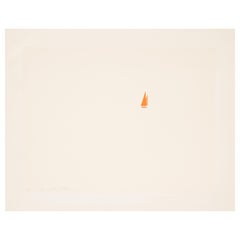
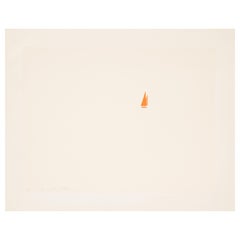
Provincetown: Late Summer Afternoon 2
By Alex Katz
Located in Toronto, Ontario
Adored by collectors and art lovers around the globe, Alex Katz is a renowned for his elegant and distinctive version of figuration and portraiture. Born in 1927, Katz worked as an...
Category

1970s Minimalist Alex Katz More Prints

Materials

Screen

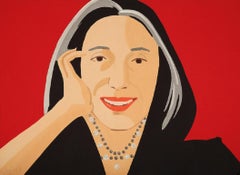
Ada - Portrait Print by Alex Katz, Ada, Red, Pearl Necklace, Portrait, Pop Art
By Alex Katz
Located in Köln, DE
"Ada" from 2011 is a Japanese woodblock in thirty-one colors on New Hosho paper. We are offering the number 18/70. 3 Artist's proofs. Ada is Alex Katz' wife and his most important mu...
Category

2010s Pop Art Alex Katz More Prints

Materials

Woodcut

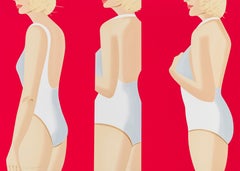
Coca-Cola Girl 8 - 21st Century, Contemporary, Alex Katz, Swim Suit, Woman, Red
By Alex Katz
Located in Köln, DE
"Coca-Cola Girl 8" is a very special one out of Alex Katz's Coca-Cola Girl series. These figures bear witness of his deep engagement with the ideas of advertisment, figurative art an...
Category

2010s Contemporary Alex Katz More Prints

Materials

Screen

Coca-Cola Girl 3 - 21st Century, Contemporary, Alex Katz, Swim Suit, Woman, Red
By Alex Katz
Located in Köln, DE
"Coca-Cola Girl 3" is one out of Alex Katz's Coca-Cola Girl series. These figures bare witness of his deep engagement with the ideas of advertisment, figurative art and how to come t...
Category

2010s Contemporary Alex Katz More Prints

Materials

Screen

Related Items
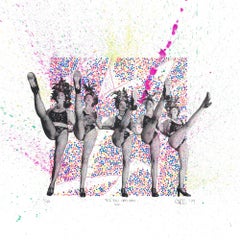
Yes You Can Can
Located in Deddington, GB
Yes You Can Can (Splats Edition) by Amy Gardner [2020] limited_edition Screen Print, Watercolour Edition number 40 Image size: H:50 cm x W:50 cm Sold Unframed Please note that insitu images are purely an indication of how a piece may look Only AP works left in this edition. This print is about women supporting women. 'YES YOU CAN CAN' splats edition limited edition of 40 Archival Bread & Butter bright white paper 270gsm 50x 50cms 5 screen...
Category

21st Century and Contemporary Pop Art Alex Katz More Prints

Materials

Paper, Watercolor, Screen

Yes You Can Can
Yes You Can Can
$253
H 19.69 in W 19.69 in D 0.04 in
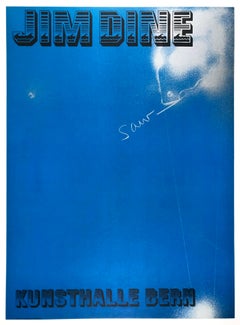
Vintage Jim Dine tool poster Kunsthalle Bern (Saw) neon blue 1970s retro font
By Jim Dine
Located in New York, NY
Original exhibition poster printed on the occasion of Jim Dine's 1971 exhibition at Kunsthalle Bern, featuring Saw, 1971. Against a sea of electric blue, Dine has written “saw” in lo...
Category

1970s Pop Art Alex Katz More Prints

Materials

Paper, Offset

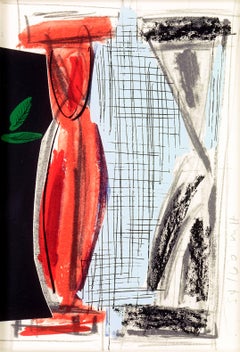
Two Columns (framed): colorful pop art abstracted Greek pillars Micheal Hurson
By Michael Hurson
Located in New York, NY
Pop art scene of abstracted Greek pillars and green leaves. Drawings in black and white, pale blue, red and grey compose this colorful print. Layers of p...
Category

1980s Contemporary Alex Katz More Prints

Materials

Lithograph, Screen

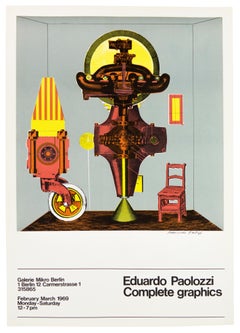
Paolozzi Signed 1969 poster Galerie Mikro vintage futuristic psychedelic pop art
By Eduardo Paolozzi
Located in New York, NY
Printed in chartreuse, dark green, bright yellow, orange, and brown, this surreal scene features a grey-walled room populated with strange machinery and a red chair. Paolozzi creates...
Category

1960s Pop Art Alex Katz More Prints

Materials

Offset

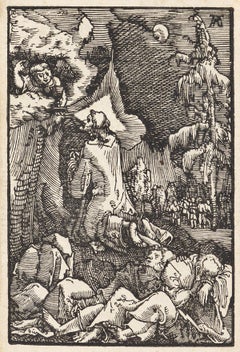
Christ on the Mount of Olives
By Albrecht Altdorfer
Located in New York, NY
A brilliant and early impression of this woodcut. Dark, well-inked, with strong contrasts and no sign of wear. From "The Fall and Salvation of Mankind Through the Life and Passion of Christ."
Category

16th Century Renaissance Alex Katz More Prints

Materials

Woodcut

Rare 1922 German Jewish Judaica Zion Woodcut Woodblock Print Hermann Fechenbach
By Hermann Israel Fechenbach
Located in Surfside, FL
Title: Zion Subject: Various biblical images depicting Creation and prayer 1922 Medium: woodcut Frame: 14" x 18" Image: 12.5" x 16.75" Provenance: owned and signed verso by Peter Keil. Central panel shows the Jewish star over a crown, with inscription in Hebrew: "When God comforts Zion, He will comfort all its ruins and make its deserts look like Eden," and "You have sanctified the seventh day, the goal of creation of Heaven and Earth." This is flanked by a Palestinian farmer pioneer on the left and a Jew praying on the right. The lower tier shows six vignettes of the days of creation from Genesis. Hermann Fechenbach was born in 1897 in Württemberg, Germany. He grew up in Bad Mergentheim where his parents had an inn, which served as a meeting place for the local Jewish community. He left school early and through family connections with clothing retailers received training in window dressing. His skill with brush writing was quickly recognised by a big firm in Dortmund where he was responsible for the displays in 10 large windows. He received his conscription papers in 1916 and recalls “being as patriotic as any other fool”. In August 1917 he was involved in a grenade attack in which he was the sole survivor. With serious injuries to both legs he struggled to safety and was eventually transported to a front line “slaughterhouse” where the first of a series of amputations was performed which led to the loss of his left leg. As a result of his injuries his father dropped his opposition to him becoming an artist. His formal art education started in 1918 with training at a Stuttgart handcraft school for invalids. He attended the Academies in Stuttgart and Munich to learn painting and restoration for 3 years. He was influenced at this time by Max Liebermann. He has been compared to Kathe Kollwitz and was a contemporary of Jakob Steinhardt and hermann Struck. In 1923 he went to Florence for a year. While in Florence he started to produce a series of miniature wood engravings to illustrate the stories of Genesis. This was followed by periods in Pisa, Venice, Vienna and Amsterdam. In 1924 he returned to Stuttgart to paint in the contemporary style “Die Neue Sachlichkeit”. (The New Objectivity was a movement in German art that arose during the 1920s Weimar republic as a reaction against expressionism. The term was coined by Gustav Friedrich Hartlaub, the director of the Kunsthalle in Mannheim, who used it as the title of an art exhibition staged in 1925 to showcase artists who were working in a post-expressionist spirit. These artists—who included Max Beckmann, Otto Dix, George Grosz, Christian Schad, Rudolf Schlichter and Jeanne Mammen) Every spring and autumn he exhibited at the “Kunstgebit” which served as the showcase for all serious artists of the period. His professional status “Kunstmaler und Grafiker” was recognised by Berlin in 1926. Practically all his work from this period was sold following exhibition. In 1926 he collaborated with an architect friend to build a bungalow in Hohenheim, a non-Jewish area and a suburb of Stuttgart. Hermann alternately lived in his country bungalow and his town studio, producing portraits for sale or barter and wood engravings for his own pleasure. In 1930 he married a non-Jewish professional photographer – Greta Batze. They had a studio in Stuttgart, which was used to teach art to a group of 12 students. In 1933 the Nazi influence removed his name from the official state register together with the right to exhibit. By spending most of his time in his bungalow out of the Jewish quarter the Fechenbachs escaped being registered by the Nazis for some years. They were ostracised and abused by their non-Jewish neighbours. Hermann made weekly visits to friends in town to teach them the practical skills they would need assuming they were to escape from Germany. His energies were directed towards protection and survival. Ultimately the Nazi persecution forced the Fechenbachs to flee their homeland. They moved to Palestine for 3 months in 1938, but found the political and physical environment unsustainable. Greta arrived in England penniless in January 1939 to work as a domestic servant and to find a guarantor for her husband. Hermann arrived in May 1939. They moved to Blackheath a few months later. Hermann resumed his painting and engraving as a means of earning a living. He raised enough money to get his parents out of Germany to join his brothers in Argentina but was unable to save his twin sister Rosa who died in a Nazi concentration camp. In 1940 Hermann was interned in Bury as a suspect alien. He protested about his treatment by starting a hunger strike. Because of his persistence he was moved to a prison in Liverpool. From Liverpool he was moved to the Hutchinson Camp in the Isle of Man with fellow artist Kurt Schwitters. Arrangements were made for Greta to be accommodated near by. While interned he commenced work on “Refugee Impressions”, a series of linocut prints (no wood was available). In 1941 when released from internment the Fechenbachs came under the sponsorship of Dr. Bela Horovitz, the Austrian art publisher who in turn made an introduction to Professor Tancred Borenius. They were offered lodgings with a family in Oxford. Hermann had his first public exhibition for many years in a small gallery in Oxford in 1942. A second exhibition of oils, pencil drawings, coloured linocut and woodblock prints held later in the year was opened by the mayor of Oxford and critically acclaimed. In 1944 the first London exhibition took place at the Anglo-Palestinian club in Piccadilly. There were two exhibitions at the Ben Uri Art gallery during this period. In 1948 a second exhibition at the Anglo Palestinian club was inaugurated by a member of the Rothschild family and several members of Parliament. This was a great success. In 1944 the Fechenbachs moved to a top floor studio flat in Colet Gardens. Open exhibitions were held each Spring at the Embankment from 1946 to 1951. Movietone News produced a short feature on the artist, which was shown in cinemas in England and Germany. In 1969 he published the Genesis story in a hard back volume containing 137 prints. He started to research the fate of the entire Jewish community of Bad Mergentheim during the period of the second world war, liaising with historian Dr. Paul Sauer and Professor Max Miller, historian and theologian. In 1972 Kohlhammer published his partly autobiographical book “The last Jews of Mergentheim”. He exhibited at the Anglo-Palestinian Club & the Ben Uri Gallery in the 1940s. His works only came to prominence during the last year of his life when he exhibited at Blond Fine Art. Peter Keil part of the Junge Wilde. In 1978, the Junge Wilde painting style arose in the German-speaking world in opposition to established avant garde, minimal art and conceptual art. It was linked to the similar Transavanguardia movement in Italy, USA (neo-expressionism) and France (Figuration Libre). They were also known as the Neue Wilde. Artists included; Austria: Siegfried Anzinger, Erwin Bohatsch, Herbert Brandl, Gunter Damisch, Hubert Scheibl, Hubert Schmalix...
Category

1980s Impressionist Alex Katz More Prints

Materials

Woodcut

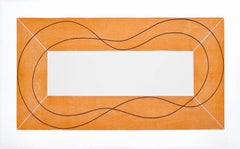
Extended Frame with Separation
By Robert Mangold
Located in New York, NY
Associated with the Minimalist art movement of the 1960s, Mangold developed a reductive vocabulary based on geometric forms, monochromatic color, and an emphasis on the flatness of t...
Category

21st Century and Contemporary Minimalist Alex Katz More Prints

Materials

Woodcut

Gestural, Abstract, Composition (Composición, in Green/Blue Spain, Catalonia)
By Joan Hernandez Pijuan
Located in Kansas City, MO
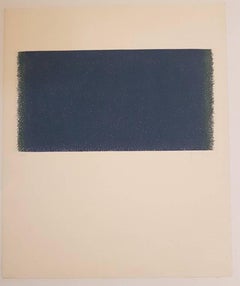
Composición, (in Green/Blue) Color etching year: 1980 signed by hand, dated and inscribed Edtion: H.C. Size: 12.3 × 24.8 on 33.3 × 27.3 inches COA provided Joan Hernández Pijuan’s l...
Category

1980s Minimalist Alex Katz More Prints

Materials

Etching

Original GEMINI Zodiac by Funky Features Psychedelic 1960s vintage poster
Located in Spokane, WA
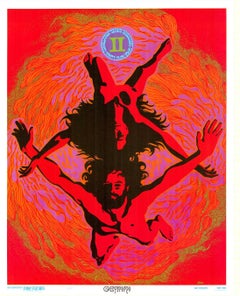
Original 1960s Gemini Zodiac Poster by Dick Moore – Vintage Psychedelic Astrology Wall Art. Bright colors, never framed. In very fine condition, be...
Category

1960s Pop Art Alex Katz More Prints

Materials

Lithograph

Eliza Southwood, Lines, Limited Edition Screen Print, Bicycle Art, Art Online
By Eliza Southwood
Located in Deddington, GB
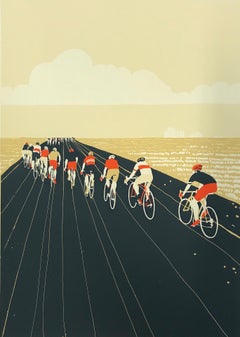
Eliza Southwood Lines Limited Edition Screen Print Edition of 80 Image Size: H 70cm x W 50cm Signed Sold Unframed Silkscreen Print – A printing technique whereby the artist paints g...
Category

21st Century and Contemporary Contemporary Alex Katz More Prints

Materials

Paper, Screen

Set of 9. From the Series "Why This Restlessness?" Figurative prints
By Casey Waterman
Located in Miami Beach, FL
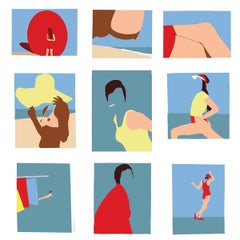
By removing parts of the image, he explores the tension between what is present and what is omitted, focusing on the reasons behind these choices and their implications. The cutouts ...
Category

2010s Minimalist Alex Katz More Prints

Materials

Archival Ink, Color

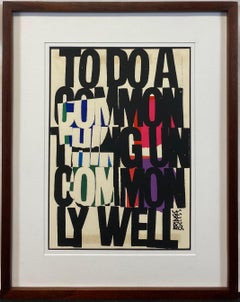
“To Do A Common Thing Uncommonly Well Brings Success, 1966” Signed Nun Pop Art
By Corita Kent
Located in Yardley, PA
An exceptional, scarce serigraph by Corita Kent from 1966-67 titled “To Do A Common Thing Uncommonly Well Brings Success”. Like many of Kent’s works, this image features a famous qu...
Category

1960s Pop Art Alex Katz More Prints

Materials

Paper, Screen

Previously Available Items
Provincetown: Late Summer Afternoon 2
By Alex Katz
Located in Toronto, Ontario
Adored by collectors and art lovers around the globe, Alex Katz is a renowned for his elegant and distinctive version of figuration and portraiture. Born in 1927, Katz worked as an...
Category

1970s Minimalist Alex Katz More Prints

Materials

Screen

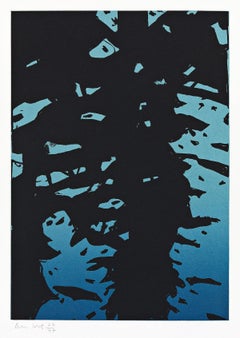
Reflection I
By Alex Katz
Located in New York, NY
A very good impression of this color aquatint and photoengraving on white wove paper. Signed and numbered 22/45 in pencil, lower left. Printed by Collaborative Art Editions, St. Pete...
Category

2010s Pop Art Alex Katz More Prints

Materials

Color, Aquatint, Photogravure

Reflection I
H 13.63 in W 9.63 in
Yellow Flags 2 - 21st Century, Alex Katz Landscape Print, Black, Yellow, Flowers
By Alex Katz
Located in Köln, DE
Yellow Flags 2 - 21st Century, Alex Katz Landscape Print, Black, Yellow, Flowers, "Yellow Flags 2" is one of Alex Katz's famous flower prints. His flowers are the most reduced forms...
Category

2010s Contemporary Alex Katz More Prints

Materials

Digital Pigment

Coca-Cola Girl 9 - 21st Century, Contemporary, Alex Katz, Swim Suit, Woman, Red
By Alex Katz
Located in Köln, DE
"Coca-Cola Girl 9" is the iconic comprehension of Katz' intension and of the spirit of the Coca-Cola Girl series. These figures bear witness of his deep engagement with the ideas of ...
Category

2010s Contemporary Alex Katz More Prints

Materials

Screen

Coca-Cola Girl 7 - 21st Century, Contemporary, Alex Katz, Swim Suit, Woman, Red
By Alex Katz
Located in Köln, DE
"Coca-Cola Girl 7" is maybe the most stunning one out of Alex Katz's Coca-Cola Girl series. These figures bear witness of his deep engagement with the ideas of advertisment, figurati...
Category

2010s Contemporary Alex Katz More Prints

Materials

Screen

Coca-Cola Girl 6 - 21st Century, Contemporary, Alex Katz, Swim Suit, Woman, Red
By Alex Katz
Located in Köln, DE
"Coca-Cola Girl 6" focuses on a "timeless beauty" which Alex Katz's Coca-Cola Girl series is famous for. These figures bear witness of his deep engagement with the ideas of advertism...
Category

2010s Contemporary Alex Katz More Prints

Materials

Screen

Coca-Cola Girl 5 - 21st Century, Contemporary, Alex Katz, Swim Suit, Woman, Red
By Alex Katz
Located in Köln, DE
"Coca-Cola Girl 5" is part of Alex Katz's Coca-Cola Girl series. These figures bear witness of his deep engagement with the ideas of advertisment, figurative art and how to come to a...
Category

2010s Contemporary Alex Katz More Prints

Materials

Screen

Coca-Cola Girl 4 - 21st Century, Contemporary, Alex Katz, Swim Suit, Woman, Red
By Alex Katz
Located in Köln, DE
"Coca-Cola Girl 4" is one of these timeless and beautyful women out of Alex Katz's Coca-Cola Girl series. These figures bare witness of his deep engagement with the ideas of advertis...
Category

2010s Contemporary Alex Katz More Prints

Materials

Screen

Coca-Cola Girl 2 - 21st Century, Contemporary, Alex Katz, Swim Suit, Woman, Red
By Alex Katz
Located in Köln, DE
"Coca-Cola Girl 2" is one out of Alex Katz's Coca-Cola Girl series. These figures bare witness of his deep engagement with the ideas of advertisment, figurative art and how to come t...
Category

2010s Contemporary Alex Katz More Prints

Materials

Screen

Coca-Cola Girl 1 - 21st Century, Contemporary, Alex Katz, Swim Suit, Woman, Red
By Alex Katz
Located in Köln, DE
"Coca-Cola Girl 1" is the first and maybe most iconic one out of Alex Katz's Coca-Cola Girl series. These figures bear witness of his deep engagement with the ideas of advertisment, ...
Category

2010s Contemporary Alex Katz More Prints

Materials

Screen

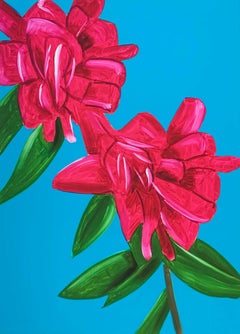
Peonies
By Alex Katz
Located in Washington, DC
Artist: Alex Katz Medium: Archival pigment ink on Innova Etching Cotton Rag 315 gsm fine art paper Title: Peonies Signed: Hand signed in pencil Year: 2021 Edition: 40/100 Sheet Size:...
Category

2010s Realist Alex Katz More Prints

Materials

Archival Pigment, Archival Ink, Archival Paper
Peonies
Peonies
H 47 in W 34 in
Ada - Portrait Print by Alex Katz, Ada, Red, Pearl Necklace, Portrait, Pop Art
By Alex Katz
Located in Köln, DE
Ada, 2011 Japanese woodblock in thirty-one colors 21 3/4 x 29 3/4 inches Edition: 70 Artist Proofs: 3 New Hosho paper Printed by Christopher T. Creyts, Collaborative Art Editions, Ta...
Category

2010s Pop Art Alex Katz More Prints

Materials

Woodcut

Alex Katz more prints for sale on 1stDibs.

Find a wide variety of authentic Alex Katz more prints available for sale on 1stDibs. If you’re browsing the collection of more prints to introduce a pop of color in a neutral corner of your living room or bedroom, you can find work that includes elements of red and other colors. You can also browse by medium to find art by Alex Katz in screen print, aquatint, etching and more. Much of the original work by this artist or collective was created during the 21st century and contemporary and is mostly associated with the contemporary style. Not every interior allows for large Alex Katz more prints, so small editions measuring 10 inches across are available. Customers who are interested in this artist might also find the work of John Baldessari, Agent X, and Robert Longo. Alex Katz more prints prices can differ depending upon medium, time period and other attributes. On 1stDibs, the price for these items starts at $5,500 and tops out at $45,119, while the average work can sell for $44,937.
Questions About Alex Katz More Prints
  • 1stDibs ExpertApril 16, 2024
    What media Alex Katz uses varies. Over the course of his career, the American artist has worked in painting, sculpture and printmaking. Always finding new perspectives on his work, he has explored using iPhone photographs as the basis for large-scale compositions in recent years. On 1stDibs, shop an assortment of Alex Katz art.
  • 1stDibs ExpertMarch 22, 2022
    Alex Katz is a contemporary artist who produced paintings, sculptures and prints. Many historians associate him with the Nouveau réalisme movement, but he also worked in figurative and Pop art styles. Shop a collection of Alex Katz art on 1stDibs.
  • 1stDibs ExpertMay 3, 2024
    Yes, Alex Katz's style is Pop art. During the 1950s, he experimented with collage and painting on aluminum sheets, with his later work in the 1960s drawing inspiration from film and advertising. In the 1970s, Katz expanded into portrait groups that regularly depicted the cultural scene of New York. In the 1980s, he extended his focus to fashion and its supermodels. These sources of inspiration align with Pop art's focus on transforming elements of popular culture into fine art. On 1stDibs, shop a collection of Alex Katz art.