Alfred Thompson Bricher Landscape Paintings
American, 1837-1908
Alfred T. Bricher (1837-1908) Marine and landscape painter Alfred Thompson Bricher is known principally for his oil and watercolor paintings of the New England coastline. He was born in Portsmouth, New Hampshire in 1837, and in 1840 relocated with his family to Newburyport, Massachusetts. Bricher moved to Boston in 1851 to seek employment, and worked as a clerk at a mercantile house while painting part-time.
As an artist, Bricher was largely self-taught, but may have studied in Newburyport and at the Lowell Institute in Boston. In 1858 he began painting full-time and established a studio in Newburyport. That year he made the first of many sketching trips–to Mt. Desert Island in Maine with Charles Temple Dix and William S. Haseltine–which, throughout his career, would take him to: Long Island, along the Hudson River, to Lake George and into the Catskill and Adirondack Mountains of New York; to New Jersey; throughout Massachusetts; to Conway, the White Mountains, and elsewhere in New Hampshire; and along the coast of Maine.
In 1859 Bricher opened a studio in Boston, though he continued to visit and work in and around Newburyport as well. In June of 1866 he made a sketching trip along the Mississippi River, and into Iowa, Wisconsin and Minnesota. During the 1860s, Bricher collaborated with L. Prang and Company to produce chromolithographs of his paintings.
One of the last great Luminist artists, Bricher was described by fellow painter William S. Barrett as “not a studio painter,” but a “lover of true nature.” In 1868, Bricher and his bride, Susan Wildes of Boston moved to New York City. In 1871 the artist began sketching along the coast of Rhode Island. Around 1874 he made his first trip to Grand Manan Island in New Brunswick, Canada. Shortly after this the artist probably traveled to England, for in 1876-77 he began exhibiting English subjects.
In 1890 he built a home in New Dorp, Staten Island, New York where he lived until his death in 1908.to
1
2
1
Overall Width
to
Overall Height
to
4
4
3
3
2
2
1
1
1
1
1
1
1
1
1
1
4
3
1
1
1
8
648
615
358
315
3
4
Artist: Alfred Thompson Bricher
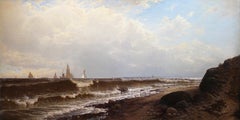
"Noon at Point Judith" Rhode Island 1877
By Alfred Thompson Bricher
Located in Jacksonville, FL
Noon at Point Judith, Rhode Island 1877
by Alfred T. Bricher (1837-1908)
Medium Oil
Medium Detail Oil on canvas
Dimensions 25 x 50 inches; Framed: 40 x 65 inches
Signed Location Sign...
Category
19th Century Alfred Thompson Bricher Landscape Paintings
Materials
Oil
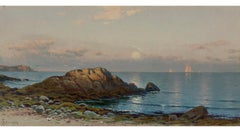
Moonlight Seascape
By Alfred Thompson Bricher
Located in New York, NY
Monogrammed lower left: ATBRICHER
Category
19th Century Hudson River School Alfred Thompson Bricher Landscape Paintings
Materials
Canvas, Oil
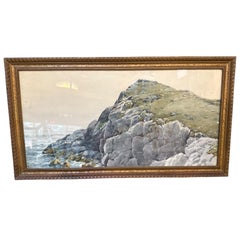
“Lake George” by Alfred Thompson Bricher (1837–1908) – Signed. Dated 1867
By Alfred Thompson Bricher
Located in Jacksonville, FL
“Lake George” by Alfred Thompson Bricher (1837–1908) – Oil on Board, Signed & Dated 1867
A luminous and tranquil landscape painting by Alfred Thompson Bricher (American, 1837–1908),...
Category
Late 19th Century American Realist Alfred Thompson Bricher Landscape Paintings
Materials
Watercolor
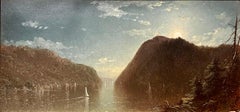
Oil Water Landscape with Mountains
By Alfred Thompson Bricher
Located in Fredericksburg, VA
Alfred Thompson Bricher, an American artist celebrated for his exquisite marine and landscape paintings, created "Boats Sailing Between Mountains." This piece exemplifies Bricher’s m...
Category
Late 19th Century Hudson River School Alfred Thompson Bricher Landscape Paintings
Materials
Paper, Oil
Related Items
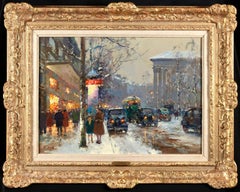
La Madeleine – Le Soir Impressionist Cityscape Oil Painting by Edouard Cortes
By Édouard Leon Cortès
Located in Marlow, Buckinghamshire
Signed figures in landscape circa 1950 by French impressionist painter Eduoard Cortes. The work depicts a view of La Madaleine, a Catholic parish church situated on Place de la Madel...
Category
Mid-20th Century Impressionist Alfred Thompson Bricher Landscape Paintings
Materials
Oil, Canvas
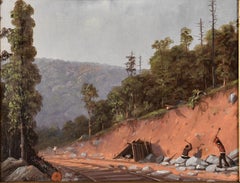
"Building the Allegheny Railroad, Pennsylvania" Alfred Wall, Scalp Level School
Located in New York, NY
Alfred S. Wall (American, 1825-1896)
Untitled (Building the Railroad), 1859
Oil on canvas
14 1/2 x 18 1/2 inches
Signed and dated lower left
For Christmas, 2008, the Pittsburgh Post-Gazette featured Alfred Wall's painting, Old Saw Mill from the collection of the Westmoreland Museum of American Art in Greensburg, PA. It was painted in 1851 in the town of Lilly, Pennsylvania in the Allegheny Mountains. The newspaper description stated that "though the saw mill is long gone, it still conveys all the warmth and coziness of this time of year. The article, written by Patricia Lowry, continued:
At first glance, Alfred S. Wall's painting of a saw mill in snowy woods triggers nostalgia for the coziness of a log cabin, the smell of a wood-burning fire and the warming of chilled hands and feet beside it.
But as sentimental as it seems on the surface, Mr. Wall's painting has a deeper and unexpected context.
This is more than a painting about sled-riding children and early industry planted in the middle of virgin forest. Intended or not, this is a painting about conquering the great divide of the Allegheny Mountains.
For the third consecutive year, the Post-Gazette features a winter-scene painting on the cover of the Christmas Day newspaper. This year's painting, Old Saw Mill, was selected by co-publisher and editor-in-chief John Robinson Block and executive editor David Shribman during a visit to the Westmoreland Museum of American Art in Greensburg.
Mr. Wall, listed as a portrait painter in the 1850 census, was about 26 when he painted Old Saw Mill in 1851. The self-taught artist was born in Mount Pleasant, Westmoreland County, to William and Lucy Wall, who'd emigrated from England around 1820. An artistic sensibility ran in the family: William was a sculptor who carved ornate tombstones here; Alfred's children, A. Bryan and Bessie, were landscape painters, as was Alfred's older brother, William Coventry Wall. For more than a century the Walls formed a prominent art dynasty in Pittsburgh, and Alfred, eventually a partner in the city's most prestigious art gallery, was well known as a painter, dealer and restorer.
In Old Saw Mill, two wood cutters, each holding an axe, meet outside the mill; one points in the direction of the forest. On the other side of the stream, one child pulls another down the hillside on a sled. Just behind the hill's slope, the roof of a building appears, perhaps the home of the sawyer. The luminous, late afternoon light comes from the northwest, casting lengthening shadows on the snow under a darkening sky.
The saw mill in "Old Saw Mill" likely would have been impossible to track down had Mr. Wall, presumably, not written on the back of the painting: "old saw mill near Jct. 4, Portage RR, Pa."
"There was no Junction 4," said Mike Garcia, park ranger at the Allegheny Portage Railroad National Historic Site, about 90 miles east of Pittsburgh near Gallitzen, Cambria County. "But there was an Inclined Plane No. 4 at Lilly, and there was a saw mill there."
In fact, there were at least six saw mills at Lilly over the years, said longtime resident Jim Salony, president of the Lilly-Washington Historical Society. But when he saw an image of the painting, Mr. Salony had no trouble coming up with a location. While there are no known photographs of the saw mill, he believes it stood near the intersection of Portage and Washington streets, next to Bear Rock Run.
Mr. Salony, retired academic dean at Mount Aloysius College, didn't know exactly when the mill was torn down, but it's been gone since at least the late 1800s. He was pleased to learn of the painting, even though that knowledge came too late for inclusion in a new book about Lilly, The Spirit of a Community, for which he served as primary author and editor. It runs to more than 700 pages. For a little town -- population 869 last year -- Lilly has a lot of history.
Nestled in a bowl on the western slope of the Allegheny Mountains about 3 miles south of Cresson, Lilly was first settled in 1806 by Joseph Meyer and his family, who named their 332-acre land patent Dundee. Although the Meyers had left by 1811, other settlers followed, but the community didn't flourish until the 1830s, when the Allegheny Portage Railroad began its 23-year-run through the town.
For 200 years the Alleghenies had stood as an impediment to trade and travel between Pittsburgh and the east. A canal from Philadelphia to Pittsburgh would change that and compete with New York's Erie Canal. But a portage railroad would have to be built, on which teams of horses would lead the canal boats over the mountains. Engineer Sylvester Welch began his surveying from the small settlement at Lilly. The railroad would require 10 inclined planes, some quite steep, between Hollidaysburg and Johnstown. To build it, trees had to be cut along a 120-foot-wide right-of-way for 36 miles, along which track and engine houses had to be built.
William Brown, who owned the saw mill on Bear Rock Run, built at least one of the engine houses at Inclined Plane No. 4; an 1834 contract also included fencing the dwelling lots at the head and foot of the plane. Lilly is located at what was the foot of Inclined Plane No. 4., giving the community one of its early informal names, Foot of Four.
Named in 1883 for Richard Lilly, who'd completed the grist mill there, Lilly had another early name: Hemlock, so dubbed by a Portage Railroad traveler who smelled the bark stripped from the trees at the saw mill.
Because there isn't another Allegheny Portage Railroad location like it, where a cut in the mountains opens into a bowl, Mr. Salony thinks it was Lilly that Charles Dickens wrote about following his trip from Harrisburg to Pittsburgh on the Pennsylvania Canal in late March 1842, describing what he saw after emerging from "the bottom of the cut": "It was very pretty while traveling, to look down into a valley full of light and softness, catching glimpses through the tree-tops of scattered cabins; children running to the doors; dogs bursting out to bark, who we could see without hearing; terrified pigs scampering homeward; families sitting out in their rude gardens; cows gazing upward with a stupid indifference; men in their shirt-sleeves looking on at their unfinished houses, planning out to-morrow's work; and we riding onward, high above them, like a whirlwind."
To get to Lilly, Mr. Wall may have taken the Pennsylvania Canal from his home in Allegheny City, now the North Side. He'd married young, at 21, to Sarah Carr in 1846, the same year he began his career as an artist. By 1880 they were living in a brick townhouse at 104 (later 814) Arch St., now demolished.
Across the river in Pittsburgh he shared a studio at 67 Fourth Ave. with his brother William; they later moved to Burke's Building, today the city's oldest office building at 209-211 Fourth. But often they worked outdoors, sometimes as part of the colony of artists that grew up around painter George Hetzel beginning in the late 1860s at Scalp Level...
Category
1850s Hudson River School Alfred Thompson Bricher Landscape Paintings
Materials
Canvas, Oil
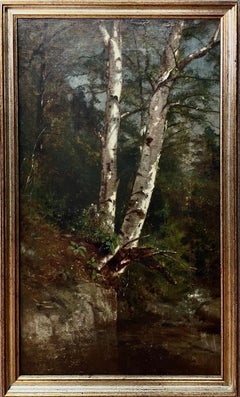
“Woodland Study”
Located in San Francisco, CA
Remarkably, this painting tells its own story on the verso. To save your eyesight, here's what it reveals: James McDougal Hart (1828-1901) Landscape, animal, and portrait painter.
A ...
Category
1860s Hudson River School Alfred Thompson Bricher Landscape Paintings
Materials
Canvas, Linen, Oil

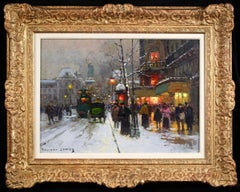
Place de la Republique - Le Soir - Impressionist Landscape Oil by Edouard Cortes
By Édouard Leon Cortès
Located in Marlow, Buckinghamshire
Signed impressionist oil on canvas landscape circa 1950 by sought after French painter Edouard Cortes. The work depicts an evening scene of the Place de la Republique square in Paris France. The ground, bare trees and buildings are covered in a dusting of white snow. The street lights are glowing and the Monument a la Republique is visible in the distance.
Signature:
Signed lower left
Dimensions:
Framed: 19"x24"
Unframed: 13"x18"
Provenance:
International Galleries - Chicago c. 1950
This work is included in the Catalogue Raisonne of the painters work "Edouard Cortes (1882-1969) : The Complete Works" Ref: EC001317
A photo certificate of authenticity accompanies the painting
Edouard Leon Cortes, the son of the painter Antonio Cortès, was sent to the front during World War I to sketch enemy positions. In civilian life, his base was in Lagny in the former studio of Cavallo-Peduzzi. Although he travelled extensively in France. Notably in Normandy, Brittany, the Champagne region and Savoy painting...
Category
1950s Impressionist Alfred Thompson Bricher Landscape Paintings
Materials
Oil, Canvas
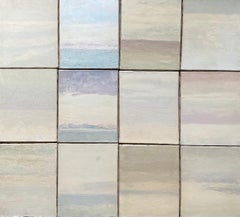
SET OF 12 OIL PAINTINGS - Mid 20th century French Impressionist Sky Clouds
Located in Cirencester, Gloucestershire
'Sky Scenes'
by Geneviève Zondervan (French 1922-2013)
set of 12 oil paintings on canvas
stamped and bottom right one dated 78'
each canvas: 10.75 x 9 inches
Think of the interior ...
Category
Late 20th Century Post-Impressionist Alfred Thompson Bricher Landscape Paintings
Materials
Oil
$3,897 Sale Price
20% Off
H 10.75 in W 9 in D 1 in
Hudson River Landscape by American Artist Johann Hermann Carmiencke (1810-1867)
By Johann Hermann Carmiencke
Located in New York, NY
Painted by Hudson River School artist Johann Hermann Carmiencke, "Hudson River Landscape" is oil on canvas and measures 12 x 18 inches. The painting is signed and dated 1865 at the l...
Category
19th Century Hudson River School Alfred Thompson Bricher Landscape Paintings
Materials
Canvas, Oil

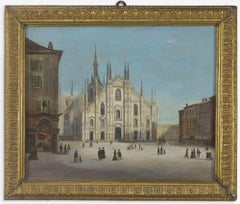
Duomo of Milan with Pesants- Oil Painting - 18th Century
Located in Roma, IT
Duomo of Milan with peasants is a modern artwork realized by an Italian Artist in 18th century.
Mixed colored oil on canvas
40x33cm with frame included.
Good conditions.
Category
18th Century Modern Alfred Thompson Bricher Landscape Paintings
Materials
Oil
$4,705
H 15.75 in W 13 in D 0.79 in
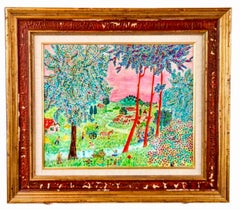
French Naive, Fauvist Oil on Panel Painting "Le Petit Clocher" Michel Loeb
Located in Surfside, FL
Michel Loeb (French, 1931- )
"Le Petit Clocher"
Oil on Panel Painting
Frame: 22.5" X 26"
Image: 14.5" X 17.75"
Hand signed bottom left
Oil on board Fauve painting of a French countryside scene with trees, farmers and houses.
Michel Loeb, 1930- painter, was born in Saint-Cloud. Lives and works in Luberon. Art naïf. Pointillist, Fauvist, Surrealist, Dadai artist, unclassifiable, highly original, unique art. His works radiate a light, a love of colors, of the absurd, of the funny, of the tender and of the poetic. French Naive art. Galerie Felix Vercel showed his work. Whether in color or black & white, in painting, sculpture or a lithograph print, the world of Michel Loeb is a poetic, joyful and exuberant paradise, where humor and fantasy are never far away. Extravagant works that sparkle like their iconoclastic author whose titles often say a lot. Each work is executed with great attention to detail, often under the magnifying glass, by this former jeweler, including its very large formats. Michel Loeb has drawn parallels to his masters of painting, facetious but always majestic winks and the desire for paintings in the style of Vincent Van Gogh, Paul Gauguin, Edward Hopper, Hokusai.
Michel Loeb is a painter born in Saint-Cloud. He first trained as a jeweler and diamond dealer like his father and painted as an amateur. He devoted himself to painting from 1970, after his meeting with the famous art dealer Félix Vercel, who then took him under contract and exhibited him in Paris, New York and Tokyo. Galerie Felix Vercel in Paris (Avenue Matignon) and New York (Madison Avenue) showed artists as Pablo Picasso, Fernand Leger, Armand Guillaumin, Maurice Utrillo and Claude Venard.
He is part of School of Paris artists that included Marcel Cosson, Jean Jansem, Claude Salomon, Michel Kouliche, Bernard Buffet, Bernard Lorjou, Jean Dufy, and others. Naive art was then in fashion and his work enjoyed great success; he has prepared no less than one exhibition per year since this period. Recently he had the opportunity to present his work in Provence, Oslo or Shanghai. Since 1988, he has settled in Oppède, in the Luberon, among vineyards, scrubland and olive groves where he draws his inspiration. His work is simimilar in its childish naive appeal and is reminiscent of Henri Maik and Gustavo Novoa. In the French tradition of Séraphine de Senlis, Ferdinand Cheval, Henri Rousseau, Louis Vivin...
Category
Mid-20th Century Fauvist Alfred Thompson Bricher Landscape Paintings
Materials
Oil, Panel
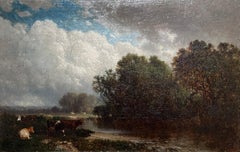
"Pastoral Landscape, " William Hart, Hudson River School, Cloudy View with Cows
By William Hart
Located in New York, NY
William Hart (1823 - 1894)
Pastoral Landscape, 1877
Oil on canvas
9 1/2 x 14 1/2 inches
Signed and dated lower left
Born in Paisley, Scotland, William Ha...
Category
1870s Hudson River School Alfred Thompson Bricher Landscape Paintings
Materials
Canvas, Oil
$15,000
H 19.5 in W 24.5 in
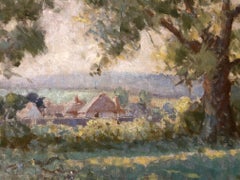
Edwardian Impressionist English Landscape Oil Painting of Findon, Sussex
By William Lee Hankey
Located in ludlow, GB
Edwadian early Twentieth Century Impressionist English Landscape Oil Painting of Findon, Sussex.
William Lee Hankey - Large Framed Oil Painting.
English Landscape with Sun dappled ...
Category
20th Century Impressionist Alfred Thompson Bricher Landscape Paintings
Materials
Oil
$4,453
H 20 in W 24 in D 2 in
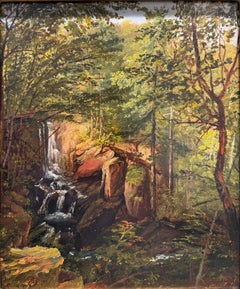
"Janetta Falls, New Jersey" Jasper F. Cropsey, Hudson River Wooded Landscape
By Jasper Francis Cropsey
Located in New York, NY
Jasper F. Cropsey
Janetta Falls, New Jersey, circa 1846
Signed J.F. Cropsey
Oil on canvas
12½ x 10¾ inches
Provenance
Private Collection, New York, 1930s
Thence by descent to the pr...
Category
1840s Hudson River School Alfred Thompson Bricher Landscape Paintings
Materials
Canvas, Oil
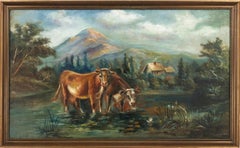
Large Scale Early 20th Century Bucolic Mt. Hood Landscape Oil Painting
By William M. Lemos
Located in Soquel, CA
Gorgeous landscape with two cows drinking water in a pond with Mt. Hood in background by listed artist William M. Lemos (American, 1861-1942). Signed "W.M. Lemos" lower right. Presented in vintage gilt-toned frame that shows wear (included as-is). Condition: Good: previously owned and used, with little or no signs of wear and is in good condition. No structural issues. Image size: 29"H x 49"W.
Born in New York, Professor Lemos moved to San Francisco in 1887 where he established a studio at 106 Geary Street. He later moved to Santa Cruz in 1896, where he settled, painting murals for many local businessmen and the Santa Cruz Beach Boardwalk.
As a boy Lemos earned money by wandering the streets and painting on request. Arriving in San Francisco in 1887, he established a studio at 106 Geary. With his wife Mabel, he worked in Los Angeles for a few years in the 1890s. After settling in Santa Cruz in 1896, he painted murals for many local businessmen. When the original Beach Casino was built there at the Boardwalk in 1904, Lemos was the first concessionaire and worked there for nearly 40 years. On his platform in the Casino, Lemos did paintings of redwoods, still lifes, forest fires, beach scenes, and marines. Many of his oils were done on redwood slabs which were popular with the tourists; in the early days these paintings sold for one dollar and up depending on the size of the work. After his vision failed and he was unable to paint, his last years were mostly spent fishing off the Municipal Pier with a friend who baited his hook for him because he could no longer see. In the March 27, 1941 Santa Cruz Sentinel News Lemos reminisced, "Them were the days when the Boardwalk was only twelve feet long and when business got slow I picked up my shotgun and went across the street and shot ducks where the Casa del Rey Hotel now stands." Exhibited: Calif. State Fair, 1885; Mechanics' Inst. (SF), 1889. In: Santa Cruz City Museum; Wawona Hotel (Yosemite).
Edan Hughes, "Artists in California, 1786-1940"
His mother was Julia Lemos, a Chicago artist famous for her depiction of the Chicago fire, “Two of Julia’s children became successful artists. Her eldest son, William, was a naïve still life, landscape, and mural painter. As a young boy in New York, he would wander the streets, earning money for the family, by ‘painting on request.’ At age 26, William moved to San Francisco, California. He opened an art studio and kept it running until he moved to Santa Cruz with his wife, Mabel, in 1896. During this period, he worked as a fresco artist painting ‘murals for many local businessmen.’
Exhibited California State Fair, Sacramento, 32nd annual, per Sacramento Daily Union, September 9, 1885. and article goes on to say “William Lemos and wife, Sacramento – Art school exhibits in which are shown such a variety of designs in decorative art, flower painting, and ornamentation, that one must give time to the examination.”
Exhibited Mechanics Institute, San Francisco, 1889.
“Lemos and his wife were in Fresno California 1890...
Category
Early 20th Century Hudson River School Alfred Thompson Bricher Landscape Paintings
Materials
Canvas, Oil, Stretcher Bars
$3,550
H 52.5 in W 32.5 in D 1.5 in
Previously Available Items
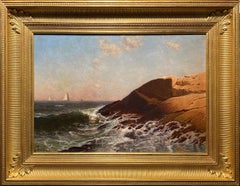
Rocky Coast, Narragansett Bay
By Alfred Thompson Bricher
Located in Milford, NH
A fine coastal seascape of Narragansett Bay, Rhode Island, by American artist Alfred Thompson Bricher (1837-1908). Bricher was a significant member of the second generation of Hudson River School landscape painters and was considered to be one of the last of the relevant American Luminists. Unlike his contemporaries who sketched and painted notable mountainous spots like the Adirondacks, the Catskills, the White Mountains, Lake George, and Lake Champlain, Bricher devoted his attention instead to painting the seashore and ocean. He painted views of Shinnecock, Narragansett, Chatham, Cape Cod, Southampton and of other various places along the Massachusetts and Maine coastlines. As a result, he is best known for his marine paintings, such as the present work, that depict New England shorelines and showcase the dynamic forces of the sea.
He was born in Portsmouth, New Hampshire, and became a businessman in Boston who, in his leisure hours, studied at the Lowell Institute in Boston and attended an academy in Newburyport, Massachusetts. By 1858 he became a professional artist and in the 1860s, he followed his contemporaries to the popular vistas of the White Mountains. There, particularly at North Conway, he studied and painted with Albert Bierstadt, William Morris Hunt, Gabriella Eddy, and Benjamin Champney. His paintings were exhibited at the Boston Athenaeum, the Boston Art Club, the National Academy of Design, the Brooklyn Art Association, the Pennsylvania Academy of the Fine Art, and the Art Institute of Chicago.
Oil on canvas, signed lower left, titled “Rocky Coast...
Category
19th Century American Realist Alfred Thompson Bricher Landscape Paintings
Materials
Canvas, Oil
Alfred Thompson Bricher landscape paintings for sale on 1stDibs.
Find a wide variety of authentic Alfred Thompson Bricher landscape paintings available for sale on 1stDibs. You can also browse by medium to find art by Alfred Thompson Bricher in oil paint, paint, canvas and more. Not every interior allows for large Alfred Thompson Bricher landscape paintings, so small editions measuring 19 inches across are available. Customers who are interested in this artist might also find the work of Ralph Albert Blakelock, William Trost Richards, and David Johnson. Alfred Thompson Bricher landscape paintings prices can differ depending upon medium, time period and other attributes. On 1stDibs, the price for these items starts at $80,000 and tops out at $95,000, while the average work can sell for $87,500.