Allen Tucker Landscape Drawings and Watercolors
American, 1866-1939
Exposure to the latest artistic currents at the 1913 Armory Show had a profound effect on Tucker's own artistic development, prompting him to move away from impressionism to a more subjective manner inspired by Post-Impressionism, especially the art of Vincent van Gogh. Tucker subsequently became one of the first American painters to experiment with pure color, spirited brushwork, and a heavily encrusted paint surface, prompting critics to dub him the "Van Gogh of America."1
A landscape specialist, Tucker's greatest delight was in painting the countryside of Maine and Massachusetts, the sea and coast of the East, and the Highlands of New Jersey. He was also drawn to scenes in France and Italy. As was the case with van Gogh, Tucker sought themes of solitude and isolation, favoring robust expanses of meadowland and mountain scenery, as well as inland forests. Both Tucker and van Gogh viewed trees as symbols of growth and renewal, and accordingly, portrayed them as dynamic, upward- shooting forms. He energized his compositions through bold juxtapositions of contrasting forms−foreground to background, dark to light−that have a dynamism drawn from his brushwork.
1 See, for example, James W. Lane, "Vincent in America: Allen Tucker," Art News, Vol. 38, December, 1939, pages 171-178.to
1
2
1
Overall Width
to
Overall Height
to
4
3
3
1
2
2
1
4
4
2
8
331
140
123
66
1
2
4
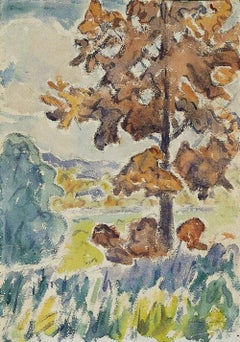
Artist: Allen Tucker
Watercolor of the Oak Tree by Allen Tucker
By Allen Tucker
Located in Hudson, NY
Landscape watercolor by Allen Tucker of an oak tree. This piece, along with several others, was gifted to Una Brage, a friend of the artist in the 1930s.
More about this artist:
Allen Tucker, was an architect and painter so influenced by Vincent Van Gogh that he was called "Vincent in America". (Gerdts 291) Robert Henri and Maurice Prendergast were also credited as having an influence on Tucker's brushwork and compositions, the latter decisively. However, as his painting evolved, he did not fit into any tidy slot for description and was known as an individualist not easily categorized in American art history.
Tucker was born in Brooklyn in 1866 and graduated from the School of Mines of Columbia University with a degree in architecture and took a job as an architectural draftsman in the architectural firm of McIvaine and Tucker, his fathers business. During that time, he studied painting at the Art Students League with Impressionist John H. Twachtman, but it was not until around 1904, when he was 38, that Tucker became a full-time painter, leaving architecture behind. Many of his early canvases were classically Impressionistic with poplar trees resembling those of Van Gogh and haystacks and corn shocks...
Category
Early 20th Century American Impressionist Allen Tucker Landscape Drawings and Watercolors
Materials
Paper, Watercolor
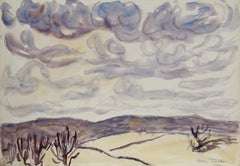
Western Landscape, Modern Watercolor by Allen Tucker 1931
By Allen Tucker
Located in Long Island City, NY
Artist: Allen Tucker, American (1866 - 1939)
Title: Western Landscape
Year: 1931
Medium: Watercolor on paper, signed and dated
Size: 14 in. x 20 in. (35.56 cm x 50.8 cm)
Category
1930s American Impressionist Allen Tucker Landscape Drawings and Watercolors
Materials
Watercolor
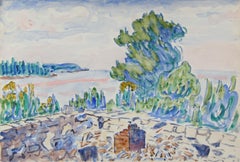
New England Landscape, Watercolor by Allen Tucker
By Allen Tucker
Located in Long Island City, NY
Artist: Allen Tucker, American (1866 - 1939)
Title: New England Landscape
Year: 1936
Medium: Watercolor, signed and dated
Size: 19 in. x 28 in. (...
Category
1930s American Impressionist Allen Tucker Landscape Drawings and Watercolors
Materials
Watercolor
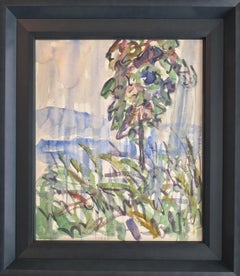
The Rainstorm a watercolor by Allen Tucker
By Allen Tucker
Located in Hudson, NY
Signed and dated "Allen Tucker 1930" lower left. Artwork measures 14" x 11 ¾" and framed 19" x 16 ½" x 2 ¼".
Provenance: Gift from the artist to his friend Una Brage, USA/Switzerland, in the 1930s
Estate of Ms. Brage to her friend Jean Corbett Peck, daughter of architect Harvey Wiley Corbett
By descent
About this artist: Allen Tucker, was an architect and painter so influenced by Vincent Van Gogh that he was called "Vincent in America". (Gerdts 291) Robert Henri and Maurice Prendergast were also credited as having an influence on Tucker's brushwork and compositions, the latter decisively. However, as his painting evolved, he did not fit into any tidy slot for description and was known as an individualist not easily categorized in American art history.
Tucker was born in Brooklyn in 1866 and graduated from the School of Mines of Columbia University with a degree in architecture and took a job as an architectural draftsman in the architectural firm of McIvaine and Tucker, his fathers business. During that time, he studied painting at the Art Students League with Impressionist John H. Twachtman, but it was not until around 1904, when he was 38, that Tucker became a full-time painter, leaving architecture behind. Many of his early canvases were classically Impressionistic with poplar trees resembling those of Van Gogh and haystacks and corn shocks...
Category
1930s Modern Allen Tucker Landscape Drawings and Watercolors
Materials
Paper, Watercolor
Related Items
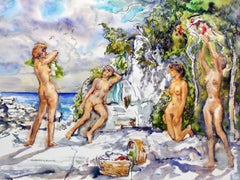
Nude Picnic Virgin Islands
By Robert Noel Blair
Located in Buffalo, NY
Robert Noel Blair (American, 1912-2003) was an American artist, painter, sculptor, printmaker and teacher. He is best known for his rural life & desert landscapes and World War II sc...
Category
1960s American Modern Allen Tucker Landscape Drawings and Watercolors
Materials
Archival Paper, Watercolor
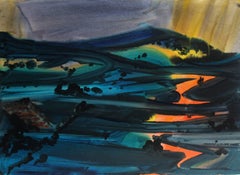
Rainstorm Sunset
By Robert Noel Blair
Located in Buffalo, NY
You are viewing a modernist American watercolor painting by Robert Noel Blair.
Robert Noel Blair (American, 1912-2003) was an American artist, painter, sculptor, printmaker and te...
Category
American Modern Allen Tucker Landscape Drawings and Watercolors
Materials
Paper, Watercolor
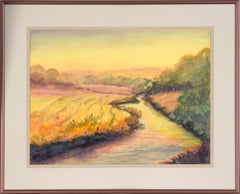
Golden Hour at the River - Watercolor Landscape on Paper
Located in Soquel, CA
Golden Hour at the River - Watercolor Landscape on Paper
Glowing sunset landscape by Rosalind O'Neal (American, b. 1927). A river winds winds towards the viewer, reflecting the glowing sunset. On the left bank, there are rows of crops in yellow and orange. On the right side, trees and shrubs line the bank. In the distance green and golden hills meet the sky.
Signed "Rosalind O'Neal" in the lower right corner.
Presented in a copper colored frame with a double mat.
Frame size: 17"H x 21"W
Image size: 12"H x 16"W
Rosalind O’Neal (American, b. 1927) was a longtime Ukiah, CA resident and a member of the Mendocino County Art Association. O’Neal was primarily a watercolor artist, focusing on portraits and landscapes, but has also worked in acrylic at times.
1997 - Ukiah Main Office Savings Bank of Mendocino County, Ukiah, CA
2003 - Savings Bank of Mendocino, Ukiah, CA
2004 - Mendocino County Art Association’s Golden Anniversary...
Category
21st Century and Contemporary American Impressionist Allen Tucker Landscape Drawings and Watercolors
Materials
Watercolor, Laid Paper

$500 Sale Price
20% Off
H 17 in W 21 in D 1 in
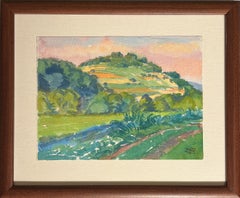
Mid Century "Napa Valley Landscape" Watercolor Painting
By Frederick Pomeroy
Located in Arp, TX
Frederick Pomeroy
"Napa Valley Landscape"
c. 1960s
Watercolor on paper
17"x14" brown wood frame float mount over linen mat
Signed in paint lower ...
Category
1960s American Modern Allen Tucker Landscape Drawings and Watercolors
Materials
Watercolor, Archival Paper
$600
H 14 in W 17 in D 0.5 in
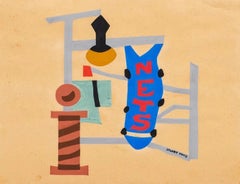
"NY Street Signs" Mid-20th Century WPA 1938 Modernist Abstract Realism Pop Art
By Stuart Davis
Located in New York, NY
"NY Street Signs" Mid-20th Century WPA 1938 Modernist Abstract Realism Pop Art
Stuart Davis (American, 1892-1964) "Street Signs" Modernist gouache and traces of pencil on paper in the proto-pop art style Davis is celebrated for, 1938, signed to lower right, framed. Image: 11 1/4 x 15 1/4 inches. Frame by Bark: 18 1/2 x 22 inches.
LITERATURE: A, Boyajian, M. Rutkowski, Stuart Davis, A Catalogue Raisonne, Vol. 2, New Haven, Connecticut, 2007, vol. II, p. 632, no. 1232, illustrated.
EXHIBITIONS: ACA Galleries, New York American Artists' Congress: Group Exhibition of Paintings and Sculpture, Dec. 3-16, 1939 (SDAB I, 12/3/39, p. 129). Outlines Gallery, Pittsburgh, Stuart Davis, Mar. 3-16, 1946. Coleman Art Gallery, Philadelphia, 5 Prodigal Sons: Former Philadelphia Artists: Ralston Crawford, Stuart Davis, Charles Demuth, Julian Levi, Charles Sheeler, Oct 4 - 30, 1947 (pamphlet), no. 12.
PROVENANCE: The artist; Mr. and Mrs. Frank Bowles, New York, Apr. 3, 1956; thence by descent, Private Collection, New York.
NOTES: According to the Catalogue Raissonne, "the title 'Street Signs' is recorded in the artist's account books...
Category
1930s American Modern Allen Tucker Landscape Drawings and Watercolors
Materials
Paper, Gouache, Pencil
$125,000
H 18.5 in W 22 in D 1 in
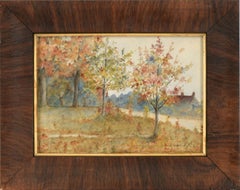
Autumn by the River - Landscape
Located in Soquel, CA
Serene landscape by J. B. Schock. Several trees line the banks of a river, bursting with fall colors. Across the river on the far bank, the roof and chimneys of a house can be seen beyond the trees. California painter...
Category
Early 20th Century American Impressionist Allen Tucker Landscape Drawings and Watercolors
Materials
Watercolor, Laid Paper
$380 Sale Price
20% Off
H 11 in W 14.25 in D 1 in
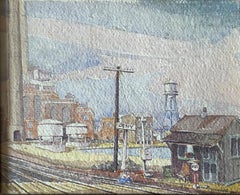
"Train Station, " Max Kuehne, Industrial City Scene, American Impressionism
By Max Kuehne
Located in New York, NY
Max Kuehne (1880 - 1968)
Train Station, circa 1910
Watercolor on paper
8 1/4 x 10 1/4 inches
Signed lower right
Provenance:
Private Collection, Illinois
Max Kuehne was born in Halle, Germany on November 7, 1880. During his adolescence the family immigrated to America and settled in Flushing, New York. As a young man, Max was active in rowing events, bicycle racing, swimming and sailing. After experimenting with various occupations, Kuehne decided to study art, which led him to William Merritt Chase's famous school in New York; he was trained by Chase himself, then by Kenneth Hayes Miller. Chase was at the peak of his career, and his portraits were especially in demand. Kuehne would have profited from Chase's invaluable lessons in technique, as well as his inspirational personality. Miller, only four years older than Kuehne, was another of the many artists to benefit from Chase's teachings. Even though Miller still would have been under the spell of Chase upon Kuehne's arrival, he was already experimenting with an aestheticism that went beyond Chase's realism and virtuosity of the brush. Later Miller developed a style dependent upon volumetric figures that recall Italian Renaissance prototypes.
Kuehne moved from Miller to Robert Henri in 1909. Rockwell Kent, who also studied under Chase, Miller, and Henri, expressed what he felt were their respective contributions: "As Chase had taught us to use our eyes, and Henri to enlist our hearts, Miller called on us to use our heads." (Rockwell Kent, It's Me O Lord: The Autobiography of Rockwell Kent. New York: Dodd, Mead and Co., 1955, p. 83). Henri prompted Kuehne to search out the unvarnished realities of urban living; a notable portion of Henri's stylistic formula was incorporated into his work.
Having received such a thorough foundation in art, Kuehne spent a year in Europe's major art museums to study techniques of the old masters. His son Richard named Ernest Lawson as one of Max Kuehne's European traveling companions. In 1911 Kuehne moved to New York where he maintained a studio and painted everyday scenes around him, using the rather Manet-like, dark palette of Henri.
A trip to Gloucester during the following summer engendered a brighter palette. In the words of Gallatin (1924, p. 60), during that summer Kuehne "executed some of his most successful pictures, paintings full of sunlight . . . revealing the fact that he was becoming a colorist of considerable distinction." Kuehne was away in England the year of the Armory Show (1913), where he worked on powerful, painterly seascapes on the rocky shores of Cornwall. Possibly inspired by Henri - who had discovered Madrid in 1900 then took classes there in 1906, 1908 and 1912 - Kuehne visited Spain in 1914; in all, he would spend three years there, maintaining a studio in Granada. He developed his own impressionism and a greater simplicity while in Spain, under the influence of the brilliant Mediterranean light. George Bellows convinced Kuehne to spend the summer of 1919 in Rockport, Maine (near Camden). The influence of Bellows was more than casual; he would have intensified Kuehne's commitment to paint life "in the raw" around him.
After another brief trip to Spain in 1920, Kuehne went to the other Rockport (Cape Ann, Massachusetts) where he was accepted as a member of the vigorous art colony, spearheaded by Aldro T. Hibbard. Rockport's picturesque ambiance fulfilled the needs of an artist-sailor: as a writer in the Gloucester Daily Times explained, "Max Kuehne came to Rockport to paint, but he stayed to sail." The 1920s was a boom decade for Cape Ann, as it was for the rest of the nation. Kuehne's studio in Rockport was formerly occupied by Jonas Lie.
Kuehne spent the summer of 1923 in Paris, where in July, André Breton started a brawl as the curtain went up on a play by his rival Tristan Tzara; the event signified the demise of the Dada movement. Kuehne could not relate to this avant-garde art but was apparently influenced by more traditional painters — the Fauves, Nabis, and painters such as Bonnard. Gallatin perceived a looser handling and more brilliant color in the pictures Kuehne brought back to the States in the fall. In 1926, Kuehne won the First Honorable Mention at the Carnegie Institute, and he re-exhibited there, for example, in 1937 (Before the Wind). Besides painting, Kuehne did sculpture, decorative screens, and furniture work with carved and gilded molding. In addition, he designed and carved his own frames, and John Taylor Adams encouraged Kuehne to execute etchings. Through his talents in all these media he was able to survive the Depression, and during the 1940s and 1950s these activities almost eclipsed his easel painting. In later years, Kuehne's landscapes and still-lifes show the influence of Cézanne and Bonnard, and his style changed radically.
Max Kuehne died in 1968. He exhibited his work at the National Academy of Design, the Art Institute of Chicago, the Carnegie Institute in Pittsburgh, the Memorial Art Gallery of the University of Rochester, and in various New York City galleries. Kuehne's works are in the following public collections: the Detroit Institute of Arts (Marine Headland), the Whitney Museum (Diamond Hill...
Category
1910s American Impressionist Allen Tucker Landscape Drawings and Watercolors
Materials
Paper, Watercolor
$2,800 Sale Price
20% Off
H 13.5 in W 15.5 in
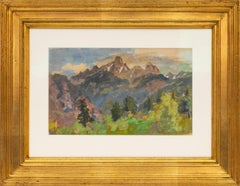
Charles Partridge Adams, Colorado Landscape Gouache, 20th-Century Plein Air Art
By Charles Partridge Adams
Located in Denver, CO
This original circa 1910s plein air field study by celebrated Colorado landscape painter Charles Partridge Adams (1858–1942) beautifully captures the tranquil majesty of the Rocky Mo...
Category
1910s American Impressionist Allen Tucker Landscape Drawings and Watercolors
Materials
Gouache
$1,880
H 13.75 in W 17.75 in D 0.75 in
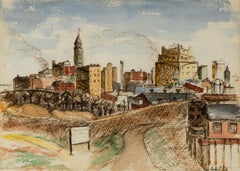
1950s Denver Skyline Painting – Graphite
Watercolor Colorado Cityscape Art
Located in Denver, CO
A captivating midcentury cityscape titled "Denver Skyline", this original 1950s watercolor and graphite painting offers a rare industrial-era view of lower downtown Denver, Colorado....
Category
1950s American Impressionist Allen Tucker Landscape Drawings and Watercolors
Materials
Watercolor, Graphite
$1,950
H 17.5 in W 21.5 in D 0.75 in
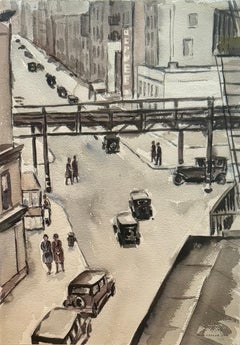
"6th Avenue El" American Scene Social Realism Mid-20th Century Cityscape Modern
By Max Arthur Cohn
Located in New York, NY
"6th Avenue El" American Scene Social Realism Mid-20th Century Cityscape Modern
Max Arthur Cohn (1903-1998)
6th Avenue Elevated
19 1/4 x 13 3/4 inches
Watercolor on paper
Signed an...
Category
1920s American Modern Allen Tucker Landscape Drawings and Watercolors
Materials
Paper, Watercolor
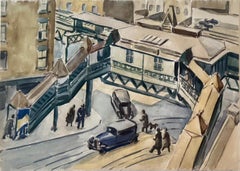
6th Avenue El at 8th St NYC Cityscape American Scene Social Realism Mid-Century
By Max Arthur Cohn
Located in New York, NY
6th Avenue El at 8th St NYC Cityscape American Scene Social Realism Mid-Century
Max Arthur Cohn (1903-1998)
6th Avenue El at 8th Street
13 x 18 inches
Watercolor on paper, c. 1930
...
Category
1930s American Modern Allen Tucker Landscape Drawings and Watercolors
Materials
Paper, Watercolor
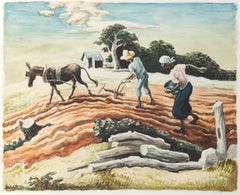
Planting (Spring Plowing) - Watercolor Landscape Painting with Figures, c. 1939
By Thomas Hart Benton
Located in Palm Desert, CA
"Planting (Spring Plowing)", a vibrant watercolor and graphite on paper by Thomas Hart Benton, circa 1939-40, embodies the artist's signature Regionalist style. The work depicts a ru...
Category
Mid-20th Century American Impressionist Allen Tucker Landscape Drawings and Watercolors
Materials
Paper, Watercolor, Graphite
Previously Available Items
Poplars, a watercolor by Allen Tucker
By Allen Tucker
Located in Hudson, NY
This 1930 watercolor by American artist and architect Allen Tucker is framed with museum quality, non-reflective glass and archival matting. It was gifted by the artist to his friend...
Category
1930s American Impressionist Allen Tucker Landscape Drawings and Watercolors
Materials
Paper, Watercolor
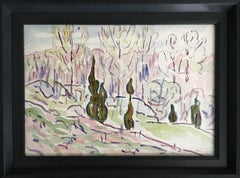
Allen Tucker landscape drawings and watercolors for sale on 1stDibs.
Find a wide variety of authentic Allen Tucker landscape drawings and watercolors available for sale on 1stDibs. You can also browse by medium to find art by Allen Tucker in paint, watercolor, paper and more. Much of the original work by this artist or collective was created during the 1930s and is mostly associated with the Impressionist style. Not every interior allows for large Allen Tucker landscape drawings and watercolors, so small editions measuring 12 inches across are available. Customers who are interested in this artist might also find the work of James March Phillips, Greta Allen, and Edith Isaac-Rose. Allen Tucker landscape drawings and watercolors prices can differ depending upon medium, time period and other attributes. On 1stDibs, the price for these items starts at $3,000 and tops out at $20,000, while the average work can sell for $8,500.