Anton Refregier Figurative Prints

American, 1905-1979

Anton Refregier was a painter and muralist active in Works Progress Administration Federal Art Project commissions, and in teaching art. He was a Russian immigrant to the United States. He is known, among other works, for his mural The History of California located in the Rincon Center, in downtown San Francisco, California. It depicts the state's history across 27 panels that he painted from 1940–48. The style of this historic mural had many of Refregier's key characteristics. The palette was composed of yellows, browns, and grays, punctuated by red in certain areas to evoke emotion. Earthy tones and the lack of bright colors remind viewers of the struggles and hardships he is depicting. Refregier also uses white to represent virtue in those inspired by a cause. His style is very flat and one-dimensional. Refregier uses solid blocks of color to denote shadows, along with depth and shade. His painting style appears to be very rudimentary and simple, but complex because of the way he uses color to evoke emotion and powerful images to tell a story. Refregier died in 1979 while in Moscow. Refregier was working on a mural for a medical center in his home city. The same year, his Rincon Mural was placed under the protection of the National Register of Historic Places.

to
1
1
Overall Width
to
Overall Height
to
2
11
859
382
367
310
2
1
1
2
1
1
1
1
1
2
Artist: Anton Refregier
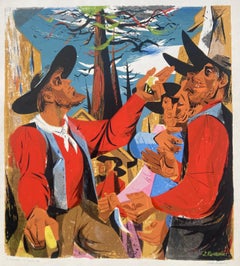
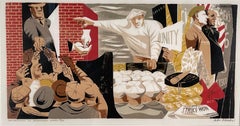
DISCOVERY OF GOLD - Very Large Serigraph - WPA Artist - California Murals
By Anton Refregier
Located in Santa Monica, CA
ANTON REFREGIER (1905 – 1979) DISCOVERY OF GOLD, 1949. Color serigraph. Signed and numbered in pencil, edition of 90. Image 23 ¼ x 21 ¾" Large sheet, 29 3/4 x 25 ¼”. Printed title...
Category

1940s American Modern Anton Refregier Figurative Prints

Materials

Screen

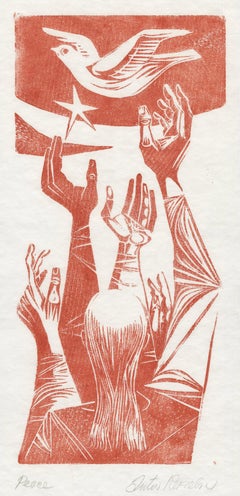
Peace
By Anton Refregier
Located in Fairlawn, OH
Peace Woodcut printed in orange red ink on japanese paper Signed and titled in pencil lower right (see photo) Titled lower left (see photo) Created along with an illustrated book project Song of Peace, 1950-1959. Condition: Excellent Image: 10 1/2 x 4 7/8" Sheet: 16 1/8 x 7"; Anton Refregier (March 20, 1905 – October 10, 1979) was a painter and muralist active in Works Progress Administration Federal Art Project commissions, and in teaching art. He was a Russian immigrant to the United States. Among his best-known works is his mural series The History of San Francisco, located in the Rincon Center in downtown San Francisco, California. It depicts the city's history across twenty seven panels that he painted from 1940 to 1948. Life and early career Refregier was born in Moscow and emigrated to the United States in 1920. After working various odd jobs in New York City, he earned a scholarship to the Rhode Island School of Design in 1921. After finishing school, Refregier moved back to New York in 1925. To earn a living, Refregier worked for interior decorators, creating replicas of François Boucher and Jean-Honoré Fragonard paintings...
Category

1950s American Modern Anton Refregier Figurative Prints

Materials

Woodcut

Related Items
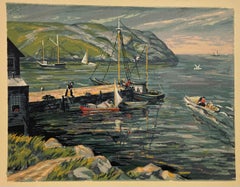
Harry Shokler, Island Harbor
By Harry Shokler
Located in New York, NY
Harry Shokler used serigraphy to great advantage in this landscape. It's colorful and detailed. It is signed in the image at the lower left. When printmakers began making serigraphs...
Category

1940s American Modern Anton Refregier Figurative Prints

Materials

Screen

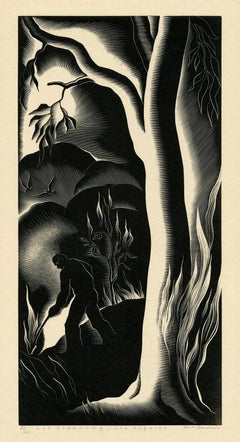
The Steps — WPA Era Graphic Modernism
By Fritz Eichenberg
Located in Myrtle Beach, SC
Fritz Eichenberg, 'The Steps', wood engraving, 1933, edition 200. Signed, titled, and annotated 'Ed. 200' in pencil. Initialed in the block, lower right. A superb, richly-inked impr...
Category

1930s American Modern Anton Refregier Figurative Prints

Materials

Woodcut

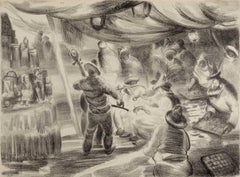
Wake on the Ferry.
By John French Sloan
Located in Storrs, CT
Wake on the Ferry. 1949. Etching. Morse catalog 313. state v. 5 x 7 (sheet 8 3/4 x 11 7/8). Edition of 350: 200 for the Art Students League and 150 for the artist. A fine impression ...
Category

1940s American Modern Anton Refregier Figurative Prints

Materials

Etching

Wake on the Ferry.
Wake on the Ferry.
$1,750 Sale Price
22% Off
H 16 in W 20 in D 0.5 in
Werner Drewes, Winter, 1933, modernist woodcut
By Werner Drewes
Located in New York, NY
A modernist fantasy winter scene created by Werner Drewes, this print brings key aspects of the period together. His cubist-inspired woodcut technique is utilized here to bring the s...
Category

1930s American Modern Anton Refregier Figurative Prints

Materials

Woodcut

Arnold Ronnebeck Lithograph "Silver Mine, Russell Gulch" Colorado Scene
By Arnold Rönnebeck
Located in Denver, CO
"Silver Mine, Russell Gulch (12/25)" is a striking black-and-white lithograph by German-born American Modernist Arnold Ronnebeck (1885–1947). This rare print depicts a historic minin...
Category

1930s American Modern Anton Refregier Figurative Prints

Materials

Lithograph

Original Continental Airlines limited edition Serigraph vintage travel poster
Located in Spokane, WA
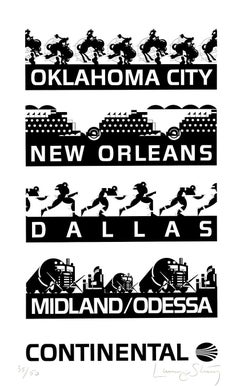
Original Continental Airlines travel poster. Linen backed in fine condition. Signed and numbered 35/50. This original Continental Airlines poster is an artistic representation of regional destinations prominently served by Continental Airlines in the past. The design is modern and bold, showcasing a unique black-and-white theme with strong, futuristic typography and graphical illustrations. Each city is creatively depicted using stylized imagery that resonates with its character—Oklahoma City features a cowboy motif, New Orleans embraces a jazzy, cultural essence, Dallas reflects the energy of movement, and Midland/Odessa highlights industrial and oil-centric themes. This limited-edition poster is printed in black and white. It features the destinations of Hawaii, San Francisco, Albuquerque and Portland Above each name is a design that represents each destination city. Hawaii has rows of palm trees and hula dancers. San Francisco has rolling hills and cable cars. Albuquerque has tribal Indians dancing. Portland has the cruise shipping. This image features the Saul Bass l967 Continental logo in the design. Continental Airlines was a major United States airline founded in 1934 and eventually headquartered in Houston, Texas. The airline was acquired by UAL Corporation, the parent company of United Airlines, on October 1, 2010. This is an original vintage Continental Airlines poster...
Category

Late 20th Century American Modern Anton Refregier Figurative Prints

Materials

Screen

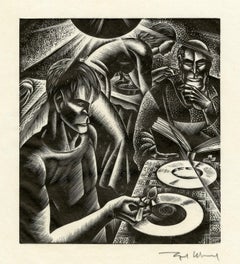
Stag
By Leonard Baskin
Located in San Francisco, CA
This artwork titled "Stag" 1957 is an original woodcut on laid paper by noted American artist Leonard Baskin, 1922-2000. It is hand signed and inscribed A.P. (Artist Proof) pencil by...
Category

Mid-20th Century American Modern Anton Refregier Figurative Prints

Materials

Woodcut

Stag
Stag
$650
H 12 in W 12 in D 0.6 in
Modern American Industrial Landscape
Located in Buffalo, NY
An original woodblock print dated 1965, titled "Our Town" but signed illegibly.
Category

1960s American Modern Anton Refregier Figurative Prints

Materials

Paper, Woodcut

Original 1973 Vail Village Colorado vintage travel and skiing poster
Located in Spokane, WA
Original 1973 Vail Village, Colorado vintage travel and skiing poster. Preservation linen-mounted in A- condition, ready to frame. Discover Vintage Vail Magic! Take a trip back i...
Category

1970s American Modern Anton Refregier Figurative Prints

Materials

Offset

The Pimp — Graphic Modernism
By Fritz Eichenberg
Located in Myrtle Beach, SC
Fritz Eichenberg, 'The Pimp', wood engraving, 1980, artist's proof before the edition. Signed in pencil. Signed in the block, lower right. A fine, richly-inked impression, on cream wove paper, with full margins (2 3/16 to 3 1/2 inches), in excellent condition. Archivally sleeved, unmatted. Image size 12 x 9 3/4 inches (305 x 248 mm); sheet size 18 x 14 inches (457 x 356 mm). ABOUT THE ARTIST Fritz Eichenberg (1901–1990) was a German-American illustrator and arts educator who worked primarily in wood engraving. His best-known works were concerned with religion, social justice, and nonviolence. Eichenberg was born to a Jewish family in Cologne, Germany, where the destruction of World War I helped to shape his anti-war sentiments. He worked as a printer's apprentice and studied at the Municipal School of Applied Arts in Cologne and the Academy of Graphic Arts in Leipzig, where he studied under Hugo Steiner-Prag. In 1923 he moved to Berlin to begin his career as an artist, producing illustrations for books and newspapers. In his newspaper and magazine work, Eichenberg was politically outspoken and sometimes wrote and illustrated his reporting. In 1933, the rise of Adolf Hitler drove Eichenberg, who was a public critic of the Nazis, to emigrate with his wife and children to the United States. He settled in New York City, where he lived most of his life. He worked in the WPA Federal Arts Project and was a member of the Society of American Graphic Artists. In his prolific career as a book illustrator, Eichenberg portrayed many forms of literature but specialized in works with elements of extreme spiritual and emotional conflict, fantasy, or social satire. Over his long career, Eichenberg was commissioned to illustrate more than 100 classics by publishers in the United States and abroad, including works by renowned authors Dostoyevsky, Tolstoy, Charlotte and Emily Brontë, Poe, Swift, and Grimmelshausen. He also wrote and illustrated books of folklore and children's stories. Eichenberg was a long-time contributor to the progressive magazine The Nation, his illustrations appearing between 1930 and 1980. Eichenberg’s work has been featured by such esteemed publishers as The Heritage Club, Random House, Book of the Month Club, The Limited Editions Club, Kingsport Press, Aquarius Press, and Doubleday. Raised in a non-religious family, Eichenberg had been attracted to Taoism as a child. Following his wife's unexpected death in 1937, he turned briefly to Zen Buddhist meditation, then joined the Religious Society of Friends in 1940. Though he remained a Quaker until his death, Eichenberg was also associated with Catholic charity work through his friendship with Dorothy Day...
Category

1980s American Modern Anton Refregier Figurative Prints

Materials

Woodcut

Original "Wagon Lits" pop art style serigraph travel by train poster
By Valerio Adami
Located in Spokane, WA
Original “Wagon Lits” serigraph poster by the artist Valerio Adami. It was printed in France by GrafiCaza (Michel Caza), one of the finest serigraph companies on woven paper—in exce...
Category

1990s American Modern Anton Refregier Figurative Prints

Materials

Screen

Modernist Silkscreen Screenprint El Station, Interior NYC Subway, WPA Artist
By Anthony Velonis
Located in Surfside, FL
screenprint printed in color ink on wove paper. New York City subway station interior. Anthony Velonis (1911 – 1997) was an American painter and designer born in New York City who helped introduce the public to silkscreen printing in the early 20th century. While employed under the federal Works Progress Administration, WPA during the Great Depression, Velonis brought the use of silkscreen printing as a fine art form, referred to as the "serigraph," into the mainstream. By his own request, he was not publicly credited for coining the term. He experimented and mastered techniques to print on a wide variety of materials, such as glass, plastics, and metal, thereby expanding the field. In the mid to late 20th century, the silkscreen technique became popular among other artists such as Robert Rauschenberg and Andy Warhol. Velonis was born into a relatively poor background of a Greek immigrant family and grew up in the tenements of New York City. Early on, he took creative inspiration from figures in his life such as his grandfather, an immigrant from the mountains in Greece, who was "an ecclesiastical painter, on Byzantine style." Velonis attended James Monroe High School in The Bronx, where he took on minor artistic roles such as the illustration of his high school yearbook. He eventually received a scholarship to the NYU College of Fine Arts, into which he was both surprised and ecstatic to have been admitted. Around this time he took to painting, watercolor, and sculpture, as well as various other art forms, hoping to find a niche that fit. He attended NYU until 1929, when the Great Depression started in the United States after the stock market crash. Around the year 1932, Velonis became interested in silk screen, together with fellow artist Fritz Brosius, and decided to investigate the practice. Working in his brother's sign shop, Velonis was able to master the silkscreen process. He reminisced in an interview three decades later that doing so was "plenty of fun," and that a lot of technology can be discovered through hard work, more so if it is worked on "little by little." Velonis was hired by Mayor LaGuardia in 1934 to promote the work of New York's city government via posters publicizing city projects. One such project required him to go on a commercial fishing trip to locations including New Bedford and Nantucket for a fortnight, where he primarily took photographs and notes, and made sketches. Afterward, for a period of roughly six months, he was occupied with creating paintings from these records. During this trip, Velonis developed true respect and affinity for the fishermen with whom he traveled, "the relatively uneducated person," in his words. Following this, Velonis began work with the Public Works of Art Project (PWAP), an offshoot of the Civil Works Administration (CWA), where he was assigned to serve the different city departments of New York. After the formation of the federal Works Progress Administration, which hired artists and sponsored projects in the arts, he also worked in theater. Velonis began working for the federal WPA in 1935. He kept this position until 1936 or 1938, at which point he began working in the graphic art division of the Federal Art Project, which he ultimately led. Under various elements of the WPA program, many young artists, writers and actors gained employment that helped them survive during the Depression, as well as contributing works that created an artistic legacy for the country. When interviewed in December 1994 by the Library of Congress about his time in the WPA, Velonis reflected that he had greatly enjoyed that period, saying that he liked the "excitement" and "meeting all the other artists with different points of view." He also said in a later interview that "the contact and the dialogue with all those artists and the work that took place was just invaluable." Among the young artists he hired was Edmond Casarella, who later developed an innovative technique using layered cardboard for woodcuts. Velonis introduced silkscreen printing to the Poster Division of the WPA. As he recalled in a 1965 interview: "I suggested that the Poster division would be a lot more productive and useful if they had an auxiliary screen printing project that worked along with them. And apparently this was very favorably received..." As a member of the Federal Art Project, a subdivision of the WPA, Velonis later approached the Public Use of Arts Committee (PUAC) for help in "propagandizing for art in the parks, in the subways, et cetera." Since the Federal Art Project could not be "self-promoting," an outside organization was required to advertise their art more extensively. During his employment with the Federal Art Project, Velonis created nine silkscreen posters for the federal government. Around 1937-1939 Velonis wrote a pamphlet titled "Technical Problems of the Artist: Technique of the Silkscreen Process," which was distributed to art centers run by the WPA around the country. It was considered very influential in encouraging artists to try this relatively inexpensive technique and stimulated printmaking across the country. In 1939, Velonis founded the Creative Printmakers Group, along with three others, including Hyman Warsager. They printed both their own works and those of other artists in their facility. This was considered the most important silkscreen shop of the period. The next year, Velonis founded the National Serigraph Society. It started out with relatively small commercial projects, such as "rather fancy" Christmas cards that were sold to many of the upscale Fifth Avenue shops...
Category

1980s American Modern Anton Refregier Figurative Prints

Materials

Screen

Previously Available Items
SAN FRANCISCO 34 WATERFRONT STRIKE
By Anton Refregier
Located in Portland, ME
Refregier, Anton (American, born Russia, 1905-1979). SAN FRANCISCO '34 WATERFRONT STRIKE. Screenprint in colors, 1949. Edition of 75. Signed in ink and numbered 47/75, with the Title...
Category

1940s Anton Refregier Figurative Prints

Materials

Screen

Deaths of Castillo and Calvo Sotelo (Spanish Civil War)
By Anton Refregier
Located in Myrtle Beach, SC
Anton Refregier, 'Deaths of Castillo and Calvo Sotelo' (Spanish Civil War), lithograph, c. 1936, edition 20. Numbered '17/20' in pencil. Signed 'REF.' ...
Category

1930s American Modern Anton Refregier Figurative Prints

Materials

Lithograph

Anton Refregier figurative prints for sale on 1stDibs.

Find a wide variety of authentic Anton Refregier figurative prints available for sale on 1stDibs. If you’re browsing the collection of figurative prints to introduce a pop of color in a neutral corner of your living room or bedroom, you can find work that includes elements of orange and other colors. You can also browse by medium to find art by Anton Refregier in woodcut print and more. Not every interior allows for large Anton Refregier figurative prints, so small editions measuring 7 inches across are available. Customers who are interested in this artist might also find the work of John DePol, Harry Sternberg, and Bob Pardo. Anton Refregier figurative prints prices can differ depending upon medium, time period and other attributes. On 1stDibs, the price for these items starts at $400 and tops out at $400, while the average work can sell for $400.

Recently Viewed

View All