Antonio Ferretti Bowls and Baskets
to
2
2
1
1
2
2
2
2
2
2
Height
to
Width
to
2
2
2
8
156
134
132
99
Creator: Antonio Ferretti
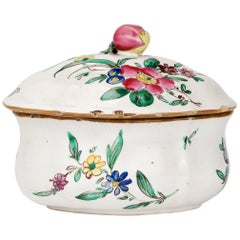
Italian Maiolica Ancient Sugar Bowl, Lodi, 1770-1780
By Antonio Ferretti
Located in Milano, IT
Maiolica sugar bowl
Antonio Ferretti Manufacture
Lodi, Circa 1770-1780
Maiolica polychrome decorated “a piccolo fuoco” (third fire).
It measures 3.54 x 4.52 x 3.54 in (9 x 11,5 x 9 cm)
Weight: 0.394 lb (0.179 kg)
State of conservation: small and slight chips on the edges.
The small sugar bowl has a swollen and ribbed body resting on a flat base. The cap-shaped lid follows the rib of the container and is topped with a small knob in the shape of a two-colored fruit.
The sugar bowl is painted “a piccolo fuoco” (third fire) with the characteristic floral motif of bunches and isolated semis.
An example which closely corresponds to this one is kept at the Civic Museum in Lodi (G. Gregorietti, Maioliche di Lodi, Milano e Pavia, Catalogo della Mostra, Milano, 1964 n. 137).
This decorative style represented a strong point of the Lodi factory, which established itself thanks to the vivid nature of the colors made possible by the introduction of a new technique perfected by Paul Hannong in Strasbourg and later introduced by Antonio Ferretti to Italy. The production process, called “piccolo fuoco” (third fire), allowed the use of a greater number of colors than in the past; in particular, the purple of Cassius, a red made from gold chloride, was introduced. Its use allowed for many more tones and shades, from pink to purple.
The Ferretti family started their maiolica manufacturing business in Lodi in 1725.
The forefather Simpliciano started the business by purchasing an ancient furnace in 1725 and, indeed, we have evidence of the full activity of the furnaces starting from April of the same year (Novasconi-Ferrari-Corvi, 1964, p. 26 n. 4). Simpliciano started a production of excellence also thanks to the ownership of clay quarries in Stradella, not far from Pavia. The production was so successful that in 1726 a decree of the Turin Chamber came to prohibit the importation of foreign ceramics, especially from Lodi, to protect internal production (G. Lise, La ceramica a Lodi, Lodi 1981, p. 59).
In its initial stages, the manufacture produced maolicas painted with the “a gran fuoco” (double fire) technique, often in turquoise monochrome, with ornamentation derived from compositional modules in vogue in Rouen in France. This was also thanks to the collaboration of painters like Giorgio Giacinto Rossetti, who placed his name on the best specimens next to the initials of the factory.
In 1748 Simpliciano made his will (Gelmini, 1995, p. 30) appointing his son Giuseppe Antonio (known as Antonio) as universal heir. After 1750, when Simpliciano passed away, Antonio was directly involved in the maiolica factory, increasing its fortunes and achieving a reputation on a European level. Particularly important was the aforementioned introduction in 1760 of the innovative “a piccolo fuoco” (third fire) processing, which, expanding the ornamental repertoire with Saxon-inspired floral themes, was able to commercially compete with the German porcelains that had one of its most renowned offerings in the naturalistic Deutsche Blumen. Antonio Ferretti understood and promoted this technique and this decoration, proposing it in a fresher and more corrective version, less linked to botanical tables, both with or without contour lines, as well as in purple or green monochrome. After efforts to introduce more industrial production techniques to the sector succeeded, even the Ferretti manufacture, in the last decade of the eighteenth century, started heading towards decline despite its attempts to adapt production to neoclassical tastes.
In 1796 the Napoleonic battle for the conquest of the Lodi bridge over the Adda definitively compromised the furnaces. Production resumed, albeit in a rather stunted manner, until Antonio's death on 29 December 1810. (M. L. Gelmini, pp. 28-30, 38, 43 sgg., 130-136 (for Simpliciano); pp. 31 sgg., 45-47, 142-192 (for Antonio).
Bibliography
G. Gregorietti, Maioliche di Lodi Milano e Pavia Catalogo della Mostra, Milano, 1964 n. 137;
C. Baroni, Storia delle ceramiche nel Lodigiano, in Archivio storico per la città e i comuni del circondario e della diocesi di Lodi, XXXIV (1915), pp. 118, 124, 142; XXXV (1916), pp. 5-8;
C. Baroni, La maiolica antica di Lodi, in Archivio storico lombardo, LVIII (1931), pp. 453-455;
L. Ciboldi, La maiolica lodigiana, in Archivio storico lodigiano, LXXX (1953), pp. 25 sgg.;
S. Levy, Maioliche settecentesche lombarde e venete, Milano 1962, pp. 17 sgg.;
A. Novasconi - S. Ferrari - S. Corvi, La ceramica lodigiana, Lodi 1964, ad Indicem; Maioliche di Lodi, Milano e Pavia (catal.), Milano 1964, p. 17;
O. Ferrari - G. Scavizzi, Maioliche italiane del Seicento e del Settecento, Milano 1965, pp. 26 sgg.;
G. C. Sciolla, Lodi. Museo civico, Bologna 1977, pp. 69-85 passim; G. Lise, La ceramica a Lodi, Lodi 1981;
M. Vitali, in Storia dell'arte ceramica...
Category
1770s Italian Rococo Antique Antonio Ferretti Bowls and Baskets
Materials
Maiolica
Two Pairs of Italian Maiolica Baskets, circa 1780
By Antonio Ferretti
Located in Milano, IT
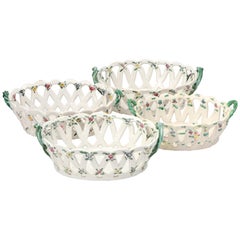
Two pairs of maiolica baskets
Antonio Ferretti Manufacture
Lodi, circa 1770-1790
Maiolica polychrome decorated “a piccolo fuoco” (third fire).
Measures: A) Height 3.54 x 6.69 x 9.84 in (9 x 17 x 25 cm);
B) Height 3.93 x 7.48 x 11.02 in (10 x 19 x 28 cm).
Total weight 4.85 lb (2.200 kg)
State of conservation:
A) One of the smaller baskets has some areas of restoration, the other slight chipping from use;
B) One of the larger baskets is intact and the other shows a clearly glued break.
The mold with which the baskets were forged simulates a wicker weave.
The two larger works have high, vertical walls, with branch-shaped handles penetrating the weave. The painted decorations, small polychrome flowers applied only externally, highlight the points where the weaves intersect.
The decision to leave the center of the basket devoid of decoration is highly unusual, but given the size and complexity of the shape, as well as the quality of the enamel, it is possible to hypothesize that it represents a precise choice in manufacturing or for a particular client.
The two smaller baskets have small, twisted handles and, on the outside, reproduce more decisively the characteristic wicker weave, obtained through thin molded lines. The interior exhibits a rich, typical decoration of naturalistic flowers: a bunch centered around a main flower and secondary stems accompanied by small “semis”. The exterior of these works is also adorned with small little flowers where the weaves intersect.
The size and morphological characteristics of the baskets confirm their attribution to the Lodi factory of Antonio Ferretti between 1770 and 1790, during its most successful period; by this point his original reworking of the "Strasbourg" decoration, known as "old Lodi", had achieved great fame even outside Italy.
This decorative choice represented a strong point of the Lodi factory, which established itself thanks to the vivid nature of the colors made possible by the introduction of a new technique perfected by Paul Hannong in Strasbourg and which Antonio Ferretti introduced in Italy. This production process, called “piccolo fuoco” (third fire), allowed the use of a greater number of colors than in the past; in particular, the purple of Cassius, a red made from gold chloride, was introduced. Its use allowed for many more tones and shades, from pink to purple.
The Ferretti family had started their maiolica manufacturing business in Lodi in 1725.
The forefather Simpliciano had started the business by purchasing an ancient furnace in 1725 and, indeed, we have evidence of the full activity of the furnaces from April of the same year (Novasconi-Ferrari-Corvi, 1964, p. 26 n. 4). Simpliciano had started a production of excellence also thanks to the ownership of clay quarries in Stradella, not far from Pavia. The production was so successful that in 1726 a decree of the Turin Chamber came to prohibit the importation of foreign ceramics, especially from Lodi, to protect internal production (G. Lise, La ceramica a Lodi, Lodi 1981, p. 59).
In its initial stages, the manufacture produced maolicas painted with the “a gran fuoco” (double fire) technique, often in turquoise monochrome, with ornamentation derived from compositional modules in vogue in Rouen in France. This was also thanks to the collaboration of painters like Giorgio Giacinto Rossetti, who placed his name on the best specimens next to the initials of the factory.
In 1748 Simpliciano made his will (Gelmini, 1995, p. 30) appointing his son Giuseppe Antonio (known as Antonio) as universal heir. After 1750, when Simpliciano passed away, Antonio was directly involved in the maiolica factory, increasing its fortunes and achieving a reputation on a European level. Particularly important was the aforementioned introduction in 1760 of the innovative “a piccolo fuoco” (third fire) processing, which, expanding the ornamental repertoire with Saxon-inspired floral themes, could commercially compete with the German porcelains that had one of its most renowned offerings in the naturalistic Deutsche Blumen. Antonio Ferretti understood and promoted this technique and this decoration, proposing it in a fresher and more corrective version, less linked to botanical tables...
Category
1770s Italian Neoclassical Antique Antonio Ferretti Bowls and Baskets
Materials
Maiolica
Related Items
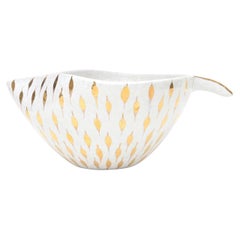
Vintage Aldo Londi For Bitossi Feather Plume Ceramic Bowl White And Gold Italian
Located in North Miami, FL
This sculptural vintage Italian Aldo Londi for Bitossi ceramic bowl or vessel has gold painted teardrop like surround shapes on the exterior over ...
Category
1960s Italian Mid-Century Modern Vintage Antonio Ferretti Bowls and Baskets
Materials
Ceramic

$641
H 5 in W 12.5 in D 10 in
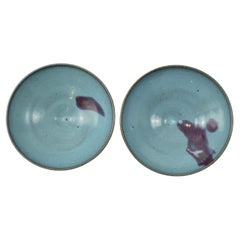
Pair of Chinese Jun Ware Bowls, Yuan Dynasty
Located in Houston, TX
Pair of Chinese Jun ware bowls, Yuan dynasty (circa 1250-1400): Large Jun Yao, purple splashed stone ware bowl Yuan Dynasty, China. Well potted, on a neatly cu...
Category
15th Century and Earlier Chinese Antique Antonio Ferretti Bowls and Baskets
Materials
Porcelain, Stoneware
Mado Jolain Signed Ceramic, circa 1950, France
By Mado Jolain
Located in Brussels, BE
Nice Mado Jolain vide-poche ceramic, circa 1950, France.
Enameled white earthenware, pale creamy yellow, grey and black decor.
Signed underneath.
Dimens...
Category
1950s French Mid-Century Modern Vintage Antonio Ferretti Bowls and Baskets
Materials
Earthenware
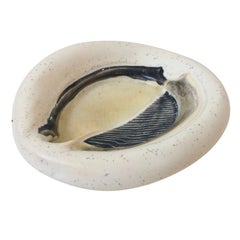
Guido Gambone Stoneware Bowl Donkey Mark Signature, Italy, 1950s
By Guido Gambone
Located in Munich, DE
Huge ceramic bowl by Guido Gambone with brown and orange glaze.
Signed on the bottom with the donkey mark.
Guido Gambone (1909 – 1969) is one of ...
Category
1950s Italian Mid-Century Modern Vintage Antonio Ferretti Bowls and Baskets
Materials
Stoneware

Spanish Painted Terracotta Bowl
Located in Los Angeles, CA
Stunning terracotta bowl from Spain, 1960's. Beautiful blue and green painted detail with etched fish design and etched wavy edge detailing. Great vintage condition. Can be hung on a...
Category
Mid-20th Century French Antonio Ferretti Bowls and Baskets
Materials
Ceramic
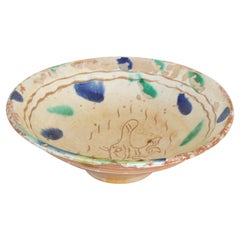
Georgian Mason
s Ironstone Dish or Plate in Bamboo
Basket Pattern, circa 1817
By Mason
s Ironstone
Located in Lincoln, Lincolnshire
This is a very decorative dish or plate by Mason's Ironstone, Lane Delph, England in the Bamboo and Basket pattern, dating to the early 19th century, Georgian period, circa 1813-1820.
The plate or dish is fairly deep and circular in shape with a notched rim.
It is decorated in one of Mason's boldly colored chinoiserie...
Category
Early 19th Century English Chinoiserie Antique Antonio Ferretti Bowls and Baskets
Materials
Ironstone
$327
H 1.15 in Dm 8.07 in
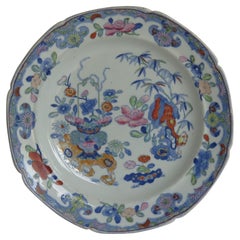
Mid-Century Fratelli Fanciullacci Italy Bowl
By Fratelli Fanciullacci
Located in Waddinxveen, ZH
Stunning and vibrant bowl with sgrafitto and hand-painted colored glossy pattern of stylised women. On the base is painted Italy 7892.
Fratelli Fanciullacci Pottery: during the fi...
Category
Mid-20th Century Italian Mid-Century Modern Antonio Ferretti Bowls and Baskets
Materials
Ceramic
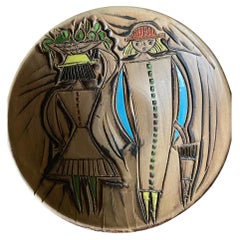
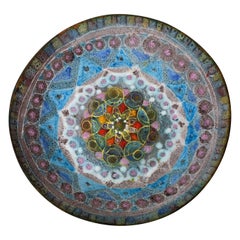
Italian Fantoni Style Salt Glaze Ceramic Bowl Mid-Century Modern Blue, Purple
Located in North Miami, FL
The beautiful pattern and intricacies of this geometric textural vintage Italian salt glaze ceramic vintage bowl has great influence and style of the work...
Category
1950s Italian Mid-Century Modern Vintage Antonio Ferretti Bowls and Baskets
Materials
Ceramic
$2,650
H 2.85 in Dm 13.85 in
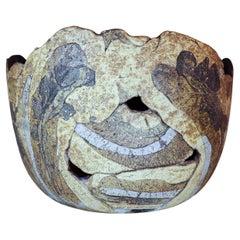
Large Ceramic Bowl / Fruit Basket - Attributed to Francesca Mascitti-Lindh
By Francesca Mascitti Lindh
Located in Stockholm, SE
A beautiful, generously sized bowl—perfect as a fruit basket on a large table. The piece is in excellent condition, with only minor surface scratches. While I haven’t found a signatu...
Category
2010s Finnish Scandinavian Modern Antonio Ferretti Bowls and Baskets
Materials
Ceramic, Stoneware
$1,016
H 7.68 in Dm 10.83 in
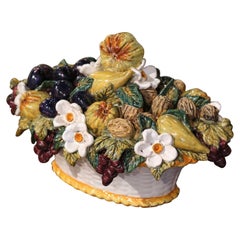
Mid-Century French Hand Painted Barbotine Ceramic Fruit Basket Centerpiece
Located in Dallas, TX
Decorate a tabletop with this colorful, majolica basket composition. Crafted in France circa 1960, the centerpiece features a realistic assortment of fruits and vegetables in high re...
Category
Mid-20th Century French Antonio Ferretti Bowls and Baskets
Materials
Ceramic, Majolica
$1,000
H 10 in W 16 in D 10.5 in
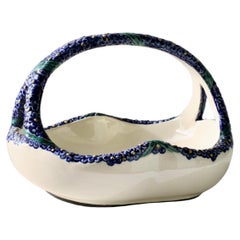
Wilhelm Süß for Karlsruher Majolika Art Nouveau Blue Flower Basket Bowl c. 1910
By Karlsruher Majolika
Located in Landau an der Isar, Bayern
Wonderful Art Nouveau large ceramic handled bowl or basket by German artist/designer Wilhelm Süß for Karlsruhe Majolika (Majolica) circa 1910. He was one of their top designers at th...
Category
Early 20th Century German Art Nouveau Antonio Ferretti Bowls and Baskets
Materials
Ceramic, Majolica
$1,016
H 6.5 in W 8.86 in D 7.68 in
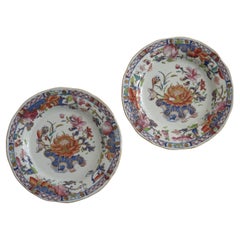
Fine PAIR of Georgian Mason
s Ironstone Plates in Water Lily Pattern, circa 1818
By Mason
s Ironstone
Located in Lincoln, Lincolnshire
These are a very good PAIR of early Mason's Ironstone pottery Desert Plates or Dishes in the very decorative Water Lily pattern, produced by the Mason's factory at Lane Delph, Staffo...
Category
Early 19th Century English Chinoiserie Antique Antonio Ferretti Bowls and Baskets
Materials
Ironstone
$580 / set
H 1.1 in Dm 8.5 in
Antonio Ferretti bowls and baskets for sale on 1stDibs.
Antonio Ferretti bowls and baskets are available for sale on 1stDibs. These distinctive items are frequently made of maiolica and are designed with extraordinary care. There are many options to choose from in our collection of Antonio Ferretti bowls and baskets, although beige editions of this piece are particularly popular. Many of the original bowls and baskets by Antonio Ferretti were created in the Rococo style in italy during the 18th century and earlier. Prices for Antonio Ferretti bowls and baskets can differ depending upon size, time period and other attributes — on 1stDibs, these items begin at $1,602 and can go as high as $4,271, while a piece like these, on average, fetch $2,936.