Archie Rand Paintings
to
1
Overall Width
to
Overall Height
to
1
1
1
1
1
1
1
1
781
713
712
689
1
Artist: Archie Rand
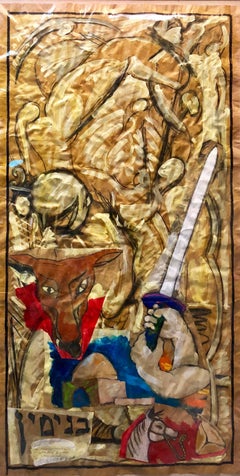
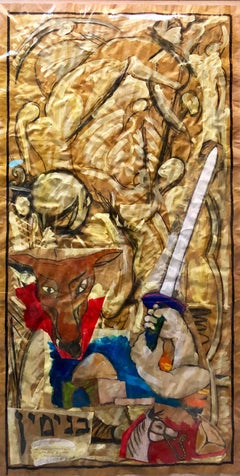
Tribe of Benjamin, Large Judaica Mixed Media Collage Painting
By Archie Rand
Located in Surfside, FL
Tribe of Benjamin, Biblical mural with wolf. I believe this is a study for a stained glass window. Untitled, mixed media on paper, signed lower left, inscribed "To my dear friend Dav...
Category
1980s American Modern Archie Rand Paintings
Materials
Paint, Paper, Mixed Media
Related Items
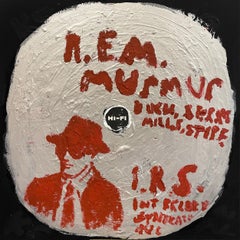
R.E.M. - Murmur (Grammy, Album Art, Iconic, Rock and Roll, Pop, Legendary)
By Kerry Smith
Located in Kansas City, MO
Kerry Smith
R.E.M. - Murmur
Mixed Media on Crescent board
Year: 2022
Size: 21x20in
Signed, dated by hand
COA provided
Ref.: 924802-1633
*Black frame with a mirror-gloss finish avail...
Category
2010s American Modern Archie Rand Paintings
Materials
Mixed Media, Acrylic, Gouache, Board

$888 Sale Price
25% Off
H 21 in W 22 in D 1 in
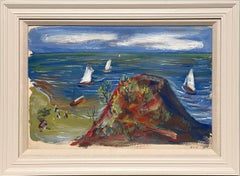
A Sunny 1948 Modern Lake Michigan Beach Scene by Chicago Artist, Harold Haydon
By Harold Haydon
Located in Chicago, IL
A charming, colorful 1948 Mid-Century Modern beach scene by notable Chicago artist, Harold Haydon. Depicting a sunlit beach scene with bathers and sailboats painted along the sandy ...
Category
1940s American Modern Archie Rand Paintings
Materials
Paper, Oil
$850
H 16 in W 21 in D 1 in
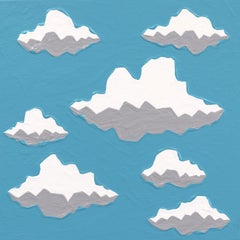
Cloud Over - Vibrant Blue Southwest Skyscape Landscape Pop Art Original Painting
By Will Beger
Located in Los Angeles, CA
Will Beger and his contemporary-minimalist paintings, take on an entirely unique approach to southwest art. Influenced by his youth and inspired by nature, he effortlessly captures a...
Category
21st Century and Contemporary American Modern Archie Rand Paintings
Materials
Mixed Media, Acrylic, Wood Panel
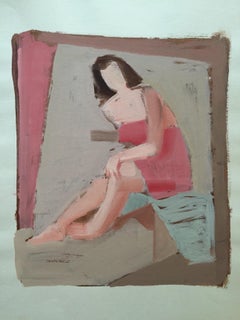
1950s "Pink Towel 2" Mid Century Nude Gouache Painting
Located in Arp, TX
From the estate of Jerry Opper & Ruth Friedman Opper
Yellow
c. 1950's
Gouache on Paper
15" x 18", Unframed
*Custom framing available for additional charge. Please expect framing time between 3-5 weeks.
From the estate of Ruth Friedmann Opper & Jerry Opper. Ruth was the daughter of Bauhaus artist, Gustav Friedmann.
San Francisco Abstract Expression
A free-spirited wave of creative energy swept through the San Francisco art community after World War II. Challenging accepted modes of painting, Abstract Expressionists produced highly experimental works that jolted the public out of its postwar complacency.
Abstract Expressionism resulted from a broad collective impulse rather than the inspiration of a small band of New York artists. Documenting the interchanges between the East and West Coasts, she cites areas of mutual influence and shows the impact of San Francisco on the New York School, including artists such as Mark Rothko and Ad Reinhardt. San Francisco's Beat poets...
Category
Mid-20th Century American Modern Archie Rand Paintings
Materials
Paper, Gouache
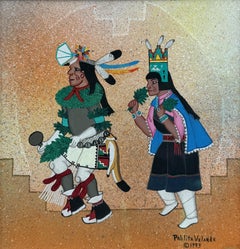
"Two Pueblo Dancers, Santa Clara" Pablita Velarde, New Mexico Native American
Located in New York, NY
Pablita Velarde
Two Pueblo Dancers, Santa Clara, 1993
Signed and dated lower right
Casein on paper
7 1/2 x 7 1/4 inches
Provenance
Adobe Gallery, New Mexico
Private Collection, Texa...
Category
1990s American Modern Archie Rand Paintings
Materials
Paper, Casein
$5,500
H 15.75 in W 15.75 in
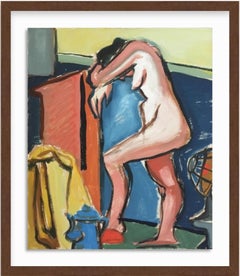
1950s "Too Much" Mid Century Nude Gouache Painting
Located in Arp, TX
From the estate of Jerry Opper & Ruth Friedman Opper
Too Much
c. 1940-1950's
Gouache on Paper
15" x 18", framed wood gallery frame float mount 21.5"x19.5"
From the estate of Ruth Friedmann Opper & Jerry Opper. Ruth was the daughter of Bauhaus artist, Gustav Friedmann.
San Francisco Abstract Expression
A free-spirited wave of creative energy swept through the San Francisco art community after World War II. Challenging accepted modes of painting, Abstract Expressionists produced highly experimental works that jolted the public out of its postwar complacency.
Abstract Expressionism resulted from a broad collective impulse rather than the inspiration of a small band of New York artists. Documenting the interchanges between the East and West Coasts, she cites areas of mutual influence and shows the impact of San Francisco on the New York School, including artists such as Mark Rothko and Ad Reinhardt. San Francisco's Beat poets...
Category
Mid-20th Century American Modern Archie Rand Paintings
Materials
Paper, Gouache
$760 Sale Price
41% Off
H 21.5 in W 19.5 in D 1 in
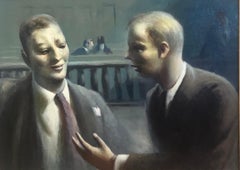
Guy Pene du Bois WPA American Modernism Realism NYC Scene Oil Lawyers in Court
By Guy Pène Du Bois
Located in New York, NY
Guy Pene du Bois' "Two Figures in Courtroom" is a WPA era American scene oil painting created in a realistic style. Modernism at its best The work is framed by Heydenryk.
Pène du Bois descended from French immigrants who settled in Louisiana in 1738 and was raised in a Creole household. He was born in 1884 in Brooklyn, NY and first studied with William Merritt Chase at the New York School of Art and later continued his training with Robert Henri. Pène du Bois was greatly impressed with Henri's credo that "real life" was subject matter for art and throughout his life a realist philosophy informed his art as well as his parallel career, art criticism. In 1905, Pène du Bois made his first visit to Paris where he painted scenes of fashionable people in cafes rendered in the dark tonalities and impasto associated with the Ashcan School. By 1920, he had achieved his mature style, which was characterized by stylized, rounded, almost sculptural figures painted with invisible brushstrokes. The subjects of his paintings were often members of society whom he gently satirized.
In 1924, Pène du Bois and his wife, Floy, left for France where they would remain until 1930. Returning to America showcases pictures the artist produced after this very productive period abroad. After five years of living in France, Pène du Bois was able to observe American life with fresh eyes. His work becomes more psychologically intense and less satirical. In Girl at Table a slender, blond is shown gazing at a small statue that she holds at arm's distance. The meaning is elusive, but a powerful sense of longing is evoked. Similarly, paintings such as Dramatic Moment and Jane are taut with unresolved dialogue. Both pictures depict mysterious interiors in which a lone woman anxiously awaits the denouement of a suspenseful scene. Other pictures, for example, Chess Tables, Washington Square and Bar, New Orleans, recall Pene du Bois's Ashcan origins in their depiction of urban entertainment.
During this period, landscape becomes an important subject for Pène du Bois. Girl Sketching...
Category
1930s American Modern Archie Rand Paintings
Materials
Paper, Oil, Board
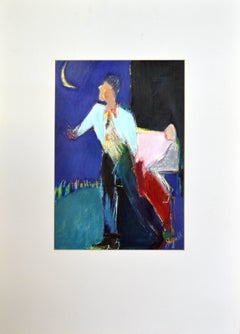
Man With Moon - Figurative Abstract
By J Gold
Located in Soquel, CA
Compelling abstract figurative oil painting in bold, primary colors of a man and the moon by J. Gold (American, 20th Century). Signed "J. Gold" lower right. Presented in a Maple woo...
Category
1980s American Modern Archie Rand Paintings
Materials
Paper, Oil
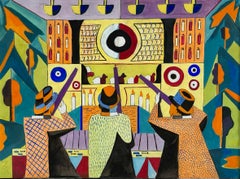
Shooting Gallery Mid 20th Century American Scene Social Abstract Realism Modern
Located in New York, NY
Shooting Gallery Mid 20th Century American Scene Social Abstract Realism Modern
*William Kienbusch (1914 – 1980)
Shooting Gallery, Sixth Avenue
Post...
Category
1940s American Modern Archie Rand Paintings
Materials
Paint, Paper
$15,000
H 23 in W 28 in D 43 in
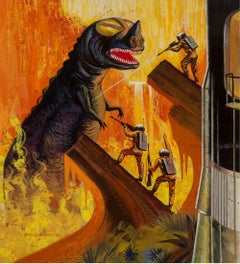
Godzilla like Dinosaur Monster, SciFi, Science Fiction Cover Illustration
By Paul Wenzel
Located in Miami, FL
Beautiful Godzilla like monster illustration from 1961. Wenzel was a prolific Disney Artist for decades. The work is beautifully matted and framed and lookes better in person.
Category
1960s American Modern Archie Rand Paintings
Materials
Mixed Media, Gouache
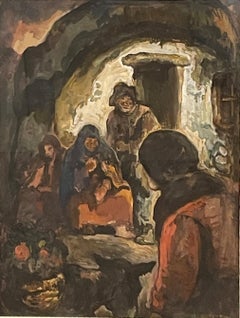
"In Foreign Parts" Eugene Higgins, Southwestern Pueblo, Modern Figurative
By Eugene Higgins
Located in New York, NY
Eugene Higgins
In Foreign Parts, circa 1913
Signed lower right
Watercolor on paper
Sight 17 x 13 inches
Born William Victor Higgins in 1884 to a Shelbyville, Indiana farm family where the only art Victor was aware of as a child was his father's love of flowers. "He loved their forms and their colors, and he tended his garden as a painter might work a canvas." At the age of nine, Victor met a young artist who traveled the Indiana countryside painting advertisements on the sides of barns. He purchased paints and brushes so the young Higgins could practice his own artwork on the inside of his father's barn. He also taught Victor about art museums and especially about the new Chicago Art Institute. This information never left the young artist, and he saved his allowance until his father allowed him at the age of fifteen to attend Chicago Art Institute. He worked a variety of jobs to finance his studies both there and at the Academy of Fine Arts.
Victor Higgins traveled to New York in 1908, where he met Robert Henri, who became a significant influence by depicting every-day scenes and stressing the importance of the spirit and sense of place as important factors in painting. Higgins was also greatly affected by the New York Armory Modernism Show of Marsden Hartley in 1913.
While Victor Higgins was in Chicago he met former mayor and avid collector Carter H. Harrison who was to prove instrumental in the growth of Higgins career for several years. Harrison agreed to support Higgins for four years to go to Paris and Munich and paint and study in the great museums in Europe. While at the Academie de la Grande Chaumier in Paris (1910-1914) he met Walter Ufer, who was another Chicago artist being sponsored by Carter Harrison. This meeting was not only a life-long friendship, but the beginning of a great change in the way Higgins looked at "American" art. He decided that America needed it's own authentic style rather than the 19th Century classic style he was taught in Europe. Very soon after returning to Chicago in 1914, Harrison sent him and Walter Ufer on a painting trip to Taos, New Mexico for a year in exchange for paintings. Higgins made other similar agreements and was able to support himself with his painting. This trip was a life-changing experience and introduced Higgins to the authentic America he had been looking for.
In 1914 Taos was an isolated village about twelve hours from Santa Fe on an impossible dirt road. But the colorful life of the pueblo people and the natural beauty drew a collection of artists who became the Taos art colony, from which the Taos Society of Artists was founded in 1915. Victor Higgins became a permanent resident within a year of his arrival and a member of the society in 1917, exhibiting with Jane Peterson in 1925 and with Wayman Adams and Janet Scudder in 1927. The members would travel around the country introducing the Southwest scenes with great success. He remained a member until the Society's dissolution in 1927. Higgins was the youngest member of the group of seven. Other members were Joseph Henry Sharp, Bert Phillips...
Category
1910s American Modern Archie Rand Paintings
Materials
Paper, Watercolor
$1,500
H 22.5 in W 18.5 in
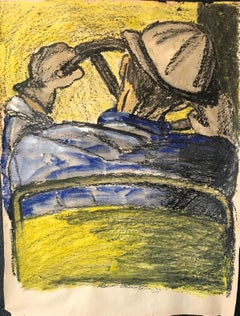
Mid Century "Driver with Hard Hat" Gouache and Oil Pastel Figurative 1960s SF
By Gloria Dudfield
Located in Arp, TX
Gloria Dudfield
Driver with Hard Hat
1960s
Gouache and Oil Pastel on Paper
27"x36" unframed
Gloria (Fischer) Dudfield
July 12, 1922 – May 27, 2015
Came from...
Category
Mid-20th Century American Modern Archie Rand Paintings
Materials
Paper, Oil Pastel, Gouache
$700
H 36 in W 27 in D 0.5 in
Previously Available Items
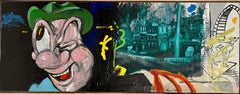
Large Archie Rand Abstract Expressionist Cartoon Oil Painting Dusseldorf
By Archie Rand
Located in Surfside, FL
"Dusseldorf, Germany" 1993, oil on canvas, hand signed and dated lower left,
Canvas (unframed):18 X 48. framed: 19.5 X 49.5
Provenance: directly from the artist. Exhibited at Phyllis Kind Gallery in NYC in 1987.
Archie Rand (American, born 1949) is an artist from Brooklyn, New York.
Rand's work as a painter and muralist is held in the collections of the San Francisco Museum of Modern Art, the Art Institute of Chicago, the Victoria and Albert Museum in London, the Bibliothèque Nationale de France in Paris, and the Tel Aviv Museum of Art.
His graphic works and books are held by the Metropolitan Museum Of Art, the Museum of Modern Art, the Whitney Museum of American Art, the Art Institute Of Chicago, The Brooklyn Museum, the Baltimore Museum of Art, the Smithsonian Institution, and The New York Public Library; and are owned by Harvard, Yale, Columbia, Brown, and Johns Hopkins universities.
Born in Brooklyn, Rand received a Bachelor of Fine Arts in cinegraphics from the Pratt Institute, having studied previously at the Art Students League of New York.
His first exhibition was in 1966, at the Tibor de Nagy Gallery in New York. He has since had over 100 solo exhibitions, and his work has been included in over 200 group exhibitions.
He is currently Presidential Professor of Art at Brooklyn College which granted him the Award for Excellence in Creative Achievement in 2016. Before joining Brooklyn College, Rand was the chair of the Department of Visual Arts at Columbia University.
The Italian Academy For Advanced Studies in America at Columbia University presented him with The Siena Prize in 1995. He was awarded a Guggenheim Foundation Foundation Fellowship in 1999 and was made a Laureate of the National Foundation for Jewish Culture, which awarded him the Achievement Medal for Contributions in the Visual Arts. In 2002 he received the Presidential Award for Excellence in Teaching from Columbia University.
In 2002 he became the artistic advisor to film director Ang Lee for his production of The Hulk, and was asked by Milestone Films to provide a commentary track for the DVD release of Henri-Georges Clouzot’s classic 1955 film The Mystery of Picasso.
Archie Rand’s earliest major works are “The Letter Paintings” (or “The Jazz Paintings”) (1968–71), a radically positioned series of technically inventive, mural-sized canvases. The Letter Paintings, by incorporating the names of mainly male and female African-American musicians, undermined prevailing aesthetic categories by conflating many contemporary movements including Conceptual Art, Color Field, Pattern and Decoration, diary entry and social commentary.
In 1974 Rand received a commission from Congregation B’nai Yosef in Brooklyn. Rand was asked to paint thematic murals on the complete 16,000-square-foot (1,500 m2) interior surfaces of the synagogue. The work took three years, and completing this commission made Rand the author of the only narratively painted synagogue in the world and the only one we know of since the 2nd Century Dura-Europos. The religious legal controversy raised by placing wall paintings in a traditionally iconoclastic space was resolved by the verdict of Rabbi Moshe Feinstein, then considered to be the world’s leading Talmudic scholar, who declared the paintings to be in conformity with the law. His subsequent turn to figuration may have been influenced by his friendship with Philip Guston, whose own work was transformed in the late 1960s. Like Guston, Rand "chafed at the limitations of purely abstract forms."
A near-cult figure who started out as a child prodigy and whose admirers range from John Ashbery to Julian Schnabel. Rand’s paintings display a vast and savvy menu of inventive and finely executed approaches. He has completed many series after the works of Paul Celan, Moyshe-Leyb Halpern, Eugenio Montale, Yehuda Amichai, Rainer Maria Rilke, Samuel Beckett/Paul Eluard and Jack Spicer. Working often with poets, he has produced books and continues to engage in publishing collaborative projects. He maintained a correspondence with the American British Jewish painter R.B. Kitaj.
In 2008, on a warehouse wall, Rand mounted the painting, “The 613”, which at 1700 square feet (17’ x 100’) is nearly twice the size of James Rosenquist’s F-111. It is one of the largest freestanding paintings ever made. Reminiscent of “The Segments” paintings it is intimidatingly enormous. Paradoxically, despite the raucous cartoony bytes that shoot colorful flashes from the manic surface, “The 613” glows warmly. Its overall effect is strangely calming and majestic.
In an article on a 2011 exhibition of Rand's "Had Gadya" series, David Kaufmann wrote:
Rand displayed his work in 15 solo exhibitions between 2008 and 2017, many of them showcasing paintings done after Scripture, or his workings with poets: Including “Had Gadya, 2005”, Borowsky Gallery, Philadelphia, PA (2011); “Gods Change, Prayers Are Here To Stay (after Yehuda Amichai), 2000", Katz Gallery, Atlanta, GA (2014); “Psalm 68, 1994”, Derfner Museum, Riverdale, NY (2014); “The Chapter Paintings”, Tribeca Gallery, NY (2015); “Men Who Turn Back (after Eugenio Montale), 1995", SRO Gallery, Brooklyn, NY (2016); “Sixty Paintings From the Bible” & “The Book of Judith, 2012”, Cleveland State University Galleries, Cleveland, OH (2016) & The American Jewish Museum, Pittsburgh, PA (2017); “Archie Rand: Early Works With Poetry: Jack Spicer, 1991 and Samuel Beckett/Paul Eluard, 1993”, St. Francis College, Brooklyn, NY (2017).
"The 613"
In 2015 Blue Rider/Penguin/Random House published The 613, allotting one color plate per page for each of the 614 units in the painting. The Wall Street Journal labeled The 613 as “dynamic…remarkable…thrilling” The New York Times selected the book as “Editors' Choice” and praised it in two separate reviews calling it “wonderfully garish” and declaring that “nothing prepared the art world for 'The 613.'
Recent Activity
In 2016 Rand showed two bodies of work that were done in Italy, “La Certosa Di Pontignano, 1995” and “Mount Etna, 2005,” at The Interchurch Center Galleries, New York. From 2016 to 2017 he served as the Curator and Juror for the Governor of Wyoming’s Capitol Arts Exhibition at The Wyoming State Museum, Cheyenne, WY.
A 2017 exhibition, “Archie Rand: Early Works With Poetry”, featured two series of work from 1991 and 1993 after poems by Jack Spicer and Samuel Beckett/Paul Eluard.
This painting was exhibited in the Phyllis Kind Gallery in NY in 1987.
(Phyllis Kind was an American art dealer active in Chicago and New York. She promoted the work of the Chicago Imagists, The Monster Roster and The Hairy Who and outsider artists. Kind opened a gallery in Chicago in 1967. Called Pro Grafica Arte, the gallery dealt in master prints and drawings. In 1975, she opened a gallery on Spring Street in New York's SoHo district. She gave some of the artists in the movement their first solo shows: Jim Nutt and Gladys Nilsson...
Category
1980s American Modern Archie Rand Paintings
Materials
Canvas, Oil
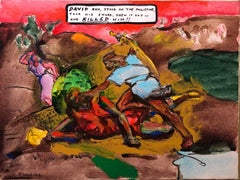
Modernist Judaica David and Goliath Biblical Expressionist Cartoon Oil Painting
By Archie Rand
Located in Surfside, FL
"David and Goliath," 1993, oil on canvas, signed and dated lower left, title label affixed verso, canvas (unframed): 18''h x 24''w. Provenance: The David C. and Sarajean Ruttenberg C...
Category
1990s American Modern Archie Rand Paintings
Materials
Canvas, Oil
Tribe of Benjamin, Large Judaica Mixed Media Collage Painting
By Archie Rand
Located in Surfside, FL
Tribe of Benjamin, Biblical mural with wolf. I believe this is a study for a stained glass window. Untitled, mixed media on paper, signed lower left,...
Category
1980s American Modern Archie Rand Paintings
Materials
Paint, Paper, Mixed Media
Archie Rand paintings for sale on 1stDibs.
Find a wide variety of authentic Archie Rand paintings available for sale on 1stDibs. You can also browse by medium to find art by Archie Rand in paint, canvas, fabric and more. Much of the original work by this artist or collective was created during the 1980s and is mostly associated with the modern style. Not every interior allows for large Archie Rand paintings, so small editions measuring 30 inches across are available. Customers who are interested in this artist might also find the work of Tarmo Pasto, Jack Hooper, and Virginia Dehn. Archie Rand paintings prices can differ depending upon medium, time period and other attributes. On 1stDibs, the price for these items starts at $1,800 and tops out at $4,500, while the average work can sell for $3,150.