Arte de Mexico Wall Decorations
to
1
1
Height
to
Width
to
1
1
1
1
1
1
1
1
435
301
294
270
Creator: Arte de Mexico
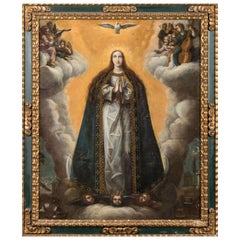
Beautiful 17th-century Mexican School - "Annunciation."
By Arte de Mexico
Located in Madrid, ES
17th-century Mexican School - "Annunciation."
Oil on canvas. 110 x 89 cm, framed 120 x 99 cm.
Framed.
This work comes from the city of Morelia, the monastery of the Capuchin Poor ...
Category
17th Century Mexican Spanish Colonial Antique Arte de Mexico Wall Decorations
Materials
Paint

Related Items
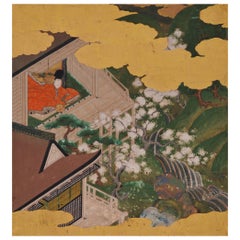
Japanese Painting, 17th Century, Tale of Genji, Tosa School
Located in Kyoto, JP
Illustration to an unidentified chapter of the Tale of Genji (Genji Monogatari)
Tosa School (second half of the 17th Century)
Ink, pigment, gofun and...
Category
Late 17th Century Japanese Edo Antique Arte de Mexico Wall Decorations
Materials
Gold Leaf

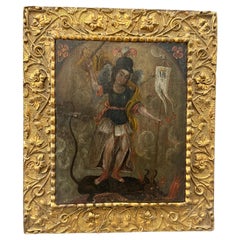
17th Century Spanish Colonial Cusco School Painting
Located in Middleburg, VA
A rare and evocative example of Spanish Colonial art from the Cusco School, this 17th-century oil on wood panel captures the iconic biblical scene of Sain...
Category
17th Century Peruvian Antique Arte de Mexico Wall Decorations
Materials
Wood, Paint, Giltwood
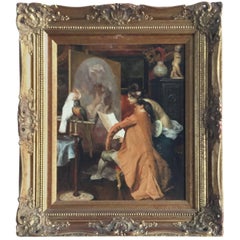
17th Century Painting
Located in Miami, FL
17th century painting
J.Castano
17th century
Spain
Category
17th Century Baroque Antique Arte de Mexico Wall Decorations
Materials
Canvas
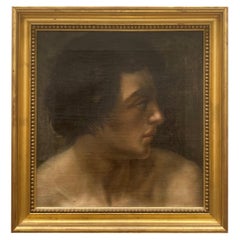
Late 17th Century Italian School, Head Of A Young Man
By Guido Reni
Located in Kent, Dover
A late XVII Century Italian School head of a young man (Circle of Guido Reni). A sensitively rendered portrait figure in profile, echoing soft modelling and restrained elegance chara...
Category
17th Century Italian Baroque Antique Arte de Mexico Wall Decorations
Materials
Canvas, Fruitwood
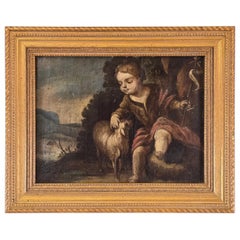
17th Century French School Christ as Shepherd
Located in Kilmarnock, VA
A beautifully rendered 17th-century oil painting on panel from the French school, depicting Christ as the infant shepherd. The composition features muted, harmonious colors and delic...
Category
17th Century French Louis XIV Antique Arte de Mexico Wall Decorations
Materials
Wood, Paint
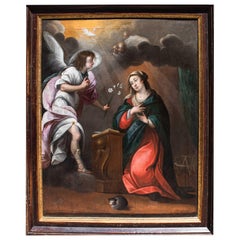
17th Century Annunciation Painting Oil on Canvas Workshop of Nuvolone
Located in Milan, IT
17th century, Nuvolone workshop
Annunciation
Measures: Oil on canvas, 98.50 x 127.00 cm - with frame 144 x 115
Depicted is a canonical Annunciation which sees Mary on her knees ...
Category
17th Century Italian Antique Arte de Mexico Wall Decorations
Materials
Canvas
$8,167
H 56.7 in W 45.28 in D 1.58 in
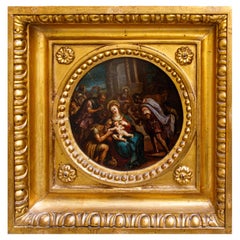
17th century, Flemish School, Adoration of the Magi
Located in Milan, IT
17th century, Flemish School
Adoration of the Magi
Oil on copper, diam. 19.5 cm
Framed 35.3 x 35.3 cm
Engraved on the back in seventeenth-century calligraphy "Fiamingo"
Vivid wo...
Category
18th Century and Earlier Dutch Other Antique Arte de Mexico Wall Decorations
Materials
Copper
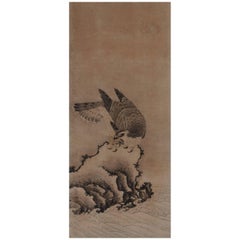
17th century Japanese Falcon Painting, Mitani Toshuku, Unkoku School
By Mitani Toshuku
Located in Kyoto, JP
Mitani Toshuku (1577-1654)
“Falcon”
Wall panel, ink and light color on paper.
Upper Seal: Mitani
Lower Seal: Toshuku
Dimensions:
Each 118.5 cm x 51 cm x 2 cm (46.5” x 20” x .75”)
Individual falcon paintings by Mitani Toshuku (1577-1654), an early artist of the Unkoku School. Founded by Unkoku Togan (1547–1618), a master of the Momoyama period, the Unkoku school enjoyed long lasting patronage in southern Japan. Togan was a retainer of the Mori family in present day Yamaguchi prefecture. Members of the school considered themselves to be in the artistic lineage of Sesshu Toyo...
Category
Early 17th Century Japanese Edo Antique Arte de Mexico Wall Decorations
Materials
Paper
$12,800
H 46.5 in W 20 in D 0.75 in
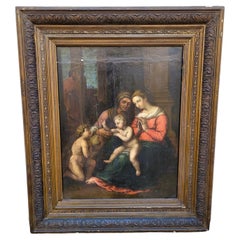
Italian School, Madonna Of Divine Love, On Panel, 17th/18th Century
Located in MARSEILLE, FR
Italian school 17th / 18th century: oil on framed panel, representing The Virgin and Child Jesus, accompanied by Saint Elizabeth and John the Baptist as a child, in the foreground
A...
Category
Late 17th Century Italian Renaissance Antique Arte de Mexico Wall Decorations
Materials
Paint
$7,206
H 25.6 in W 21.86 in D 1.97 in
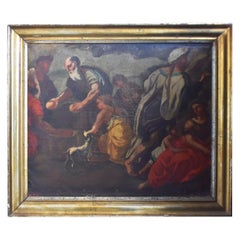
17th Century Italian School Biblical Scene
Located in Marseille, FR
17th century oil on canvas representation of the "Feeding of the 4,000" of Italian school.
Category
17th Century French Baroque Antique Arte de Mexico Wall Decorations
Materials
Canvas
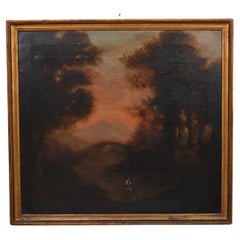
17th Century Oil Painting School of Claude Lorrain
By (after) Claude Lorrain (Claude Gellée)
Located in 263-0031, JP
A copy of the 1636 painting “River Ford” by the French proto-plein-air painter Claude Lorrain (1600-1682). This suivier, or follower, has faithfully reproduced the original but revis...
Category
17th Century European Antique Arte de Mexico Wall Decorations
Materials
Canvas
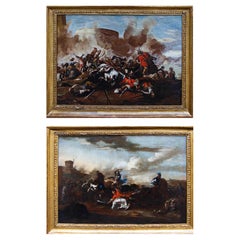
Neapolitan school, 17th century, battle scenes
Located in Milan, IT
Neapolitan School of the 17th Century
Battle scenes between Christians and Turks
(2) Oil on canvas, 52 x 71 cm
Framed, 61 x 80 cm
One genre that met with wide acclaim in seventeenth-century Neapolitan painting and flattering success among collectors was that of battle. The Parthenopean nobility loved to adorn the walls of their salons with battles depicting single acts of heroism or complex combats that exalted patriotism and warlike prowess, virtues with which members of the wealthy aristocracy of the time liked to identify.
The Church, in the Neapolitan area, was also at the forefront of commissions, commissioning artists to depict the spectacular triumphs of Christendom over the infidels, such as the memorable naval battle of Lepanto in 1571, which marked a historical turning point with the great victory over the Turks, becoming a repeated iconographic motif imbued with devotional value, replicated several times through the interest of the Dominican order, which was very devoted to Our Lady of the Rosary, who benevolently followed earthly events from above in heaven. Other themes dear to the Church within the genre were drawn from the Old and New Testaments, such as Constantine's Victory at the Milvian Bridge or St. James at the Battle of Clodius.
Among the leading Neapolitan artists of that period, several specialized in battle scenes: these include Francesco Graziani, known as Ciccio Napoletano, a battler active between Naples and Rome in the second half of the 17th century; Andrea De Lione, who lived in Naples from 1610 to 1685, a versatile narrator of battles without heroes, of horsemen assaulting or retreating, and of profane scenes immersed in a wild and primordial, yet already classicized, nature; and Carlo Coppola. The latter was active for more than twenty years, from 1640 to 1665, and his catalog, which is interesting because it bears witness to a particular historical moment and the tastes of private patrons, has yet to be defined, although many of his works are initialed. It is precisely to Coppola's corpus that these two paintings could come close: with the production of the Neapolitan battler the two paintings seem to share the smoky colors, the accentuated chiaroscuro and the marked dynamism of the scenes. Moreover, it is necessary to mention how that of the battle between Christians and Turks was an absolutely central theme in Coppola's pictorial production. Also close to the manner of the two paintings analyzed here is the production of one of Coppola's most celebrated pupils, Giovanni Luigi Rocco...
Category
17th Century Italian Other Antique Arte de Mexico Wall Decorations
Materials
Canvas
Previously Available Items
Beautiful 17th-century Mexican School - "Annunciation."
By Arte de Mexico
Located in Madrid, ES
17th-century Mexican School - "Annunciation."
Oil on canvas. 110 x 89 cm, framed 120 x 99 cm.
Framed.
This work comes from the city of Morelia, the monastery of the Capuchin Poor ...
Category
17th Century Mexican Spanish Colonial Antique Arte de Mexico Wall Decorations
Materials
Paint
Arte De Mexico wall decorations for sale on 1stDibs.
Arte de Mexico wall decorations are available for sale on 1stDibs. These distinctive items are frequently made of paint and are designed with extraordinary care. There are many options to choose from in our collection of Arte de Mexico wall decorations, although brown editions of this piece are particularly popular. Prices for Arte de Mexico wall decorations can differ depending upon size, time period and other attributes — on 1stDibs, these items begin at $5,741 and can go as high as $5,741, while a piece like these, on average, fetch $5,741.
Questions About Arte de Mexico Wall Decorations
- 1stDibs ExpertApril 5, 2022Giorgio de Chirico was the founder of the art movement scuola metafisica. This movement was influential in the surrealist art movement as well. In his later years de Chirico also worked in the neo-Baroque style. On 1stDibs, find a collection of authentic Giorgio de Chirico pieces and prints from top sellers.
- 1stDibs ExpertApril 5, 2022Art from Niki de Saint Phalle is in the collections of numerous institutions. They include the Courtauld Institute of Art in London, UK; the Museum of Modern Art in New York, New York; the Musée d'Art Moderne d'Art Contemporain in Nice, France; and Walker Art Center in Minneapolis, Minnesota. On 1stDibs, find a range of Niki de Saint Phalle art.
- 1stDibs ExpertMarch 22, 2022Niki de Saint Phalle did paintings and sculptures. She also made films. Many people classify her work as “outsider art” because she had no formal training in any type of artistic tradition. On 1stDibs, find a range of Niki de Saint Phalle.