Arthur Szyk
to
1
Overall Width
to
Overall Height
to
1
1
1
1
1
1
1
1
1
1
1
1
1
1
1
9,962
2,753
1,376
1,373
1
1
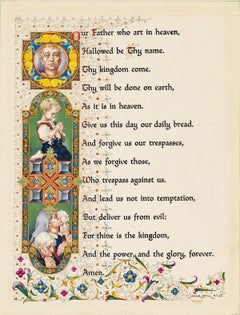
Artist: Arthur Szyk
The Lord
s Prayer, Illustration for Coronet Magazine, 1945
By Arthur Szyk
Located in Fort Washington, PA
Medium: Ink and Gouache on Stiff Paper
Signature: Signed Lower Right
"The Lord's Prayer." Illustration published in the January 1946 edition of Coronet magazine, appearing on the in...
Category
1940s Arthur Szyk
Materials
Paper, Ink, Gouache
Related Items
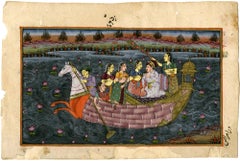
Mughal School, 18th century Emperor Jangahir on a pleasure boat with his harem a
Located in Middletown, NY
Emperor Jahangir depicted with his harem attendees aboard a pleasure cruise, the water filled with lotus blossoms; symbols of paradise itself.
Circa 1750. Gouache and ink with gold ...
Category
18th Century Rajput Arthur Szyk
Materials
Gold

$850
H 5.4 in W 10.79 in
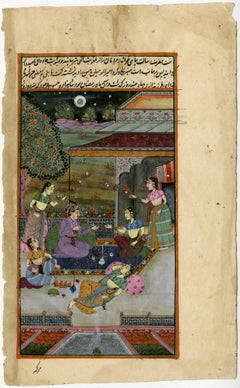
Mughal School, 18th century Emperor Jahangir taking tea in his harem
Located in Middletown, NY
An illuminated page from a book likely in reference to palace life during Emperor Jahangir's reign over the Mughal Empire.
circa 1750. Gouache and ink with heightening in gold on li...
Category
18th Century Rajput Arthur Szyk
Materials
Gold
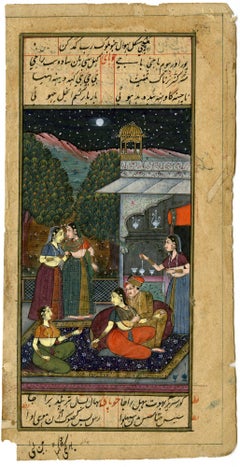
Mughal School, 17th century – Emperor Jahangir reclining in his harem
Located in Middletown, NY
An illuminated page from a book likely in reference to palace life during Emperor Jahangir's reign over the Mughal Empire.
Circa 1690. Gouache and ink with gold heightening on light...
Category
18th Century Rajput Arthur Szyk
Materials
Gold
$1,000
H 10.79 in W 5.4 in
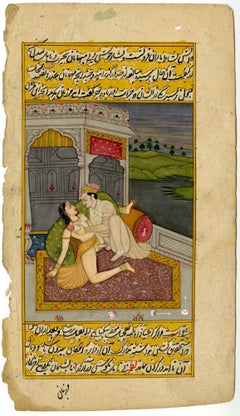
Mughal School, 18th century – Emperor Jahangir in his harem in flagrante delicto
Located in Middletown, NY
An illuminated page from a book likely in reference to palace life during Emperor Jahangir's reign over the Mughal Empire.
Circa 1750. Gouache and ink with gold heightening on cre...
Category
18th Century Rajput Arthur Szyk
Materials
Gold
$800
H 9.14 in W 5.24 in
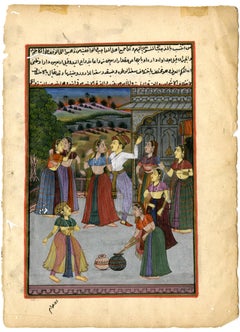
Mughal School, 18th century – Emperor Jahangir dancing with his harem attendees
Located in Middletown, NY
A joyful scene of lighthearted merriment in the palace of Jangahir Mahal Agra
Circa 1750. Gouache and ink with gold heightening on light weight cream laid paper, 8 1/4 x 6 inches (2...
Category
18th Century Rajput Arthur Szyk
Materials
Gold
$850
H 8.27 in W 6.03 in
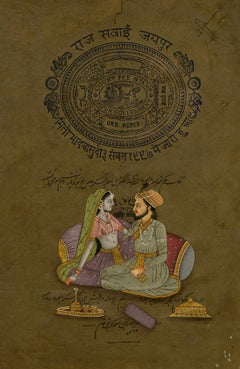
Shah Jahan taking tea with a concubine. Rajasthani School, 19th century
Located in Middletown, NY
Ink and gouache with gold heightening on brown laid paper with a Jaipur Court Fee tax stamp in black ink, 13 3/8 x 8 3/4 inches (340 x 222 mm). Toning, handling creases and minor sca...
Category
19th Century Rajput Arthur Szyk
Materials
Gold
$650
H 13.38 in W 8.75 in
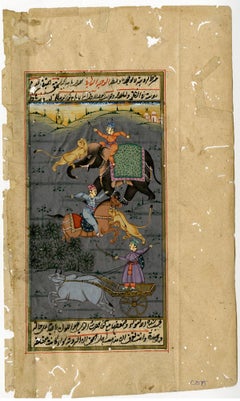
Mughal School, 17th century Tiger Hunt near the Jahangir Maha, Agra
Located in Middletown, NY
An illuminated page from a book likely in reference to palace life during Emperor Jahangir's reign over the Mughal Empire.
c 1690. Gouache and ink with heightening in gold on light ...
Category
17th Century Rajput Arthur Szyk
Materials
Gold
Mughal School, 18th century – Emperor Jahangir in his harem in flagrante delicto
Located in Middletown, NY
Emperor Jahangir in his harem surrounded by lotus blossoms; symbols of paradise itself.
Circa 1690. Gouache and ink with gold heightening on cream laid paper, 8 1/2 x 6 1/4 inches (...
Category
17th Century Rajput Arthur Szyk
Materials
Gold
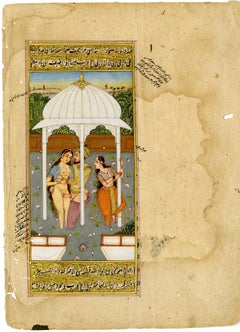
$800
H 8.27 in W 6.3 in
Mughal School, 18th century Emperor Jahangir with Empress Nur Jahan
concubine
Located in Middletown, NY
An illuminated page from a book likely in reference to palace life during Emperor Jahangir's reign over the Mughal Empire.
circa 1750. Gouache and ink with heightening in gold on li...
Category
17th Century Rajput Arthur Szyk
Materials
Gold
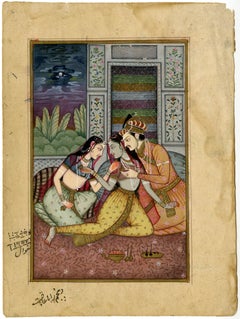
$900
H 10.24 in W 6.15 in
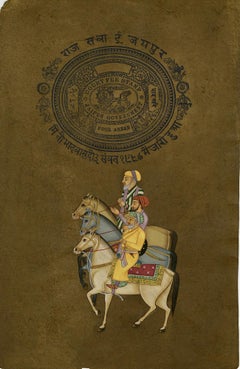
Three Rajput noblemen on horseback – Rajasthani School, 19th century
Located in Middletown, NY
Ink and gouache with gold heightening on fibrous, brown laid paper, with a Jaipur Court Fee tax stamp in black ink on the recto, as well as the Jaipur City Council blindstamp, 13 5/8...
Category
19th Century Rajput Arthur Szyk
Materials
Gold
Rajput Ragamala miniature of woman with bell&rattle. Rajasthani School, 19th C.
Located in Middletown, NY
Ink and gouache with gold heightening on fibrous, brown laid paper with a Jaipur Court Fee tax stamp in gray ink, and the 1889 Jaipur State Council stamp in black ink, 13 1/4 x 8 3/4 inches (335 x 222 mm). Toning, handling creases and minor scattered surface soiling throughout. There are scattered coeval Hindi inscriptions in ink on the recto.
"A ragamala, translated from Sanskrit as "garland of ragas," is a series of paintings depicting a range of musical melodies known as ragas. Its root word, raga, means color, mood, and delight, and the depiction of these moods was a favored subject in later Indian court paintings...
Category
19th Century Rajput Arthur Szyk
Materials
Gold
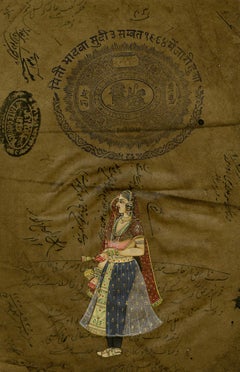
$800
H 13.25 in W 8.75 in
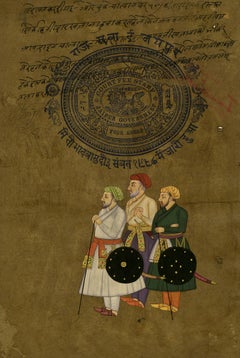
Three hunters; two with a spear and dagger... Rajasthani School, 19th century
Located in Middletown, NY
Ink and gouache with gold heightening on brown laid paper with a Jaipur Court Fee tax stamp in black ink, 12 5/8 x 8 9/16 inches (320 x 217 mm). Toning, handling creases and minor sc...
Category
19th Century Rajput Arthur Szyk
Materials
Gold
$650
H 12.63 in W 8.57 in
Previously Available Items
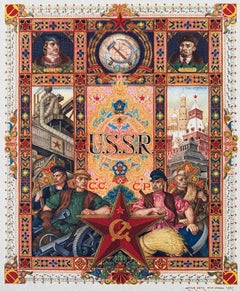
U.S.S.R Russian Folk Art Print Judaica Jewish Artist Cartoonist Arthur Szyk
By Arthur Szyk
Located in Surfside, FL
ARTHUR SZYK 1894-1951
Lodz, Poland 1894 - 1951 New Canaan, Connecticut (Polish/American)
signed by artist l.r.
Arthur Szyk is renowned for The Szyk Haggadah which was described by the London Times as "a book worthy to be placed among the most beautiful of books that the hand of man has produced."
ARTHUR SZYK 1894-1951
Lodz, Poland 1894 - 1951 New Canaan, Connecticut (Polish/American)
signed in plate by artist l.r.
Arthur Szyk is renowned for The Szyk Haggadah which was described by the London Times as "a book worthy to be placed among the most beautiful of books that the hand of man has produced."
Arthur Szyk (Polish: 1894 – 1951) was a Polish-Jewish artist who worked primarily as a book illustrator and political artist throughout his career. From 1921, he lived and created his works mainly in France and Poland, and in 1937 he moved to the United Kingdom. In 1940, he settled permanently in the United States, where he was granted American citizenship in 1948.
Arthur Szyk became a renowned artist and book illustrator as early as the interwar period. His works were exhibited and published not only in Poland, but also in France, the United Kingdom, Israel and the United States. However, he gained broad popularity in the United States primarily through his political caricatures, in which, after the outbreak of World War II, he savaged the policies and personalities of the leaders of the Axis powers. After the war, he also devoted himself to political issues, especially the support of the creation of the state of Israel.
Szyk's work is characterized in its material content by social and political commitment, and in its formal aspect by its rejection of modernism and embrace of the traditions of medieval and renaissance painting, especially illuminated manuscripts from those periods. Unlike most caricaturists, Szyk always showed great attention to the colouristic effects and details in his works.
Today, Szyk is an increasingly well-known and often exhibited artist only in his last home country, the United States. However, exhibitions in Poland and Germany are familiarizing Europe with one of the most prolific artists of World War II. Even though his family was culturally assimilated and did not practice Orthodox Judaism, Arthur also liked drawing biblical scenes from the Hebrew Bible. These interests and talents prompted his father, upon the advice of Szyk's teachers, to send Szyk to Paris to study at Académie Julian, a studio school popular among French and foreign students. When studying in Paris, Szyk remained closely involved with the social and civic life of Łódź. During the years 1912–1914 the teenage artist produced numerous drawings and caricatures on contemporary political themes that were published in the Lodz satirical magazine Śmiech ("Laughter"). After four years in France, Szyk returned to Poland in 1913 and continued his studies in Teodor Axentowicz's class at Jan Matejko Academy of Fine Arts in Kraków, which was under Austrian rule at that time.
In 1921 Arthur Szyk and his family moved to Paris where they stayed until 1933. The relocation to Paris is marked by a breakthrough in the formal aspect of Szyk's works. While Szyk's prior book illustrations were drawings in pen and ink (Szyk had illustrated six books before 1925, including three published in the Yiddish language). In recognition for his work, Arthur Szyk was decorated with the Gold Cross of Merit by the Polish government.
The last major exhibition of Szyk's works before the outbreak of World War II was the presentation of his paintings at the 1939 New York World's Fair, which opened in April 1939 in New York. During the war years Szyk drew more and more caricatures directed at the Axis powers and their leaders, and his popularity steadily grew. In 1940, the American publisher G.P. Putnam's Sons offered to publish a collection of his drawings. Szyk agreed, and the result was the 1941 book The New Order, available months before the United States joined the war. Thomas Craven declared on the dust jacket of The New Order that Szyk:
His caricatures of the leaders of the Axis powers (Hitler, Mussolini, Hirohito) and other drawings appeared practically everywhere: in newspapers, magazines (including Time (cover caricature of Admiral Isoroku Yamamoto in December 1941), Esquire, and Collier's), on posters, postcards and stamp...
Category
Early 20th Century Folk Art Arthur Szyk
Materials
Color
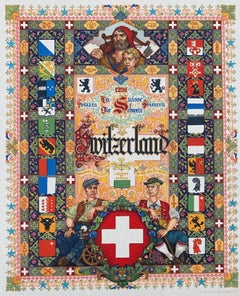
Switzerland Swiss Folk Art Print Artist Arthur Szyk Judaica Cartoonist
By Arthur Szyk
Located in Surfside, FL
ARTHUR SZYK 1894-1951
Lodz, Poland 1894 - 1951 New Canaan, Connecticut (Polish/American)
signed by artist l.r.
Arthur Szyk is renowned for The Szyk Haggadah which was described by the London Times as "a book worthy to be placed among the most beautiful of books that the hand of man has produced."
ARTHUR SZYK 1894-1951
Lodz, Poland 1894 - 1951 New Canaan, Connecticut (Polish/American)
signed in plate by artist l.r.
Arthur Szyk is renowned for The Szyk Haggadah which was described by the London Times as "a book worthy to be placed among the most beautiful of books that the hand of man has produced."
Arthur Szyk (Polish: 1894 – 1951) was a Polish-Jewish artist who worked primarily as a book illustrator and political artist throughout his career. From 1921, he lived and created his works mainly in France and Poland, and in 1937 he moved to the United Kingdom. In 1940, he settled permanently in the United States, where he was granted American citizenship in 1948.
Arthur Szyk became a renowned artist and book illustrator as early as the interwar period. His works were exhibited and published not only in Poland, but also in France, the United Kingdom, Israel and the United States. However, he gained broad popularity in the United States primarily through his political caricatures, in which, after the outbreak of World War II, he savaged the policies and personalities of the leaders of the Axis powers. After the war, he also devoted himself to political issues, especially the support of the creation of the state of Israel.
Szyk's work is characterized in its material content by social and political commitment, and in its formal aspect by its rejection of modernism and embrace of the traditions of medieval and renaissance painting, especially illuminated manuscripts from those periods. Unlike most caricaturists, Szyk always showed great attention to the colouristic effects and details in his works.
Today, Szyk is an increasingly well-known and often exhibited artist only in his last home country, the United States. However, exhibitions in Poland and Germany are familiarizing Europe with one of the most prolific artists of World War II. Even though his family was culturally assimilated and did not practice Orthodox Judaism, Arthur also liked drawing biblical scenes from the Hebrew Bible. These interests and talents prompted his father, upon the advice of Szyk's teachers, to send Szyk to Paris to study at Académie Julian, a studio school popular among French and foreign students. When studying in Paris, Szyk remained closely involved with the social and civic life of Łódź. During the years 1912–1914 the teenage artist produced numerous drawings and caricatures on contemporary political themes that were published in the Lodz satirical magazine Śmiech ("Laughter"). After four years in France, Szyk returned to Poland in 1913 and continued his studies in Teodor Axentowicz's class at Jan Matejko Academy of Fine Arts in Kraków, which was under Austrian rule at that time.
In 1921 Arthur Szyk and his family moved to Paris where they stayed until 1933. The relocation to Paris is marked by a breakthrough in the formal aspect of Szyk's works. While Szyk's prior book illustrations were drawings in pen and ink (Szyk had illustrated six books before 1925, including three published in the Yiddish language). In recognition for his work, Arthur Szyk was decorated with the Gold Cross of Merit by the Polish government.
The last major exhibition of Szyk's works before the outbreak of World War II was the presentation of his paintings at the 1939 New York World's Fair, which opened in April 1939 in New York. During the war years Szyk drew more and more caricatures directed at the Axis powers and their leaders, and his popularity steadily grew. In 1940, the American publisher G.P. Putnam's Sons offered to publish a collection of his drawings. Szyk agreed, and the result was the 1941 book The New Order, available months before the United States joined the war. Thomas Craven declared on the dust jacket of The New Order that Szyk:
His caricatures of the leaders of the Axis powers (Hitler, Mussolini, Hirohito) and other drawings appeared practically everywhere: in newspapers, magazines (including Time (cover caricature of Admiral Isoroku Yamamoto in December 1941), Esquire, and Collier's), on posters, postcards and stamp...
Category
Early 20th Century Folk Art Arthur Szyk
Materials
Color
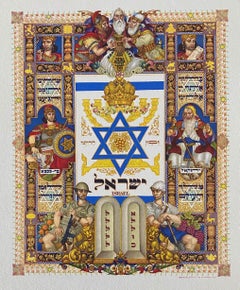
Shehecheyanu Prayer, Folk Art Judaica Polish Jewish Prayer Print Arthur Szyk
By Arthur Szyk
Located in Surfside, FL
ARTHUR SZYK 1894-1951
Lodz, Poland 1894 - 1951 New Canaan, Connecticut (Polish/American)
signed in plate by artist l.r.
Arthur Szyk is renowned for The Szyk Haggadah which was described by the London Times as "a book worthy to be placed among the most beautiful of books that the hand of man has produced."
Arthur Szyk (Polish: 1894 – 1951) was a Polish-Jewish artist who worked primarily as a book illustrator and political artist throughout his career. From 1921, he lived and created his works mainly in France and Poland, and in 1937 he moved to the United Kingdom. In 1940, he settled permanently in the United States, where he was granted American citizenship in 1948.
Arthur Szyk became a renowned artist and book illustrator as early as the interwar period. His works were exhibited and published not only in Poland, but also in France, the United Kingdom, Israel and the United States. However, he gained broad popularity in the United States primarily through his political caricatures, in which, after the outbreak of World War II, he savaged the policies and personalities of the leaders of the Axis powers. After the war, he also devoted himself to political issues, especially the support of the creation of the state of Israel.
Szyk's work is characterized in its material content by social and political commitment, and in its formal aspect by its rejection of modernism and embrace of the traditions of medieval and renaissance painting, especially illuminated manuscripts from those periods. Unlike most caricaturists, Szyk always showed great attention to the colouristic effects and details in his works.
Today, Szyk is an increasingly well-known and often exhibited artist only in his last home country, the United States. However, exhibitions in Poland and Germany are familiarizing Europe with one of the most prolific artists of World War II. Even though his family was culturally assimilated and did not practice Orthodox Judaism, Arthur also liked drawing biblical scenes from the Hebrew Bible. These interests and talents prompted his father, upon the advice of Szyk's teachers, to send Szyk to Paris to study at Académie Julian, a studio school popular among French and foreign students. When studying in Paris, Szyk remained closely involved with the social and civic life of Łódź. During the years 1912–1914 the teenage artist produced numerous drawings and caricatures on contemporary political themes that were published in the Lodz satirical magazine Śmiech ("Laughter"). After four years in France, Szyk returned to Poland in 1913 and continued his studies in Teodor Axentowicz's class at Jan Matejko Academy of Fine Arts in Kraków, which was under Austrian rule at that time.
In 1921 Arthur Szyk and his family moved to Paris where they stayed until 1933. The relocation to Paris is marked by a breakthrough in the formal aspect of Szyk's works. While Szyk's prior book illustrations were drawings in pen and ink (Szyk had illustrated six books before 1925, including three published in the Yiddish language). In recognition for his work, Arthur Szyk was decorated with the Gold Cross of Merit by the Polish government.
The last major exhibition of Szyk's works before the outbreak of World War II was the presentation of his paintings at the 1939 New York World's Fair, which opened in April 1939 in New York. During the war years Szyk drew more and more caricatures directed at the Axis powers and their leaders, and his popularity steadily grew. In 1940, the American publisher G.P. Putnam's Sons offered to publish a collection of his drawings. Szyk agreed, and the result was the 1941 book The New Order, available months before the United States joined the war. Thomas Craven declared on the dust jacket of The New Order that Szyk:
His caricatures of the leaders of the Axis powers (Hitler, Mussolini, Hirohito) and other drawings appeared practically everywhere: in newspapers, magazines (including Time (cover caricature of Admiral Isoroku Yamamoto in December 1941), Esquire, and Collier's), on posters, postcards and stamp...
Category
Early 20th Century Folk Art Arthur Szyk
Materials
Color
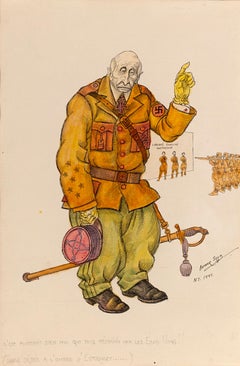
C
est Pourtant Bien Moi by Arthur Szyk
By Arthur Szyk
Located in New Orleans, LA
C'est pourtant bien moi qui suis reconnu par les Etats Unis!
(It is nevertheless me who is recognized by the United States!)
Signed and dated “Arthur Szyk / N.Y. 1941” (lower right)...
Category
20th Century Post-War Arthur Szyk
Materials
Paper, Ink, Watercolor, Pencil
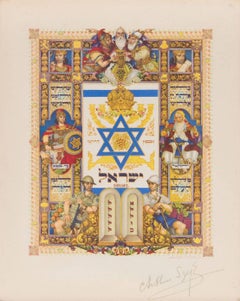
Shehechiyanu Prayer, Folk Judaica Print
By Arthur Szyk
Located in Surfside, FL
ARTHUR SZYK 1894-1951
Lodz, Poland 1894 - 1951 New Canaan, Connecticut (Polish/American)
signed by artist l.r.
Arthur Szyk is renowned for The Szyk Haggadah which was described by t...
Category
Early 20th Century Folk Art Arthur Szyk
Materials
Color
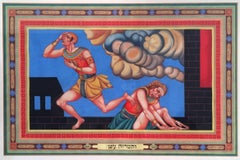
Columns of Smoke
By Arthur Szyk
Located in London, GB
ARTHUR SZYK 1894-1951
Lodz, Poland 1894 - 1951 New Canaan, Connecticut (Polish/American)
Title: Columns of Smoke, 1935-1939
Technique: Original Signed Tempera on brown laid p...
Category
1930s Arthur Szyk
Materials
Paper, Tempera
Arthur Szyk art for sale on 1stDibs.
Find a wide variety of authentic Arthur Szyk available for sale on 1stDibs. Customers who are interested in this artist might also find the work of Louis Valtat, Henry Maurice CAHOURS, and Mario Sironi.