Arturo Martini Abstract Prints

Italian, 1889-1947

Arturo Martini was an Italian sculptor and engraver. He studied ceramics in Faenza and sculpture in Treviso. His copious artistic production is characterized by immediate plasticity, halcyon inventiveness and thorough mastery of all technical processes like stone, bronze, terracotta, ceramics, etc. Whilst the artist preferred a primitive style in his earliest works, he then sought a simplification of volumes. With an admirable sense of style, he managed to be inspired by the most diverse Historic, Archaic, Etruscan, Romanesque and Baroque forms without losing originality of inventiveness, nor vitality of form. In his latest works, he abandoned sculpture in order to dedicate himself to painting. He was also an excellent illustrator and ceramist and created works of narrative spirit and decorative value.

to
2
1
Overall Width
to
Overall Height
to
2
17
660
215
169
165
3
2
3
3
3
Artist: Arturo Martini
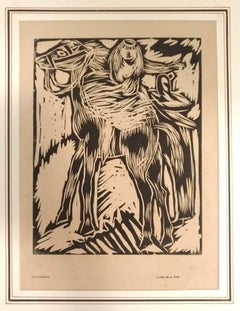
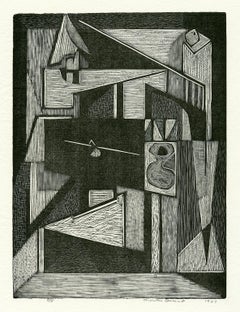
La Cavallerizza
By Arturo Martini
Located in Roma, IT
"La Cavallerizza" is an original xylograph realized by Arturo Martini in 1914. Title and signature printed on the lower margin. Very good condition. Passepartout included : 55 x 44....
Category

1910s Modern Arturo Martini Abstract Prints

Materials

Woodcut

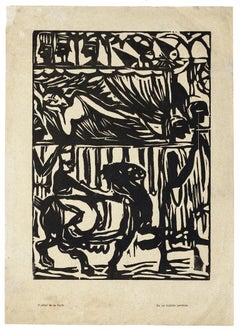
Persian Ballet - Woodcut by Arturo Martini - 20th Century
By Arturo Martini
Located in Roma, IT
Persian Ballet is a woodcut on ivory-colored, realized at the beginning of the XX century by the Italian artist Arturo Martini (Treviso, 1889 - Milan, 1947). On the lower margin, the printed inscriptions with the title and the author: "Persian Ballet/ Martini de la Valle...
Category

20th Century Arturo Martini Abstract Prints

Materials

Woodcut

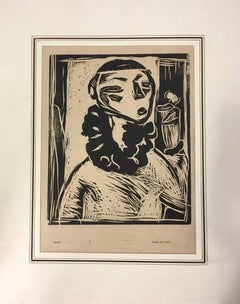
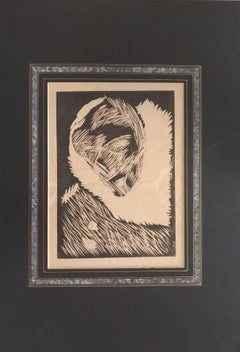
Portrait of Woman
By Arturo Martini
Located in Roma, IT
This very rare xylograph is in excellent conditions. Title and signature printed on the lower margin. The artist used the name of his mother "Martini de la Valle". Passepartout included : 55 x 45 cm Image Dimensions : 30 x 24.5 cm Arturo Martini (1889-1947) was an Italian sculptor. He studied ceramics in Faenza and sculpture in Treviso. His copious artistic production is characterized by immediate plasticity, halcyon inventiveness, and thorough mastery of all technical processes: stone, bronze, terracotta...
Category

1910s Modern Arturo Martini Abstract Prints

Materials

Woodcut

Related Items
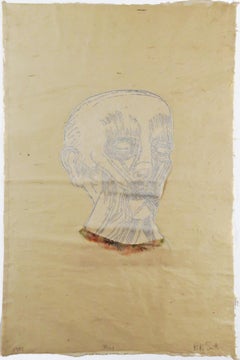
Untitled
By Kiki Smith
Located in New York, NY
Kiki Smith 'Untitled,' 1995 Woodcut with color additions by hand 31 x 21 inches Edition 43 of 47 Signed In 1995 five well-known American artists - Donald Baechler, Julian Lethbridge...
Category

1990s Arturo Martini Abstract Prints

Materials

Woodcut

Untitled
Untitled
$4,000
H 31 in W 21 in
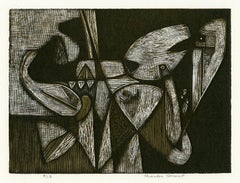
Still Life — Mid-century Modern
By Charles Quest
Located in Myrtle Beach, SC
Charles Quest, 'Still Life', 1947, wood engraving, edition 8. Signed, dated, and numbered '3/8' in pencil. Titled and annotated 'wood engraving' in the bottom left margin. A fine impression, on off-white wove paper, with full margins (1 to 2 inches), in excellent condition. Scarce. Matted to museum standards, unframed. ABOUT THE ARTIST Charles Quest, painter, printmaker, and fine art instructor, worked in various mediums, including mosaic, stained glass, mural painting, and sculpture. Quest grew up in St. Louis, his talent evident as a teenager when he began copying the works of masters such as Michelangelo on his bedroom walls. He studied at the Washington University School of Fine Arts, where he later taught from 1944 to 1971. He traveled to Europe after his graduation in 1929 and studied at La Grande Chaumière and Academie Colarossi, Paris, continuing to draw inspiration from the works of the Old Masters. After returning to St. Louis, Quest received several commissions to paint murals in public buildings, schools, and churches, including one from Joseph Cardinal Ritter, to paint a replica of Velasquez's Crucifixion over the main altar of the Old Cathedral in St. Louis. Quest soon became interested in the woodcut medium, which he learned through his study of J. J. Lankes' A Woodcut Manual (1932) and Paul Landacre's articles in American Artist magazine ‘since no artists in St. Louis were working in wood’ at that time. Quest also revealed that for him, wood cutting and engraving were ‘more enjoyable than any other means of expression.’ In the late 1940s, his graphic works began attracting critical attention—several of his woodcuts won prizes and were acquired by major American and European museums. His wood engraving entitled ‘Lovers’ was included in the American Federation of Art's traveling print exhibition in 1947. Two years later, Quest's two prize-winning prints, ‘Still Life with Grindstone’ and ‘Break Forth into Singing’, were exhibited in major American museums in a traveling show organized by the Philadelphia Print Club. His work was included in the Chicago Art Institute's exhibition, ‘Woodcut Through Six Centuries’, and the print ‘Still Life with Vise’ was purchased by the Museum of Modern Art in New York. In 1951 he was invited by artist-Curator Jacob Kainen to exhibit thirty wood engravings and color woodcuts in a one-person show at the Smithsonian's National Museum (now known as the American History Museum). Kainen's press release praised the ‘technical refinement’ of Quest's work: ‘He obtains a great variety of textural effects through the use of the graver, and these dense or transparent grays are set off against whites or blacks to achieve sparkling results. His work has the handsome qualities characteristic of the craftsman and designer.’ At the time of the Smithsonian exhibition, Quest's work was represented by three New York galleries in addition to one in his home town. He had won 38 prizes, and his prints were in the collections of the Library of Congress, the Chicago Art Institute, the Metropolitan Museum, and the Philadelphia Museum of Art. In cooperation with the Art in Embassies program, his color woodcuts were displayed at the American Embassy in Paris in 1951. Recognition at home came in 1955 with his first solo exhibition in St. Louis. Press coverage of the show heralded the ‘growth of graphic arts toward rivaling painting and sculpture as a major independent medium’. An exhibition of his prints at the Bethesda Art Gallery in 1983 attracted Curator Emeritus Joseph A. Haller, S.J., who began purchasing his work for Georgetown University's collection. In 1990 Georgetown University Library's Special Collections Division was the recipient of a large body of Quest's work, including prints, drawings, paintings, sculpture, stained glass, and his archive of correspondence and professional memorabilia. These extensive holdings, including some 260 of his fine prints, provide a rich opportunity for further study and appreciation of this versatile and not-to-be-forgotten mid-Western American artist...
Category

1940s American Modern Arturo Martini Abstract Prints

Materials

Woodcut

Underwater — Mid-century Modern
By Charles Quest
Located in Myrtle Beach, SC
Charles Quest, 'Underwater', 1948, chiaroscuro wood engraving, edition 12. Signed, titled, dated and numbered '3/12' in pencil. A fine, richly-inked impression, in dark brown and warm black, on off-white wove paper, with full margins (5/8 to 1 1/2 inch), in excellent condition. Scarce. ABOUT THE ARTIST Charles Quest, painter, printmaker, and fine art instructor, worked in various mediums, including mosaic, stained glass, mural painting, and sculpture. Quest grew up in St. Louis, his talent evident as a teenager when he began copying the works of masters such as Michelangelo on his bedroom walls. He studied at the Washington University School of Fine Arts, where he later taught from 1944 to 1971. He traveled to Europe after his graduation in 1929 and studied at La Grande Chaumière and Academie Colarossi, Paris, continuing to draw inspiration from the works of the Old Masters. After returning to St. Louis, Quest received several commissions to paint murals in public buildings, schools, and churches, including one from Joseph Cardinal Ritter, to paint a replica of Velasquez's Crucifixion over the main altar of the Old Cathedral in St. Louis. Quest soon became interested in the woodcut medium, which he learned through his study of J. J. Lankes' A Woodcut Manual (1932) and Paul Landacre's articles in American Artist magazine ‘since no artists in St. Louis were working in wood’ at that time. Quest also revealed that for him, wood cutting and engraving were ‘more enjoyable than any other means of expression.’ In the late 1940s, his graphic works began attracting critical attention—several of his woodcuts won prizes and were acquired by major American and European museums. His wood engraving entitled ‘Lovers’ was included in the American Federation of Art's traveling print exhibition in 1947. Two years later, Quest's two prize-winning prints, ‘Still Life with Grindstone’ and ‘Break Forth into Singing’, were exhibited in major American museums in a traveling show organized by the Philadelphia Print Club. His work was included in the Chicago Art Institute's exhibition, ‘Woodcut Through Six Centuries’, and the print ‘Still Life with Vise’ was purchased by the Museum of Modern Art in New York. In 1951 he was invited by artist-Curator Jacob Kainen to exhibit thirty wood engravings and color woodcuts in a one-person show at the Smithsonian's National Museum (now known as the American History Museum). Kainen's press release praised the ‘technical refinement’ of Quest's work: ‘He obtains a great variety of textural effects through the use of the graver, and these dense or transparent grays are set off against whites or blacks to achieve sparkling results. His work has the handsome qualities characteristic of the craftsman and designer.’ At the time of the Smithsonian exhibition, Quest's work was represented by three New York galleries in addition to one in his home town. He had won 38 prizes, and his prints were in the collections of the Library of Congress, the Chicago Art Institute, the Metropolitan Museum, and the Philadelphia Museum of Art. In cooperation with the Art in Embassies program, his color woodcuts were displayed at the American Embassy in Paris in 1951. Recognition at home came in 1955 with his first solo exhibition in St. Louis. Press coverage of the show heralded the ‘growth of graphic arts toward rivaling painting and sculpture as a major independent medium’. An exhibition of his prints at the Bethesda Art Gallery in 1983 attracted Curator Emeritus Joseph A. Haller, S.J., who began purchasing his work for Georgetown University's collection. In 1990 Georgetown University Library's Special Collections Division was the recipient of a large body of Quest's work, including prints, drawings, paintings, sculpture, stained glass, and his archive of correspondence and professional memorabilia. These extensive holdings, including some 260 of his fine prints, provide a rich opportunity for further study and appreciation of this versatile and not-to-be-forgotten mid-Western American artist...
Category

1940s American Modern Arturo Martini Abstract Prints

Materials

Woodcut

"Rainbow-Man" - Abstracted Mexican Figurative Woodblock Print
By Pedro Puesta
Located in Soquel, CA
"Rainbow-man," an abstracted Mexican figurative woodblock by Pedro Puerta (Mexican, 20th Century), 1974. Titled "Rainbow-Man" lower left and "from a Michoacan Pot" "Reproduced with a...
Category

1970s Other Art Style Arturo Martini Abstract Prints

Materials

Paper, Ink, Woodcut

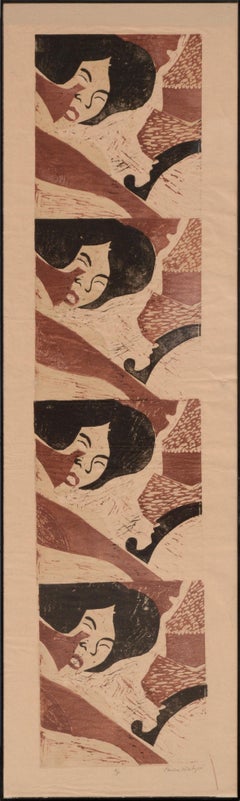
Face of a Woman, Figurative Abstract Pop Art Woodcut Portrait on Handmade Paper
By Paula Walzer
Located in Soquel, CA
Face of a Woman, Figurative Abstract Pop Art Woodcut Portrait on Handmade Paper Bold pop art woodcut print on handmade paper of a woman's face in black and red, repeated in 4 vertical registers like a film strip, by Monterey Bay artist Paula Walzer...
Category

Late 20th Century Pop Art Arturo Martini Abstract Prints

Materials

Paper, Handmade Paper, Woodcut

La Penitenciaria
By David Siqueiros
Located in New York, NY
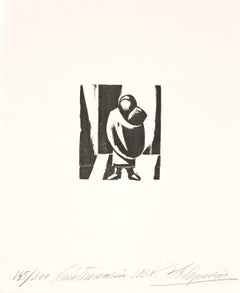
A very good impression of this early woodcut. Signed, titled, dated and numbered 145/300 in pencil by Siqueiros.
Category

1930s Realist Arturo Martini Abstract Prints

Materials

Woodcut

La Penitenciaria
$3,500
H 3.88 in W 3.25 in
Soleil Recercle
By Hans (Jean) Arp
Located in Missouri, MO
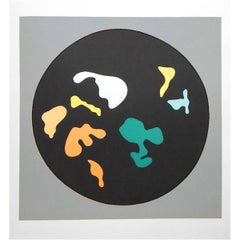
Soleil Recercle Color woodcut, 1966, on wove, Signed and Numbered ed. 50 Cat. Rais. Arntz Sheet Size: approx. 22 x 17.5 inches Framed Size: approx. 24 x 20 inches Jean Arp was a p...
Category

1960s Modern Arturo Martini Abstract Prints

Materials

Woodcut

The energy of the dance floor comes straight back to my ears
By Thierry Noir
Located in London, GB
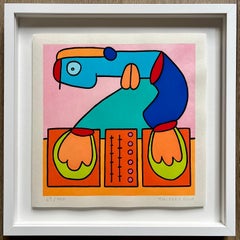
Thierry Noir The energy of the dance floor comes straight back to my ears, 2025 Ukiyo-e print in colours on kizuki hosho paper hand made by Ichibei Iwano 27.4 x 27.4 cm 35.7 x 35.7 c...
Category

2010s Street Art Arturo Martini Abstract Prints

Materials

Woodcut

Clench 1969 linocut screen print
Located in Rochester Hills, MI
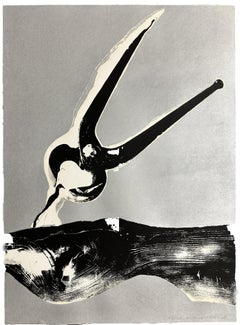
Michael Rothenstein Clench – 1969 Print – Colour linocut, photo screenprint black 23” x 31.25” Edition: Signed in pencil and marked 44/125 Unframed in Good Condition. Condition no...
Category

1960s Modern Arturo Martini Abstract Prints

Materials

Woodcut

Clench 1969  linocut screen print
$360 Sale Price
20% Off
H 31.25 in W 23 in D 1 in
Serpientes Cafe - Figurative Abstract Woodcut
By Cecelia Sánchez Duarte
Located in Soquel, CA
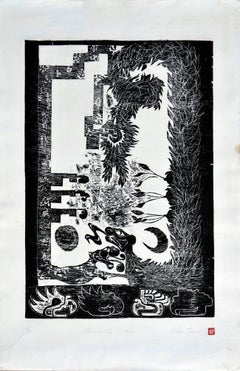
Figurative abstract woodcut print titled "Serpientes Cafe" by Cecelia Sánchez Duarte. Pencil signed with "P/A" (Artist Proof), title, and signature bottom margin. Image, 31"H x 23.25"W. Sanchez Duarte is a visual artist and a cultural activist. Cecelia also teaches Art History at Escuela Profesional de Danza de Mazatlán, is the Fine Arts Coordinator at Centro Municipal de Artes, cofounder of the new Técnico en Artes Plásticas and founder of a painting workshop for children. She has had more than 300 collective exhibits internationally as well as 17 solo shows. Cecelia Sánchez Duarte lives in Mazatlán, Mexico. Cecilia Sánchez Duarte became the new director of the Art Museum of Mazatlan in 2017. Cecilia Sanchez Duarte works in printmaking at the Taller Experimental de Estampa Jose Guadalupe Posada...
Category

1990s Folk Art Arturo Martini Abstract Prints

Materials

Archival Paper, Woodcut

February -- Orchid. (Nigatsu - Ranjo no saku).
By Shiko Munakata
Located in Plano, TX
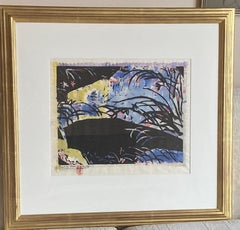
February -- Orchid. (Nigatsu - Ranjo no saku). 1956. Woodcut with hand-applied color from the verso. Kodansha vol.9 No. 125. 17 x 13 (sheet 18 1/4 x 21 1/2). Series: Calender in the ...
Category

Mid-20th Century Modern Arturo Martini Abstract Prints

Materials

Watercolor, Woodcut

February -- Orchid. (Nigatsu - Ranjo no saku).
$6,500 Sale Price
35% Off
H 20 in W 26 in D 1 in
Midnight Madness - Witches on Night Flight
Located in Miami, FL
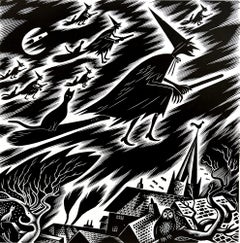
Pioneering female illustrator Gwenda Morgan creates an exuberantly complex image of a squad of broom-riding - pointed-hatted witches with black cats in tow. They fly through an inky black moonlit sky and are witnessed by only a rooftop owl. With the simple means of black and white, Morgan has rendered a highly charged composition that pluses with electricity. The whole image is on the cusp of being abstract while being representational. It is brilliantly designed with great attention to detail and is evocative of a sorcerer's malignant powers. Unframed. not signed Printed from the original block as part of the suite of 8 prints that accompanied the limited edition book Diary of a Land Girl, Whittington Press, 2000. The suite of prints was included with the first 50 copies of the book, and a further 8 suites were printed, from which this print comes. Gwenda Morgan (1 February 1908 – 1991) was a British wood engraver. She lived in the town of Petworth in West Sussex. Early life Morgan was born in Petworth, her father having moved there to work at the ironmongers, Austen & Co, of which he later became proprietor. He was the son of a Welsh-born military farrier. Education Following school in Petworth and at Brighton and Hove High School, Morgan, studied at Goldsmiths' College of Art in London from 1926. From 1930 she attended the Grosvenor School of Modern Art in Pimlico where she was taught and strongly influenced by the principal, Iain Macnab. The Grosvenor School was a progressive art school and the championing of wood engraving and linocuts fitted with its democratic approach to the arts. Works Morgan was commissioned to illustrate a number of books published by private presses. For the Samson Press she produced the frontispiece for Duke Hamilton...
Category

1950s Contemporary Arturo Martini Abstract Prints

Materials

Woodcut

Previously Available Items
Simulacrum of Pierrot
By Arturo Martini
Located in Roma, IT
Original xylograph. Title and signature printed on the lower margin., "Martini de la Valle". Very good condition. In the center of the right margin, is marked...
Category

1910s Modern Arturo Martini Abstract Prints

Materials

Woodcut

Simulacrum of Pierrot
H 15.16 in W 11.03 in D 0.08 in

Arturo Martini abstract prints for sale on 1stDibs.

Find a wide variety of authentic Arturo Martini abstract prints available for sale on 1stDibs. You can also browse by medium to find art by Arturo Martini in woodcut print and more. Much of the original work by this artist or collective was created during the 20th century and is mostly associated with the modern style. Not every interior allows for large Arturo Martini abstract prints, so small editions measuring 11 inches across are available. Customers who are interested in this artist might also find the work of Massimo Campigli, Mino Maccari, and Toti Scialoja. Arturo Martini abstract prints prices can differ depending upon medium, time period and other attributes. On 1stDibs, the price for these items starts at $8,694 and tops out at $18,382, while the average work can sell for $18,382.