Auguste Brouet Interior Prints

French, 1872-1941

Auguste Brouet was a French etcher and book illustrator. He was born and raised in a poor family in the popular north-east quarters of Paris and in Les Lilas, in the near suburbs. While apprenticed to a lithographer, he struggled for artistic education through the evening drawing classes of Eugène Quignolot, also briefly attending Gustave Moreau's atelier. Starting from around 1895, Brouet would make a living by doing hack work for fashionable artists and also crafting reproductive etchings in color, in the workshop of Eugène Delâtre. Around 1902, he started to devise original etchings, sometimes larger pieces in color, more often smaller works in black and white, as was the growing trend at the time. In the 1920s, Brouet's etchings came under strong demand both in France and in the United States, in the wake of the Print Revival. At that time, he also produced a significant body of book illustrations, most notably for Devambez, under the direction of Édouard Chimot. This period of prosperity ends with the Great Depression, from which the print market never quite recovered. Brouet died in 1941 in poverty.

to
1
Overall Width
to
Overall Height
to
17
108
79
47
30
1
1
1
1
1
1
1
1
1
1
1
1
Artist: Auguste Brouet
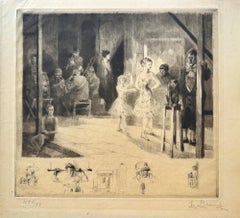
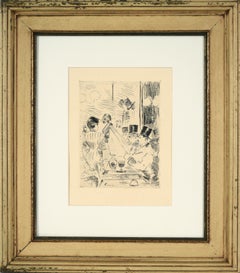
La Parade
By Auguste Brouet
Located in Middletown, NY
Etching on wove Japon paper, 8 5/8 x 9 1/4 inches (219 x 235 mm), wide margins. Signed, titled, and numbered 6/75 in pencil, lower margin, and with the Dietrich & Cie éditeurs blinds...
Category

Early 20th Century French School Auguste Brouet Interior Prints

Materials

Handmade Paper, Etching

Related Items
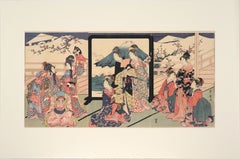
"Toy Horse Dance" Japanese Woodblock Triptych with Beauties and Mt Fuji
Located in Soquel, CA
"Toy Horse Dance" Japanese Woodblock Triptych with Beauties and Mt Fuji Vibrant three-panel woodblock print by Utagawa Toyohiro (Japanese,...
Category

Early 20th Century Edo Auguste Brouet Interior Prints

Materials

Ink, Rice Paper, Woodcut

Bow Street Office: Rowlandson Hand-colored Engraving from Microcosm of London
By Thomas Rowlandson
Located in Alamo, CA
An early 19th century print entitled "Bow Street Office", an illustration (Plate 11) from "The Microcosm of London", published in London in 1808 by R. Acker...
Category

Early 1800s Other Art Style Auguste Brouet Interior Prints

Materials

Aquatint, Etching

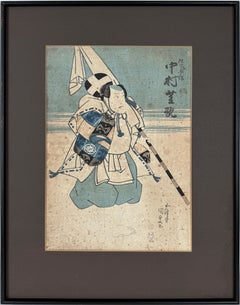
Kabuki actor Nakamura Shikan II by Utagawa Kunisada Edo Japanese Woodblock Print
By Utagawa Kunisada (Toyokuni III)
Located in Soquel, CA
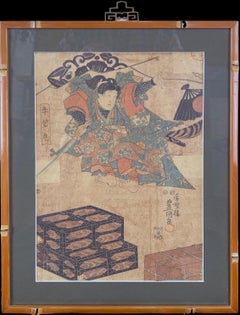
Kabuki actor Nakamura Shikan II by Utagawa Kunisada Japanese Woodblock Print Wonderful portrait of Nakamura Shikan II, a prominent kabuki actor, in the role of Kisen Hoshi Toyokuni ...
Category

1820s Realist Auguste Brouet Interior Prints

Materials

Printer s Ink, Rice Paper, Woodcut

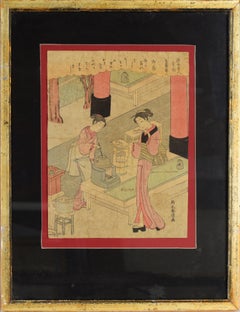
Deutzia Flowers: The Wife of Kasamori - Original Woodblock Print
Located in Soquel, CA
Deutzia Flowers: The Wife of Kasamori - Original Woodblock Print Deutzia Flowers: The Wife of Kasamori, from the Series "Beauties of the Floating World Associated with Flowers" by S...
Category

1760s Edo Auguste Brouet Interior Prints

Materials

Woodcut, Ink, Rice Paper

"Le café de la Nouvelle Athènes" French Impressionist Etching
By Jean Louis Forain
Located in Soquel, CA
"Le café de la Nouvelle Athènes" French Impressionist Etching Etching of the bustling Café de la Nouvelle Athènes by Jean-Louis Forain (French b. 1852 d. 1931.) A row of men in top...
Category

1870s Impressionist Auguste Brouet Interior Prints

Materials

Paper, Ink, Etching

"Waiting for Rehearsal"
By Paul Cadmus
Located in Astoria, NY
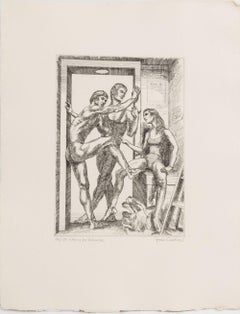
Paul Cadmus (American, 1904-1999), "Waiting for Rehearsal", Etching on Paper, signed in pencil lower right, titled and numbered edition "138/175" lower left, and blind stamped "Pelav...
Category

Mid-20th Century Modern Auguste Brouet Interior Prints

Materials

Paper, Etching

General Washington Saying Farewell to His Officers in Fraunces Tavern, New York
By Samuel Chamberlain
Located in Soquel, CA
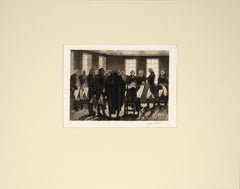
General Washington Saying Farewell to His Officers in Fraunces Tavern, New York This etching, 'General Washington Saying Farewell to His Officers in Fraunces Tavern, New York', was ...
Category

1930s American Impressionist Auguste Brouet Interior Prints

Materials

Laid Paper, Etching

William Hogarth s "Analysis of Beauty": A Set of Two Framed 18th C. Engravings
By William Hogarth
Located in Alamo, CA
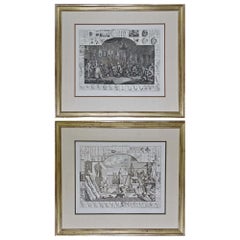
The two plates in this set were created utilizing both engraving and etching techniques by William Hogarth in 1753, originally as illustrations of his book on aesthetics, entitled "Analysis of Beauty". Due to their popularity, these plates were later published separately. The publication line in the lower right reads: "Designed, Engraved, and Publish'd by Wm. Hogarth, March 5th 1753, according to Act of Parliament." Hogarth's original copper plates were refurbished where needed by James Heath and engravings were republished in London in 1822 by Braddock, Cradock & Joy. This was the last time Hogarth's copper plates were used for printing. Most were melted during World War I for the construction of bombs. These large folio sized "Analysis of Beauty" engravings are presented in antiqued gold-colored frames with double mats; the outer silk mats are light brown-colored and the inner mats are dark brown. Each frame measures 27.38" x 31.25" x 1.13". There is one tiny spot in the right margin of plate 1 and another in the lower margin; the latter could be from the printing process. The prints are otherwise in excellent condition. The "Analysis of Beauty" series is in the collection of many major museums, including: The British Museum, The Metropolitan Museum of Art, The Tate Museum, The Chicago Art Institute and The Fine Arts Museums of San Francisco. The first engraving (Plate 1) depicts a courtyard of statues which is filled with some of the most famous works of classical sculpture. The most important sculptures are surrounded by less impressive works. The Medicean Venus (#13) is in the center with a statue of Julius Caesar (#19) to the right, elevated on a pulley with a short, overdressed Brutus stands over the falling Caesar. The Apollo Belvedere (#12) is next. A judge stands to the right with his foot on a cherub (#16). Another crying cherub holds a gallows and wipes his tears with the judge's robe. A sphinx (#21) and the drunken Silenus (#107) are below the Venus. Michaelangelo's torso (#54) and a statue of Antonius (#6) are seen in the foreground. The Farnese Hercules (#3) and a bust of another Hercules (#4) under two statuettes of Isis are also included in the scene. The key to these objects is included in the form of a serpentine line winding around a cone (#26), Hogarth's "Line of Beauty". For Hogarth the winding line is an essential element of beauty in art. Hogarth's theory of beauty is communicated in this plate. Plate 2 is thought to represent the Wanstead Assembly, with the Earl of Tynley and his household. It is an adaptation of a scene in the Happy Marriage series, which complements Hogarth's Marriage à la Mode...
Category

Mid-18th Century Old Masters Auguste Brouet Interior Prints

Materials

Engraving, Etching

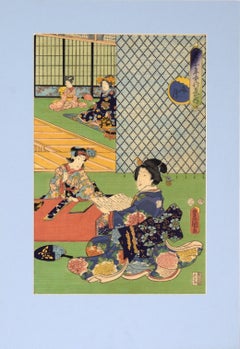
Annual Events for Young Murasaki (July) - Tales of Genji - Japanese Woodblock
By Utagawa Kunisada (Toyokuni III)
Located in Soquel, CA
Annual Events for Young Murasaki (July) - Tales of Genji - Japanese Woodblock Rightmost panel a triptych, depicting monthly events for Wakamurasaki (Young Murasaki). This is the month of July. There appears to be a lesson taking place, possibly for writing or poetry. Artist: Toyokuni III/Kunisada (1786 - 1864) Publisher: Ebisu-ya Shoshichist Presented in a new blue mat. Mat size: 19"H x 13"W Paper size: 14.5"H x 10"W Commentary on the triptych: In the Edo period, Tanabata was designated as one of the five seasonal festivals, and became an annual event for the imperial court, aristocrats, and samurai families, and gradually came to be celebrated by the general public. Its origins are said to be a combination of the Kikoden festival, which originated from the Chinese legend of Altair and the Weaver Girl, and Japan's ancient Tanabata women's faith. Ink is ground with dew that has accumulated on potato leaves, poems and wishes are written on five colored strips of paper, which are then hung on bamboo branches to celebrate the two stars that meet once a year. Although the illustration is a Genji painting...
Category

1850s Realist Auguste Brouet Interior Prints

Materials

Printer s Ink, Rice Paper, Woodcut

Kumasaka Chōhan to Ushiwakamaru - One of a Diptych Original Woodcut Print
By Utagawa Kunisada (Toyokuni III)
Located in Soquel, CA
Kumasaka Chōhan to Ushiwakamaru is a Japanese Ukiyo-e print created between 1848 and 1854 by artist Utagawa Kunisada (Japanese, 1786-1864). The print is a Diptych, and is part of the...
Category

1850s Realist Auguste Brouet Interior Prints

Materials

Printer s Ink, Rice Paper, Woodcut

"House Cleaning in Preparation for the New Year" - Japanese Woodblock on Paper
By Kitagawa Utamaro 1
Located in Soquel, CA
"House Cleaning in Preparation for the New Year" - Japanese Woodblock on Paper House cleaning scene by Kitagawa Utamaro (Japanese, 1753-1806). This print was originally published around 1796-1799, with this example being a later reprint. The full scene is five sheets - there are two more sheets to the right that show more members of the house. However, it is these three sheets that contain the majority of the action - a maid sweeping at a mouse, a lady fainting, and a painting moved aside to allow for cleaning. Presented in a new black mat. Mat size: 24"H x 38"W Paper size: 17.75"H x 33"W Print Impression: 14.63"H x 29.5"W Utamaro Kitagawa...
Category

18th Century Edo Auguste Brouet Interior Prints

Materials

Rice Paper, Woodcut

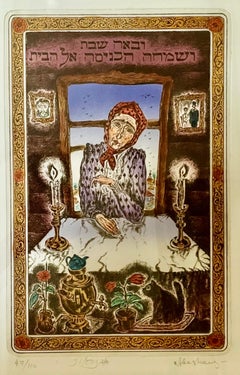
Jewish Shtetl Shabbat Candles Russian Judaica Etching w Hand Watercolor Painting
By Eugene Abeshaus
Located in Surfside, FL
EUGENE ABESHAUS Leningrad, Russia, (1939-2008) Hand-Colored, with watercolor painting, Etching hand signed in pencil in English and Hebrew Numbered 47/110 Framed 21.5 x 16. image 13.5 x 9 Eugene Abeshaus (also spelled Evgeny Abezgauz, Евгений Абезгауз in Russian; 1939–2008) was a Jewish artist who worked in Russia (then USSR) and Israel. Born in Leningrad to a typical intelligentsia family, Abeshaus was educated as an electrical engineer but soon abandoned this career and enrolled in the Mukhina School for Applied Art. By the time of his graduation from the famous “Mukha” (Fly in Russian), he had already developed a critical stance towards the official Soviet art dominated by the Communist ideology and began exhibiting at semi-underground exhibitions. This was culminated by his taking part in a famous 1975 exhibition at the Nevsky Palace of Culture. Abeshaus was fired from his job and censured by the official press – which however admitted his "artistic taste, a good sense of color and form". Soon afterwards, Abeshaus set up, together with several Jewish artists, the Alef Group and became its leader. The group’s first exhibition in November 1975 was held at Abeshauses’ small apartment. According to the Alef Manifesto written by Alek Rapoport, “We are trying to conquer the influence of small-town Jewish art and find sources for our work in deeper, wiser, and more spiritual European culture, and from it build a bridge to today and tomorrow". He was part of a generation of Russian, mostly Jewish artist's that included Oskar Rabin, Evgeny Rukhin...
Category

20th Century Modern Auguste Brouet Interior Prints

Materials

Watercolor, Etching, Paper

Auguste Brouet interior prints for sale on 1stDibs.

Find a wide variety of authentic Auguste Brouet interior prints available for sale on 1stDibs. You can also browse by medium to find art by Auguste Brouet in etching, handmade paper, paper and more. Not every interior allows for large Auguste Brouet interior prints, so small editions measuring 10 inches across are available. Auguste Brouet interior prints prices can differ depending upon medium, time period and other attributes. On 1stDibs, the price for these items starts at $850 and tops out at $850, while the average work can sell for $850.

Still Thinking About These?

All Recently Viewed