Barbara Latham Art
American, 1896-1989
Beginning her career as a commercial artist, Barbara Latham travelled to Taos in 1925 seeking material for a greeting card. Serendipitously, she also found her life partner, Howard Cook, who was similarly looking for ideas for illustrations. Perhaps both were fueled in their quest by the tales of their mutual teacher, Andrew Dasburg, who knew of the energy and stimulation of this artist community. Observing local people and customs, Latham created genre scenes that offer a window into this now-vanished time and place. Her lively illustrations for numerous children’s books are a significant contribution to that graphic art in the mid-20th century.
Born in Walpole, Massachusetts, Latham’s student days included Norwich Art School and Pratt Institute in Brooklyn; but it was contact with the charismatic Dasburg at the Art Students League in Woodstock that opened her world and her view of art. Getting work with companies like Norcross Publishing and Forum magazine, she eventually made her way to Taos. Among all the spirited young artists gathered there, she met Howard Cook, who was designing illustrations for Willa Cather’s Death Comes to the Archbishop. The two married in Santa Fe and began a nomadic life together. The young couple made their way to Paris, a likely destination for modernist artists. Upon receiving a Guggenheim to study fresco painting in 1932, Cook, along with Latham, took an alternative direction and headed to Taxco, Mexico. At this time, Mexican muralists, such as Diego Rivera, were capturing the attention of progressive artists. During the Depression, both Cook and Latham aligned themselves with a populist ideal. Latham contributed work, such as Fording the Stream and Bear Family, to the American Artists Group, which was founded to produce original prints at affordable prices. When Latham settled in Taos, she was committed to an art of and for the people. Rather than a romanticized re-creation, her choice of subjects was based in common everyday activities, favoring those which brought people together. Providing a livelihood, Latham’s illustrations for children’s books reflected her heartfelt belief in the availability of art for all, and her style of open brushwork contributed to a modernist transformation of this graphic art.
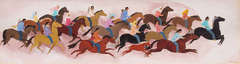
After World War II, Latham experimented with Surrealism and abstraction. Many of her painted genre scenes of the fifties simplify forms in order to intensify the interplay of color and shapes. With minimal background, figures are elegantly drawn to an essence, which seems to both capture their actions and take them out of time. Riders on horses have the same linear classicism of Parthenon sculptures, and the brilliance of figure groupings separate them from the background like a frieze.
Latham and Cook had a long-lived marriage, which was grounded in keeping their creative life separate. Latham even confessed that she did not recognize some of her husband’s work upon exhibition. In 1976, the couple moved to Santa Fe, which became their final home.
©David Cook Galleries, LLCto
1
Overall Width
to
Overall Height
to
1
1
1
1
1
1
1
1
1
1
9,980
2,753
1,376
1,373
1
1
1
Artist: Barbara Latham
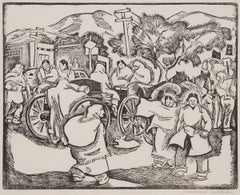
Barbara Latham 1950s Modernist Linocut “Saturday Morning, Taos Plaza”
By Barbara Latham
Located in Denver, CO
A vibrant celebration of Taos life and culture, Saturday Morning (Market, Taos Plaza, New Mexico) is a striking 1950s modernist linocut print by acclaimed New Mexico artist Barbara L...
Category
Mid-20th Century American Modern Barbara Latham Art
Materials
Linocut
Related Items
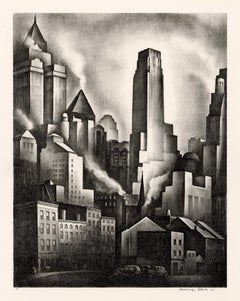
Financial District
, New York City — American Modernism
By Howard Norton Cook
Located in Myrtle Beach, SC
Howard Cook, 'Financial District', lithograph, 1931, edition 75, Duffy 155. A fine, richly-inked impression, on cream wove paper, the full sheet with wide margins (2 3/4 to 5 5/8 inches), in excellent condition. Image size 13 5/16 x 10 3/8 inches (338 x 264 mm); sheet size 23 x 16 inches (584 x 406 mm). Matted to museum standards, unframed.
Literature: 'American Master Prints from the Betty and Douglas Duffy Collection', the Trust for Museum Exhibitions, Washington, D.C., 1987.
Collections: Crystal Bridges Museum of American Art, Library of Congress, Metropolitan Museum of Art, Philadelphia Museum of Art, Smithsonian American Art Museum.
ABOUT THE ARTIST
Howard Norton Cook (1901-1980) was one of the best-known of the second generation of artists who moved to Taos. A native of Massachusetts, he studied at the Art Students League in New York City and at the Woodstock Art Colony. Beginning his association with Taos in 1926, he became a resident of the community in the 1930s. During his career, he received two Guggenheim Fellowships and was elected an Academician in the National Academy of Design. He earned a national reputation as a painter, muralist, and printmaker.
Cook’s work in the print mediums received acclaim early in his career with one-person exhibitions at the Denver Art Museum (1927) and the Museum of New Mexico (1928). He received numerous honors and awards over the years, including selection in best-of-the-year exhibitions sponsored by the American Institute of Graphics Arts, the Brooklyn Museum, the Society of American Etchers, and the Philadelphia Print Club. His first Guggenheim Fellowship took him to Taxco, Mexico in 1932 and 1933; his second in the following year enabled him to travel through the American South and Southwest.
Cook painted murals for the Public Works of Art Project in 1933 and the Treasury Departments Art Program in 1935. The latter project, completed in Pittsburgh, received a Gold Medal from the Architectural League of New York. One of his most acclaimed commissions was a mural in the San Antonio Post Office in 1937.
He and Barbara Latham settled in Talpa, south of Taos, in 1938 and remained there for over three decades. Cook volunteered in World War II as an Artist War Correspondent for the US Navy, where he was deployed in the Pacific. In 1943 he was appointed Leader of a War Art Unit...
Category
1930s American Modern Barbara Latham Art
Materials
Lithograph

$12,000
H 13.32 in W 10.38 in
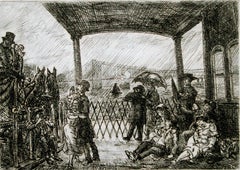
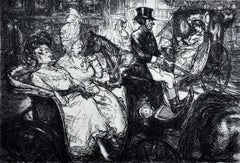
Wake on the Ferry.
By John French Sloan
Located in Storrs, CT
Wake on the Ferry. 1949. Etching. Morse catalog 313. state v. 5 x 7 (sheet 8 3/4 x 11 7/8). Edition of 350: 200 for the Art Students League and 150 for the artist. A fine impression ...
Category
1940s American Modern Barbara Latham Art
Materials
Etching
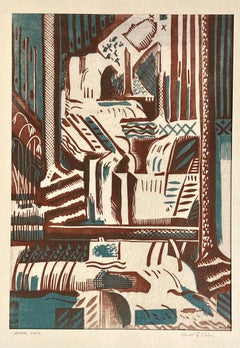
Harold E. Keeler, Water Fall
Located in New York, NY
Harold E. Keeler worked in Hollywood as a set designer. That seems especially important here because the Water Fall looks a little as though it could be a w...
Category
1930s American Modern Barbara Latham Art
Materials
Linocut
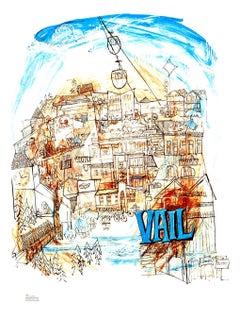
Original 1973 Vail Village Colorado vintage travel and skiing poster
Located in Spokane, WA
Original 1973 Vail Village, Colorado vintage travel and skiing poster. Preservation linen-mounted in A- condition, ready to frame.
Discover Vintage Vail Magic!
Take a trip back i...
Category
1970s American Modern Barbara Latham Art
Materials
Offset
$619
H 29.5 in W 21.5 in D 0.3 in
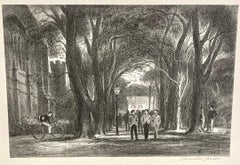
Charles Locke, McCosh Walk, Princeton University
By Charles Locke
Located in New York, NY
This lithograph is signed in pencil under the image at the lower right. Just above that, in the image, are the artist's initials and the date, 1942.
This well-known walkway on the P...
Category
1940s American Modern Barbara Latham Art
Materials
Lithograph
Original
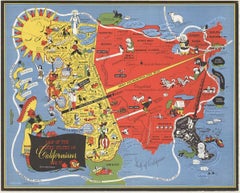
Map of the United States as Californians See It
vintage map poster
Located in Spokane, WA
Original vintage poster: "Map of the United States as Californians See It". 1947, artist: Oren Arnold. Size: 16.5" x 20.5", R. H. MOEBUS COMPANY This poster is not linen-backed. This poster is in very good fine condition, ready to frame.
A humorous satirical pictorial map from 1947 with the golden sun on the upper left, gives a detailed depiction of California, its relative size to the rest of the United States, showing Florida as "Death Valley", the rest of the United States as "Unexplored" 'Unimportant anyway, not in California". The image has your Mexican singer; bikini-clad bathers and others set in the image. Shows rivers, lakes, harbors, landmarks, parks, recreational activities, and local people.
This map shows Los Angeles’ city...
Category
1940s American Modern Barbara Latham Art
Materials
Offset
$1,280 Sale Price
20% Off
H 16.5 in W 20.5 in D 0.04 in
Roofs, Summer Night.
By John French Sloan
Located in Storrs, CT
Roofs, Summer Night. 1906. Etching. Morse catalog 137 state ii. 5 1/4 x 7 (sheet 9 1/2 x 12 1/8). Series: New York City Life. A fine impression on cream ...
Category
Early 1900s American Modern Barbara Latham Art
Materials
Etching

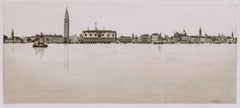
La Bella Venezia
By John Taylor Arms
Located in Middletown, NY
(New York: John Taylor Arms, 1930)
Etching on antique cream laid paper with a fancy "G" watermark, 7 1/8 x 16 1/2 inches (182 x 442 mm), full margins. Signed, dated and inscribed "Ed. 70" in pencil, lower margin. From a total edirion of 81 plus 5 trial proofs. Printed by Henry E. Carling. Number 18 from the Italian Series. A superb impression of this scarce print, with all of the subtleties and details of the reflections in the water printing clearly. [Fletcher 232]
[Illustrated: Page 192, Arms, Dorothy Noyes, "Hilltowns and Cities of Northern Italy"].
Along with his constant companion and wife, Dorothy Noyes, Arms spent decades exploring and documenting gothic structures throughout Europe. Noyes, an accomplished travel writer, had gifted Arms an etching set...
Category
1930s American Modern Barbara Latham Art
Materials
Etching
Fifth Avenue Critics.
By John French Sloan
Located in Storrs, CT
Fifth Avenue Critics. 1909. Etching. Morse 128.x/xi. 6 x 8 (sheet 9 3/4 x 12 1/4). Edition 100 in this state (few proofs in earlier states, and a large unsigned edition printed for t...
Category
Early 1900s American Modern Barbara Latham Art
Materials
Etching
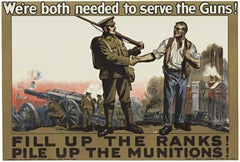
Original
We
re both needed to serve the Guns!" vintage British poster, 1915
Located in Spokane, WA
Original poster: FILL UP THE RANKS PILE UP THE MUNITIONS!
Artist: F. Gardner. Year: 1915. Horizontal original British WW1 poster. Very good cond...
Category
1910s American Modern Barbara Latham Art
Materials
Lithograph
$780 Sale Price
20% Off
H 20 in W 29 in D 0.05 in
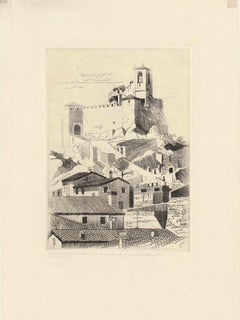
San Marino (Sketch)
By John Taylor Arms
Located in Middletown, NY
Ecthing in black ink on cream laid paper with a partial watermark, full margins. In excellent condition. A very scarce work from an edition of less than 20 impressions. Signed, date...
Category
Mid-20th Century American Modern Barbara Latham Art
Materials
Laid Paper, Etching
Original Concours Automobiles Classiques et Louis Vuitton original signed poster
By Razzia (Gérard Courbouleix–Dénériaz)
Located in Spokane, WA
Original poster: Parc de Bagatelle et Louis Vuitton 1999
Hand-signed by the artist Razzia in black marker on the left side. In plate right side.
Linen backed, ready to frame. Excellent condition.
Linen-backed Parc de Bagatelle. Concours Automobiles et Louis Vuitton. September 1999. Hand-signed by the artist in black marker in the lower left. The signature on the plate is in the lower right. This original poster is also archivally linen-backed and ready to frame.
This was the merger of Mercedes Benz and Chrysler with an automobile from each company represented. The Louis Vuitton house...
Category
1990s American Modern Barbara Latham Art
Materials
Offset

$498
H 31.5 in W 23.75 in D 0.05 in
Previously Available Items
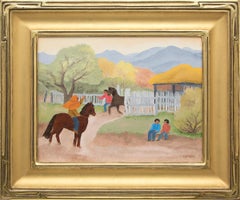
For a Sunday Ride (New Mexico)
By Barbara Latham
Located in Denver, CO
Original vintage oil painting by 20th century New Mexico artist, Barbara Latham (1896-1989), "For a Sunday Ride" depicts a horses and riders in an early autumn New Mexico Landscape w...
Category
20th Century American Modern Barbara Latham Art
Materials
Oil, Canvas
Our Mexican Kitchen
By Barbara Latham
Located in New Orleans, LA
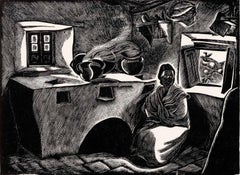
Barbara Latham created this wood engraving of the kitchen in the Taxco, Mexico home she shared with her husband, artist Howard Cook. The house that Barbara and Howard Cook rented from John Evans, the son of Mabel Dodge Luhan, is shown with the Mexican cook who worked for them. It also shows the lemon tree outside their window.
Painter, print maker, and children's book illustrator Barbara Latham was born in Walpole, Massachusetts, in 1896. She was raised in Norwich, Connecticut, and studied at the Norwich Free Academy and then attended Pratt Institute from 1915 to her graduation in 1919. She then studied with Andrew Dasburg at the Art Students League's summer school in Woodstock, New York.
She spent the early part of her career in New York, where she worked for the Norcross Publishing Company and did illustrations for Forum magazine and the New York Times Sunday magazine.
In 1925, Latham went to Taos, New Mexico, for the first time to seek material for illustrations for a greeting card company. She met artist Howard Cook, who was in the process of developing illustrations for Willa Cather's Death Comes to the Archbishop. The couple married in 1927. From 1928 to 1935, they traveled widely including to Mexico; Springfield, Massachusetts; Paris; and Connecticut. In 1933, the couple made their home near Taos. In 1976, they settled in Santa Fe.
Latham created prints and paintings of New Mexico subjects: the Taos landscape, views of the town and genre scenes depicting the seasons of rural life including that of the Taos Indians. She also illustrated children's books and did pencil drawings. Latham's illustrations for children's books included those for Pedro, Nina and Perrito, 1939, and Maggie, which was chosen as one of the best books from the period of 1945 to 1950 by the American Institute of Graphic Arts. One of her paintings, Approaching Storm, c. 1930, is an expressive painting emphasizing the orange of the earth and green of trees against the dark, stormy sky. In style, the painting is a blend of the characteristics of the New Mexico landscape, the colorful approach to landscape developed by the original Taos painters...
Category
1930s American Modern Barbara Latham Art
Materials
Wood, Engraving
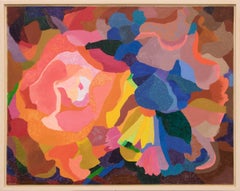
Bouquet, Modernist Abstract Painting Coral, Pink, Orange, Yellow, Blue, Green
By Barbara Latham
Located in Denver, CO
Bouquet is an original oil painting by 20th Century New Mexico Modernist woman artist, Barbara Latham (1896-1989), a mid-century modern abstract composition with Coral, Pink, Orange, Yellow, Blue and Green stylized flowers. Presented in a custom frame, outer dimensions measure 25 ½ x 31 ½ x 2 inches; image size is 24 x 29 ¾ inches.
Beginning her career as a commercial artist, Barbara Latham travelled to Taos in 1925 seeking material for a greeting card. Serendipitously, she also found her life partner, Howard Cook, who was similarly looking for ideas for illustrations. Perhaps both were fueled in their quest by the tales of their mutual teacher, Andrew Dasburg, who knew of the energy and stimulation of this artist community. Observing local people and customs, Latham created genre scenes that offer a window into this now-vanished time and place. Her lively illustrations for numerous children’s books are a significant contribution to that graphic art in the mid-20th century.
Born in Walpole, Massachusetts, Latham’s student days included Norwich Art School and Pratt Institute in Brooklyn; but it was contact with the charismatic Dasburg at the Art Students League in Woodstock that opened her world and her view of art. Getting work with companies like Norcross Publishing and Forum magazine, she eventually made her way to Taos. Among all the spirited young artists gathered there, she met Howard Cook, who was designing illustrations for Willa Cather’s Death Comes to the Archbishop. The two married in Santa Fe and began a nomadic life together.
The young couple made their way to Paris, a likely destination for modernist artists. Upon receiving a Guggenheim to study fresco painting in 1932, Cook, along with Latham, took an alternative direction and headed to Taxco, Mexico. At this time, Mexican muralists, such as Diego Rivera, were capturing the attention of progressive artists. During the Depression, both Cook and Latham aligned themselves with a populist ideal. Latham contributed work, such as Fording the Stream and Bear Family, to the American Artists Group, which was founded to produce original prints at affordable prices. The couple also traveled in the Deep South to the Ozarks and to “Alabama’s Black Belt.”
When Latham settled in Taos, she was committed to an art of and for the people. Rather than a romanticized re-creation, her choice of subjects was based in common everyday activities, favoring those which brought people together. Taos Pueblo was an ancient, indigenous community, and Latham’s view extended that tradition into a contemporary, multi-ethnic village. Sharing some of the spirit of WPA photographs...
Category
20th Century American Modern Barbara Latham Art
Materials
Oil, Board
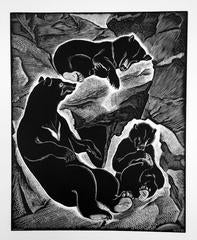
Bear Family
By Barbara Latham
Located in New York, NY
Barbara Latham (1896-1988), Bear Family, 1937, wood engraving, unsigned [signed and dated in the block]. Published by American Artists Group. In excellent condition, on an ivory wove paper, the full sheet with full margins, 10 x 8, the sheet 13 x 18 inches. Window matting, with archival board, unattached mylar hinging.
A fine impression of this charming image.
The American Artists Group was formed in 1934, during the Great Depression, with the express purpose of providing unsigned inexpensive prints which were to be widely distributed. AAG published prints by Ganso, Spruance, Meissner, Ruzicka and Lankes, among many other noted artists. Although the prices of these prints was minimal, sales were sluggish in that economy and editions werenot sold out; most printingswere under 200...
Category
1930s American Realist Barbara Latham Art
Materials
Woodcut
Acequia Madre (New Mexico)
By Barbara Latham
Located in Denver, CO
Oil on canvas. Housed in a custom hand-carved gold leaf frame; outer dimensions measure 17.75 x 29.5 x 1.5 inches. Image measures 12.5 x 24.25 inches.
Provenance:
Private Collection, Colorado
About the Artist:
Beginning her career as a commercial artist, Barbara Latham traveled to Taos in 1925 seeking material for a greeting card. Serendipitously, she also found her life partner, Howard Cook, who was similarly looking for ideas for illustrations. Perhaps both were fueled in their quest by the tales of their mutual teacher, Andrew Dasburg, who knew of the energy and stimulation of this artist community. Observing local people and customs, Latham created genre scenes that offer a window into this now-vanished time and place. Her lively illustrations for numerous children's books are a significant contribution to that graphic art in the mid-20th century.
Born in Walpole, Massachusetts, Latham's student days included Norwich Art School and Pratt Institute in Brooklyn; but it was contact with the charismatic Dasburg at the Art Students League in Woodstock that opened her world and her view of art. Getting work with companies like Norcross Publishing and Forum magazine, she eventually made her way to Taos. Among all the spirited young artists gathered there, she met Howard Cook, who was designing illustrations for Willa Cather's Death Comes to the Archbishop. The two married in Santa Fe and began a nomadic life together.
The young couple made their way to Paris, a likely destination for modernist artists. Upon receiving a Guggenheim to study fresco painting in 1932, Cook, along with Latham, took an alternative direction and headed to Taxco, Mexico. At this time, Mexican muralists, such as Diego Rivera, were capturing the attention of progressive artists. During the Depression, both Cook and Latham aligned themselves with a populist ideal. Latham contributed work, such as "Fording the Stream" and "Bear Family," to the American Artists Group, which was founded to produce original prints at affordable prices. The couple also travelled in the Deep South to the Ozarks and to "Alabama's Black Belt."
When Latham settled in Taos, she was committed to an art of and for the people. Rather than a romanticized re-creation, her choice of subjects was based in common everyday activities, favoring those which brought people together. Taos Pueblo was an ancient, indigenous community, and Latham's view extended that tradition into a contemporary, multi-ethnic village. Sharing some of the spirit of WPA photographs...
Category
20th Century Folk Art Barbara Latham Art
Materials
Oil
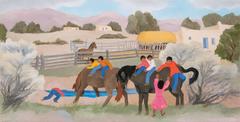
Starting on a Rabbit Hunt
By Barbara Latham
Located in Denver, CO
Framed dimensions are 15.5 x 41.5 inches.
Complimentary Shipping within the United States. Contact us for a quote on international shipping. Same Day Shipping and expedited servic...
Category
1950s Modern Barbara Latham Art
Materials
Oil, Masonite
Barbara Latham art for sale on 1stDibs.
Find a wide variety of authentic Barbara Latham art available for sale on 1stDibs. You can also browse by medium to find art by Barbara Latham in linocut, paint, watercolor and more. Much of the original work by this artist or collective was created during the 20th century and is mostly associated with the modern style. Not every interior allows for large Barbara Latham art, so small editions measuring 14 inches across are available. Customers who are interested in this artist might also find the work of John Taylor Arms, Alfred Bendiner, and Samuel Chamberlain. Barbara Latham art prices can differ depending upon medium, time period and other attributes. On 1stDibs, the price for these items starts at $795 and tops out at $1,600, while the average work can sell for $1,198.