Camille Pissarro Animal Prints

French, 1830-1903

Camille Pissarro was one of the most influential members of the French Impressionist movement and the only artist to participate in all eight Impressionist exhibitions.

Born in July of 1830 on the island of Saint Thomas in the Danish West Indies, Camille was the son of Frédéric and Rachel Pissarro. At the age of 12, he went to school in Paris, where he displayed a penchant for drawing. He returned again to Paris in 1855, having convinced his parents to allow him to pursue a career as an artist rather than work in the family import/export business. Camille studied at the Académie Suisse alongside Claude Monet, and, during this time, he met Paul Cézanne, Édouard Manet and Pierre-Auguste Renoir.

In 1869, Camille settled in Louveciennes. The outbreak of the Franco-Prussian War in 1870 prompted him to move to England, and, with Monet, Camille painted a series of landscapes around Norwood and Crystal Palace, while studying English landscape painting in the museums. Upon returning a year later at the end of the War to Louveciennes, Camille discovered that only 40 of his 1,500 paintings — almost 20 years’ work — remained undamaged.

Camille settled in Pontoise in the summer of 1871, remaining there and gathering a close circle of friends around him for the next 10 years. He reestablished relationships with Cézanne, Manet, Monet, Renoir and Edgar Degas, expressing his desire to create an alternative to the Salon, so that their group could display their own unique styles. Camille married Julie Vellay, with whom he would have seven children. Cézanne repeatedly came to stay with them, and, under Camille’s influence, he learned to study nature more patiently, even copying one of Camille’s landscapes in order to learn his teacher’s technique.

The first Impressionist group exhibition, initiated by Monet in 1874, earned the Impressionists much criticism for their art. While mainly interested in landscape, Camille introduced people — generally, peasants going about their rural occupations — and animals into his works, and they often became the focal point of the composition. It was this unsentimental and realistic approach, with the complete absence of any pretense, which seemed to stop his work from finding appreciation in the general public.

One of the few collectors who did show interest in Camille’s work was a bank employee named Paul Gauguin, who, after acquiring a small collection of Impressionist works, turned to Camille for advice on becoming a painter himself. For several years, Gauguin closely followed his mentor, and, although their friendship was fraught with disagreement and misunderstandings, Gauguin still wrote shortly before Camille’s death in 1906: “He was one of my masters, and I do not deny him.”

In the 1880s, Camille moved from Pontoise to nearby Osny, before Eragny, a small village much further from Paris. At a time when he was dissatisfied with his work, in 1885, Camille met both Paul Signac and Georges Seurat. He was fascinated by their efforts to replace the intuitive perceptive approach of the Impressionists with a “Divisionist” method, or scientific study of nature’s phenomena based on optical laws. Despite having reached his mid-50s, Camille did not hesitate to follow the two young innovators. The following year, he passed on this new concept to Vincent Van Gogh, who had just arrived in Paris and was keen to learn of the most recent developments in art. However, after a few years, Camille felt restricted by Seurat’s theories and returned to his more spontaneous technique while retaining the lightness and purity of color acquired during his Divisionist phase.

In the last years of his life, Camille divided his time between Paris, Rouen, Le Havre and Eragny, painting several series of different aspects of these cities, with varying light and weather effects. Many of these paintings are considered among his best and make for an apt finale to his long and prodigious career.

When Camille Pissarro died in the autumn of 1903, he had finally started to gain public recognition. Today his work can be found in many of the most important museums and collections throughout the world.

Find original Camille Pissarro art on 1stDibs.

(Biography provided by Stern Pissarro Gallery)

to
1
Overall Width
to
Overall Height
to
16
195
162
119
97
1
1
1
1
1
1
1
1
Artist: Camille Pissarro
19th century black and white etching aquatint outdoors figurative animal print
By Camille Pissarro
Located in Milwaukee, WI
"Vachere au Bord de L'Eau" is an original etching and aquatint by Camille Pissarro, the 8th state. It can be found in the catalogue raisonne Delteil #93. It features a woman sitting ...
Category

1890s Realist Camille Pissarro Animal Prints

Materials

Etching, Aquatint

Related Items
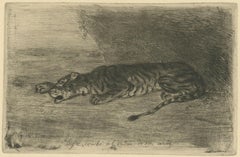
Tigre couché à l entrée de son antre (Tiger Lying at the Entrance to its Lair)
By Eugène Delacroix
Located in Middletown, NY
Etching, drypoint, and roulette on watermarked Hallines cream laid paper, 3 3/4 x 5 7/8 inches (95 x 148 mm), full margins. A very good impression of this charming image, with all of...
Category

Early 19th Century Realist Camille Pissarro Animal Prints

Materials

Laid Paper, Drypoint, Etching

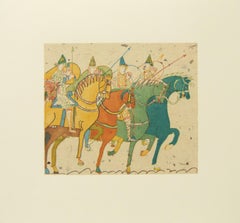
Untitled (Horses)
By Laura Owens
Located in New York, NY
Los Angeles-based artist, Laura Owens' horse prints often incorporate her characteristic style, which challenges traditional assumptions about figuration and abstraction . Her work f...
Category

Early 2000s Contemporary Camille Pissarro Animal Prints

Materials

Etching, Aquatint

Untitled (Horses)
Untitled (Horses)
$3,000
H 21 in W 19 in D 1 in
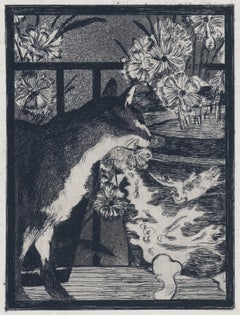
Le Chat et les Fleurs (from "Les Chats par Champfleury")
By Édouard Manet
Located in Kansas City, MO
Edouard Manet Le Chat et les Fleurs (from "Les Chats par Champfleury") 1869 Etching and aquatint on Rives paper Image: 6.25 x 5.125 (17.3 × 13 cm) Plate: 8 x 6 inches (20.3 x 15.2 c...
Category

1860s Impressionist Camille Pissarro Animal Prints

Materials

Etching, Aquatint

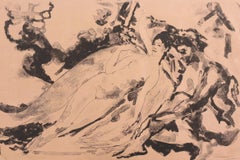
Lida the Swan , New York Armory Show, Ashcan School, ASL, NYMOMA, AIC, LACMA
By Arthur B. Davies
Located in Santa Cruz, CA
Signed lower right, 'Arthur B. Davies' for Arthur Bowen Davies (American, 1862-1928) and created circa 1915. An early twentieth-century sugar-lift aquatint showing Zeus in the guise...
Category

Early 1900s Camille Pissarro Animal Prints

Materials

Paper, Aquatint

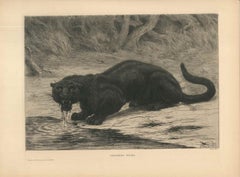
Black Panther - Etching and Aquatint by Evert van Muyden - 1901
By Evert Louis van Muyden
Located in Roma, IT
Panthère noire is a wonderful etching and aquatint on cream-colored laid paper, realized in 1901 by Evert Van Muyden (1853-1922). Signed and dated on plate, this beautiful plate was...
Category

Early 1900s Camille Pissarro Animal Prints

Materials

Etching, Aquatint

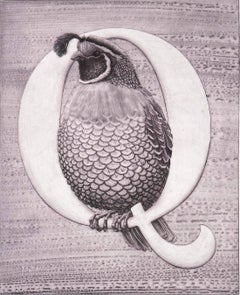
"Q", for Quail, from Kelvin Mann s animal Alphabet
By Kelvin Mann
Located in Palm Springs, CA
The single letter "Q", from the alphabet, illustrated by a quail. All letters are available, and the full set of 27 etchings in folio box is available for $3200. Animals, real and im...
Category

2010s Contemporary Camille Pissarro Animal Prints

Materials

Etching, Aquatint

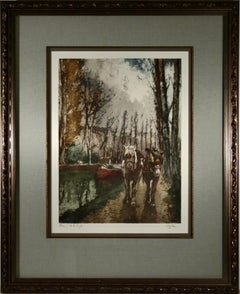
Chemin de Halage
Located in San Francisco, CA
This artwork titled "Chemin de Halage" c.1930 is a color etching with aquatint on Wove paper by French artist Ferdinand Jean Luigini, 1870-1943. It is hand signed and titled in penci...
Category

Early 20th Century Impressionist Camille Pissarro Animal Prints

Materials

Etching, Aquatint

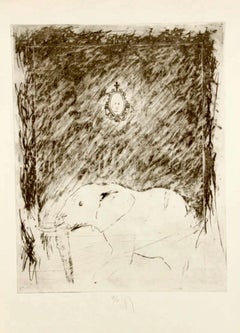
Large Donald Saff Surrealist Pop Art Aquatint Etching African Elephant
By Donald Saff
Located in Surfside, FL
Artist: Donald Saff Medium: Etching with Aquatint, Hand signed and numbered in pencil. Donald Jay Saff (born 12 December 1937) is an artist, art historian, educator, and lecturer, ...
Category

1980s Pop Art Camille Pissarro Animal Prints

Materials

Etching, Aquatint

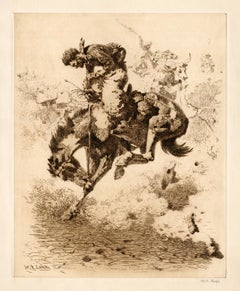
Foul Rope (Left) — Early American Southwest Rodeo
By William Robinson Leigh
Located in Myrtle Beach, SC
William Robinson Leigh, 'Foul Rope (Left)', etching, c. 1920, edition unknown but small. Signed in pencil and signed in the plate, lower left. A superb, richly-inked impression, in dark brown ink, on buff wove Umbria paper, the full sheet with margins (1 1/2 to 2 3/4 inches); slight toning at the sheet edges, otherwise in excellent condition. Very scarce. Archivally matted to museum standards, unframed. Image size 14 7/8 x 11 15/16 inches (378 x 303 mm); sheet size 20 3/8 x 15 3/8 inches (518 x 391 mm). ABOUT THE ARTIST Born near Falling Waters, West Virginia, on a plantation a year after the Civil War and raised in Baltimore, William Robinson Leigh (1866 - 1955) became one of the foremost painters of the American West. His career spanning some seventy-five years, Leigh created some of the most iconic depictions of the Western landscape, with admirers referring to him as ‘The Sagebrush Rembrandt.’ The son of impoverished Southern aristocrats, Leigh received his first art training at age 14 from Hugh Newell at the Maryland Institute, where he was regarded as the best student in his class. From 1883 to 1895, he studied in Europe, mainly at the Royal Academy in Munich with Ludwig Loefftz. From 1891 to 1896, he painted six cycloramas or murals in the round, a giant German panorama. In 1896, Leigh began working as a magazine illustrator for Scribner's and Collier's Weekly Magazine in New York City. He also painted portraits, landscapes, and genre scenes. Leigh's trips to the Southwest began in 1906 when he agreed to paint the Grand Canyon with William Simpson, Santa Fe Railway advertising manager, in exchange for free transportation West. In 1907, he completed his Grand Canyon painting, which led to more commissions and an extensive painting trip through Arizona and New Mexico. These travels inspired him to paint western subjects for the next 50 years, and his primary interests were the Hopi and Navajo Indians. In 1910, he traveled to Wyoming, where he painted in Yellowstone Park and created sketches, many of which he later converted into large canvases such as ‘Lower Falls of the Yellowstone’ (1915) and ‘Grand Canyon of the Yellowstone’ (1911). In 1926, he traveled to Africa at the invitation of Carl Akeley for the American Museum of Natural History, and from this experience, wrote and illustrated 'Frontiers of Enchantment: An Artist's Adventures in Africa'. In 1933, he wrote and illustrated 'The Western Pony'. His adventures were chronicled in several popular magazines, including Life, the Saturday Evening Post, and Colliers. For many years, Grand Central Art Galleries at the Biltmore Hotel handled his work exclusively in New York. In 1953, Leigh was elected an associate member of the National Academy of Design and became a full Academician in 1955. In March 1999, the Historical Center of Cody, Wyoming, held an exhibition of his field sketches and finished works depicting his experiences near Cody early in the century. Between 1910 and 1921, when he often painted in the Carter Mountain vicinity, these years were considered pivotal to his artistic development and devotion to the Western landscape. Leigh's work is held in many museum collections of American Western art...
Category

1920s Realist Camille Pissarro Animal Prints

Materials

Etching

Great Horned Owl, Etching on paper, pencil signed, titled and annotated Proof
By Christine McGinnis
Located in New York, NY
Christine McGinniss Charming, 1960s work - makes a wonderful gift Etching with plate tone on off-white wove paper Pencil titled and signed Artists Proof, aside from the regular editi...
Category

1960s Realist Camille Pissarro Animal Prints

Materials

Etching

Skull
By Arnold A. Grossman
Located in San Francisco, CA
This artwork titled "Skull" c.1990 is an original color etching and aquatint by noted California artist Arnold A. Grossman, 1923-2016. It is hand signed in pencil by the artist. The ...
Category

Late 20th Century American Impressionist Camille Pissarro Animal Prints

Materials

Aquatint

Skull
Skull
$300
H 15 in W 20.75 in D 0.01 in
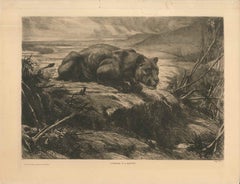
Lionne à l affût - Etching and Aquatint by Evert van Muyden - 1900
By Evert Louis van Muyden
Located in Roma, IT
Lionne à l'affût is a wonderful etching on cream-colored laid paper, realized in 1900 by Evert Van Muyden (1853-1922). Signed and dated on plate on the lower left margin, this beaut...
Category

Early 1900s Camille Pissarro Animal Prints

Materials

Etching, Aquatint

Previously Available Items
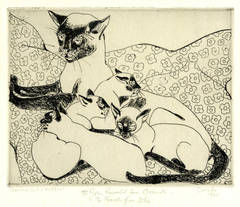
Siamese Cats and Kittens
By Camille Pissarro
Located in Fairlawn, OH
Signed, dated and titled in pencil; Dedicated in pencil - "To John Rewald from Orovida, To Francis from John" Provenance: Gift of the artist- John Rewald (1912- 1994), noted au...
Category

1940s Camille Pissarro Animal Prints

Camille Pissarro animal prints for sale on 1stDibs.

Find a wide variety of authentic Camille Pissarro animal prints available for sale on 1stDibs. You can also browse by medium to find art by Camille Pissarro in aquatint, etching and more. Not every interior allows for large Camille Pissarro animal prints, so small editions measuring 18 inches across are available. Customers who are interested in this artist might also find the work of Francois Nicolas Martinet, Leon Danchin, and Carl Arlen. Camille Pissarro animal prints prices can differ depending upon medium, time period and other attributes. On 1stDibs, the price for these items starts at $10,150 and tops out at $10,150, while the average work can sell for $10,150.
Questions About Camille Pissarro Animal Prints
  • 1stDibs ExpertFebruary 13, 2024
    Camille Pissarro was born in the Danish West Indies to Jewish parents of Portuguese and French descent. At the age of 12, he went to school in Paris, where he displayed a penchant for drawing. Pissarro would go on to become one of the most influential members of the French Impressionist movement and the only artist to participate in all eight Impressionist exhibitions. On 1stDibs, shop a variety of Camille Pissarro art.
  • 1stDibs ExpertApril 5, 2022
    Camille Pissarro was a Dutch-French painter whose primary style of painting was French Impressionism, although he explored a variety of styles, including Realism and Neo-Impressionism. His brilliant canvasses are covered with splashes of pure pigment in energetic brushstrokes. Find a collection of Camille Pissarro art from top sellers on 1stDibs.

Recently Viewed

View All