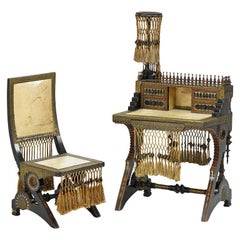
Carlo Bugatti Desks
Imaginative, bold and full of poetic details, the work of Carlo Bugatti pushed the boundaries of the Art Nouveau style. The Italian furniture designer and decorative artist’s celebrated chairs, tables and other pieces are representative of a range of influences that include European Gothic, Moorish traditions and classical Japanese art. Bugatti’s appetite for experimentation with new forms and materials has fueled the imaginations of designers everywhere.
Bugatti was born in 1856 in Milan. The son of successful interior decorator, sculptor and architect Giovanni Bugatti, Carlo set out to follow in his father’s footsteps, studying architecture at the Accademia di Belle Arti di Brera and working as a cabinetmaker. He moved to Paris in 1875 to continue his studies in design at the prestigious Academie des Beaux-Arts. By the early 1880s, Bugatti had moved back to Milan to continue his career in furniture design.
Antique Bugatti seating, center tables and other large furnishings are visually striking in their level of ornamentation. These works feature hand-carved motifs and were frequently inlaid with luxury materials such as mother-of-pearl, ebony and brass — his distinctive Throne chair (ca. 1900), for example, featured pierced copper and vellum. Detailed themes rooted in nature, stencils and geometric patterns adorn his venturesome decorative screens and handcrafted mahogany and walnut chairs and tables.
In 1888, the designer displayed his work publicly for the first time, showcasing pieces at the Industrial Arts Exhibition in Milan and later at the Italian Exhibition in London. His flamboyant furniture led to his becoming an overnight success among members of the aristocracy, who flooded him with commissions to design custom furniture for their homes. In 1904, Bugatti and his family moved to France, where designed furniture for department stores such as Maison Dufayel and Le Bon Marché. His two sons also pursued work in design — Rembrandt Bugatti became a noted sculptor while Ettore gained renown as a leading automobile designer and manufacturer.
Although his furniture became increasingly subdued in appearance over the years — and he would eventually begin to design serveware and jewelry — Bugatti garnered acclaim throughout his career. He received an award at the 1900 Paris Exposition and exhibited interiors and a furniture collection at the inaugural International Exposition of Modern Decorative Arts in Turin, Italy, in 1902. Today, Bugatti’s work remains on permanent display at the Musée de la Chartreuse in Molsheim, France.
Find antique Carlo Bugatti seating, tables and case pieces on 1stDibs.
1910s Italian Art Nouveau Vintage Carlo Bugatti Desks
Copper, Pewter
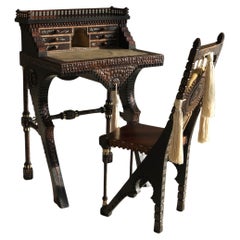
1890s Chinese Chinese Chippendale Antique Carlo Bugatti Desks
Mahogany
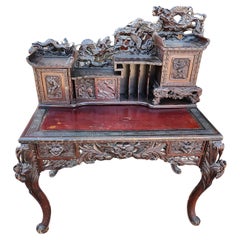

1960s North American Mid-Century Modern Vintage Carlo Bugatti Desks
Iron
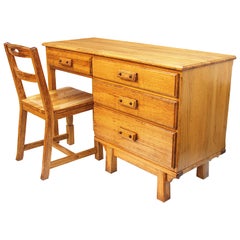
Early 1900s Italian Art Nouveau Antique Carlo Bugatti Desks
Wood
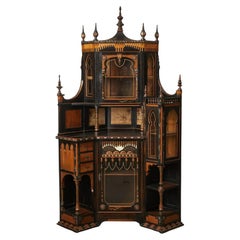
1940s Mid-Century Modern Vintage Carlo Bugatti Desks
Wood
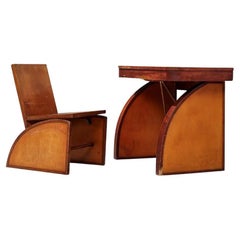
20th Century Arts and Crafts Carlo Bugatti Desks
Oak
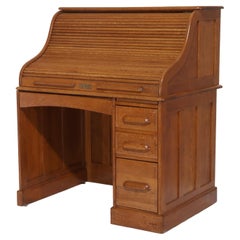
1950s American Vintage Carlo Bugatti Desks
Iron
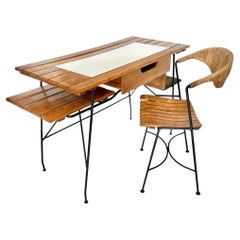
Early 20th Century Lebanese Moorish Carlo Bugatti Desks
Wood, Cedar
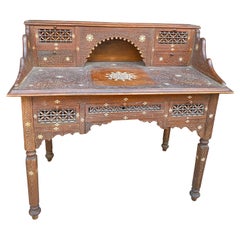
2010s Italian Modern Carlo Bugatti Desks
Leather, Wood
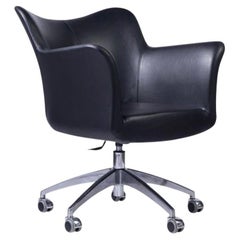
Early 1900s Swedish Jugendstil Antique Carlo Bugatti Desks
Mahogany
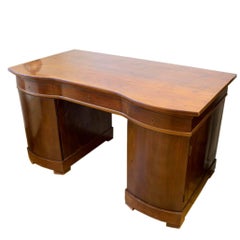
1950s Spanish Vintage Carlo Bugatti Desks
Ceramic

Early 20th Century American Arts and Crafts Carlo Bugatti Desks
Brass
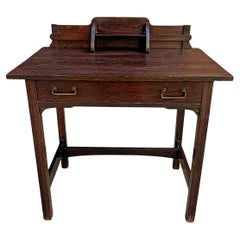
Early 20th Century Swedish Jugendstil Carlo Bugatti Desks
Bronze
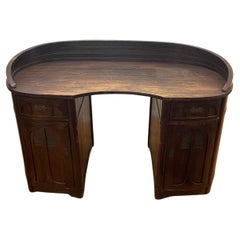
Early 1900s Italian Moorish Antique Carlo Bugatti Desks
Walnut