Carol Wax Figurative Prints
American, b. 1953
Carol Wax originally trained to be a classical musician at the Manhattan School of Music but fell in love with printmaking. Soon after she began engraving mezzotints she was asked by the renowned print dealer Sylvan Cole to exhibit at Associated American Artists Gallery, launching her career as a professional artist/printmaker. With the publication of her book, The Mezzotint: History and Technique, published by Abrams, 1990 and 1996, Carol added author and teacher to her credits. In the ensuing years she has expanded her repertoire of mediums beyond printmaking into other works on paper and painting.
Recognition of Carol's art includes an Individual Support Grant from the Adolph and Esther Gottlieb Foundation, Inc., two Artist Fellowships from the New York Foundation for the Arts, a Concordia Career Advancement Award from NYFA, The Louise Nevelson Award for Excellence in Printmaking from the American Academy of Arts and Letters, and residences at The MacDowell Colony and Marie Walsh Sharpe Art Foundation's Space Program. A selection of the many collections that own her prints are The Metropolitan Museum of Art, The New York and Boston Public Libraries, The Philadelphia Museum of Art, The Library of Congress, and The National Museum of American Art, Smithsonian Institution.to
1
1
Overall Width
to
Overall Height
to
1
25
860
382
366
310
1
1
1
1
1
1
1
Artist: Carol Wax
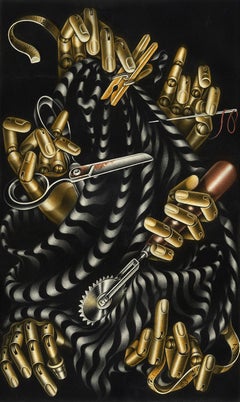
Sew What (the swells and swirls of the stripes are now in the hands of others)
By Carol Wax
Located in New Orleans, LA
"Sew What" is a color mezzotint with burin engraving created in an edition of 35. This impression is #6. I love sumptuously designed textiles in both real life and art. Patterns metamorphosing over fabric folds appeal to my interest in modulating rhythmic forms, particularly the swells and swirls of calligraphic stripes. I’m also fascinated by articulated wooden hand models, which appear in many of my paintings. Combining these passions with sewing paraphernalia from my seamstress days provided inspiration for my color mezzotint engraving "Sew What".
Carol Wax originally trained to be a classical musician at the Manhattan School of Music but fell in love with printmaking. Soon after she began engraving mezzotints she was asked by the renowned print dealer...
Category
21st Century and Contemporary Contemporary Carol Wax Figurative Prints
Materials
Mezzotint
Related Items
"King of the Friendly Islands" (Tonga); Engraving from Captain Cook
s 3rd Voyage
By John Webber
Located in Alamo, CA
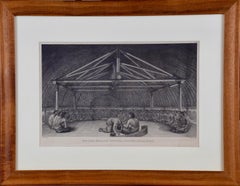
"Poulaho, King of the Friendly Islands, Drinking Kava" is an engraving created by William Sharp (1749-1824), from a drawing by John Webber (1752-1793), who was the artist on Captain James Cook's 3rd and final voyage of discovery. It was published in the atlas of "A Voyage to the Pacific Ocean Undertaken by the Command of His Majesty, for Making Discoveries in the Northern Hemisphere", the official British Admirality sanctioned journal published upon completion of the voyage in London in 1784 by Strahan & Cadell.
Captain Cook visited Tonga on his 3rd voyage, which he named The Friendly Islands because of the warm welcome he and his crew received, unlike some of the other more hostile Pacific islands. The engraving depicts Cook and his men observed a kava ceremony at the village of Mu’a on Tongatapu. King Paulaho sits in the centre foreground, his back to the spectator with a man kneeling before him. The ceremonial mat depicted behind Paulaho indicates that nobody was allowed to sit behind him. The figure in the centre holds a single cup, referring to the Tongan custom of offering the cup to the king first. Kava is native to the islands of the South Pacific and was first described for English readers in 1768 by Captain James Cook. The kava root has been used for centuries as a central feature of ceremonies and celebrations because it was able to bring about a calming and pleasant social atmosphere. The root was crushed and processed into coconut milk to become the focal ceremonial beverage, simply referred to as kava.
This engraving is presented in a Koa wood frame and a white mat. Koa wood is legendary in Hawaii. There are occasional faint spots, but the print is otherwise in very good condition. This amazing Koa wood is native to Hawaii and it is known for the deep rich colors and varied grain pattern. Koa has an honored heritage in Hawaii and is highly revered and sacred. The word “koa” means “warrior” in Hawaiian. The warriors of King Kamehameha the Great, created canoes and weapons from a wood plentiful on the Big Island of Hawaii. This wood became synonymous with the warriors themselves, and it became known as koa.
There are three other engravings listed from the official journal of Captain Cook's 3rd voyage available that are presented in identical Koa wood frames and mats (LU117324682422, LU117324684052, LU117324684032). They would make a wonderful grouping for a display of 2, 3 or 4 prints. A discount is available for a grouping depending on the number of items included.
Captain Cook is remembered as one of the greatest explorers and navigators in history. His explorations included Australia, New Zealand and islands of the South Pacific and the northwest coast of North America. Hawaii was discovered by Captain Cook during this voyage. Hawaii was originally called The Sandwich Islands in honor of The Earl of Sandwich...
Category
1780s Realist Carol Wax Figurative Prints
Materials
Engraving

$1,900 Sale Price
20% Off
H 18.25 in W 23.5 in D 0.88 in
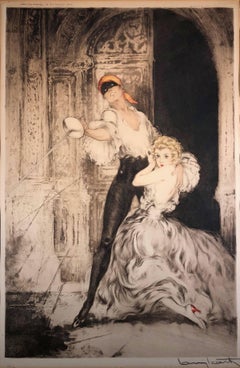
Don Juan
By Louis Icart
Located in Missouri, MO
Aquating Engraving
Image Size: approx. 20 1/4 x 13 3/8
Framed Size: 28 x 20.5 inches
Pencil Signed Lower Right
Louis Justin Laurent Icart was born in Toulouse in 1890 and died in Paris in 1950. He lived in New York City in the 1920s, where he became known for his Art-Deco color etchings of glamourous women.
He was first son of Jean and Elisabeth Icart and was officially named Louis Justin Laurent Icart. The use of his initials L.I. would be sufficient in this household. Therefore, from the moment of his birth he was dubbed 'Helli'. The Icart family lived modestly in a small brick home on rue Traversière-de-la-balance, in the culturally rich Southern French city of Toulouse, which was the home of many prominent writers and artists, the most famous being Henri de Toulouse-Lautrec.
Icart entered the l'Ecole Superieure de Commerce de Toulouse in order to continue his studies for a career in business, particularly banking (his father's profession). However, he soon discovered the play writings of Victor Hugo (1802-1885), which were to change the course of his life. Icart borrowed whatever books he could find by Hugo at the Toulouse library, devouring the tales, rich in both romantic imagery and the dilemmas of the human condition. It was through Icart's love of the theater that he developed a taste for all the arts, though the urge to paint was not as yet as strong for him as the urge to act.
It was not until his move to Paris in 1907 that Icart would concentrate on painting, drawing and the production of countless beautiful etchings, which have served (more than the other mediums) to indelibly preserve his name in twentieth century art history.
Art Deco, a term coined at the 1925 Paris Exposition des Arts Decoratifs, had taken its grip on the Paris of the 1920s. By the late 1920s Icart, working for both publications and major fashion and design studios, had become very successful, both artistically and financially. His etchings reached their height of brilliance in this era of Art Deco, and Icart had become the symbol of the epoch. Yet, although Icart has created for us a picture of Paris and New York life in the 1920s and 1930s, he worked in his own style, derived principally from the study of eighteenth-century French masters such as Jean Antoine Watteau, François Boucher and Jean Honoré Fragonard.
In Icart's drawings, one sees the Impressionists Degas...
Category
1920s Art Deco Carol Wax Figurative Prints
Materials
Engraving, Aquatint
Jesus and the Woman at the Well,
by Amand-Durand, Engraving
By Armand Durand
Located in Oklahoma City, OK
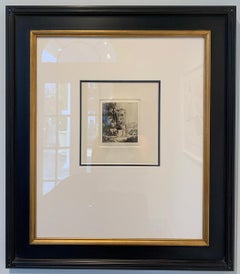
This early 19th century framed 35" x 31" engraving by artist Amand-Durand depcits an etching of 'Jesus and the Woman at the Well,' after the Dutch master, Rembrandt van Rijn. This poignant Biblical story is depicted by Arman-Durand in Rembrandt style...
Category
Early 19th Century Old Masters Carol Wax Figurative Prints
Materials
Engraving
$1,200 Sale Price
20% Off
H 30.5 in W 26.5 in D 1.5 in
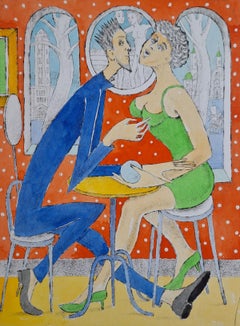
In the cafeteria - Figurative Drypoint Print, Colorful, Polish Art
By Czeslaw Tumielewicz
Located in Warsaw, PL
CZESLAW TUMIELEWICZ (b. 1942)
In 1968, he studied at the Architecture faculty of Gdank, before continuing his course at the Technical University in the same city, and then he taught ...
Category
Early 2000s Contemporary Carol Wax Figurative Prints
Materials
Paper, Drypoint, Watercolor
$332 Sale Price
20% Off
H 10.83 in W 8.08 in
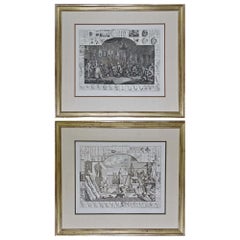
William Hogarth
s "Analysis of Beauty": A Set of Two Framed 18th C. Engravings
By William Hogarth
Located in Alamo, CA
The two plates in this set were created utilizing both engraving and etching techniques by William Hogarth in 1753, originally as illustrations of his book on aesthetics, entitled "Analysis of Beauty". Due to their popularity, these plates were later published separately. The publication line in the lower right reads: "Designed, Engraved, and Publish'd by Wm. Hogarth, March 5th 1753, according to Act of Parliament." Hogarth's original copper plates were refurbished where needed by James Heath and engravings were republished in London in 1822 by Braddock, Cradock & Joy. This was the last time Hogarth's copper plates were used for printing. Most were melted during World War I for the construction of bombs.
These large folio sized "Analysis of Beauty" engravings are presented in antiqued gold-colored frames with double mats; the outer silk mats are light brown-colored and the inner mats are dark brown. Each frame measures 27.38" x 31.25" x 1.13". There is one tiny spot in the right margin of plate 1 and another in the lower margin; the latter could be from the printing process. The prints are otherwise in excellent condition.
The "Analysis of Beauty" series is in the collection of many major museums, including: The British Museum, The Metropolitan Museum of Art, The Tate Museum, The Chicago Art Institute and The Fine Arts Museums of San Francisco.
The first engraving (Plate 1) depicts a courtyard of statues which is filled with some of the most famous works of classical sculpture. The most important sculptures are surrounded by less impressive works. The Medicean Venus (#13) is in the center with a statue of Julius Caesar (#19) to the right, elevated on a pulley with a short, overdressed Brutus stands over the falling Caesar. The Apollo Belvedere (#12) is next. A judge stands to the right with his foot on a cherub (#16). Another crying cherub holds a gallows and wipes his tears with the judge's robe.
A sphinx (#21) and the drunken Silenus (#107) are below the Venus. Michaelangelo's torso (#54) and a statue of Antonius (#6) are seen in the foreground. The Farnese Hercules (#3) and a bust of another Hercules (#4) under two statuettes of Isis are also included in the scene.
The key to these objects is included in the form of a serpentine line winding around a cone (#26), Hogarth's "Line of Beauty". For Hogarth the winding line is an essential element of beauty in art. Hogarth's theory of beauty is communicated in this plate.
Plate 2 is thought to represent the Wanstead Assembly, with the Earl of Tynley and his household. It is an adaptation of a scene in the Happy Marriage series, which complements Hogarth's Marriage à la Mode...
Category
Mid-18th Century Old Masters Carol Wax Figurative Prints
Materials
Engraving, Etching
$2,380 Sale Price
20% Off
H 27.38 in W 31.25 in D 1.13 in
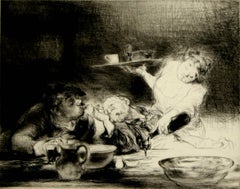
Vin Rouge (Red Wine)
By Edmund Blampied
Located in Storrs, CT
1932. Drypoint. Appleby 167. 9 1/4 x 11 5/8 (sheet 11 3/8 x 17 15/16). Edition 100 #48. Mat line, well outside the image; otherwise excellent condition. A rich impression with drypo...
Category
1930s Modern Carol Wax Figurative Prints
Materials
Drypoint
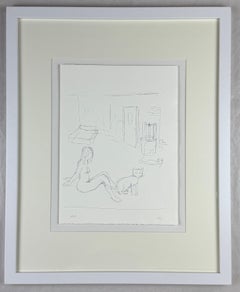
Xisco Mensua Spanish artist 1995 original signed framed engraving print n2
By Xisco Mensua
Located in Miami, FL
Xisco Mensua (Spain, 1960)
Untitled from Portfolio "Junio - Julio", 1995
engraving on paper
12.6 x 9.5 in. (32 x 24 cm.)
Edition of 6
Frame 16x20 in.
ID: MEN1253-002
Hand-signed by a...
Category
1990s Contemporary Carol Wax Figurative Prints
Materials
Paper, Engraving
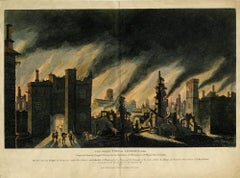
The Great Fire of London, 1666
By James Stow
Located in Middletown, NY
A rare early 19th century view of the Great Fire of London over Ludgate, enhanced with hand coloring.
London: Robert Wilkinson, 1811.
Copperplat...
Category
Early 19th Century English School Carol Wax Figurative Prints
Materials
Handmade Paper, Engraving, Watercolor
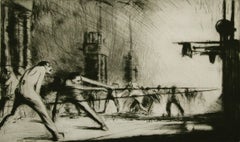
France at her Furnaces
By James McBey
Located in Storrs, CT
1917. Etching. Hardie 175. 8 x 15 (sheet 10 1/8 x 16 15/16). Edition 76. Slight mat line; otherwise excellent condition. A rich impression printed on antique laid paper with full m...
Category
1910s Modern Carol Wax Figurative Prints
Materials
Drypoint, Etching
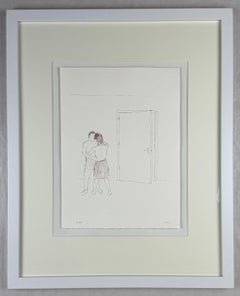
Xisco Mensua Spanish artist 1995 original signed framed engraving print n3
By Xisco Mensua
Located in Miami, FL
Xisco Mensua (Spain, 1960)
Untitled from Portfolio "Junio - Julio", 1995
engraving on paper
12.6 x 9.5 in. (32 x 24 cm.)
Edition of 6
Frame 16x20 in.
ID: MEN1253-003
Hand-signed by a...
Category
1990s Contemporary Carol Wax Figurative Prints
Materials
Paper, Engraving
La diligence de Beaucaire
By Félix Hilaire Buhot
Located in Middletown, NY
Paris: Lemerre, 1880.
Etching, drypoint, aquatint (dust ground and spirit ground), spit bite, and roulette in black on cream laid paper with a deckle edge, 6 3/4 x 4 1/2 inches (170 x 112 mm), full margins. Third state (of 3). An illustration from Alphonse Daudet's, Lettres de mon moulin, Paris, 1880. In very good condition with some light uniform toning and two areas of paper tape at the top right and left corners on the verso (from a former mount). With the 1921 J.H. de Bois circular ink stamp in green ink in the lower right margin on the recto (Lugt L.733).
[Bourcard 110].
A note regarding the provenance:
J. H. de Bois was a well known late-19th century modern art...
Category
1880s French School Carol Wax Figurative Prints
Materials
Laid Paper, Drypoint, Etching, Aquatint

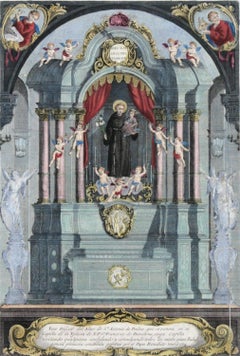
Altar de St. Antonio de Padua Hand Colored Engraving 1724
Located in Paonia, CO
Anthony of Padua or Anthony of Lisbon born Fernando Martins de Bulhoes 15 August 1195 – 13 June 1231) was a Portuguese Catholic priest and friar of the Franciscan Order. He was born and raised by a wealthy family in Lisbon, Portugal, and died in Padua, Italy. Noted by his contemporaries for his powerful preaching, expert knowledge of scripture, and undying love and devotion to the poor and the sick, he was one of the most quickly canonized saints in church history, being canonized less than a year after his death. He was proclaimed a Doctor of the Church by Pope Pius XII...
Category
1720s Baroque Carol Wax Figurative Prints
Materials
Engraving
Previously Available Items
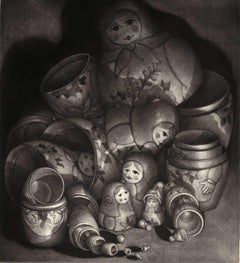
Matryoshka (Russian nesting dolls / No Collusion, No Obstruction)
By Carol Wax
Located in New Orleans, LA
Thirty five years ago, Carol Wax created an image that might seem more relevant in today's political setting. Traditional Russian dolls of decreasing size nested inside of one anothe...
Category
Late 20th Century American Modern Carol Wax Figurative Prints
Materials
Mezzotint
H 11.75 in W 10.75 in
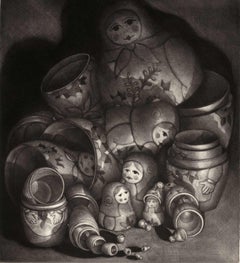
Matryoshka (Russian nesting dolls / No Collusion, No Obstruction)
By Carol Wax
Located in New Orleans, LA
Thirty five years ago, Carol Wax created an image that might seem more relevant in today's political setting. Traditional Russian dolls of decreasing size nested inside of one anothe...
Category
Late 20th Century American Modern Carol Wax Figurative Prints
Materials
Mezzotint
H 11.75 in W 10.75 in
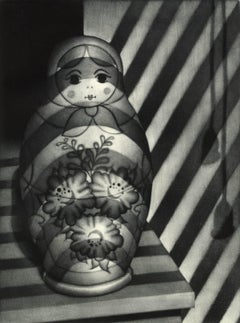
Venetian Blinds Russian Doll (Matryoshka resting dolls with light from blinds)
By Carol Wax
Located in New Orleans, LA
Thirty five years ago, Carol Wax created an image that might seem more relevant in today's political setting. Traditional Russian dolls of decreasing size nested inside of one another continue to surprise as smaller and smaller figures are discovered when opened. The Russian doll is posed in the light coming through venetian blinds...
Category
Late 20th Century American Modern Carol Wax Figurative Prints
Materials
Mezzotint
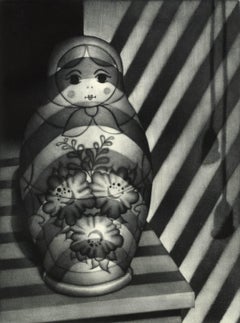
Venetian Blinds Russian Doll (Matryoshka resting dolls with light from blinds)
By Carol Wax
Located in New Orleans, LA
Thirty five years ago, Wax created an image that might seem more relevant in today's political setting. Traditional Russian dolls of decreasing size nested inside of one another continue to surprise as smaller and smaller figures are discovered when opened. The Russian doll is posed in the light coming through venetian blinds...
Category
Late 20th Century American Modern Carol Wax Figurative Prints
Materials
Mezzotint
Carol Wax figurative prints for sale on 1stDibs.
Find a wide variety of authentic Carol Wax figurative prints available for sale on 1stDibs. You can also browse by medium to find art by Carol Wax in engraving, mezzotint and more. Much of the original work by this artist or collective was created during the 21st century and contemporary and is mostly associated with the contemporary style. Not every interior allows for large Carol Wax figurative prints, so small editions measuring 12 inches across are available. Customers who are interested in this artist might also find the work of Thomas McKnight, Sara Zielinski, and Juan Fuentes. Carol Wax figurative prints prices can differ depending upon medium, time period and other attributes. On 1stDibs, the price for these items starts at $825 and tops out at $825, while the average work can sell for $825.