César Baldaccini Animal Prints
French, 1921-1998
César Baldaccini was born to immigrant Italian parents in Marseille and his life span was from 1921–98. He was considered to be one of the most important French artists and sculptors of the 20th century. Much of his work involved the compression of junk material and automobile material. He became associated with the 1960s Paris based Nouveau réalisme movement. Most importantly, Baldaccini just had a major retrospective at the Pompidou Center in Paris. His work is very collectible and desirable.
to
1
1
Overall Width
to
Overall Height
to
1
29
192
158
115
99
2
2
2
2
1
1
1
1
1
1
1
1
Artist: César Baldaccini
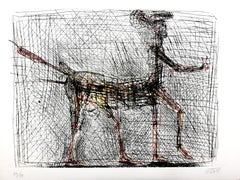
César - Centaur - Picasso
s Homage - Original Signed Etching
By César Baldaccini
Located in Collonge Bellerive, Geneve, CH
César Baldaccini
Original Etching
Dimensions: 56.5 x 40 cm
Signed and Numbered
Edition of 99
It is the only original etching ever made by César.
César Baldaccini was born in Marseille in 1921. At the age of 12, he left the school to help his father, cooper. At 15 years old, he studied at the Art college of Marseille. He took evening drawing teachings, and then was interested in sculpture until 1939.
In 1942, César received a scholarship and went to Paris. He studied ten years at the School of Beaux-Arts; he worked in the studios of Gaumont and Alfred Jeanniot and was named “Grand Massier” (teacher) of this school. At that time, he was living in the same house as Alberto Giacometti.
In 1944, short of resources, he went to Marseille, then return to Paris, next year. With the 50s, he made discovered his work through his first exhibitions. One of its works (« The fish ») obtained a place in the Museum of Modern Art in Paris (1955). Henceforth, he exhibited ceaselessly, participating in numerous “Salons” in France and abroad. César received numerous prices there. He got personal exhibitions everywhere (Japan, the United States, Holland, France, Italy, etc.). Important retrospectives came, later. In 1970, he was named professor a foreman to the School of Beaux-Arts in Paris.
During his all life, Caesar was stimulated by « the love of the profession » and by an extraordinary will to innovate. The humor of the man did not miss and was noticed through his work. Pablo Picasso was his major reference, also Alberto Giacometti, Germaine Richier, Pablo Gargallo and Julio Gonzales...
Category
1980s Realist César Baldaccini Animal Prints
Materials
Etching
Centaure, Hommage à Picasso, Surrealist Lithograph by César Baldaccini
By César Baldaccini
Located in Long Island City, NY
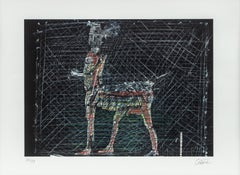
Cesar Baldaccini, French (1921 - 1998) - Centaure, Hommage a Picasso, Year: 1985, Medium: Lithograph, signed and numbered in pencil, Edition: 99/99, Size: 11.75 x 15.75 in. (29.8...
Category
1980s Surrealist César Baldaccini Animal Prints
Materials
Lithograph
Related Items
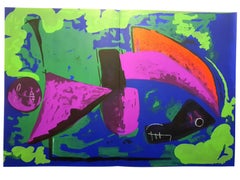
Marino Marini - Knight - Original Lithograph
By Marino Marini
Located in Collonge Bellerive, Geneve, CH
Marino Marini - Knight - Original Lithograph
1968
Dimensions: 32 x 48 cm
From the art review XXe siècle
Unsigned and unumbered as issued
Category
1960s Surrealist César Baldaccini Animal Prints
Materials
Lithograph

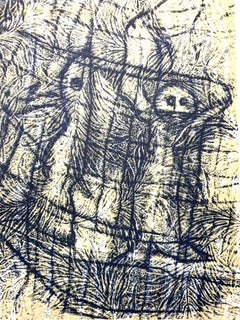
Max Ernst - Elektra - Lithograph
By Max Ernst
Located in Collonge Bellerive, Geneve, CH
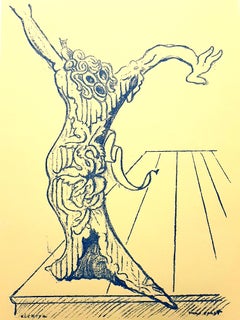
Max Ernst - Elektra
Lithograph
1939
Dimensions: 32 x 24 cm
Signed in the plate
From XXe siècle
Unsigned and unumbered as issued
Category
1930s Surrealist César Baldaccini Animal Prints
Materials
Lithograph
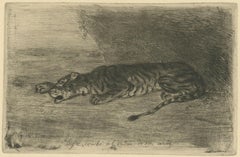
Tigre couché à l
entrée de son antre (Tiger Lying at the Entrance to its Lair)
By Eugène Delacroix
Located in Middletown, NY
Etching, drypoint, and roulette on watermarked Hallines cream laid paper, 3 3/4 x 5 7/8 inches (95 x 148 mm), full margins. A very good impression of this charming image, with all of...
Category
Early 19th Century Realist César Baldaccini Animal Prints
Materials
Laid Paper, Drypoint, Etching
19th century black and white etching aquatint outdoors figurative animal print
By Camille Pissarro
Located in Milwaukee, WI
"Vachere au Bord de L'Eau" is an original etching and aquatint by Camille Pissarro, the 8th state. It can be found in the catalogue raisonne Delteil #93. It features a woman sitting ...
Category
1890s Realist César Baldaccini Animal Prints
Materials
Etching, Aquatint

Camille Pissarro19th century black and white etching aquatint outdoors figurative animal print, 1890
$10,150
H 20.125 in W 17.625 in
Max Ernst - Composition - Original Lithograph
By Max Ernst
Located in Collonge Bellerive, Geneve, CH
Max Ernst - Composition - Original Lithograph
1958
Dimensions: 32 x 24 cm
XXe siècle
Unsigned and unnumbered, as issued
Max Ernst was born in Bruhl, a place near Cologne, in Germany. He was raised in a strict Catholic family, and both of his parents were disciplinarians who were dedicated to training their children into God-fearing and talented individuals. Although his father was deaf, Ernst learned so much from him, particularly when it comes to painting. In fact, much of his early years were lived under the inspiration of his father who was also a teacher. He was the one who introduced painting to Ernst at an early age.
In 1914, Ernst attended the University of Bonn where he studied philosophy. However, he eventually dropped out of school because he was more interested in the arts. He claimed that his primary sources of interest included anything that had something to do with painting. Moreover, he became fascinated with psychology, among other subjects in school.
Primarily, Ernst's love for painting was the main reason why he became deeply interested with this craft and decided to pursue it later on in his life. During his early years, he became familiar with the works of some of the greatest artists of all time including Claude Monet, Paul Cezanne and Vincent van Gogh. He was also drawn to themes such as fantasy and dream imagery, which were among the common subjects of the works of Giorgio de Chirico.
During World War I, Ernst was forced to join the German Army, and he became a part of the artillery division that exposed him greatly to the drama of warfare. A soldier in the War, Ernst emerged deeply traumatized and highly critical of western culture. These charged sentiments directly fed into his vision of the modern world as irrational, an idea that became the basis of his artwork. Ernst's artistic vision, along with his humor and verve come through strongly in his Dada and Surrealists works; Ernst was a pioneer of both movements.
It was Ernst's memories of the war and his childhood that helps him create absurd, yet interesting scenes in his artworks. Soon, he took his passion for the arts seriously when he returned to Germany after the war. With Jean Arp, a poet and artist, Ernst formed a group for artists in Cologne. He also developed a close relationship with fellow artists in Paris who propagated Avant-Garde artworks.
In 1919, Ernst started creating some of his first collages, where he made use of various materials including illustrated catalogs and some manuals that produced a somewhat futuristic image. His unique masterpieces allowed Ernst to create his very own world of dreams and fantasy, which eventually helped heal his personal issues and trauma. In addition to painting and creating collages, Ernst also edited some journals. He also made a few sculptures that were rather queer in appearance.
In 1920s, influenced by the writings of psychologist Sigmund Freud, the literary, intellectual, and artistic movement called Surrealism sought a revolution against the constraints of the rational mind; and by extension, they saw the rules of a society as oppressive. Surrealism also embraces a Marxist ideology that demands an orthodox approach to history as a product of the material interaction of collective interests, and many renown Surrealism artists later on became 20th century Counterculture symbols such as Marxist Che Guevara. In 1922 Ernst moved to Paris, where the surrealists were gathering around Andre Breton. In 1923 Ernst finished Men Shall Know Nothing of This, known as the first Surrealist painting. Ernst was one of the first artists who apply The Interpretation of Dreams by Freud to investigate his deep psyche in order to explore the source of his own creativity. While turning inwards unto himself, Ernst was also tapping into the universal unconscious with its common dream imagery.
Despite his strange styles, Ernst gained quite a reputation that earned him some followers throughout his life. He even helped shape the trend of American art during the mid-century, thanks to his brilliant and extraordinary ideas that were unlike those of other artists during his time. Ernst also became friends with Peggy Guggenheim, which inspired him to develop close ties with the abstract expressionists.
When Ernst lived in Sedona, he became deeply fascinated with the Southwest Native American navajo art. In fact, the technique used in this artwork inspired him and paved the way for him to create paintings that depicted this style. Thus, Ernst became a main figure of this art technique, including the rituals and spiritual traditions included in this form of art. Pollock, aside from the other younger generations of abstract expressionists, was also inspired by sand painting of the Southwest...
Category
1960s Surrealist César Baldaccini Animal Prints
Materials
Lithograph
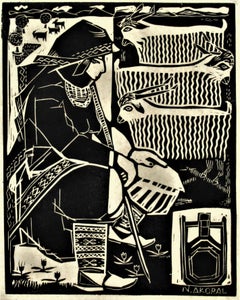
Woman with Three Goats
By Nevzat Akoral
Located in San Francisco, CA
This artwork "Woman with Three Goats" c.1960 is an original linocut on thin fiber paper by noted Turkish artist Nevzat Akoral, 1926-2016 It is signed in the plate as issue. The image...
Category
Mid-20th Century Realist César Baldaccini Animal Prints
Materials
Linocut
Marino Marini - Original Lithograph
By Marino Marini
Located in Collonge Bellerive, Geneve, CH
Marino Marini - Knight - Original Lithograph
1970
Dimensions: 32 x 24 cm
From the art review XXe siècle
Unsigned and unumbered as issued
Category
1970s Surrealist César Baldaccini Animal Prints
Materials
Lithograph
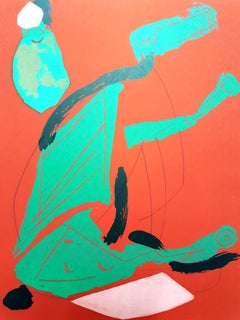
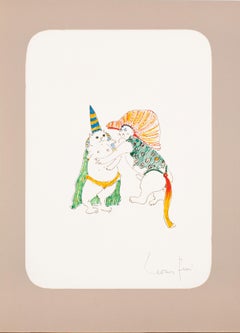
Hatted Cats
By Leonor Fini
Located in Columbia, MO
LEONOR FINI
Hatted Cats
1973
Color lithograph
Ed. 157/230
12.5 x 9 inches
Category
1970s Surrealist César Baldaccini Animal Prints
Materials
Lithograph
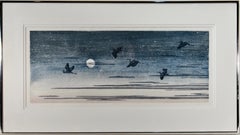
Heron Moon
Located in San Francisco, CA
This artwork titled "Heron Moon" c.1990, is a color woodblock print on paper by noted Canadian/Japanese artist Suezan Aikins, b.1952. It is signed, titled and numbered 58/150 in pencil by the artist. The artwork (image) size is 8.5 x 21 inches, framed size is 15.75 x 28.25 inches. Custom framed in a silver metal frame, with double off white matting. It is in excellent condition, the frame have some small minor rubs, barely visible.
About the artwork:
This artwork required have 5 different carved wood blocks and 9 layers of colors to complete.
About the artist:
Born in Montreal in 1952, Suezan was influenced early in her life by the works of modern Japanese woodblock printmakers which hung throughout her parents’ home. She attended the Fine Arts programme at Mount Allison University in Sackville, New Brunswick (1969 - 1971), The Ontario College of Art (1971-73), L’ ecole du Musee des Beaux Arts (1974), Nova Scotia College of Art and Design -BFA (1975) as well as a very intensive year of study with Toshi Yoshida in Tokyo (1984-85).
She has exhibited extensively in both public and private galleries throughout North America and Japan. Recent exhibitions include solo shows in Tokyo, Osaka, Okinawa, and Boston with group exhibitions at the Wenniger Gallery, Boston, Royal Canadian Academy in Toronto and the Canadian Museum of Nature in Ottawa.
Her paintings and woodblock prints are found in many collections such as The Canada Council Art Bank, The Nickle Art Museum, The Art Gallery of Nova Scotia, The Royal Bank of Canada, Prince Takamanonamiya Norihito, the Embassy of Canada in Tokyo, The Thomas Moore Institute as well as private collections.
Suezan Aikins was awarded the Elizabeth Greenshields Foundation grant in 1983, Nova Scotia Department of Culture - Development Grants in 1980, 1987 and 1988. She was elected to the Royal Canadian Academy of Art in 1990 and received the Canadian Progress Club- Women of Excellence Award for Culture in 1993. Her work has been featured in a number of television documentaries as well as many Canadian magazines.
STUDIES:
Yoshida Woodblock Print Studio Tokyo, 84-85
Nova Scotia College of Art & Design, Halifax, 74-75 BFA
Ecole du Musee des Beaux Arts, Montreal, 74
Ontario College of Art, Toronto, 71-73
Mt. Allison University, 69-72
SELECTED SOLO SHOWS:
25 Year Retrospective of Woodblock Prints traveled to three Public Galleries in Germany: Dornum Castle; Tollhousverein, Leer; Rastede Palace, Oldenberg 2000-2001 color catalog and reviews.
Private Exhibitions, Falmouth, Mass., July 1996; Montreal, November 1996; Gibson Island, Md., April 1999.
Gold Paintings and Woodblock Retrospective, travelling: Kabutoya Gallery, Tokyo; Genkan Gallery, Tokyo American Club; Blue Nile Gallery, Osaka; Kanda's Gallery BOQ, Okinawa; May 1994 (color catalogue)
Edo Gallery, Boston, November 1992, Private Exhibitions, Chatham, Mass, July 1992, Toronto, Oct. 1991
New Paintings and Woodblocks Kabutoya Gallery, Tokyo, May 1991, and also in 1987.
Japanese Garden and Pavilion Foundation, Montreal, September 1990, Ownens Art Gallery, Mount Allison University 1988
Zwickers Gallery, Halifax, NS, 1979; Gallery 78; Fredericton, November, 1983; Robertson Galleries, Ottawa, November, 1982
SELECTED GROUP SHOWS:
"A New Leaf" 30 foot instalation of mixed media/ goldleaf reliefs, Artsplace, Annapolis Royal, N.S., 2000 color catalog
"Far and Wide" Juried Bienials, Art Gallery of Nova Scotia; 1996 to '99, travelling, catalogs
"Moku Hanga Travelling Exhibition: Contemporary Japanese Woodcuts...
Category
Late 20th Century Realist César Baldaccini Animal Prints
Materials
Woodcut
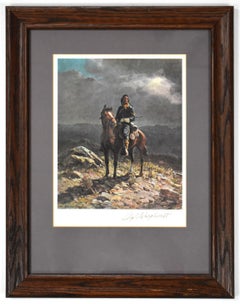
"INDIAN ON HORSE" WESTERN NATIVE AMERICAN
By Olaf Wieghorst
Located in San Antonio, TX
Olaf Wieghorst
(1899 - 1988)
California, New York, New Mexico, Arizona, Texas Artist
Image Size: 11 x 8.5
Frame Size: 18.5 x 14.5
Medium: Print
"Indian on Horse...
Category
20th Century Realist César Baldaccini Animal Prints
Materials
Archival Pigment
Max Ernst - Abstract Birds - Original Lithograph
By Max Ernst
Located in Collonge Bellerive, Geneve, CH
Max Ernst - Birds - Original Lithograph
Birds, 1962
Dimensions: 32 x 24 cm
From the art review XXe siècle
Unsigned and unumbered as issued
Category
1960s Surrealist César Baldaccini Animal Prints
Materials
Lithograph
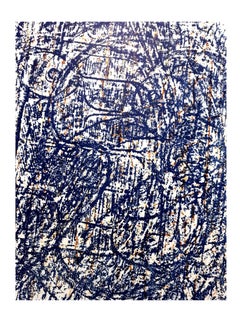
Max Ernst - Birds - Original Lithograph
By Max Ernst
Located in Collonge Bellerive, Geneve, CH
Max Ernst - Birds - Original Lithograph
Birds, 1964 (BNF, 63)
Dimensions: 32 x 24 cm
Revue Art de France
ax Ernst was born in Bruhl, a place near Cologne, in Germany. He was raised in a strict Catholic family, and both of his parents were disciplinarians who were dedicated to training their children into God-fearing and talented individuals. Although his father was deaf, Ernst learned so much from him, particularly when it comes to painting. In fact, much of his early years were lived under the inspiration of his father who was also a teacher. He was the one who introduced painting to Ernst at an early age.
In 1914, Ernst attended the University of Bonn where he studied philosophy. However, he eventually dropped out of school because he was more interested in the arts. He claimed that his primary sources of interest included anything that had something to do with painting. Moreover, he became fascinated with psychology, among other subjects in school.
Primarily, Ernst's love for painting was the main reason why he became deeply interested with this craft and decided to pursue it later on in his life. During his early years, he became familiar with the works of some of the greatest artists of all time including Claude Monet, Paul Cezanne and Vincent van Gogh. He was also drawn to themes such as fantasy and dream imagery, which were among the common subjects of the works of Giorgio de Chirico.
During World War I, Ernst was forced to join the German Army, and he became a part of the artillery division that exposed him greatly to the drama of warfare. A soldier in the War, Ernst emerged deeply traumatized and highly critical of western culture. These charged sentiments directly fed into his vision of the modern world as irrational, an idea that became the basis of his artwork. Ernst's artistic vision, along with his humor and verve come through strongly in his Dada and Surrealists works; Ernst was a pioneer of both movements.
It was Ernst's memories of the war and his childhood that helps him create absurd, yet interesting scenes in his artworks. Soon, he took his passion for the arts seriously when he returned to Germany after the war. With Jean Arp, a poet and artist, Ernst formed a group for artists in Cologne. He also developed a close relationship with fellow artists in Paris who propagated Avant-Garde artworks.
In 1919, Ernst started creating some of his first collages, where he made use of various materials including illustrated catalogs and some manuals that produced a somewhat futuristic image. His unique masterpieces allowed Ernst to create his very own world of dreams and fantasy, which eventually helped heal his personal issues and trauma. In addition to painting and creating collages, Ernst also edited some journals. He also made a few sculptures that were rather queer in appearance.
In 1920s, influenced by the writings of psychologist Sigmund Freud, the literary, intellectual, and artistic movement called Surrealism sought a revolution against the constraints of the rational mind; and by extension, they saw the rules of a society as oppressive. Surrealism also embraces a Marxist ideology that demands an orthodox approach to history as a product of the material interaction of collective interests, and many renown Surrealism artists later on became 20th century Counterculture symbols such as Marxist Che Guevara. In 1922 Ernst moved to Paris, where the surrealists were gathering around Andre Breton. In 1923 Ernst finished Men Shall Know Nothing of This, known as the first Surrealist painting. Ernst was one of the first artists who apply The Interpretation of Dreams by Freud to investigate his deep psyche in order to explore the source of his own creativity. While turning inwards unto himself, Ernst was also tapping into the universal unconscious with its common dream imagery.
Despite his strange styles, Ernst gained quite a reputation that earned him some followers throughout his life. He even helped shape the trend of American art during the mid-century, thanks to his brilliant and extraordinary ideas that were unlike those of other artists during his time. Ernst also became friends with Peggy Guggenheim, which inspired him to develop close ties with the abstract expressionists.
When Ernst lived in Sedona, he became deeply fascinated with the Southwest Native American navajo art. In fact, the technique used in this artwork inspired him and paved the way for him to create paintings that depicted this style. Thus, Ernst became a main figure of this art technique, including the rituals and spiritual traditions included in this form of art. Pollock, aside from the other younger generations of abstract expressionists, was also inspired by sand painting of the Southwest...
Category
1960s Surrealist César Baldaccini Animal Prints
Materials
Lithograph
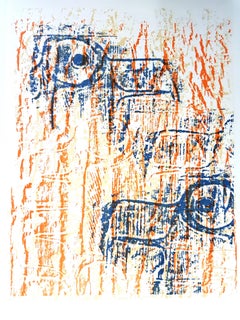
César Baldaccini animal prints for sale on 1stDibs.
Find a wide variety of authentic César Baldaccini animal prints available for sale on 1stDibs. You can also browse by medium to find art by César Baldaccini in etching and more. Not every interior allows for large César Baldaccini animal prints, so small editions measuring 23 inches across are available. Customers who are interested in this artist might also find the work of Leon Danchin, Francois Nicolas Martinet, and Peter Sculthorpe. César Baldaccini animal prints prices can differ depending upon medium, time period and other attributes. On 1stDibs, the price for these items starts at $2,594 and tops out at $2,594, while the average work can sell for $2,594.