Charles Demuth Drawings and Watercolor Paintings

American, 1883-1935

Acclaimed for his lively Impressionistic watercolors — as well as for his important role in Precisionism, a movement that emphasized geometry and shared commonalities with Cubism and Futurism — American painter Charles Demuth created some of his most recognized works on borrowed time. In the final decade of his life, plagued by ailing health, Demuth painted his renowned Precisionist works like I Saw the Figure 5 in Gold and My Egypt. With each painting, Demuth filled up a life bookended by illness — maladies that both ignited his art career and, ultimately, snuffed it out.

Born in Lancaster, Pennsylvania, Demuth was bedridden at a young age, around four or five, from what would come to be known as Perthes, which affected his mobility and forced him to spend much of his youth at home. Fortunately, his mother provided him with an ample amount of art supplies and nurtured a passion for painting that he sustained over the course of his life. 

While Demuth relied on a cane for much of his life, he was well enough to attend Franklin and Marshall College and study art at both Drexel University and the Pennsylvania Academy of the Fine Arts. He completed his first oil self-portrait in 1907 and met the first of what would become a string of influential friends in American artist William Merritt Chase and American painter and arts administrator Thomas Anshutz.

Shifting his focus from oil paintings to watercolors after concluding his studies, Demuth created works that depicted Harlem Renaissance-era jazz clubs and chronicled taboo gay subculture in New York City. The artist was openly gay, and works of this type, even as they were not intended for public exhibition at the time, influenced artists such as Andy Warhol in the decades that followed. His network grew to include artists Alfred Maurer, Patrick Henry Bruce, John Marin and photographer Edward Steichen. American photographer Alfred Stieglitz and modernist painter Georgia O’Keeffe proved to be among the most artistically influential on Demuth. Stieglitz’s famed art gallery in New York, 291, became a spot that the Pennsylvania painter frequented and a location at which he developed an interest in Auguste Rodin’s watercolors and O’Keeffe’s Precisionism.

Demuth also befriended wealthy pharmacist Dr. Albert Barnes in 1905. After the artist received his diabetes diagnosis, a death sentence at the time, Barnes requested Demuth consult with Dr. Frederick Allen, then the leading expert on diabetes in America. Barnes helped with funding Demuth’s insulin treatment — the painter was among the first patients to receive insulin in the United States. Demuth turned largely to painting still lifes of flowers and produce that his mother brought into the house. He died in 1935.

Today, the Barnes Foundation holds the largest collection of Demuth’s artwork. His paintings are also held in the collections of the Philadelphia Museum of Art and the Demuth Museum, which is located in Demuth’s former studio and home and merged with the Lancaster Museum of Art in 2014. 

On 1stDibs, find a collection of Charles Demuth drawings and watercolor paintings.

to
2
1
Overall Width
to
Overall Height
to
3
2
3
2
1
1
1
1
1
1
1
3
3
2
3
971
401
359
279
3
3
Artist: Charles Demuth
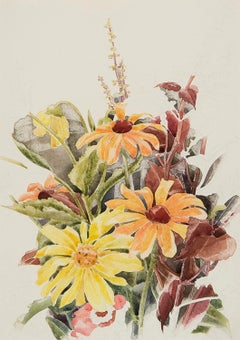
Garden Flowers
By Charles Demuth
Located in New York, NY
Charles Demuth was one of the most complex, talented, and deeply sensitive artists of the American modern period. Whether he was painting floral still lifes, industrial landscapes, or Turkish bathhouses, art was, for Demuth, fraught with personal meaning. A fixture of the vanguard art scene in New York, Demuth navigated the currents of Modernism, producing some of the most exquisite watercolors and original oil paintings in twentieth-century American art. Demuth was born in Lancaster, Pennsylvania, the only child of a well-to-do family. He had an awkward and introverted childhood shaped by a childhood illness, Perthes, a disease of the hip that not only left him permanently lame, but, as part of the “cure,” bedridden for two years in the care of his mother. This long period of incapacitation had a deep impact on Demuth, who came to see himself as an invalid, an outsider who was different from everyone else. It was perhaps during this period of indoor confinement that his keen interest in art developed. Several relatives on his father’s side had been amateur artists, and, following his convalescence, his mother encouraged his artistic pursuits by sending him to a local painter for instruction. The majority of his early pictures are of flowers, a subject for which Demuth maintained a lifelong passion. Following high school, Demuth enrolled at the Drexel Institute of Art in Philadelphia, a school renowned for its commercial arts program. He advanced through the program rapidly, and, in 1905, at the encouragement of his instructors, he began taking courses at the Pennsylvania Academy of the Fine Arts. The two leading teachers then at the Academy were William Merritt Chase and Thomas Anshutz. Anshutz, himself a former student of Thomas Eakins, was well liked by his students, and is best known as the teacher of Robert Henri, John Sloan, and several of the other artists of the Ashcan School. Demuth, too, adopted a similar idiom, working in a controlled, realistic manner while at the Academy, where he remained until 1910. In 1907, Demuth made his first trip to Europe, staying in Paris. He spent time on the periphery of the art scene composed of the numerous American artists there, including John Marin and Edward Steichen. He returned to Philadelphia five months later, and immediately resumed courses at the Academy. Despite his introduction to advanced modern styles in Europe, Demuth’s work of this period retains the academic style he practiced before the trip. It wasn’t until he had summered at New Hope, Pennsylvania, in 1908 and 1911, that his style began to evolve. New Hope was a prominent American Impressionist art colony whose members were largely affiliated with the Pennsylvania Academy. Demuth dropped the conservative tone of his style and adopted a freer and more colorful palette. Although he remained based in Philadelphia, Demuth frequently went to New York during this period. Many of the same American artists of the Parisian art scene Demuth had encountered on his earlier European trip now formed the nucleus of New York’s avant-garde, which centered around Alfred Stieglitz’s 291 gallery. It wasn’t long before Demuth began to apply modernist-inspired strategies to his work. He was particularly influenced by the watercolor work of John Marin, also a former student of Anshutz, whose bold use of color in the medium Demuth freely adapted into looser washes of color. In 1912, Demuth again left for Paris, this time studying in the Académie Moderne, Académie Colorossi, and Académie Julian. In Paris Demuth met the American modernist Marsden Hartley. Hartley, a principal figure in the expatriate art circle, acted as a mentor to Demuth, and introduced him to the wide array of modern styles currently practiced in Europe. Hartley also introduced Demuth to many of the members of the Parisian avant-garde, including Gertrude Stein. Demuth was an aspiring writer, and he spent many hours in conversation with Stein. He wrote extensively during this period, and published two works shortly after his return to America. He also developed an interest in illustrating scenes from literary texts. From 1914 to 1919, Demuth produced a series of watercolors of scenes from books such as Emile Zola’s Nana and Henry James’s The Turn of the Screw. Upon his return to America, Demuth settled in New York. In 1914, Demuth had his first one-man show at Charles Daniel’s gallery, which promoted emerging modern American artists, including Man Ray, Rockwell Kent, Yasuo Kuniyoshi, Stuart Davis, and Max Weber. Demuth drew closer to the artistic vanguard in New York, becoming friends with many in the Stieglitz and Daniel circles, including Georgia O’Keeffe, Marcel Duchamp, Carl Van Vechten, and Edward Fiske. New York’s cosmopolitan atmosphere and active nightlife appealed greatly to Demuth. In a sketchy style well suited to watercolor, he painted many vaudeville and circus themes, as well as nightclub, café, and bathhouse scenes. Often with Duchamp, Demuth took part in an urban subculture replete with nightclubs, bars, drugs, and sexual permissiveness, which, for a homosexual artist like himself, allowed room for previously unattainable personal expression. Demuth’s pictures of sailors, bathhouses, and circus performers embody a sensual and sexual undercurrent, expressing the artist’s sense of comfort and belonging in the bohemian subculture of New York. Simultaneously, Demuth deepened his interest in floral pictures, painting these almost exclusively in watercolor. His style evolved from the broad color washes of his earlier pictures to more spare, flattened, and sinuous compositions, inspired by the drawings of Aubrey Beardsley and other artists of the Aesthetic Movement. Demuth’s flower watercolors are moody and atmospheric, sensuous and elegant, introspective and yet full of expressive power. Moreover they are beautiful, and are unequivocally among the finest still lifes in American art. Despite numerous subsequent artistic undertakings that led him in a variety of directions, Demuth never stopped painting flower pictures, ultimately adding fruits and other still-life objects to his repertoire. In 1916, Demuth began to develop a style later known as Precisionism, a form of landscape painting infused with Cubism, in which space is divided into precisely drawn geometric regions of color. Demuth first began to paint the landscape in an appropriated Cubist mode while on a trip with Hartley to Bermuda. In these early landscapes, in which the curvilinear forms of trees intersect the geometrically articulated architectural forms, Demuth explored ideas that shaped the future development of modernism in America. The full realization of Demuth’s explorations came after his return to America in 1917, when he turned his attention to industrial subjects. These works derive from a “machine aesthetic,” espoused by New York artists such as Francis Picabia, Joseph Stella, Albert Gleizes, and Duchamp, by which artists viewed machines as embodying mystical, almost religious significance as symbols of the modern world. Rather than painting the skyscrapers and bridges of New York as did most of his like-minded contemporaries, Demuth returned to his home town of Lancaster, where he painted factories and warehouses in a Precisionist idiom. The titles for these pictures are often contain literary references, which serve as clues for the viewer to aid in the decoding of the artist’s meaning. In 1923, Demuth planned a series of abstract “poster portraits” of his friends and contemporaries in the New York art and literary scene. In these “portraits,” Demuth combined text and symbolic elements to evoke the essential nature of his sitters’ distinguishing characteristics. In this fashion, he painted portraits of such artists as Georgia O’Keeffe, John Marin, and Arthur Dove. His most famous poster portrait, I Saw the Figure 5 in Gold...
Category

20th Century American Modern Charles Demuth Drawings and Watercolor Paintings

Materials

Paper, Watercolor

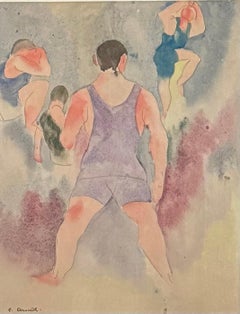
"Bathers" American Scene Social Realism 20th Century Modernism Ashcan Fauvism
By Charles Demuth
Located in New York, NY
"Bathers" American Scene Social Realism 20th Century Modernism Ashcan Fauvism Charles Demuth (1883-1935) "Bathers" 10 1/2 x 8 1/4 inches watercolor on paper, c. 1930 Signed lower le...
Category

1930s American Modern Charles Demuth Drawings and Watercolor Paintings

Materials

Paper, Watercolor

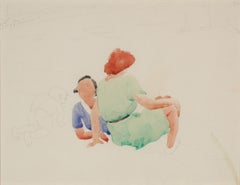
Two Women and a Child on the Beach at Provincetown
By Charles Demuth
Located in Fairlawn, OH
Two Women and a Child on the Beach at Provincetown Unsigned. Watercolor on paper, c. 1934 A beautiful Provincetown beach scene, included in the catalogue raisonne. Please see Babcoc...
Category

1930s American Modern Charles Demuth Drawings and Watercolor Paintings

Materials

Watercolor

Related Items
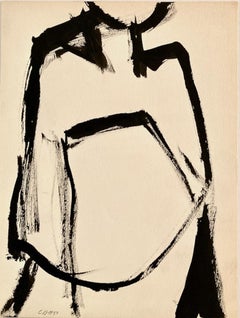
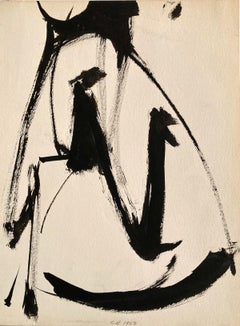
Clinton Hill, (Nude #1), 1951, drawing, figure/abstraction
By Clinton Hill
Located in New York, NY
Clinton Hill (1922-2003), created quintessential mid-century images, but figures are unusual in his work. This is from a very early period. In 1951 Hill studied at the Academie de la...
Category

Mid-20th Century American Modern Charles Demuth Drawings and Watercolor Paintings

Materials

Gouache

Clinton Hill, (Nude #2), 1950, drawing, figure/abstraction
By Clinton Hill
Located in New York, NY
Clinton Hill (1922-2003), created quintessential mid-century images, but figures are unusual in his work. This is from a very early period. From 1949 to 1951 he attended the Brooklyn...
Category

Mid-20th Century American Modern Charles Demuth Drawings and Watercolor Paintings

Materials

Gouache

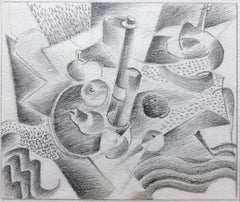
A Striking 1940s Cubist Still Life Drawing by Modern Artist Stanley Bielecky
By Stanley Bielecky
Located in Chicago, IL
A striking 1940s Modern cubist still life drawing by Notable Chicago and Michigan artist Stanley Bielecky. Image size: 4 x 5 inches. Archivally matted to 13 1/4 x 16 inches. Estate stamped and numbered 58, lower left. Stanley Bielecky was an Indiana artist who painted the American Scene, from the industrial factories and workers around East Chicago to the pastoral settings of Mackinac Island...
Category

1940s American Modern Charles Demuth Drawings and Watercolor Paintings

Materials

Graphite, Paper

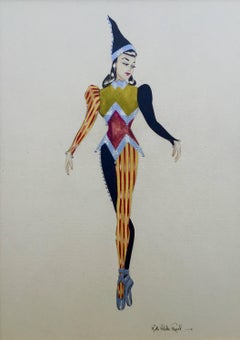
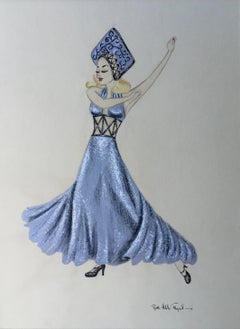
"Radio City Rockette"
By Ruth Adele Mysel
Located in Southampton, NY
Watercolor on paper of a Radio City Music Hall Rockette done in the late 1940's or early 1950's. Ruth Adele Mysel grew up in Boston and attended the New Eng...
Category

1940s American Modern Charles Demuth Drawings and Watercolor Paintings

Materials

Watercolor

"Radio City Rockette"
$275 Sale Price
35% Off
H 13.75 in W 10 in D 0.5 in
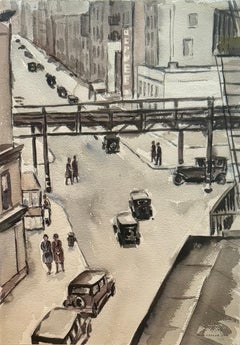
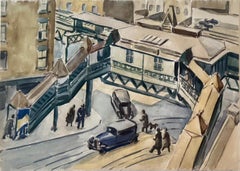
"6th Avenue El" American Scene Social Realism Mid-20th Century Cityscape Modern
By Max Arthur Cohn
Located in New York, NY
"6th Avenue El" American Scene Social Realism Mid-20th Century Cityscape Modern Max Arthur Cohn (1903-1998) 6th Avenue Elevated 19 1/4 x 13 3/4 inches Watercolor on paper Signed an...
Category

1920s American Modern Charles Demuth Drawings and Watercolor Paintings

Materials

Paper, Watercolor

6th Avenue El at 8th St NYC Cityscape American Scene Social Realism Mid-Century
By Max Arthur Cohn
Located in New York, NY
6th Avenue El at 8th St NYC Cityscape American Scene Social Realism Mid-Century Max Arthur Cohn (1903-1998) 6th Avenue El at 8th Street 13 x 18 inches Watercolor on paper, c. 1930 ...
Category

1930s American Modern Charles Demuth Drawings and Watercolor Paintings

Materials

Paper, Watercolor

“Pauline Trigere”
By Kenneth Paul Block
Located in Southampton, NY
Here for your consideration is an original watercolor and gouache with traces of acrylic paint fashion illustration by the world renowned fashion artist, Kenneth Paul Block. Painted ...
Category

1960s American Modern Charles Demuth Drawings and Watercolor Paintings

Materials

Watercolor, Gouache, Archival Paper, Acrylic
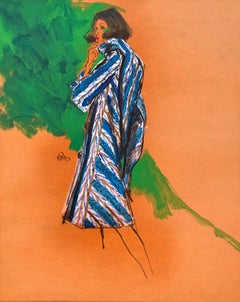
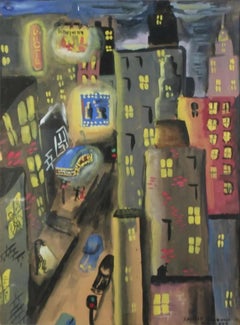
"Times Square" Mid 20th Century 1937 Modernism Broadway Drawing NYC Cityscape
Located in New York, NY
"Times Square" Mid 20th Century 1937 Modernism Broadway Drawing NYC Cityscape Philip Goodwin (20th Century) "Times Square," 23 ½ x 17 ¼ inches. Gouache...
Category

1930s American Modern Charles Demuth Drawings and Watercolor Paintings

Materials

Paper, Gouache

“Woman in Plaid”
By Kenneth Paul Block
Located in Southampton, NY
Here for your consideration is an original watercolor and gouache with traces of acrylic paint fashion illustration by the world renowned fashion artist, Kenneth Paul Block. Painted ...
Category

1960s American Modern Charles Demuth Drawings and Watercolor Paintings

Materials

Acrylic, Watercolor, Gouache, Archival Paper
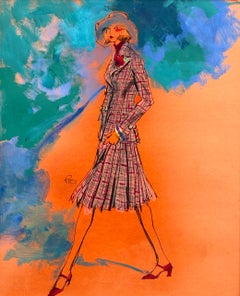
MOMA Exhibited Watercolor by Chicago Artist Francis Chapin, "Tourists in Taxco"
By Francis Chapin
Located in Chicago, IL
A charming, vibrant, early Mexican city street scene by famed Chicago Modern artist Francis Chapin (Am. 1899-1965). Titled "Tourists in Taxco", the watercolor was exhibited at the M...
Category

1930s American Modern Charles Demuth Drawings and Watercolor Paintings

Materials

Paper, Watercolor

"Showgirl"
By Ruth Adele Mysel
Located in Southampton, NY
Very well executed watercolor on paper by Ruth Adele Mysel of a beautiful showgirl. Signed lower right. Circa 1940 to 1950. Ruth Adele Mysel was raised in Boston and attended the Ne...
Category

1940s American Modern Charles Demuth Drawings and Watercolor Paintings

Materials

Watercolor

"Showgirl"
"Showgirl"
$275 Sale Price
35% Off
H 13.75 in W 10.25 in D 0.5 in
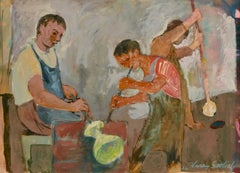
Glassblowers WPA American Scene Mid- 20th Century Modern Figurative Workers 1932
By Harry Gottlieb
Located in New York, NY
Glassblowers WPA American Scene Mid- 20th Century Modern Figurative Workers. Dated and signed "32 Harry Gottlieb" lower right. Sight: 13 1/8" H x 18 1/4" W. Harry Gottlieb, painter, screenprinter, educator, and lithographer, was born in Bucharest, Rumania. He emigrated to America in 1907, and his family settled in Minneapolis. From 1915 to 1917, Gottlieb attended the Minneapolis Institute of Arts. After a short stint as an illustrator for the U.S. Navy, Gottlieb moved to New York City; he became a scenic and costume designer for Eugene O"Neill's Provincetown Theater Group. He also studied at the Philadelphia Academy of Fine Arts and the National Academy of Design. He was one of America's first Social Realist painters, influenced by that Robert Henri-led movement in New York City where Gottlieb settled in 1918. He was also a pioneer in screen printing, which he learned while working for the WPA. He married Eugenie Gershoy, and the couple joined the artist colony at Woodstock, New York. He lectured widely on art education. In 1923, Gottlieb settled in Woodstock, New York and in 1931, spent a a year abroad studying under a Guggenheim Fellowship. In 1935, he joined the Federal Art Project...
Category

1930s American Modern Charles Demuth Drawings and Watercolor Paintings

Materials

Paper, Gouache

Charles Demuth drawings and watercolor paintings for sale on 1stDibs.

Find a wide variety of authentic Charles Demuth drawings and watercolor paintings available for sale on 1stDibs. You can also browse by medium to find art by Charles Demuth in paint, watercolor, paper and more. Much of the original work by this artist or collective was created during the 20th century and is mostly associated with the modern style. Not every interior allows for large Charles Demuth drawings and watercolor paintings, so small editions measuring 10 inches across are available. Customers who are interested in this artist might also find the work of Jackson Lee Nesbitt, William Grauer, and Virginia Dehn. Charles Demuth drawings and watercolor paintings prices can differ depending upon medium, time period and other attributes. On 1stDibs, the price for these items starts at $55,000 and tops out at $375,000, while the average work can sell for $110,000.

Still Thinking About These?

All Recently Viewed