Charles E. Chambers Art

American, 1883-1941

The work of American realist painter and illustrator Charles Edward Chambers is characterized by such an exceptional mastery of color and composition that, in his day, his refined figurative paintings may have fooled collectors into thinking he was a graduate of the Académie des Beaux-Arts

Born in 1883 in Ottumwa, Iowa, Chambers studied at the School of the Art Institute of Chicago and the Art Students League of New York under Canadian-American painter George Bridgman. Another of his teachers was illustrator Fanny Munsell (later his wife), who influenced his style and technique. Munsell secured illustration work for a range of magazines, including Cosmopolitan and Women’s Home Companion, before she died in 1920.

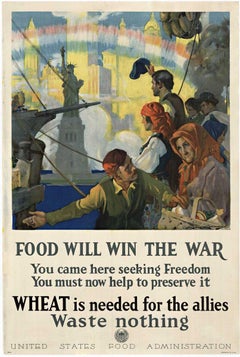
Chambers learned to modify his painting technique so that his work was primed for reproduction on a mass scale. He gained recognition as a classical figurative painter and illustrator during World War I when, in 1917, he illustrated a well-known poster for the U.S. Food Administration titled Food Will Win The War. He was also a regular contributor as an illustrator at the time to Harper’s Monthly and created covers for Redbook magazine.

Throughout the 1920s and 1930s, Chambers kept busy with editorial assignments and advertising campaigns. While it’s true that Art Nouveau posters were plastered everywhere along the streets of Paris during the early years of the Belle Époque, poster art continued to remain very relevant in the Art Deco years, too. While creating illustrations for authors such as Pearl Buck, W. Somerset Maugham, Faith Baldwin and Louis Bromfield, Chambers earned advertising commissions from the decades’ prominent companies and brands. These included painting portraits of famous musicians Sergei Rachmaninoff, Alfred Cortot and Ignacy Jan Paderewski for Steinway Sons and designing billboard ads and posters for cigarette company Chesterfield and soap manufacturer Palmolive.

Today, Chambers’s works remain favorites among collectors of vintage 20th-century art.

Find original Charles Edward Chambers paintings and prints on 1stDibs.

to
7
1
Overall Width
to
Overall Height
to
8
2
2
2
5
3
8
7
5
3
2
1
1
1
1
1
1
1
1
1
1
1
1
1
1
7
7
6
6
1
8
9,962
2,752
1,376
1,373
3
8
Artist: Charles E. Chambers
Original "Food Will Win The War" vintage World War 1 poster
By Charles E. Chambers
Located in Spokane, WA
Original World War 1 vintage poster: Food Will Wn the War. Arhival linen backed. PRINTER: Rusling Wood Litho., New York Bright and in good condition. There is some marks down the left side of the poster, possible ink from when the poster was printed. This poster calls on immigrants to do their part in the war effort. It depicts recent immigrants standing near a sailing ship with the Statue of Liberty and a rainbow stretched across the New York City skyline in the background. The text reads: You came here seeking Freedom. You must now help preserve it. Wheat is needed by the allies. Waste nothing. The generosity and compassion of the American people and the great agricultural resources of the North American continent would be called upon... Twenty million Americans signed pledges of membership in the Food Administration...
Category

1910s American Realist Charles E. Chambers Art

Materials

Lithograph

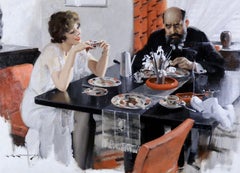
Story illustration for “Appearance and Reality” by Somerset Maugham
By Charles E. Chambers
Located in Fort Washington, PA
Story illustration for “Appearance and Reality” by W. Somerset Maugham, published in Cosmopolitan, November 1934, pages 22-23. Described as "A masterfully witty story of manners and...
Category

1930s Charles E. Chambers Art

Materials

Canvas, Oil

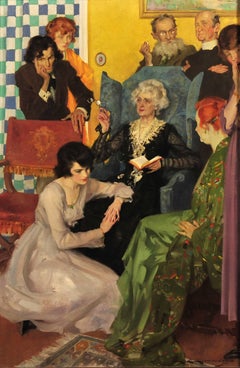
Family Escape
By Charles E. Chambers
Located in Fort Washington, PA
Date: 1917 Medium: Oil on Board Dimensions: 32.00" x 21.00" Signature: Signed Lower Right Story illustration: Group of people gathered around seated old woman. “Isn't it quite as i...
Category

1910s Charles E. Chambers Art

Materials

Oil, Board

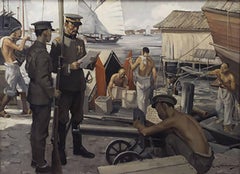
“Wang the Tiger had his own port…” Story illustration for Sons by Pearl S. Buck
By Charles E. Chambers
Located in Fort Washington, PA
Date: 1932 Medium: Oil on Canvas Dimensions: 24.00" x 33.00" Signature: Signed Lower Left Story illustration for “Sons” by Pearl S. Buck, published in Cosmopolitan, October 1932, pages 66-67. "Sons" serves as the poignant sequel to Buck's story The Good Earth...
Category

1930s Charles E. Chambers Art

Materials

Canvas, Oil

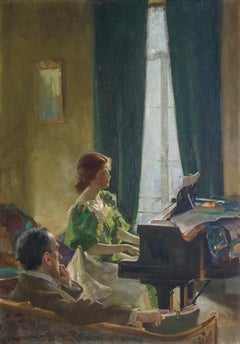
The Piano Lesson
By Charles E. Chambers
Located in Fort Washington, PA
Signature: Signed Lower Left
Category

20th Century Charles E. Chambers Art

Materials

Canvas, Oil

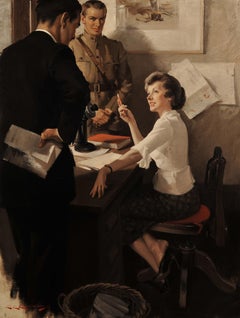
She Answers The Question
By Charles E. Chambers
Located in Fort Washington, PA
Image of two men standing in front of woman seated at desk. Charles Edward Chambers was born in Ottumwa, Iowa, studied at the Chicago Art Institute, and later the Art Students Lea...
Category

1920s Charles E. Chambers Art

Materials

Canvas, Oil

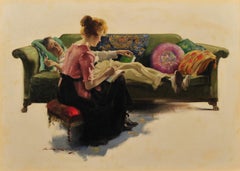
"Ringmaster"
By Charles E. Chambers
Located in Fort Washington, PA
Story illustration, image of man on couch, woman in chair writing Charles Edward Chambers was born in Ottumwa, Iowa, studied at the Chicago Art Institute, and later the Art Students League in New York with George Bridgman. His illustrations were extremely skillful, marked by subtlety of value and color. He early learned to adapt his method of painting for the best possible reproduction, and to insure fidelity of printing, he often followed the assignments through to the hands of the engraver who made the plates. Chambers divided his time almost equally between editorial and advertising assignments. Among his advertising commissions was an outstanding series of portraits of musicians for Steinway & Sons. His distinctive illustrations for billboards, notably for Chesterfield and Palmolive Soap...
Category

1920s Other Art Style Charles E. Chambers Art

Materials

Canvas, Oil

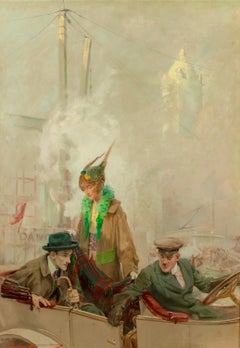
Couple with Chauffeur
By Charles E. Chambers
Located in Fort Washington, PA
Couple in a car with a Chauffeur Signed lower left. Charles Edward Chambers was born in Ottumwa, Iowa, studied at the Chicago Art Institute, and later the Art Students League in ...
Category

20th Century Other Art Style Charles E. Chambers Art

Materials

Canvas, Oil

Related Items
Spring Collection: Pocket Bluebells, Baroque Still Life, Flower art, Realism
By Dani Humberstone
Located in Deddington, GB
Spring Collection: Pocket Bluebells is an original oil painting by Dani Humberstone as part of her Pocket Painting series featuring small scale realistic oil paintings, with a nod to...
Category

2010s Realist Charles E. Chambers Art

Materials

Canvas, Oil

The Dandy a Salon in Paris 19th Century portrait of a young man French painting
Located in Norwich, GB
A wonderful depiction of a dapper Parisian dandy, dating from 1848. I love his air of decadence! It is a work by F de Korff, a mysterious French aristocratic portrait artist who had ...
Category

Mid-19th Century Academic Charles E. Chambers Art

Materials

Canvas, Oil

"Still Life of Fruit and Flowers, " Oil on Canvas
Located in Chicago, IL
This impressionist still life by French painter Léon Garraud depicts a table set with a plate of peaches and a vase of pink peonies and delicate white flowers. The warm palette of or...
Category

Early 20th Century Impressionist Charles E. Chambers Art

Materials

Canvas, Oil

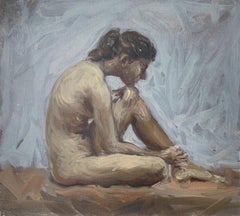
Seated Nude in the Studio – A Modernist Study from the 1920s
Located in Stockholm, SE
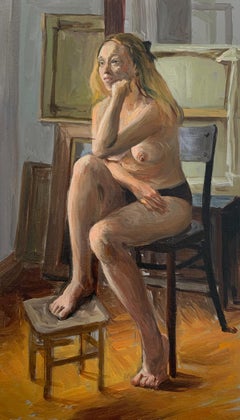
This evocative oil painting, titled Studio Muse, depicts a seated nude in a quiet moment of contemplation. The model is shown in profile, resting on a simple wooden stool against a n...
Category

1920s Modern Charles E. Chambers Art

Materials

Canvas, Oil

Andrew Wyeth, May Day, from The Four Seasons (after)
By Andrew Wyeth
Located in Southampton, NY
This exquisite lithograph after Andrew Wyeth (1917–2009), titled May Day, originates from the distinguished 1962 folio The Four Seasons: Paintings and Drawings by Andrew Wyeth. Published and printed by Art in America Company, Inc., New York, the edition embodies Wyeth’s lyrical study of springtime renewal and human connection to the land. May Day captures a tender seasonal moment—nature reawakening beneath soft light—rendered with Wyeth’s quiet precision and emotional restraint that elevate the ordinary into the timeless. Executed on velin paper, this lithograph measures 17 x 13 inches (43.2 x 33 cm). As issued, it is unsigned and unnumbered, representing the folio’s authentic format. The Four Seasons series was conceived by the editors of Art in America in collaboration with Andrew and Betsy Wyeth, who selected drawings from the artist’s studio and private collection to express the cyclical harmony between nature and spirit. Each image reflects Wyeth’s devotion to atmosphere and the fragile poetry of the passing year. Artwork Details: Artist: After Andrew Wyeth (1917–2009) Title: May Day, from The Four Seasons, Paintings and Drawings by Andrew Wyeth, 1962 Medium: Lithograph on velin paper Dimensions: 17 x 13 inches (43.2 x 33 cm) Inscription: Unsigned and unnumbered, as issued Date: 1962 Publisher: Art in America Company, Inc., New York Printer: Art in America Company, Inc., New York Condition: Well preserved, consistent with age and medium Provenance: From the 1962 folio The Four Seasons, Paintings and Drawings by Andrew Wyeth, published and printed by Art in America Company, Inc., New York Notes: Excerpted from the 1962 folio: "In 1962 the editors of Art in America proposed to Wyeth a portfolio of images of his recent dry-brush drawings. The artist and his wife suggested the theme, 'The Four Seasons,' because of the essential role played in his work by the cycle of the seasons. The drawings were selected by Andrew and Betsy Wyeth from works in the house and studio at Chadds Ford, supplemented by some owned by friends. With a few exceptions they had never been exhibited or reproduced. The plates were made directly from the originals. In these drawings Wyeth's loving concentration on the object is fully revealed. But as always in his work, this concern with the tangible is balanced by sensibility to mood, to the emotion arising from the actual. They are pervaded with a sense of the season—the exact time of year, the hour of the day, the quality of the light. To the truth and subtlety with which he captures these intangible factors, these drawings owe their poignant poetry." About the Artist: Andrew Wyeth (1917–2009) was an American visual artist and one of the best-known painters of the mid-20th century. Although he considered himself an abstractionist, Wyeth’s work is characterized by a meticulous realism imbued with psychological depth and atmosphere. He often painted the landscapes and people surrounding his homes in Chadds Ford, Pennsylvania, and Cushing, Maine, creating an intimate record of American rural life. The son of the celebrated illustrator N. C. Wyeth, Andrew trained under his father before developing his own deeply personal visual language inspired by Winslow Homer, Henry David Thoreau, and King Vidor. His wife, Betsy Wyeth, was both his muse and career manager, while his son Jamie Wyeth continued the family’s artistic legacy. Among Wyeth’s best-known works is Christina’s World (1948), housed in the Museum of Modern Art, New York—a quintessential image of 20th-century American art. His other notable series include The Helga Pictures and his window studies, each reflecting a profound meditation on solitude, memory, and perception. Wyeth was the first painter to receive both the Presidential Medal of Freedom and the Congressional Gold Medal, and was elected to the French Académie des Beaux-Arts in 1980. In 2022, Andrew Wyeth's painting Day Dream sold for USD 23.29 million at Christie’s New York, setting a world record for the artist. Andrew Wyeth lithograph...
Category

1960s American Realist Charles E. Chambers Art

Materials

Lithograph

Andrew Wyeth, Teel’s Island, from The Four Seasons (after)
By Andrew Wyeth
Located in Southampton, NY
This exquisite lithograph after Andrew Wyeth (1917–2009), titled Teel’s Island, originates from the distinguished 1962 folio The Four Seasons: Paintings and Drawings by Andrew Wyeth....
Category

1960s American Realist Charles E. Chambers Art

Materials

Lithograph

Andrew Wyeth, Storing Up, from The Four Seasons (after)
By Andrew Wyeth
Located in Southampton, NY
This exquisite lithograph after Andrew Wyeth (1917–2009), titled Storing Up, originates from the distinguished 1962 folio The Four Seasons: Pai...
Category

1960s American Realist Charles E. Chambers Art

Materials

Lithograph

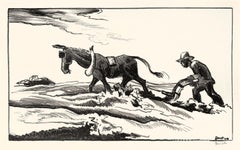
Plowing It Under — WPA Era American Regionalism
By Thomas Hart Benton
Located in Myrtle Beach, SC
Thomas Hart Benton, 'Goin' Home', lithograph, 1937, edition 250, Fath 14. Signed in pencil. Signed in the stone, lower right. A fine, richly-inked impression, on off-white, wove pape...
Category

1930s American Realist Charles E. Chambers Art

Materials

Lithograph

‘Oriental Girls - Mediants à Tanger’, Jean François Portaels ( 1818 - 1895 )
Located in Knokke, BE
Jean François Portaels 1818 - Brussels - 1895 Belgian Painter ‘Oriental Girls - Mediants à Tanger, Maroc’ Signature: signed lower right ‘J. Portaels’ Medium: oil on canvas Dimensions: image size 40,5 x 28,5 cm, frame size 67,5 x 56 cm Biography: Jean François Portaels, also known as Jan Portaels, was a versatile Belgian painter born on April 3, 1818, in Vilvoorde and passed away on February 8, 1895, in Schaerbeek. He was celebrated for his genre scenes, biblical stories, landscapes, portraits, and Orientalist subjects. As a teacher and director of the Academy of Fine Arts of Ghent and the Académie Royale des Beaux-Arts in Brussels, Portaels significantly impacted Belgian art, becoming a pivotal figure in the Belgian Orientalist school. His works were known for their 'everyday elegance and feminine grace,' and he played a crucial role in influencing the next generation of Belgian artists, including notable figures like Théo van Rysselberghe. Portaels was the son of a wealthy brewer who also served as Vilvoorde's mayor. Showing an early passion for drawing, he was sent to the Académie Royale des Beaux-Arts in Brussels in 1836, where he studied under François-Joseph Navez, a former student of Jacques-Louis David. Navez invited him to his studio, which was renowned at the time, allowing Portaels to refine his skills alongside other talented students like Charles de Groux and Joseph Stallaert. In 1841, Portaels moved to Paris, enrolling at the Ecole des Beaux-Arts and studying under Paul Delaroche. He became influenced by the emerging Orientalist movement, which was gaining traction in Paris. In 1842, he won the Grand Prix de Rome, which funded his travels across Italy and other regions, including Morocco, Algeria, Egypt, Lebanon, Judea, Spain, Hungary, and Norway. These journeys profoundly influenced his artistic vision, particularly his Orientalist works. Upon his return to Belgium in 1847, Portaels was appointed Director of the academy in Ghent. In 1849, he married Marie Hélène Navez, the daughter of his first teacher. Despite being offered the directorship of the Brussels Academy, he initially declined, opting to preserve his independence. He later accepted a teaching position at the Academy and eventually became its director in 1878, succeeding Eugène Simonis. Portaels was known for his broad range of artistic talents, including history painting, portraiture, and genre art. He was particularly recognised for his Orientalist depictions, often portraying the 'Oriental woman' with distinctive features like arched eyebrows and almond-shaped eyes. His style, marked by charm and elegance, distinguished him from the dominant artistic movements of Classicism and Romanticism. He was a pioneer in monumental art in Belgium, working with Jean Baptiste van Eycken to introduce fresco techniques like water glass painting...
Category

Mid-19th Century Impressionist Charles E. Chambers Art

Materials

Canvas, Oil

Large Orientalist Painting of an Egyptian Landscape by Löffler
Located in London, GB
Large Orientalist painting of an Egyptian landscape by Löffler German, c. 1850 Canvas: Height 103cm, width 148cm Frame: Height 116cm, width 159.5cm, depth 8cm This superb oil paint...
Category

19th Century Charles E. Chambers Art

Materials

Canvas, Wood, Oil, Wood Panel

Andrew Wyeth, Burning Off, from The Four Seasons (after)
By Andrew Wyeth
Located in Southampton, NY
This exquisite lithograph after Andrew Wyeth (1917–2009), titled Burning Off, originates from the distinguished 1962 folio The Four Seasons: Paintings and Drawings by Andrew Wyeth. Published and printed by Art in America Company, Inc., New York, the edition captures Wyeth’s poetic meditation on atmosphere and transformation. Burning Off depicts a summer morning’s sea fog gradually lifting from the landscape, revealing the tranquil geometry of field and horizon. Through restrained tonal contrasts and delicate textural nuance, Wyeth conveys both the mystery and stillness of the natural world in transition. Executed on velin paper, this lithograph measures 17 x 13 inches (43.2 x 33 cm). As issued, it is unsigned and unnumbered, representing the folio’s authentic format. The Four Seasons series was conceived by the editors of Art in America in collaboration with Andrew and Betsy Wyeth, who selected drawings from the artist’s studio and personal collection to embody the cyclical poetry of the seasons. Each image reflects Wyeth’s profound sensitivity to light, time, and emotion—his ability to evoke the spiritual essence of landscape through quiet realism. Artwork Details: Artist: After Andrew Wyeth (1917–2009) Title: Burning Off, from The Four Seasons, Paintings and Drawings by Andrew Wyeth, 1962 Medium: Lithograph on velin paper Dimensions: 17 x 13 inches (43.2 x 33 cm) Inscription: Unsigned and unnumbered, as issued Date: 1962 Publisher: Art in America Company, Inc., New York Printer: Art in America Company, Inc., New York Condition: Well preserved, consistent with age and medium Provenance: From the 1962 folio The Four Seasons, Paintings and Drawings by Andrew Wyeth, published and printed by Art in America Company, Inc., New York Notes: Excerpted from the 1962 folio: "In 1962 the editors of Art in America proposed to Wyeth a portfolio of images of his recent dry-brush drawings. The artist and his wife suggested the theme, 'The Four Seasons,' because of the essential role played in his work by the cycle of the seasons. The drawings were selected by Andrew and Betsy Wyeth from works in the house and studio at Chadds Ford, supplemented by some owned by friends. With a few exceptions they had never been exhibited or reproduced. The plates were made directly from the originals. In these drawings Wyeth's loving concentration on the object is fully revealed. But as always in his work, this concern with the tangible is balanced by sensibility to mood, to the emotion arising from the actual. They are pervaded with a sense of the season—the exact time of year, the hour of the day, the quality of the light. To the truth and subtlety with which he captures these intangible factors, these drawings owe their poignant poetry." About the Artist: Andrew Wyeth (1917–2009) was an American visual artist and one of the best-known painters of the mid-20th century. Although he considered himself an abstractionist, Wyeth’s work is characterized by a meticulous realism imbued with psychological depth and atmosphere. He often painted the landscapes and people surrounding his homes in Chadds Ford, Pennsylvania, and Cushing, Maine, creating an intimate record of American rural life. The son of the celebrated illustrator N. C. Wyeth, Andrew trained under his father before developing his own deeply personal visual language inspired by Winslow Homer, Henry David Thoreau, and King Vidor. His wife, Betsy Wyeth, was both his muse and career manager, while his son Jamie Wyeth continued the family’s artistic legacy. Among Wyeth’s best-known works is Christina’s World (1948), housed in the Museum of Modern Art, New York—a quintessential image of 20th-century American art. His other notable series include The Helga Pictures and his window studies, each reflecting a profound meditation on solitude, memory, and perception. Wyeth was the first painter to receive both the Presidential Medal of Freedom and the Congressional Gold Medal, and was elected to the French Académie des Beaux-Arts in 1980. In 2022, Andrew Wyeth's painting Day Dream sold for USD 23.29 million at Christie’s New York, setting a world record for the artist. Andrew Wyeth lithograph...
Category

1960s American Realist Charles E. Chambers Art

Materials

Lithograph

Andrew Wyeth, New Leaves, from The Four Seasons (after)
By Andrew Wyeth
Located in Southampton, NY
This exquisite lithograph after Andrew Wyeth (1917–2009), titled New Leaves, originates from the distinguished 1962 folio The Four Seasons: Paintings and Drawings by Andrew Wyeth. Published and printed by Art in America Company, Inc., New York, the edition exemplifies Wyeth’s quiet observation of nature and the passage of time. New Leaves captures the delicate stir of spring renewal—the subtle emergence of life in the landscape—rendered with Wyeth’s hallmark balance of precision, restraint, and emotional depth. Executed on velin paper, this lithograph measures 17 x 13 inches (43.2 x 33 cm). As issued, it is unsigned and unnumbered, representing the folio’s authentic format. The Four Seasons series was conceived by the editors of Art in America in collaboration with Andrew and Betsy Wyeth, who selected drawings from the artist’s studio and personal archive to embody the poetic rhythm of the changing seasons. Each composition reveals Wyeth’s mastery of atmosphere, mood, and the quiet intensity of natural experience. Artwork Details: Artist: After Andrew Wyeth (1917–2009) Title: New Leaves, from The Four Seasons, Paintings and Drawings by Andrew Wyeth, 1962 Medium: Lithograph on velin paper Dimensions: 17 x 13 inches (43.2 x 33 cm) Inscription: Unsigned and unnumbered, as issued Date: 1962 Publisher: Art in America Company, Inc., New York Printer: Art in America Company, Inc., New York Condition: Well preserved, consistent with age and medium Provenance: From the 1962 folio The Four Seasons, Paintings and Drawings by Andrew Wyeth, published and printed by Art in America Company, Inc., New York Notes: Excerpted from the 1962 folio: "In 1962 the editors of Art in America proposed to Wyeth a portfolio of images of his recent dry-brush drawings. The artist and his wife suggested the theme, 'The Four Seasons,' because of the essential role played in his work by the cycle of the seasons. The drawings were selected by Andrew and Betsy Wyeth from works in the house and studio at Chadds Ford, supplemented by some owned by friends. With a few exceptions they had never been exhibited or reproduced. The plates were made directly from the originals. In these drawings Wyeth's loving concentration on the object is fully revealed. But as always in his work, this concern with the tangible is balanced by sensibility to mood, to the emotion arising from the actual. They are pervaded with a sense of the season—the exact time of year, the hour of the day, the quality of the light. To the truth and subtlety with which he captures these intangible factors, these drawings owe their poignant poetry." About the Artist: Andrew Wyeth (1917–2009) was an American visual artist and one of the best-known painters of the mid-20th century. Although he considered himself an abstractionist, Wyeth’s work is characterized by a meticulous realism imbued with psychological depth and atmosphere. He often painted the landscapes and people surrounding his homes in Chadds Ford, Pennsylvania, and Cushing, Maine, creating an intimate record of American rural life. The son of the celebrated illustrator N. C. Wyeth, Andrew trained under his father before developing his own deeply personal visual language inspired by Winslow Homer, Henry David Thoreau, and King Vidor. His wife, Betsy Wyeth, was both his muse and career manager, while his son Jamie Wyeth continued the family’s artistic legacy. Among Wyeth’s best-known works is Christina’s World (1948), housed in the Museum of Modern Art, New York—a quintessential image of 20th-century American art. His other notable series include The Helga Pictures and his window studies, each reflecting a profound meditation on solitude, memory, and perception. Wyeth was the first painter to receive both the Presidential Medal of Freedom and the Congressional Gold Medal, and was elected to the French Académie des Beaux-Arts in 1980. In 2022, Andrew Wyeth's painting Day Dream sold for USD 23.29 million at Christie’s New York, setting a world record for the artist. Andrew Wyeth lithograph...
Category

1960s American Realist Charles E. Chambers Art

Materials

Lithograph

Previously Available Items
Elderly Couple
By Charles E. Chambers
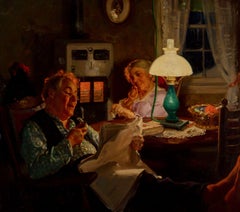
Located in Fort Washington, PA
Signature: Signed Lower Left Framed: 36.00" x 41.00"
Category

20th Century Charles E. Chambers Art

Materials

Canvas, Oil

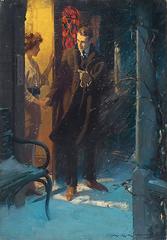
Couple Parting on Porch in Snow
By Charles E. Chambers
Located in Fort Washington, PA
Date: 1915 Medium: Oil on Canvas Dimensions: 30.00" x 21.00" Signature: Signed Lower Right Couple parting on porch in snow. “They had formed a little code of leave-taking” Story illustration: “The Turmoil”, author: Booth Tarkington...
Category

1910s Charles E. Chambers Art

Materials

Canvas, Oil

Charles E. Chambers art for sale on 1stDibs.

Find a wide variety of authentic Charles E. Chambers art available for sale on 1stDibs. You can also browse by medium to find art by Charles E. Chambers in oil paint, paint, canvas and more. Not every interior allows for large Charles E. Chambers art, so small editions measuring 20 inches across are available. Customers who are interested in this artist might also find the work of Coby Whitmore, Henry Soulen, and Benton Clark. Charles E. Chambers art prices can differ depending upon medium, time period and other attributes. On 1stDibs, the price for these items starts at $1,100 and tops out at $29,000, while the average work can sell for $15,500.

Recently Viewed

View All