Charles-Emile Jacque Landscape Prints

French, 1813-1894

Charles Emile Jacque was born in 1813 in Paris. He was part of the first generation of painters to leave Paris for Barbizon and the forest of Fontainebleau. Jacque was also a founding and influential member of the “Men of 1830” (also called L'école Française De Paysage), an artistic movement who, spurred on by the Revolution of 1830, sought out new directions in landscape painting. His strong, realistic, yet sensitive depictions of shepherds and their flocks form one of the most cohesive and important bodies of work produced by the movement. During the 1840s, he and his friend, Jean-François Millet moved to the village of Barbizon where they felt they could more realistically portray nature. Jacque bought a house there and was influenced by Narcisse Diaz’s technique and Millet’s themes, he found his inspiration in hen-houses, pigsties and flocks of sheep at pasture. He left Barbizon in 1854 and continued to paint in the outskirts of Paris until he died on May 7, 1894. Works by his hand are held by numerous museums such as the Baltimore Museum of Art, Isabella Stewart Gardner Museum in Boston, Cincinnati Art Museum, National Galleries of Scotland in Edinburgh, Gallery of Modern Art in Glasgow, Minneapolis Institute of Arts, Metropolitan Museum of Art in New York, Ashmolean Museum of Art and Archaeology, and Philadelphia Museum of Art and, of course, at the Musée du Louvre and Musée d’Orsay in Paris.

to
2
Overall Width
to
Overall Height
to
10
188
169
156
147
2
2
2
1
1
1
1
1
2
2
2
2
Artist: Charles-Emile Jacque
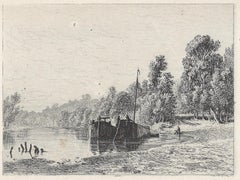
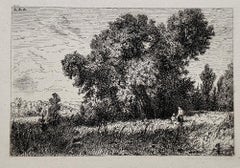
Bords d une rivière avec deux bateaux (River banks with two boats)
By Charles-Emile Jacque
Located in Middletown, NY
Etching on chine collé mounted to white wove paper, 3 11/16 x 5 (92 x 125 mm), full margins. In good condition with minor mat tone. Printed by Delâtre, Paris. [Guiffrey 34]
Category

Mid-19th Century French School Charles-Emile Jacque Landscape Prints

Materials

Handmade Paper, Etching

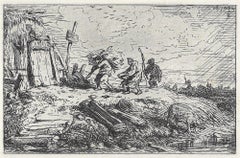
Une bourrasque
By Charles-Emile Jacque
Located in Middletown, NY
Etching on chine collé mounted to white wove paper, 3 x 4 5/8 inches (75 x 112 mm), full margins. Scattered light areas of adhesive residue with associated discoloration along the to...
Category

Mid-19th Century French School Charles-Emile Jacque Landscape Prints

Materials

Handmade Paper, Etching

Related Items
"Enshoku Sanju-roku Kasen" (Thirty-six Enchanting Flowers) Woodblock on paper
By Toyohara Kunichika
Located in Soquel, CA
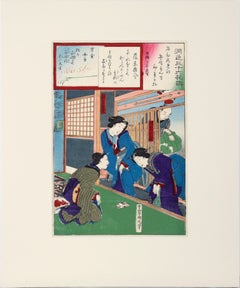
"Enshoku Sanju-roku Kasen" (Thirty-six Enchanting Flowers) Woodblock on paper Elegant woodblock print by Toyohara Kunuchika (Japanese, 1835-1900). Three women are in talking with each other inside, while a man waits outside holding a bag of some kind. The colors in this piece are rich and saturated, primarily blues, greens, and purple. Mat size: 16"H x 20"W Paper size: 14.75"H x 9.88"W Born in 1835, Toyohara Kunichika grew up in the Kyobashi district of Edo in the midst of merchants and artisans. In 1848, at age 13, he was accepted as an apprentice into the studio of Utagawa Kunisada I...
Category

1880s Edo Charles-Emile Jacque Landscape Prints

Materials

Ink, Rice Paper, Woodcut

Kiyomi Barrier Seiken Temple Near Okitsu- Japanese Woodcut Print on Rice Paper
By Utagawa Hiroshige
Located in Soquel, CA
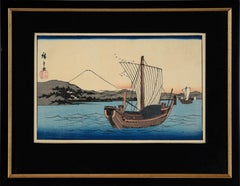
Kiyomi Barrier & Seiken Temple Near Okitsu - Japanese Woodcut Print on Rice Paper Woodblock print of boats in a harbor by Utagawa Hiroshige (Japanese, 1797-1858). Originally publish...
Category

1850s Impressionist Charles-Emile Jacque Landscape Prints

Materials

Rice Paper, Woodcut

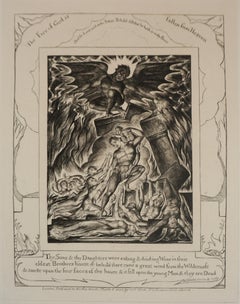
Illustrations From The Book of Job - "The Fire of God is Fallen From Heaven"
By William Blake
Located in Soquel, CA
"Illustrations of the Book of Job" Engraving "The Fire of God is Fallen From Heaven...And the Lord said unto Satan Behold All that he hath is in thy Power" Engraving, third printing...
Category

1870s Symbolist Charles-Emile Jacque Landscape Prints

Materials

Handmade Paper, Engraving

Page from "Spring View in Takanawa" Mid 18th Century Ukiyo-e Print
By Utagawa Kunisada (Toyokuni III)
Located in Soquel, CA
Page from "Spring View in Takanawa" Mid 18th Century Ukiyo-e Print Left page from the triptych print "Spring View in Takanawa" by Utagawa Kunisada (Toyokuni III) (Japanese b. 1786 d...
Category

1840s Edo Charles-Emile Jacque Landscape Prints

Materials

Printer s Ink, Mulberry Paper, Woodcut
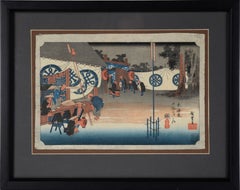
Stage 48 of the 53 Stages of the Tokaido - Japanese Woodblock on Rice Paper
By Utagawa Hiroshige
Located in Soquel, CA
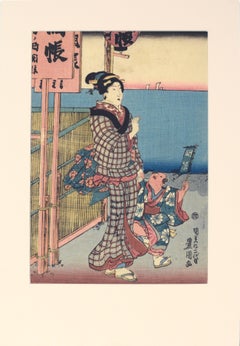
Stage 48 of the 53 Stages of the Tokaido - Japanese Woodblock on Rice Paper Woodblock print of clothing vendors by Utagawa Hiroshige (Japanese, 1797-1858). Originally printed in 183...
Category

1830s Impressionist Charles-Emile Jacque Landscape Prints

Materials

Rice Paper, Woodcut

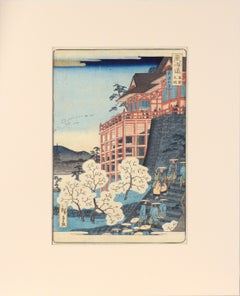
Kiyomizu Temple, Scenes of Famous Places along Tôkaidô Road - Woodblock on Paper
By Utagawa Hiroshige II
Located in Soquel, CA
Kiyomizu Temple, Scenes of Famous Places along Tôkaidô Road - Woodblock on Paper Full Title: Kyoto: Kiyomizu Temple (Kyô Kiyomizudera), from the series Scenes of Famous Places along...
Category

1860s Edo Charles-Emile Jacque Landscape Prints

Materials

Ink, Rice Paper, Woodcut

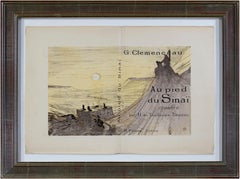
Toulouse Lautrec Original Lithograph Famous Political 1800s Collection Signed
By Henri de Toulouse-Lautrec
Located in Milwaukee, WI
"Lautrec Book: From Au Pied du Sinai written by Georges Clemenceau" lithographs created by the legendary Henri de Toulouse-Lautrec. This book, Au Pied...
Category

1890s Post-Impressionist Charles-Emile Jacque Landscape Prints

Materials

Lithograph, Mulberry Paper

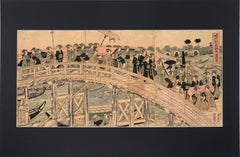
Mitate of a Daimyo s Procession Crossing Ryogoku Bridge - Woodblock Print
By Keisai Eisen
Located in Soquel, CA
Mitate of a Daimyo's Procession Crossing Ryogoku Bridge - Woodblock Print Woodblock print of a procession by Keisai Eisen (Japanese, 1790–1848). Terrific triptych of a procession of...
Category

Early 19th Century Edo Charles-Emile Jacque Landscape Prints

Materials

Ink, Rice Paper, Woodcut

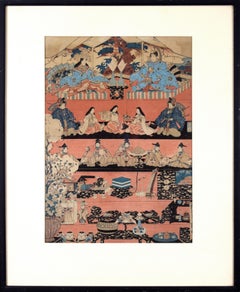
"Various Himochi" Wagashi Festival Japanese Woodblock Print by Utagawa Toyokuni
By Utagawa Toyokuni
Located in Soquel, CA
"Various Himochi" Wagashi Festival Japanese Woodblock Print by Utagawa Toyokuni Rare oversized early 19th century 5-tiered woodblock by Utagawa Ichiyosai Toyokuni, (Japan, 1769-1825), a Japanese lord and wife oversee a sekku festival of food, music, and dolls or toys. '"oshi" is the first day of “Mi (Snake)” in the third month of the lunar calendar. This day, known in modern Japan as the Girls' Festival, originated in China as a form of purification ceremony in which water and drinking peach blossom wine were used to drive away evil. Many kinds of hishi-mochi appear in this picture of hina ningyo (dolls associated with Hinamatsuri, or the Girl’s Day) from Omochae. The custom of eating special dishes at events throughout the year and at milestones in people's lives has existed since ancient times. This paragraph specifically focuses on the annual event called sekku, and life events that involve eating sweets. Joshi is the first day of “Mi (Snake)” in the third month of the lunar calendar. This day, known in modern Japan as the Girls' Festival, originated in China as a form of purification ceremony in which water and drinking peach blossom wine were used to drive away evil. According to the Keiso saijiki, in ancient China, on the third day of the third lunar month, people ate “ryuzetsuhan,” which is the juice of gogyo (Jersey cudweed) mixed with rice flour and nectar. In Japan, there is a record in the Heian period history book Nihon Montoku tenno jitsuroku [839-5] that it was an annual event to make kusamochi using gogyo on the third day of the third month of the lunar calendar, which may have been influenced by Chinese customs. The tradition of eating kusamochi on the third day of the third month of the lunar calendar continued after that. By the Edo period, however, hishimochi had come to be used as a sweet to serve on the third day of the third month. A picture of a hishimochi is included in the Morisada manko , which we mentioned in Part 1. According to it, hishimochi in the Edo period were often three layers of green-white-green instead of the now common red-white-green. However, it is possible to see from our collection that not all hishimochi were made in this way. Omochae published in 1857, is a good example. Omochae is a type of ukiyoe print...
Category

1820s Edo Charles-Emile Jacque Landscape Prints

Materials

Ink, Rice Paper, Woodcut

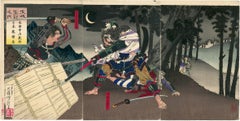
Ôkubo Hikozaemon Protects the Hidden Shogun Triptych
By Taiso Yoshitoshi
Located in Burbank, CA
“War Chronicles of Osaka” (Osaka gunki no uchi). Okubo Hikozaemon, raising his sword, protects the hidden Tokugawa shogun from the spear of Gorô Matabei Mototsugu in a moonlit fores...
Category

1880s Other Art Style Charles-Emile Jacque Landscape Prints

Materials

Mulberry Paper, Woodcut

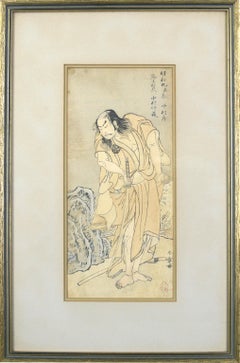
Actor as Samurai - 18th Century Japanese Woodblock Print
By Katsukawa Shunshō
Located in Soquel, CA
Actor as Samurai - 18th Century Japanese Woodblock Print Woodblock print depicting an actor, possibly Nakamura Denkuro II, as a samurai. The actor stands with his sword unsheathed a...
Category

Late 18th Century Edo Charles-Emile Jacque Landscape Prints

Materials

Woodcut, Rice Paper

Village Triptych - XX century, Figurative Etching Print, very small edition 2/X
By Andrzej Juchniewicz
Located in Salzburg, AT
The graphic is already framed. About Andrzej Juchniewicz - 1967–1972 Secondary School of Fine Arts in Gdynia-Orłowo. 1978–1983 studies at the Acad...
Category

1990s Contemporary Charles-Emile Jacque Landscape Prints

Materials

Paper, Etching

Previously Available Items
Paysage; Isle D Aligre
By Charles-Emile Jacque
Located in Middletown, NY
Etching on Chine collé mounted to cream wove paper, 3 5/8 x 5 1/8 (90 x 129 mm), full margins. With a pencil notation in the right margin on the recto (outside of image area), as we...
Category

Mid-19th Century Old Masters Charles-Emile Jacque Landscape Prints

Materials

Handmade Paper, Etching

Charles-emile Jacque landscape prints for sale on 1stDibs.

Find a wide variety of authentic Charles-Emile Jacque landscape prints available for sale on 1stDibs. You can also browse by medium to find art by Charles-Emile Jacque in etching, handmade paper, paper and more. Much of the original work by this artist or collective was created during the 19th century and is mostly associated with the Old Masters style. Not every interior allows for large Charles-Emile Jacque landscape prints, so small editions measuring 5 inches across are available. Customers who are interested in this artist might also find the work of Edgar Chahine, Auguste Louis Lepère, and Charles Amand Durand. Charles-Emile Jacque landscape prints prices can differ depending upon medium, time period and other attributes. On 1stDibs, the price for these items starts at $350 and tops out at $450, while the average work can sell for $450.