Charles Inder Art
to
1
Overall Width
to
Overall Height
to
1
1
1
1
1
9,962
2,753
1,376
1,373
1
1
Artist: Charles Inder
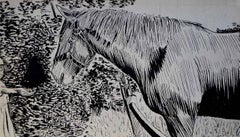
Girl Feeding Horse. Pen
Ink. Mid 20th Century
By Charles Inder
Located in London, GB
Charles Inder
Flourished: 1920 - 1940
Girl Feeding Horse
Ink on paper
Image size: 6 x 8 cm
Acid free incised mount and black frame
Category
20th Century Charles Inder Art
Materials
Paper, Ink
Related Items
Modern British, 20th Century St. Ives artist, Sven Berlin
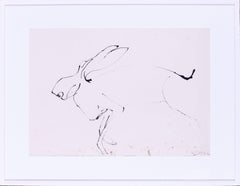
Running Hare
Located in Petworth, West Sussex
Sven Berlin (British, 1911 - 1999)
Running Hare
Black and brown ink on paper
15.3/4 x 22 in. (40 x 55.8 cm.)
Category
20th Century Romantic Charles Inder Art
Materials
Paper, Ink

$1,387
H 15.75 in W 22 in D 1 in
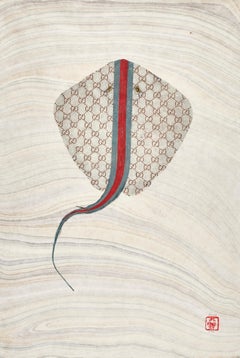
Gucci Ray - Sumi Ink on Mulberry Paper, Original Artwork, Gyotaku Style
By Jeff Conroy
Located in Chicago, IL
Designers have an wide reach through out the world but have yet to reach the depths of the ocean. Artist Jeff Conroy has created this Gyotaku print of large ray entitled simply "Gucci Ray" to fill that void. To achieve this remarkable painting, the artist applies sumi ink to a sting ray he caught himself on Florida's Gulf Coast, then "prints" it onto Marbled Mulberry paper - a soft, handmade paper. He then embellishes the details with watercolor to give extraordinary dimension and interest to its overall aesthetic. The artwork is unframed. Please contact the gallery for framing options.
Jeff Conroy
Gucci Ray
sumi ink and watercolor on mulberry paper
37h x 25w in
93.98h x 63.50w cm
JEC088
Gyotaku - A Japanese word translated from "gyo" meaning fish and "taku" meaning stone impression and is believed to get its inspiration from Chinese stone rubbings of calligraphy, which then gave rise to printing . This tradition dates back to the mid-1800s and was used by fishermen to record their catches, but has also become an art form of its own. Prints were made using Sumi ink and Washi paper. It is rumored that Samurai would settle fishing competitions using Gyotaku prints. This original form of Gyotaku is still utilized today, and can be seen hanging in fish and tackle shops all...
Category
21st Century and Contemporary Contemporary Charles Inder Art
Materials
Sumi Ink, Watercolor, Mulberry Paper
$1,440 Sale Price
34% Off
H 37 in W 25 in
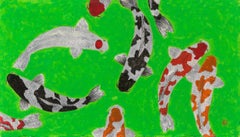
Koi Pond Conclave - Japanese Style Gyotaku Painting on Archival Kraft Paper
By Jeff Conroy
Located in Chicago, IL
In Japan they are known as Nishikigoi, or living jewels. These brilliantly colored varieties of the Amur carp have been selectively bred by family owned fisheries for generations. When I began this series of Gyotaku (Japanese fish printing) I studied the many varieties of Koi, each with their own unique colors and patterns. My particular favorites are the Tanchos which can be identified by the distinct red spot on their heads. To create these pieces I print common carp I catch myself with sumi ink using traditional techniques used by Japanese fisherman...
Category
21st Century and Contemporary Contemporary Charles Inder Art
Materials
Sumi Ink, Watercolor, Archival Paper
$2,800 Sale Price
43% Off
H 35.5 in W 63 in
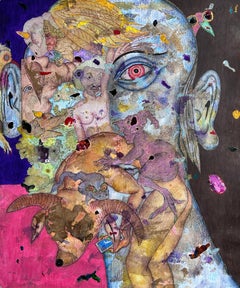
Ink Drawing, Colored Pencils, and Oil Pastel on Paper. “Beyond Words”
Located in Bogotá, Bogotá
“Beyond Words” is an original drawing on paper Fabriano by Colombian artist Luis Xiua, whose work fuses figurative and abstract elements inspired by nature, symbolism, and constructi...
Category
2010s Contemporary Charles Inder Art
Materials
Paper, Oil Pastel, Ink, Pen, Pencil, Pigment
$500
H 11.82 in W 9.85 in D 0.4 in
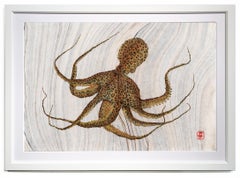
Cheetahpus - Gyotaku Style Japanese Sumi Ink Painting, Cheetah Patterned Octopus
By Jeff Conroy
Located in Chicago, IL
A newly discovered sea creature?? No, just an imaginative artist creating a Gyo-Tako print of large octopus by Jeff Conroy entitled "Cheetahpus". To achieve this remarkable painting, the artist inks the octopus using traditional sumi ink then "prints" it onto Mulberry paper - a soft, handmade paper. He then embellishes the details with watercolor to give extraordinary dimension and interest to its overall aesthetic. Framed as shown.
Jeff Conroy
Cheetahpus
sumi ink and watercolor on mulberry paper
25h x 36.50w in
63.50h x 92.71w cm
JEC080
Gyotaku - A Japanese word translated from "gyo" meaning fish and "taku" meaning stone impression and is believed to get its inspiration from Chinese stone rubbings of calligraphy, which then gave rise to printing . This tradition dates back to the mid-1800s and was used by fishermen to record their catches, but has also become an art form of its own. Prints were made using Sumi ink and Washi paper. It is rumored that Samurai would settle fishing competitions using Gyotaku prints. This original form of Gyotaku is still utilized today, and can be seen hanging in fish and tackle shops all...
Category
21st Century and Contemporary Contemporary Charles Inder Art
Materials
Sumi Ink, Watercolor, Mulberry Paper
$2,000 Sale Price
33% Off
H 25 in W 36.5 in
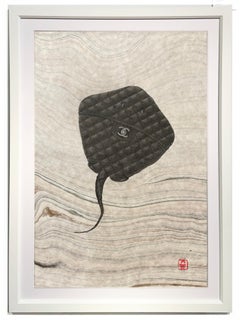
Chanel Quilted Black Caviar Ray - Sumi Ink on Mulberry Paper, Gyotaku Original
By Jeff Conroy
Located in Chicago, IL
Designers have an wide reach through out the world but have yet to reach the depths of the ocean. Artist Jeff Conroy has created this Gyotaku print of large ray entitled simply "Channel Quilted Black Caviar Ray" to fill that void. To achieve this remarkable painting, the artist applies sumi ink to a sting ray he caught himself on Florida's Gulf Coast, then "prints" it onto Marbled Mulberry paper - a soft, handmade paper. He then embellishes the details with watercolor to give extraordinary dimension and interest to its overall aesthetic. The artwork is framed as shown.
Jeff Conroy
Chanel Quilted Black Caviar Ray
sumi ink and watercolor on mulberry paper
37h x 25w in
93.98h x 63.50w cm
FRAMED DIMENSIONS
42.50h x 30.75w x 1d in
107.95h x 78.11w x 2.54d cm
JEC083
Gyotaku - A Japanese word translated from "gyo" meaning fish and "taku" meaning stone impression and is believed to get its inspiration from Chinese stone rubbings of calligraphy, which then gave rise to printing . This tradition dates back to the mid-1800s and was used by fishermen to record their catches, but has also become an art form of its own. Prints were made using Sumi ink and Washi paper. It is rumored that Samurai would settle fishing competitions using Gyotaku prints. This original form of Gyotaku is still utilized today, and can be seen hanging in fish and tackle shops all...
Category
21st Century and Contemporary Contemporary Charles Inder Art
Materials
Sumi Ink, Watercolor, Mulberry Paper
$1,760 Sale Price
20% Off
H 37 in W 25 in
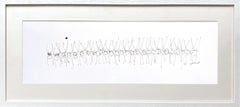
Watusi wall - Gabielle Pool - Whimsical ink drawing of African Watusi cattle
By Gabrielle Pool
Located in Coltishall, GB
A wall of Watusi cattle in Kenya.
The strength and drama of long-horned African cattle is captured in a mesmerizing interplay of delicate lines and abstract forms, creating a rhythm...
Category
21st Century and Contemporary Charles Inder Art
Materials
Wood, Paper, Ink
$673
H 13 in W 28.35 in D 0.79 in
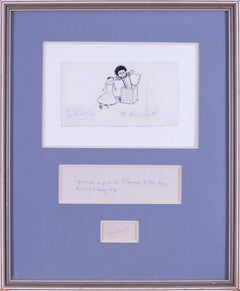
British illustration by EH Shephard, illustrator for Winnie the Pooh
Located in Petworth, West Sussex
Ernest Howard Shephard (British, 1879 – 1976)
The land of the lost toys – ‘Oh that’s you is it’
Inscribed with title (lower edge), and further inscribed ...
Category
20th Century English School Charles Inder Art
Materials
Paper, Ink, Pen
$1,197
H 3.75 in W 7 in D 1 in
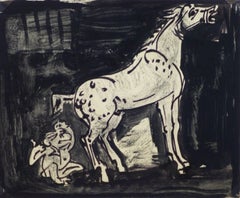
Ink Drawing - Startled in the Stall
By Kaupisch Von Reppert Irmgard
Located in Houston, TX
Amusing black and white ink drawing of a horse being startled by a small figure or vice versa by artist Irmgard Von Reppert, circa 1960.
Original artwork on paper displayed on a ...
Category
1960s Charles Inder Art
Materials
Ink, Paper
$250
H 16 in W 0.1 in D 12 in
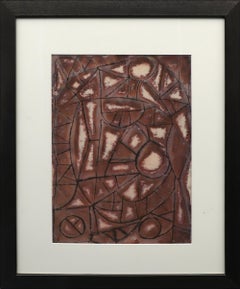
Original 1940s Abstract Pen
Ink Drawing “The Chicken” by Edward Marecak
By Edward Marecak
Located in Denver, CO
This striking original pen and ink drawing, titled “The Chicken”, was created by celebrated 20th-century American modernist Edward Marecak (1919–1993) in the 1940s. A powerful exampl...
Category
1940s Abstract Geometric Charles Inder Art
Materials
Paper, Ink
$1,750
H 23.75 in W 19.75 in D 0.75 in
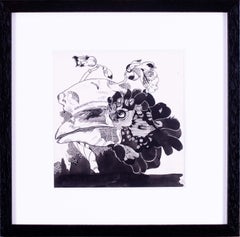
Early 20th Century British illustration of a hornbill bird by Edward Detmold
By Edward Julius Detmold
Located in Petworth, West Sussex
Edward Julius Detmold (British, 1883 – 1957)
Hornbill
Pen and ink on paper
Signed with initials’ ED’ (lower right)
16.3 x 15.8 cm.
Edward Julius Detmold (21 November 1883 Putney, Wandsworth, Surrey - 1 July 1957 Montgomery) and his twin brother Charles Maurice Detmold (1883-1908) were prolific Victorian book illustrators.
Their parents were Edward Detmold and Mary Agnes Luck. Their father, an electrical engineer was chronically ill, and they lived with their uncle and guardian, Dr Edward Barton Shuldham, who saw to their tuition and was a noted collector of porcelain and Japanese woodprints of plants and animals. Dr Shuldham occupied a house in Upper Richmond Road, Putney, where the twins had been born. He ensured their interest in natural history and art, and created a nurturing environment for their precocious talents. They also spent time with another uncle, the painter Henry E. Detmold, who encouraged them in their art. Most of their prodigious energy was expended on depicting animal subjects and their work showed great influence from traditional Japanese art, Albrecht Dürer and later the Art Nouveau movement. They were exhibiting watercolours at the Royal Academy and the Royal Institute of Painters in Water Colours at the age of 13. Edward Burne-Jones praised their work and warned against the dangers of uniformity inherent in art schools.
The twins subsequently mastered the techniques of watercolour etching and of colour printing with copper plates, buying a printing press and producing their own proofs at home.
In 1898 they compiled a portfolio of colour etchings of animals and flowering plants done in the Japanese style. These were much sought after and were rapidly sold out. They collaborated on the etchings and illustrations for their first book Pictures From Birdland published in 1899. This book resulted from a number of drawings being shown in the autumn of 1897, to the publisher J. M. Dent, who was so impressed that the two brothers were asked to provide coloured illustrations for a book of his. The first title mooted was Alphabet of Birds, eventually becoming Pictures from Birdland. "Particularly noticeable are the early influences in the paintings, Edward's design for an osprey, with its unusual water effects, testifying to a Japanese contribution. Already apparent is that style in which a searching study of natural forms, especially bird plumage, is subordinated to decorative arrangement" - David Larkin (The Fantastic Creatures of Edward Julius Detmold) This was followed in 1900, by an exhibition at the Fine Art Society's Gallery in London.
Their next joint project was to produce a set of 16 watercolours for Rudyard Kipling's The Jungle Book published in 1903, by Macmillan. The success of their painting careers seemed assured, but Maurice ended his life by inhaling chloroform in April 1908, shortly before they were due to leave for a holiday in Sussex with Dr Shuldham, who had arranged that Maurice put down the household cats using the anaesthetic. Although stunned by the death of Maurice, Edward threw himself into his work.
The recognition accorded the twins' illustrations of Kipling's classic tale was extraordinary. Consequently, in 1909 Edward illustrated The Fables of Aesop, producing 23 colour plates and a host of pen & ink drawings. This proved so popular that in 2006 The Folio Society of London published a facsimile of the original Hodder & Stoughton edition.
In 1911, Detmold worked on illustrations for Maurice Maeterlinck's The Life of the Bee, Camille Lemonnier's Birds and Beasts and Florence Dugdale's Book of Baby Beasts. In the following year he worked on Maeterlinck's Hours of Gladness, in 1913, on Florence Dugdale's Book of Baby Birds and in 1919, on W. H. Hudson's Birds in Town and Village In 1919, he also produced a portfolio of Twenty Four Nature Pictures and, in 1921, on Our Little Neighbours and Jean-Henri...
Category
20th Century Art Deco Charles Inder Art
Materials
Paper, Ink, Pen
$598
H 6.42 in W 6.23 in D 1.97 in
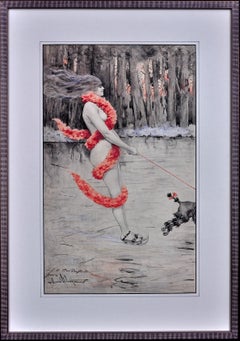
Art Nouveau Watercolor Painting Naked Lady Red Boa Skating Pulled By A Poodle
Located in Sutton Poyntz, Dorset
Oscar Wilson.
English ( b.1867 - d.1930 ).
The Lady Of The Lake.
Watercolor & Ink On Paper.
Signed Lower Left.
Image size 17 inches x 10.2 inches ( 43cm x 26cm ).
Frame size 23 inc...
Category
Early 20th Century Art Nouveau Charles Inder Art
Materials
Ink, Watercolor, Paper
$5,422
H 23.04 in W 16.15 in D 0.79 in
Charles Inder art for sale on 1stDibs.
Find a wide variety of authentic Charles Inder art available for sale on 1stDibs. You can also browse by medium to find art by Charles Inder in ink, paper and more. Not every interior allows for large Charles Inder art, so small editions measuring 8 inches across are available. Customers who are interested in this artist might also find the work of Ella Bruce, Paul Sandby, and John Rattenbury Skeaping. Charles Inder art prices can differ depending upon medium, time period and other attributes. On 1stDibs, the price for these items starts at $537 and tops out at $537, while the average work can sell for $537.