Charles Quest Art

1904-1993

Charles Quest, a successful artist, and fine art instructor, worked in a variety of mediums including mosaic, stained glass, mural painting, and sculpture, but remains best known as a printmaker. Quest grew up in St. Louis, his talent evident as a teenager when he began copying the works of masters such as Michelangelo on his bedroom walls. He studied at the Sam Fox School of Design Visual Arts at Washington University where he later taught from 1944–71. He traveled to Europe after his graduation in 1929, and studied at the Académie de la Grande Chaumière and Académie Colarossi, Paris, continuing to draw inspiration from the works of the Old Masters. After returning to St. Louis, Quest received several commissions to paint murals in public buildings, schools, and churches, including one from Joseph Cardinal Ritter to paint a replica of Velázquez's Crucifixion over the main altar of the Old Cathedral in St. Louis.

Quest soon became interested in the woodcut medium which he apparently learned through his study of J. J. Lankes' A Woodcut Manual (1932) and Paul Landacre's articles in the American Artist magazine since no artists in St. Louis were working in wood at that time. Quest also revealed that for him, woodcutting and engraving were ‘more enjoyable than any other means of expression.’ In the late 1940s, his graphic works began attracting a lot of critical attention — several of his woodcuts won prizes and were acquired by major American and European museums. His wood engraving entitled Lovers was included in the American Federation of Art's traveling print exhibition in 1947. Two years later Quest's two prize-winning prints, Still Life with Grindstone and Break Forth into Singing were exhibited in major American museums in a traveling show organized by the Philadelphia Print Club. His work was included in the Chicago Art Institute's exhibition, Woodcut Through Six Centuries and the print Still Life with Vise, which was purchased by the Museum of Modern Art in New York. In 1951, he was invited by artist-curator Jacob Kainen to exhibit 30 wood engravings and color woodcuts in the Graphic Arts Division of the Smithsonian's National Museum (now known as the American History Museum). This one-man exhibition was a remarkable achievement for Quest, who had been working in the medium for only about 10 years.

In the press release for the show, Kainen praised the ‘technical refinement’ of Quest's work. “He obtains a great variety of textural effects through the use of the graver, and these dense or transparent grays are set off against whites or blacks to achieve sparkling results. His work has the handsome qualities characteristic of the craftsman and designer,” noted Kainen. At the time of the Smithsonian exhibition, Quest's work was represented by three New York galleries in addition to one in his hometown. He had also won 38 prizes, and his prints were in the collections of the Library of Congress, the Art Institute of Chicago, the Metropolitan Museum and the Philadelphia Museum of Art. In cooperation with the Art in Embassies program, his color woodcuts were displayed at the American Embassy in Paris in 1951. Recognition at home came in 1955 with his first solo exhibition in St. Louis. Press coverage of the show heralded the growth of graphic arts toward rivaling painting and sculpture as a major independent medium.

Quest retired from teaching in 1971 and made relatively few prints in his later years, as the rigors of the medium were too demanding. He moved to Tryon, North Carolina, with his wife Dorothy, an artist and portrait painter, and remained active as a painter until he died in 1993. An exhibition of his prints at the Bethesda Art Gallery in 1983 attracted the interest of Curator Emeritus Joseph A. Haller, S. J., who began purchasing his work for the University's collection. In 1990, Georgetown University Library's Special Collections Division became the grateful recipient of a large body of Quest's work including prints, drawings, paintings, sculpture, and stained glass, as well as his archive of correspondence and professional memorabilia. These extensive holdings, including some 260 of his fine prints, provide a rich opportunity for further study and appreciation of this versatile and not-to-be-forgotten mid-Western American artist of the 20th century.

to
3
3
2
2
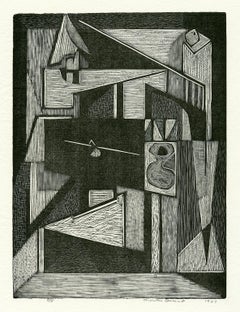
Still Life — Mid-century Modern
By Charles Quest
Located in Myrtle Beach, SC
Charles Quest, 'Still Life', 1947, wood engraving, edition 8. Signed, dated, and numbered '3/8' in pencil. Titled and annotated 'wood engraving' in the bottom left margin. A fine impression, on off-white wove paper, with full margins (1 to 2 inches), in excellent condition. Scarce. Matted to museum standards, unframed. ABOUT THE ARTIST Charles Quest, painter, printmaker, and fine art instructor, worked in various mediums, including mosaic, stained glass, mural painting, and sculpture. Quest grew up in St. Louis, his talent evident as a teenager when he began copying the works of masters such as Michelangelo on his bedroom walls. He studied at the Washington University School of Fine Arts, where he later taught from 1944 to 1971. He traveled to Europe after his graduation in 1929 and studied at La Grande Chaumière and Academie Colarossi, Paris, continuing to draw inspiration from the works of the Old Masters. After returning to St. Louis, Quest received several commissions to paint murals in public buildings, schools, and churches, including one from Joseph Cardinal Ritter, to paint a replica of Velasquez's Crucifixion over the main altar of the Old Cathedral in St. Louis. Quest soon became interested in the woodcut medium, which he learned through his study of J. J. Lankes' A Woodcut Manual (1932) and Paul Landacre's articles in American Artist magazine ‘since no artists in St. Louis were working in wood’ at that time. Quest also revealed that for him, wood cutting and engraving were ‘more enjoyable than any other means of expression.’ In the late 1940s, his graphic works began attracting critical attention—several of his woodcuts won prizes and were acquired by major American and European museums. His wood engraving entitled ‘Lovers’ was included in the American Federation of Art's traveling print exhibition in 1947. Two years later, Quest's two prize-winning prints, ‘Still Life with Grindstone’ and ‘Break Forth into Singing’, were exhibited in major American museums in a traveling show organized by the Philadelphia Print Club. His work was included in the Chicago Art Institute's exhibition, ‘Woodcut Through Six Centuries’, and the print ‘Still Life with Vise’ was purchased by the Museum of Modern Art in New York. In 1951 he was invited by artist-Curator Jacob Kainen to exhibit thirty wood engravings and color woodcuts in a one-person show at the Smithsonian's National Museum (now known as the American History Museum). Kainen's press release praised the ‘technical refinement’ of Quest's work: ‘He obtains a great variety of textural effects through the use of the graver, and these dense or transparent grays are set off against whites or blacks to achieve sparkling results. His work has the handsome qualities characteristic of the craftsman and designer.’ At the time of the Smithsonian exhibition, Quest's work was represented by three New York galleries in addition to one in his home town. He had won 38 prizes, and his prints were in the collections of the Library of Congress, the Chicago Art Institute, the Metropolitan Museum, and the Philadelphia Museum of Art. In cooperation with the Art in Embassies program, his color woodcuts were displayed at the American Embassy in Paris in 1951. Recognition at home came in 1955 with his first solo exhibition in St. Louis. Press coverage of the show heralded the ‘growth of graphic arts toward rivaling painting and sculpture as a major independent medium’. An exhibition of his prints at the Bethesda Art Gallery in 1983 attracted Curator Emeritus Joseph A. Haller, S.J., who began purchasing his work for Georgetown University's collection. In 1990 Georgetown University Library's Special Collections Division was the recipient of a large body of Quest's work, including prints, drawings, paintings, sculpture, stained glass, and his archive of correspondence and professional memorabilia. These extensive holdings, including some 260 of his fine prints, provide a rich opportunity for further study and appreciation of this versatile and not-to-be-forgotten mid-Western American artist...
Category

1940s American Modern Charles Quest Art

Materials

Woodcut

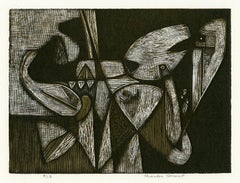
Underwater — Mid-century Modern
By Charles Quest
Located in Myrtle Beach, SC
Charles Quest, 'Underwater', 1948, chiaroscuro wood engraving, edition 12. Signed, titled, dated and numbered '3/12' in pencil. A fine, richly-inked impression, in dark brown and warm black, on off-white wove paper, with full margins (5/8 to 1 1/2 inch), in excellent condition. Scarce. ABOUT THE ARTIST Charles Quest, painter, printmaker, and fine art instructor, worked in various mediums, including mosaic, stained glass, mural painting, and sculpture. Quest grew up in St. Louis, his talent evident as a teenager when he began copying the works of masters such as Michelangelo on his bedroom walls. He studied at the Washington University School of Fine Arts, where he later taught from 1944 to 1971. He traveled to Europe after his graduation in 1929 and studied at La Grande Chaumière and Academie Colarossi, Paris, continuing to draw inspiration from the works of the Old Masters. After returning to St. Louis, Quest received several commissions to paint murals in public buildings, schools, and churches, including one from Joseph Cardinal Ritter, to paint a replica of Velasquez's Crucifixion over the main altar of the Old Cathedral in St. Louis. Quest soon became interested in the woodcut medium, which he learned through his study of J. J. Lankes' A Woodcut Manual (1932) and Paul Landacre's articles in American Artist magazine ‘since no artists in St. Louis were working in wood’ at that time. Quest also revealed that for him, wood cutting and engraving were ‘more enjoyable than any other means of expression.’ In the late 1940s, his graphic works began attracting critical attention—several of his woodcuts won prizes and were acquired by major American and European museums. His wood engraving entitled ‘Lovers’ was included in the American Federation of Art's traveling print exhibition in 1947. Two years later, Quest's two prize-winning prints, ‘Still Life with Grindstone’ and ‘Break Forth into Singing’, were exhibited in major American museums in a traveling show organized by the Philadelphia Print Club. His work was included in the Chicago Art Institute's exhibition, ‘Woodcut Through Six Centuries’, and the print ‘Still Life with Vise’ was purchased by the Museum of Modern Art in New York. In 1951 he was invited by artist-Curator Jacob Kainen to exhibit thirty wood engravings and color woodcuts in a one-person show at the Smithsonian's National Museum (now known as the American History Museum). Kainen's press release praised the ‘technical refinement’ of Quest's work: ‘He obtains a great variety of textural effects through the use of the graver, and these dense or transparent grays are set off against whites or blacks to achieve sparkling results. His work has the handsome qualities characteristic of the craftsman and designer.’ At the time of the Smithsonian exhibition, Quest's work was represented by three New York galleries in addition to one in his home town. He had won 38 prizes, and his prints were in the collections of the Library of Congress, the Chicago Art Institute, the Metropolitan Museum, and the Philadelphia Museum of Art. In cooperation with the Art in Embassies program, his color woodcuts were displayed at the American Embassy in Paris in 1951. Recognition at home came in 1955 with his first solo exhibition in St. Louis. Press coverage of the show heralded the ‘growth of graphic arts toward rivaling painting and sculpture as a major independent medium’. An exhibition of his prints at the Bethesda Art Gallery in 1983 attracted Curator Emeritus Joseph A. Haller, S.J., who began purchasing his work for Georgetown University's collection. In 1990 Georgetown University Library's Special Collections Division was the recipient of a large body of Quest's work, including prints, drawings, paintings, sculpture, stained glass, and his archive of correspondence and professional memorabilia. These extensive holdings, including some 260 of his fine prints, provide a rich opportunity for further study and appreciation of this versatile and not-to-be-forgotten mid-Western American artist...
Category

1940s American Modern Charles Quest Art

Materials

Woodcut

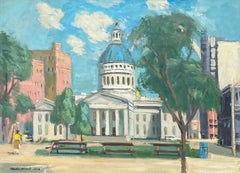
The Old Courthouse
By Charles Quest
Located in Missouri, MO
The Old Courthouse, 1968 By. Charles Quest (American, 1904-1993) Signed and Dated Lower Left 32 x 44 inches 38.25 x 50.25 inches with frame Born in Troy, New York, Charles Quest was...
Category

20th Century American Impressionist Charles Quest Art

Materials

Canvas, Oil

Related Items
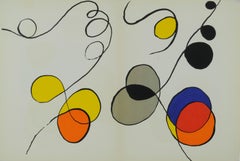
Composition with Red and Blue Ball - Original lithograph (Mourlot)
By Alexander Calder
Located in Paris, IDF
Alexander CALDER Composition with Red and Blue Ball Original lithograph (printed in Mourlot workshop) Printed signature in the plate On Arches vellum 25 x 19 cm (c. 10 x 8 inch) Edi...
Category

1960s American Modern Charles Quest Art

Materials

Lithograph

1975 Andrew Dasburg Color Lithograph, "Trees in Ranchitos II" Taos Modernist
By Andrew Michael Dasburg
Located in Denver, CO
"Trees in Ranchitos II" is a striking 1975 color lithograph by acclaimed modernist artist Andrew Michael Dasburg (1887–1979). This collectible artwork, initialed in the lower right, beautifully captures the serene landscapes of New Mexico, reflecting Dasburg’s signature fusion of Post-Impressionism and Cubist influences. The composition conveys the tranquil rhythm of trees and desert terrain, combining geometric abstraction with lyrical naturalism. The lithograph is presented in a custom frame measuring 30 ½ x 36 ¼ inches, with an image size of 16 ½ x 23 ¼ inches, making it a sophisticated and visually compelling addition to any collection of Taos Modernist art, American modernism, or Southwestern landscape prints. About Andrew Michael Dasburg (1887–1979): Born in Paris, France, Dasburg immigrated to New York City in 1892, where his early talent was recognized. He trained at the Art Students League of New York under notable instructors including Robert Henri, Kenyon Cox, and Birge Harrison. In 1908, he returned to Paris and encountered the works of Henri Matisse and Paul Cézanne, experiences that ignited his lifelong commitment to modernism. After settling in Woodstock, NY, Dasburg immersed himself in the avant-garde scene, collaborating with Morgan Russell...
Category

1970s American Modern Charles Quest Art

Materials

Lithograph

Impressionist view of people in St. Marks Square in Venice
By Pam Masco
Located in Woodbury, CT
Wonderful Impressionist view of St. Marks Square, Venice. Pam Masco was an American from Massachusetts, and a graduate of the School of the Boston Museum of Fine Arts (1976). She was married to the English artist John Heseltine. Her work is in well-known private and corporate collections and has been shown at the Royal Society of British Artists, the Royal Watercolour Society and other London Galleries as well as in the Provinces. She travelled throughout the U.S.A. and Europe and painted American and European subjects, portraits, landscape and figure compositions, still life and interiors. From 1978 she was involved in drawing, painting, technical painting courses, watercolour and graphic design. She illustrated for major British and American publishers until 1988. Authors include Bruce Chatwin...
Category

Early 2000s American Impressionist Charles Quest Art

Materials

Canvas, Oil

"View of New York Harbor, Staten Island Ferry, " Gustave Wolff, Impressionism
By Gustave Wolff
Located in New York, NY
Gustav (Gustave) Wolff (1863 - 1935) View of New York Harbor from the Staten Island Ferry Oil on canvas 16 x 12 inches Signed lower right In the Autumn of 1913, the German Associati...
Category

Early 20th Century American Impressionist Charles Quest Art

Materials

Canvas, Oil

San Gabriel Mountains in Autumn Landscape California School 1930s
Located in Soquel, CA
Beautiful California plein air painting of San Gabriel Mountains in autumn with iconic Sycamore tree in foreground. Circa 1960. Unsigned. Presented in vintage gilt-toned carved wood frame. Image size: 10"H x 14"W. The San Gabriel Mountains have inspired many famous plein air painters including Hanson Puthuff, Marion Kavanagh Wachtel, Maurice Braun...
Category

1960s American Impressionist Charles Quest Art

Materials

Canvas, Oil, Illustration Board

Sierra Mountain Waterfall, Vintage California Landscape w. Ornate Giltwood Frame
Located in Soquel, CA
Sierra Mountain Waterfall, Vintage California Landscape w. Ornate Giltwood Frame Beautiful large-scale vertical landscape of a majestic waterfall in the Sierra Mountains by Califor...
Category

1960s American Impressionist Charles Quest Art

Materials

Canvas, Oil

"Weeping Forsythia at the Park" Colorful Landscape Oil Painting on Canvas Framed
By Robert Waltsak
Located in New York, NY
A wonderful impressionist pastoral landscape with beautiful color tones throughout. Waltsak has portrayed this piece in a most intimate, yet energetic way, and has packed much feelin...
Category

21st Century and Contemporary American Impressionist Charles Quest Art

Materials

Canvas, Oil

Landscape with Flowers, Impressionist Oil Painting by Leonard Rodowicz
Located in Long Island City, NY
An original oil on board painting measuring 11 x 14 inches by Polish/American artist Leonard Rodowicz, signed lower left.
Category

Mid-20th Century American Impressionist Charles Quest Art

Materials

Canvas, Oil

"Bush Lupine" Colorful Impressionistic Spring Time Landscape Oil Painting Framed
By David Chapple
Located in New York, NY
A wonderful impressionist pastoral landscape with beautiful color tones throughout. David Chapple has portrayed this piece in a most intimate, yet energetic way, and has packed much ...
Category

21st Century and Contemporary American Impressionist Charles Quest Art

Materials

Oil, Board, Canvas

"Snow Covered Village"
By Walter Emerson Baum
Located in Lambertville, NJ
Jim’s of Lambertville is proud to offer this artwork. Signed lower left. Complemented by a hand carved and gilt frame. Walter Emerson Baum (1884 - 1956) Born in Sellersville, Pe...
Category

1930s American Impressionist Charles Quest Art

Materials

Canvas, Oil

"Twilight, Mianus, Connecticut, " Charles Courtney Curran, Greenwich Landscape
By Charles Courtney Curran
Located in New York, NY
Charles Courtney Curran (1861 - 1942) Twilight, Mianus, Connecticut, 1892 Oil on canvas 18 x 32 inches Signed titled, and dated lower left An Impressionist figure, genre, and landsc...
Category

1890s American Impressionist Charles Quest Art

Materials

Canvas, Oil

Love Apple (Brown background).
By Jane Martin VonBosse
Located in Storrs, CT
Love Apple (Brown background). 1967. Linoleum cut printed in black, red, orange, brown and tan. 16 1/2 x 12 1/2 (sheet 21 3/4 x 15). Edition 18. A vivid impression printed on wove pa...
Category

1960s American Modern Charles Quest Art

Materials

Linocut

Previously Available Items
Work Bench — Mid-century Modern
By Charles Quest
Located in Myrtle Beach, SC
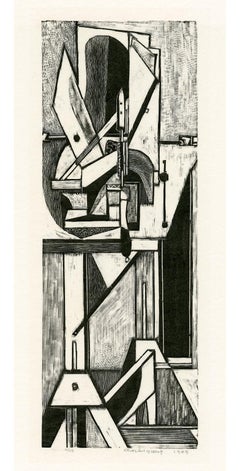
Charles Quest, 'Work Bench', 1949, wood engraving, edition 40. Signed, dated and numbered 9/40 in pencil. Titled and annotated 'wood engraving 1949' in pencil, in the artist’s hand, lower right margin. A fine, richly-inked impression, on off-white wove Japan, with full margins (1 3/4 to 2 inches), in excellent condition. Matted to museum standards, unframed. ABOUT THE ARTIST Charles Quest, a successful artist, and fine art instructor, worked in a variety of mediums including mosaic, stained glass, mural painting, and sculpture, but remains best known as a printmaker. Quest grew up in St. Louis, his talent evident as a teenager when he began copying the works of masters such as Michelangelo on his bedroom walls. He studied at the Washington University School of Fine Arts where he later taught from 1944 to 1971. He traveled to Europe after his graduation in 1929, and studied at La Grande Chaumière and Academie Colarossi, Paris, continuing to draw inspiration from the works of the Old Masters. After returning to St. Louis, Quest received several commissions to paint murals in public buildings, schools, and churches, including one from Joseph Cardinal Ritter to paint a replica of Velasquez's Crucifixion over the main altar of the Old Cathedral in St. Louis. Quest soon became interested in the woodcut medium which he apparently learned through his study of J. J. Lankes' A Woodcut Manual (1932) and Paul Landacre's articles in American Artist magazine ‘since no artists in St. Louis were working in wood’ at that time. Quest also revealed that for him, wood cutting and engraving were ‘more enjoyable than any other means of expression.’ In the late 1940s, his graphic works began attracting a lot of critical attention—several of his woodcuts won prizes and were acquired by major American and European museums. His wood engraving entitled ‘Lovers’ was included in the American Federation of Art's traveling print exhibition in 1947. Two years later Quest's two prize-winning prints, ‘Still Life with Grindstone’ and ‘Break Forth into Singing’ were exhibited in major American museums in a traveling show organized by the Philadelphia Print Club. His work was included in the Chicago Art Institute's exhibition, ‘Woodcut Through Six Centuries’ and the print ‘Still Life with Vise’, was purchased by the Museum of Modern Art in New York. In 1951 he was invited by artist-Curator Jacob Kainen to exhibit thirty wood engravings and color woodcuts in the Graphic Arts Division of the Smithsonian's National Museum (now known as the American History Museum). This one-man exhibition was a remarkable achievement for Quest, who had been working in the medium for only about ten years. In the press release for the show, Kainen praised the ‘technical refinement’ of Quest's work: ‘He obtains a great variety of textural effects through the use of the graver, and these dense or transparent grays are set off against whites or blacks to achieve sparkling results. His work has the handsome qualities characteristic of the craftsman and designer.’ At the time of the Smithsonian exhibition, Quest's work was represented by three New York galleries in addition to one in his home town. He had also won 38 prizes, and his prints were in the collections of the Library of Congress, the Chicago Art Institute, the Metropolitan Museum and the Philadelphia Museum of Art. In cooperation with the Art in Embassies program, his color woodcuts were displayed at the American Embassy in Paris in 1951. Recognition at home came in 1955 with his first solo exhibition in St. Louis. Press coverage of the show heralded the ‘growth of graphic arts toward rivaling painting and sculpture as a major independent medium’. Charles Quest retired from teaching in 1971 and made relatively few prints in his later years, as the rigors of the medium were too demanding. He moved to Tryon, North Carolina, with his wife Dorothy, an artist and portrait painter, and remained active as a painter until his death in 1993. An exhibition of his prints at the Bethesda Art Gallery in 1983 attracted the interest of Curator Emeritus Joseph A. Haller, S.J., who began purchasing his work for the University's collection. In 1990 Georgetown University Library's Special Collections Division became the grateful recipient of a large body of Quest's work including prints, drawings, paintings, sculpture, and stained glass, as well as his archive of correspondence and professional memorabilia. These extensive holdings, including some 260 of his fine prints, provide a rich opportunity for further study and appreciation of this versatile and not-to-be-forgotten mid-Western American artist...
Category

1940s American Modern Charles Quest Art

Materials

Woodcut

Charles Quest art for sale on 1stDibs.

Find a wide variety of authentic Charles Quest art available for sale on 1stDibs. You can also browse by medium to find art by Charles Quest in woodcut print, canvas, fabric and more. Much of the original work by this artist or collective was created during the 20th century and is mostly associated with the modern style. Not every interior allows for large Charles Quest art, so small editions measuring 5 inches across are available. Customers who are interested in this artist might also find the work of Giovanni Pintori, Caroline Durieux, and Paul Sample. Charles Quest art prices can differ depending upon medium, time period and other attributes. On 1stDibs, the price for these items starts at $750 and tops out at $1,500, while the average work can sell for $875.

Artists Similar to Charles Quest

Recently Viewed

View All