Charles William Smith Art
to
1
Overall Width
to
Overall Height
to
1
1
1
1
1
1
10,138
2,778
1,375
1,370
1
Artist: Charles William Smith
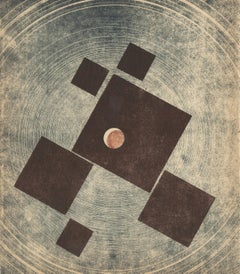
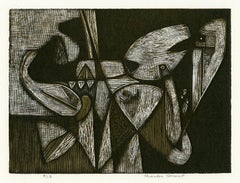
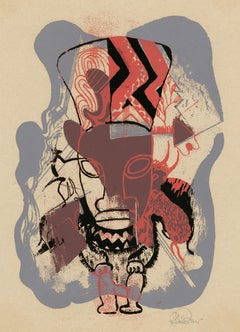
Untitled
By Charles William Smith
Located in Fairlawn, OH
Untitled
Color woodcut, 1939
Unsigned as issued
Signed and dedicated by the artist on the justification page (see photo)
From:
Abstractions By Charles Smith
Forward by Carl O. Schnie...
Category
1930s American Modern Charles William Smith Art
Materials
Woodcut
Related Items
Douglas Semivan Print "Abstract in Gold and Black"
By Douglas Semivan
Located in Detroit, MI
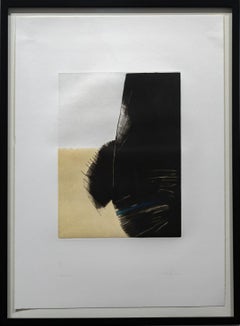
"Abstract in Gold and Black" is a well-balanced calm piece. The placement of the gold and white can be read as a distant landscape giving much imagined space to the heavier black area which contains a linear element and the color blue. Semivan is a Master Printmaker and sculptor. He often breaks his surfaces and extends beyond the perimeters in his sculptures. The particular placement of the black area in this piece suggests such a breakage beyond the edge where one imagines a continuation of the strokes or linear elements. This is an altogether extraordinary print.
Born in Detroit, Michigan, Douglas Semivan...
Category
Late 20th Century American Modern Charles William Smith Art
Materials
Paper, Printer s Ink

$2,900
H 31 in W 23.25 in
River View
— Mid-Century American Modernism
By Edward August Landon
Located in Myrtle Beach, SC
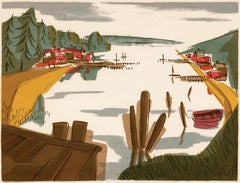
Edward Landon 'River View, color serigraph, 1942, edition 50, Ryan 159. Signed in pencil in the image, lower right. Titled, dated, and annotated '9 COLORS – 50 PRINTS' in the screen,...
Category
1940s American Modern Charles William Smith Art
Materials
Screen
Still Life — Mid-century Modern
By Charles Quest
Located in Myrtle Beach, SC
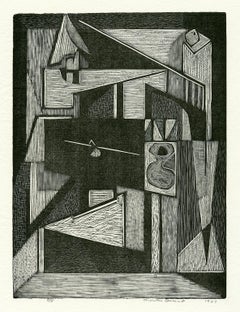
Charles Quest, 'Still Life', 1947, wood engraving, edition 8. Signed, dated, and numbered '3/8' in pencil. Titled and annotated 'wood engraving' in the bottom left margin. A fine impression, on off-white wove paper, with full margins (1 to 2 inches), in excellent condition. Scarce. Matted to museum standards, unframed.
ABOUT THE ARTIST
Charles Quest, painter, printmaker, and fine art instructor, worked in various mediums, including mosaic, stained glass, mural painting, and sculpture. Quest grew up in St. Louis, his talent evident as a teenager when he began copying the works of masters such as Michelangelo on his bedroom walls. He studied at the Washington University School of Fine Arts, where he later taught from 1944 to 1971. He traveled to Europe after his graduation in 1929 and studied at La Grande Chaumière and Academie Colarossi, Paris, continuing to draw inspiration from the works of the Old Masters.
After returning to St. Louis, Quest received several commissions to paint murals in public buildings, schools, and churches, including one from Joseph Cardinal Ritter, to paint a replica of Velasquez's Crucifixion over the main altar of the Old Cathedral in St. Louis. Quest soon became interested in the woodcut medium, which he learned through his study of J. J. Lankes' A Woodcut Manual (1932) and Paul Landacre's articles in American Artist magazine ‘since no artists in St. Louis were working in wood’ at that time. Quest also revealed that for him, wood cutting and engraving were ‘more enjoyable than any other means of expression.’
In the late 1940s, his graphic works began attracting critical attention—several of his woodcuts won prizes and were acquired by major American and European museums. His wood engraving entitled ‘Lovers’ was included in the American Federation of Art's traveling print exhibition in 1947. Two years later, Quest's two prize-winning prints, ‘Still Life with Grindstone’ and ‘Break Forth into Singing’, were exhibited in major American museums in a traveling show organized by the Philadelphia Print Club. His work was included in the Chicago Art Institute's exhibition, ‘Woodcut Through Six Centuries’, and the print ‘Still Life with Vise’ was purchased by the Museum of Modern Art in New York.
In 1951 he was invited by artist-Curator Jacob Kainen to exhibit thirty wood engravings and color woodcuts in a one-person show at the Smithsonian's National Museum (now known as the American History Museum). Kainen's press release praised the ‘technical refinement’ of Quest's work: ‘He obtains a great variety of textural effects through the use of the graver, and these dense or transparent grays are set off against whites or blacks to achieve sparkling results. His work has the handsome qualities characteristic of the craftsman and designer.’
At the time of the Smithsonian exhibition, Quest's work was represented by three New York galleries in addition to one in his home town. He had won 38 prizes, and his prints were in the collections of the Library of Congress, the Chicago Art Institute, the Metropolitan Museum, and the Philadelphia Museum of Art. In cooperation with the Art in Embassies program, his color woodcuts were displayed at the American Embassy in Paris in 1951.
Recognition at home came in 1955 with his first solo exhibition in St. Louis. Press coverage of the show heralded the ‘growth of graphic arts toward rivaling painting and sculpture as a major independent medium’.
An exhibition of his prints at the Bethesda Art Gallery in 1983 attracted Curator Emeritus Joseph A. Haller, S.J., who began purchasing his work for Georgetown University's collection. In 1990 Georgetown University Library's Special Collections Division was the recipient of a large body of Quest's work, including prints, drawings, paintings, sculpture, stained glass, and his archive of correspondence and professional memorabilia. These extensive holdings, including some 260 of his fine prints, provide a rich opportunity for further study and appreciation of this versatile and not-to-be-forgotten mid-Western American artist...
Category
1940s American Modern Charles William Smith Art
Materials
Woodcut
Underwater — Mid-century Modern
By Charles Quest
Located in Myrtle Beach, SC
Charles Quest, 'Underwater', 1948, chiaroscuro wood engraving, edition 12. Signed, titled, dated and numbered '3/12' in pencil. A fine, richly-inked impression, in dark brown and warm black, on off-white wove paper, with full margins (5/8 to 1 1/2 inch), in excellent condition. Scarce.
ABOUT THE ARTIST
Charles Quest, painter, printmaker, and fine art instructor, worked in various mediums, including mosaic, stained glass, mural painting, and sculpture. Quest grew up in St. Louis, his talent evident as a teenager when he began copying the works of masters such as Michelangelo on his bedroom walls. He studied at the Washington University School of Fine Arts, where he later taught from 1944 to 1971. He traveled to Europe after his graduation in 1929 and studied at La Grande Chaumière and Academie Colarossi, Paris, continuing to draw inspiration from the works of the Old Masters.
After returning to St. Louis, Quest received several commissions to paint murals in public buildings, schools, and churches, including one from Joseph Cardinal Ritter, to paint a replica of Velasquez's Crucifixion over the main altar of the Old Cathedral in St. Louis. Quest soon became interested in the woodcut medium, which he learned through his study of J. J. Lankes' A Woodcut Manual (1932) and Paul Landacre's articles in American Artist magazine ‘since no artists in St. Louis were working in wood’ at that time. Quest also revealed that for him, wood cutting and engraving were ‘more enjoyable than any other means of expression.’
In the late 1940s, his graphic works began attracting critical attention—several of his woodcuts won prizes and were acquired by major American and European museums. His wood engraving entitled ‘Lovers’ was included in the American Federation of Art's traveling print exhibition in 1947. Two years later, Quest's two prize-winning prints, ‘Still Life with Grindstone’ and ‘Break Forth into Singing’, were exhibited in major American museums in a traveling show organized by the Philadelphia Print Club. His work was included in the Chicago Art Institute's exhibition, ‘Woodcut Through Six Centuries’, and the print ‘Still Life with Vise’ was purchased by the Museum of Modern Art in New York.
In 1951 he was invited by artist-Curator Jacob Kainen to exhibit thirty wood engravings and color woodcuts in a one-person show at the Smithsonian's National Museum (now known as the American History Museum). Kainen's press release praised the ‘technical refinement’ of Quest's work: ‘He obtains a great variety of textural effects through the use of the graver, and these dense or transparent grays are set off against whites or blacks to achieve sparkling results. His work has the handsome qualities characteristic of the craftsman and designer.’
At the time of the Smithsonian exhibition, Quest's work was represented by three New York galleries in addition to one in his home town. He had won 38 prizes, and his prints were in the collections of the Library of Congress, the Chicago Art Institute, the Metropolitan Museum, and the Philadelphia Museum of Art. In cooperation with the Art in Embassies program, his color woodcuts were displayed at the American Embassy in Paris in 1951.
Recognition at home came in 1955 with his first solo exhibition in St. Louis. Press coverage of the show heralded the ‘growth of graphic arts toward rivaling painting and sculpture as a major independent medium’.
An exhibition of his prints at the Bethesda Art Gallery in 1983 attracted Curator Emeritus Joseph A. Haller, S.J., who began purchasing his work for Georgetown University's collection. In 1990 Georgetown University Library's Special Collections Division was the recipient of a large body of Quest's work, including prints, drawings, paintings, sculpture, stained glass, and his archive of correspondence and professional memorabilia. These extensive holdings, including some 260 of his fine prints, provide a rich opportunity for further study and appreciation of this versatile and not-to-be-forgotten mid-Western American artist...
Category
1940s American Modern Charles William Smith Art
Materials
Woodcut
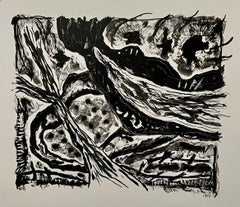
Black/White Lithograph American Modernist Gregory Amenoff Abstract Expressionist
By Gregory Amenoff
Located in Surfside, FL
Gregory Amenoff (Contemporary American abstract painter, b. 1948),
Title: Haven, STATE II
Lithograph, 1986
Edition 4/4 Printer Proof
Image Size 21.5 x 30.75"
Gregory Amenoff is a...
Category
1980s American Modern Charles William Smith Art
Materials
Lithograph
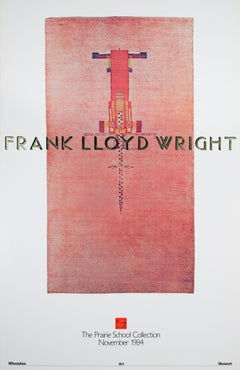
Late 20th century color lithograph prairie style Frank Lloyd Wright architecture
By Frank Lloyd Wright
Located in Milwaukee, WI
"The Prairie School Collection - Rug" is an offset lithograph poster with gold foil. This piece advertises an exhibition of Frank Lloyd Wright's designs. Unsigned.
34 7/8" x 22" art...
Category
1980s American Modern Charles William Smith Art
Materials
Offset
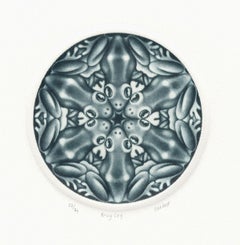
Frog Cog
By Carol Wax
Located in New Orleans, LA
Carol Wax describes her circular images as "most often quasi abstract works that refer to ancient islamic designs using the shapes and attributes of animals, in this case the frog. T...
Category
Late 20th Century American Modern Charles William Smith Art
Materials
Mezzotint
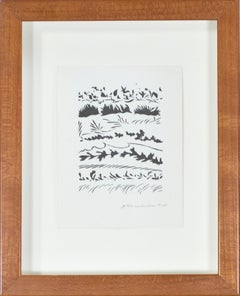
Winter Silhouettes,
offset lithograph by Schomer Lichtner
By Schomer Lichtner
Located in Milwaukee, WI
'Winter Silhouettes,' a small and delicate print, is an original offset lithograph by the Milwaukee artist Schomer Lichtner. The composition displays registers of foliage, emerging from the white of the paper as though emerging from the snow-covered ground. The artwork is thus plays with the materials of printmaking; the paper is both the support and the primary indication of the season. The subtle texture of the tooth of the paper also adds life to the image, giving the snow a wind-swept, creature trodden surface. The free forms of the grasses and leaves resemble the lyrical mid-century works of the French artist Henri Matisse, which combined with these material concerns demonstrate Lichter's modern sensibilities.
3.75 x 2.75 inches, image
5.5 x 4.5 inches, paper
10 x 8 inches frame
Signed and dated in the stone, lower right
Framed to conservation standards in a shadow-box style mounting, using 100 percent rag matting, museum glass, and housed in a cherry wood moulding
Overall excellent condition; some toning to edges of paper; some minor abrasions to frame
Milwaukee artist Schomer Lichtner was well known for his whimsical cows and ballerinas and abstract imagery. He and his late wife Ruth Grotenrath, both well-known Wisconsin artists, began their prolific careers as muralists for WPA projects, primarily post offices.
Lichtner also painted murals for industry and private clients. Schomer was a printmaker and produced block prints, lithographs, and serigraph prints. His casein (paint made from dairy products) and acrylic paintings are of the rural Wisconsin landscape and farm animals. He became interested in cows when he and Ruth spent summers near Holy Hill in Washington County. According to David Gordon, director of the Milwaukee Art Museum, Schomer Lichtner had a tremendous joie de vivre and expressed it in his art.
Schomer Lichtner was nationally known for his whimsical paintings and sculptures of black- and white-patterned Holstein cows and elegant ballerina dancers. Lichtner also painted all sorts of combinations of beautiful women, flowers and country landscapes. James Auer, former Milwaukee Journal Sentinel art critic, said that his art eventually "exploded into expressionistic design elements with bold, flat areas of color and high energy that anticipated Pop Art." Auer went on to describe Lichtner’s work as full of "wit, vigor and virtuosity."
As early as 1930, Lichtner’s work was shown at the prestigious Carnegie International Exhibition in New York and at museums throughout the Midwest. As a student, he was a protégé of another icon of 20th century American art, Gustave Moeller.
Lichtner and his wife, Ruth Grotenrath (1912-1988), are celebrated as Milwaukee’s first couple of painting and are regarded as major Wisconsin artists. Lichtner’s impressive production, perseverance, longevity, and positive approach to his life and art made him and his work distinctive and much loved by his many admirers. His work is currently represented in collections at the Milwaukee Art Museum, the John Michael Kohler Art Center, the West Bend Museum, and in the collections of many individuals. Books on the lives and art work of both Lichtner and Grotenrath are in progress and it is anticipated that they will be published next year.
Schomer Lichtner passed away on May 9, 2006 at the age of 101. He continued to amaze and create with his whimsical paintings of ballerinas...
Category
1960s American Modern Charles William Smith Art
Materials
Black and White, Lithograph
$775
H 9.875 in W 7.875 in
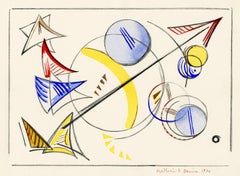
Variation 4, Vol. I
By Katherine Sophie Dreier
Located in Myrtle Beach, SC
Katherine S. Dreier, 'Variation 4, Vol. I' from '1 to 40 Variations', lithograph with pochoir and hand-coloring, 1934, edition 65. Stenciled signature and date, lower right. Annotate...
Category
Mid-20th Century American Modern Charles William Smith Art
Materials
Watercolor, Lithograph, Stencil
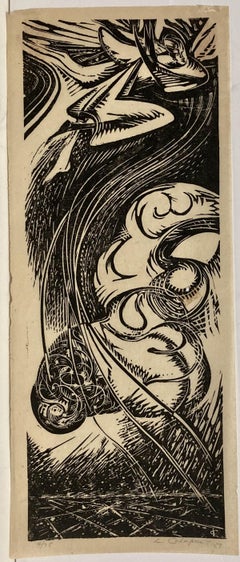
Letterio Calapai, (Sky Abstraction), 1957, mid-century wood engraving
By Letterio Calapai
Located in New York, NY
Letterio Calapai is widely recognized as a major American artist of the twentieth century. He is widely respected as a printmaker, especially for engravings and wood engravings, and ...
Category
1950s American Modern Charles William Smith Art
Materials
Woodcut
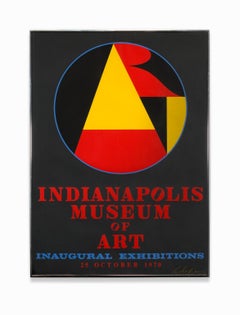
"Indianapolis Museum of Art Inaugural Exhibitions", Color Silkscreen, Signed
By Robert Indiana
Located in Detroit, MI
"Indianapolis Museum of Art Inaugural Exhibitions", 25 October 1970, is an eye popping large bold colorful geometric abstract silk screen. It is signed on the lower right.
Robert Indiana, one of the preeminent figures in American art since the 1960s, played a central role in the development of assemblage art, hard-edge painting, Pop art, Neo-Dada, American Modernism and Modern Art. A self-proclaimed “American painter of signs,” Indiana created a highly original body of work that explores American identity, personal history, and the power of abstraction and language, establishing an important legacy that resonates in the work of many contemporary artists such as Andy Warhol, Keith Haring, Roy Lectenstein, David Hockney, Romero Britto, Richard Hamilton and Robert Rauschenberg who make the written word a central element of their oeuvre.
Robert Indiana was born Robert Clark in New Castle, Indiana on September 13, 1928. Adopted as an infant, he spent his childhood moving frequently throughout his namesake state. At 14 he moved to Indianapolis in order to attend Arsenal Technical High School, known for its strong arts curriculum. After graduating he spent three years in the U.S. Air Force and then studied at the Art Institute of Chicago, the Skowhegan School of Sculpture and Painting in Maine, and the Edinburgh College of Art in Scotland.
In 1956, two years after moving to New York, Indiana met Ellsworth Kelly, and upon his recommendation took up residence in Coenties Slip, where a community of artists that would come to include Kelly, Agnes Martin, James Rosenquist, and Jack Youngerman had studios. Indiana, like some of his fellow artists, scavenged the area’s abandoned warehouses for materials, creating sculptural assemblages from old wooden beams, rusted metal wheels, and other remnants of the shipping trade that had thrived in Coenties Slip. The discovery of 19th century brass stencils led to the incorporation of brightly colored numbers and short emotionally charged words onto these sculptures as well as canvases, and became the basis of his new painterly vocabulary.
Although acknowledged as a leader of Pop, Indiana distinguished himself from his Pop peers by addressing important social and political issues and incorporating profound historical and literary references into his works. In 1964 Indiana accepted Philip Johnson’s invitation to design a new work for the New York State Pavilion at the New York World’s Fair, creating a 20-foot EAT sign...
Category
1970s American Modern Charles William Smith Art
Materials
Paper, Ink, Screen
$2,200
H 35.5 in W 25.5 in
African Idol
— American Modernism, Chicago Avant-garde
By Robert Vale Faro
Located in Myrtle Beach, SC
Robert Vale Faro, untitled (African Idol), serigraph, c. 1940, edition 6. Signed in pencil. A fine impression, with fresh colors, on buff wove paper; the full sheet with margins(5/8 to 1 3/8 inches), in excellent condition. Very rare.
Matted to museum standards, unframed.
Image size 8 3/4 x 6 inches (222 x 152 mm); sheet size 11 x 7 1/2 inches (279 x 192 mm).
ABOUT THE ARTIST
Robert Vale Faro (1902-1988) was a well-known modernist architect and artist associated with the Chicago Bauhaus. He received his degree in architecture and design from the Armour Institute in Chicago and worked at L'Ecole des Beaux-Arts, Paris, from 1924-27, where he was influenced by Harry Kurt Bieg and Le Corbusier. Upon his return to Chicago, Faro worked with the important modernist Chicago architects George and William Keck under Louis Sullivan.
Faro founded the avant-garde printmaking group Vanguard in 1945. The group counted Atelier 17 artists Stanley William Hayter, Sue Fuller, and Anne Ryan as New York members and Francine...
Category
1940s American Modern Charles William Smith Art
Materials
Screen
Previously Available Items
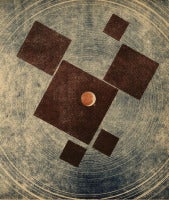
Abstraction
By Charles William Smith
Located in Fairlawn, OH
Unsigned
Category
1930s Charles William Smith Art
Charles William Smith art for sale on 1stDibs.
Find a wide variety of authentic Charles William Smith art available for sale on 1stDibs. You can also browse by medium to find art by Charles William Smith in woodcut print and more. Much of the original work by this artist or collective was created during the 1930s and is mostly associated with the modern style. Not every interior allows for large Charles William Smith art, so small editions measuring 8 inches across are available. Customers who are interested in this artist might also find the work of Ernest Tino Trova, Dennis Ray Beall, and Richard Florsheim. Charles William Smith art prices can differ depending upon medium, time period and other attributes. On 1stDibs, the price for these items starts at $700 and tops out at $700, while the average work can sell for $700.