Clarence Holbrook Carter Interior Prints
American, 1904-2000
Clarence Holbrook Carter achieved a level of national artistic success that was nearly unprecedented among Cleveland School artists of his day, with representation by major New York dealers, scores of awards and solo exhibits, and streams of praise flowing from pens of the top art critics. Over the course of his 60+ year career Carter evolved from an exceptionally fine American Scene painter capable of evoking deep reservoirs of mood, into an abstractionist with a strongly surrealist bent.
While his two bodies of work seem at first to be worlds apart, owing to their different formal vocabularies, they, in fact, explore virtually the same subject: the nexus between life and death and the transition from earth to spirit. The early work finds its expressive power through specific people, events, and landscapes—most of which are drawn from his experiences growing up in the river town of Portsmouth, Ohio—while the later work from the 1960s on evokes potent states of being through pure flat shape, color and form that read as universals. As his primary form he adopted the ovoid or egg shape, endowing it with varying degrees of transparency. Alone or in multiples, the egg moves through Carter’s landscapes and architectural settings like a sentient spirit on a restless quest.
Born and raised in southern Ohio along the banks of the mercurial Ohio River and its treacherous floods, Carter developed a love of drawing as a child, and was encouraged by both his parents. He was self-directed, found inspiration all around him, and was strongly encouraged by the fact that his teenage work consistently captured art prizes in county and state fairs. Carter studied at the Cleveland School of Art from 1923-27, where he trained under painters Henry Keller, Frank Wilcox and Paul Travis.
Returning to Cleveland in 1929, Carter had his first solo show, and through Milliken taught studio classes at the Cleveland Museum of Art from 1930-37. In 1938, he moved to Pittsburgh to teach at the Carnegie Institute of Technology until 1944. Carter’s American Scene paintings of the ’30s and ’40s, which launched his artistic star, are the works for which the artist remains best known.
During and immediately after World War II, Clarence Carter realized his attraction to bold pattern, dramatic perspective and eye-catching hard-edged design was a poor fit with the prevailing style of Abstract Expressionism. Fortunately, these same hallmarks of his style were prized within the realm of commercial art.
Around 1964 Carter acknowledged a need to break from the confines of representational painting. Once Carter had found a potent symbol in the egg, he used it to create an astounding body of imagery for the rest of his life. Among the most ambitious of all his later paintings were his Transections, a theological term meaning to cross, specifically between life and death.to
1
1
Overall Width
to
Overall Height
to
1
1
112
109
79
58
44
2
2
2
1
1
1
1
1
1
1
2
2
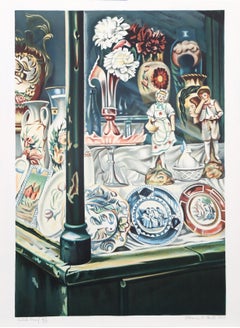
Artist: Clarence Holbrook Carter
Hospitalities Long Past, Signed Screenprint by Clarence Carter
By Clarence Holbrook Carter
Located in Long Island City, NY
Hospitalities Long Past
Clarence Holbrook Carter
American (1904–2000)
Date: 1979
Screenprint, signed and numbered in pencil
Edition of 200, AP 30
Image Size: 27.75 x 20 inches
Size...
Category
1970s American Modern Clarence Holbrook Carter Interior Prints
Materials
Screen
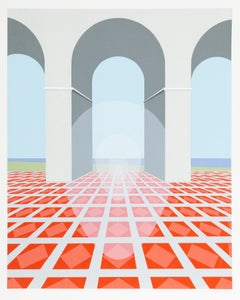
Villa by The Sea, Surrealist Screenprint by Clarence Holbrook Carter
By Clarence Holbrook Carter
Located in Long Island City, NY
Artist: Clarence Holbrook Carter, American (1904 - 2000)
Title: Arches
Year: 1979
Medium: Screenprint, signed and numbered in pencil
Edition: 200, 30 AP
Size: 35 in. x 26 in. (88.9 c...
Category
1970s Surrealist Clarence Holbrook Carter Interior Prints
Materials
Screen
Related Items
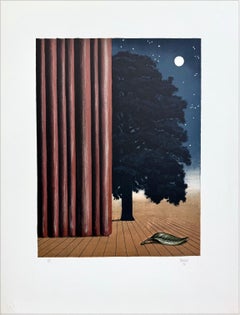
THE MAIN ATTRACTION Hand Drawn Lithograph, Surrealist, Moon, Tree Onstage
By Michael Hasted
Located in Union City, NJ
THE MAIN ATTRACTION is an original hand drawn limited edition lithograph by the British artist, Michael Hasted printed using hand lithography on archival Somerset paper, 100% acid fr...
Category
1980s Surrealist Clarence Holbrook Carter Interior Prints
Materials
Lithograph
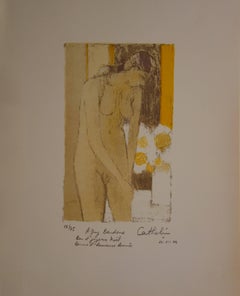
Nude with Bouquet of Flowers - Handsigned lithograph /75ex - Mourlot 1974
By Bernard Cathelin
Located in Paris, IDF
Bernard CATHELIN
Nude with Bouquet of Flowers
Original stone lithograph
Signed in pencil
Numbered / 75 ex
With dedication to the painter Guy Bardone
On Arches vellum 39 x 31 cm (c. 16 x 12 in)
REFERENCES : Catalog raisonne Cathelin lithographs...
Category
1970s American Modern Clarence Holbrook Carter Interior Prints
Materials
Lithograph

$478
H 15.36 in W 12.21 in
Lady Godiva
By Salvador Dalí
Located in OPOLE, PL
Salvador Dali (1904-1989) - Lady Godiva
Lithograph from 1970.
Edition of 187/256.
Dimensions of work: 68 x 50 cm
Publisher: Simeon Wajntraub.
On B.F.K Rives paper as stated in t...
Category
1970s Surrealist Clarence Holbrook Carter Interior Prints
Materials
Lithograph
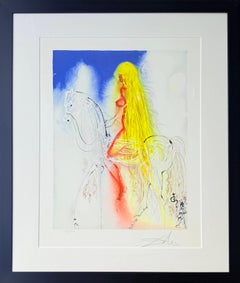
RANDOM SELECTION 2, Hand Drawn Lithograph, Surrealist Landscape, Window View
By Michael Hasted
Located in Union City, NJ
RANDOM SELECTION 2 is an original hand drawn limited edition lithograph by the British artist, Michael Hasted printed using hand lithography on archival Somerset paper, 100% acid fre...
Category
1980s Surrealist Clarence Holbrook Carter Interior Prints
Materials
Lithograph
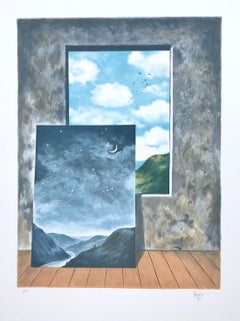
Le Cheval de Triomphe
By Salvador Dalí
Located in OPOLE, PL
Salvador Dali (1904-1989) - Le cheval de triomphe
Lithograph from 1970.
Edition of 187/254.
Dimensions of work: 68 x 50 cm
On B.F.K Rives paper as stated in the Field catalogue.
...
Category
1970s Surrealist Clarence Holbrook Carter Interior Prints
Materials
Lithograph
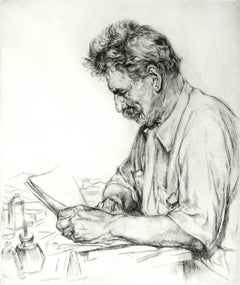
Portrait of Albert Schweitzer.
By Arthur William Heintzelman
Located in Plano, TX
Portrait of Albert Schweitzer. Etching. 11 3/4 x 9 3/4 (sheet 16 1/4 x 14). Illustrated: Beall, American Prints in the Library of Congress, page 205....
Category
1950s American Modern Clarence Holbrook Carter Interior Prints
Materials
Etching, Drypoint
$750 Sale Price
50% Off
H 11.75 in W 9.75 in D 0.5 in
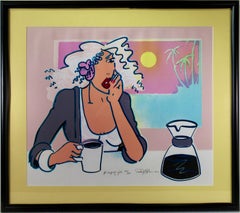
II Cup of Joe
Located in San Francisco, CA
This artwork titled "II Cup of Joe" c.1990, is an original color serigraph by American artist Rickey Jewell Hohimer, 1946-2021. It is hand signed, titled and numbered 250/300 in pencil by the artist. The image size is 19.5 x 23.5 inches, framed size is 26.75 x 30 inches. The artwork is in excellent condition, the frame is slightly damaged at the top, and will be replaced by a new similar black frame when sold. This will bring the over all condition to excellent.
About the artist:
Although formally trained with a MFA in painting, Rickey Jewell Hohimer has used the styles of Van Gogh and Gaughin to reach for the spontaneity and simplicity of today's folk art. Hohimer creates figures which are not photos of reality; they are romantically stylized to encourage straightforward emotional responses both to the colorful images and to the situations in which they find themselves. Each of Hohimer's paintings lays out a basic story line to which viewers add their own details. "I want the viewer to become personally involved. My paintings offer a change from those which encourage extensive intellectualizing about what the artist is trying to convey. I want viewers to smile -- to enjoy the whimsical nature of what they are experiencing -- to feel it, not to analyze it!. His jazz paintings are stories on canvas of inspired musicians spontaneously making music of the moment. Life in the jazz age is clubs and nightlife beckoning to musicians to produce jazz art...
Category
Late 20th Century American Modern Clarence Holbrook Carter Interior Prints
Materials
Screen
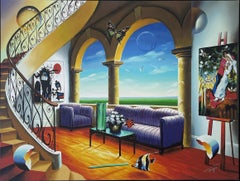
Serenity
By Ferjo, Fernando de Jesus Oliveira
Located in Hollywood, FL
Artist: Ferjo
Title: Serenity
Size: 30 x 40 Inches
Medium: Giclee on Canvas
Edition: AP
Year: 2003
Notes: Hand Signed on Front. Stretched. Gallery COA Included. Custom Framed...
Category
Early 2000s Surrealist Clarence Holbrook Carter Interior Prints
Materials
Canvas, Giclée
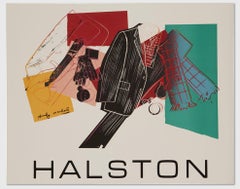
Andy Warhol - Halston Men
s Wear Advertising Campaign Poster
By Andy Warhol
Located in London, GB
Paper Size: 23 x 28.75 inches
Edition Size Unknown
Near Mint, very light signs of handling
Original Serigraph poster designed for an in-store advertising campaign printed in 1982.
...
Category
1980s American Modern Clarence Holbrook Carter Interior Prints
Materials
Paper
$1,507
H 23 in W 28.75 in
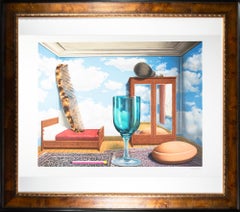
"Les valeurs personnelles (Personal Values), " Lithograph after Rene Magritte
By René Magritte
Located in Milwaukee, WI
"Les valeurs personnelles (Personal Values)" is a color lithograph after the original 1952 painting by Rene Magritte. This interior scene has objects of various sizes. A comb, match, brush, and glass are bigger than typically larger objects like a queen bed and chest of drawers. The walls are a bright cloudy sky.
Art: 19.63 x 4.75 in
Frame: 34.13 x 38.88 in
René-François-Ghislain Magritte was born November 21, 1898, in Lessines, Belgium and died on August 15, 1967 in Brussels. He is one of the most important surrealist artists. Through his art, Magritte creates humor and mystery with juxtapositions and shocking irregularities. Some of his hallmark motifs include the bourgeois “little man,” bowler hats, apples, hidden faces, and contradictory texts.
René Magritte’s father was a tailor and his mother was a miller. Tragedy struck Magritte’s life when his mother committed suicide when he was only fourteen. Magritte and his two brothers were thereafter raised by their grandmother.
Magritte studied at the Brussels Academy of Fine Arts from 1916 to 1918. After graduating he worked as a wallpaper designer and in advertisement. It was during this period that he married Georgette Berger, whom he had known since they were teenagers.
In 1926, René Magritte signed...
Category
Early 2000s Surrealist Clarence Holbrook Carter Interior Prints
Materials
Lithograph
$8,410
H 34.13 in W 38.88 in
HOMAGE TO DALI
By Ferjo, Fernando de Jesus Oliveira
Located in Aventura, FL
Giclee on canvas. Hand signed and numbered by the artist. AP edition. Canvas is not stretched.
Artwork is in excellent condition. Certificate of authenticity included. All reas...
Category
21st Century and Contemporary Surrealist Clarence Holbrook Carter Interior Prints
Materials
Canvas, Giclée
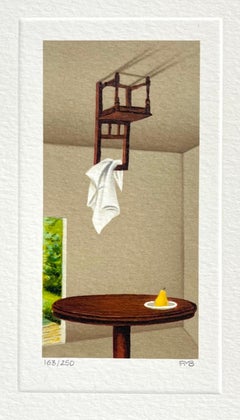
STILL LIFE WITH PEAR Signed Mini Lithograph, Surreal Interior, Table and Chair
By Fanny Brennan
Located in Union City, NJ
STILL LIFE WITH PEAR is a rarely seen, hand drawn limited edition lithograph by the American surrealist artist Fanny Brennan, created using traditional hand lithography techniques printed on archival Arches paper, 100% acid-free. STILL LIFE WITH PEAR is an engaging miniature interior scene depicting a simple room where a white dish and yellow pear is positioned on a round wood table...
Category
1990s Surrealist Clarence Holbrook Carter Interior Prints
Materials
Lithograph
$598 Sale Price
25% Off
H 7 in W 6 in
Clarence Holbrook Carter interior prints for sale on 1stDibs.
Find a wide variety of authentic Clarence Holbrook Carter interior prints available for sale on 1stDibs. You can also browse by medium to find art by Clarence Holbrook Carter in screen print and more. Much of the original work by this artist or collective was created during the 1970s and is mostly associated with the Surrealist style. Not every interior allows for large Clarence Holbrook Carter interior prints, so small editions measuring 26 inches across are available. Customers who are interested in this artist might also find the work of Ferjo, Fernando de Jesus Oliveira, Michael Hasted, and Tom Bennett. Clarence Holbrook Carter interior prints prices can differ depending upon medium, time period and other attributes. On 1stDibs, the price for these items starts at $750 and tops out at $750, while the average work can sell for $750.