Clifford Ellis Still-life Drawings and Watercolors

British, 1907-1985

Clifford Ellis was born in Bognor in Sussex and trained at Saint Martin’s School of Art and Regent Street Polytechnic. He was a graphic artist and illustrator who is best known for the posters he produced for London Transport during the 1930s. Ellis generally collaborated on posters with his wife, Rosemary, whom he married in 1931. The General Post Office, Shell and the Empire Marketing Board were also clients for the couple's posters. They signed their posters C&RE, their initials being in alphabetical order, and they are readily recognizable by their ebullient use of color and form. 

Employed during the war as a camoufleur, along with so many other artists, Ellis was also an official war artist, serving with the Grenadier Guards. Rosemary, meanwhile, was an artist for the Recording Britain project. Following the war, they trained art teachers at the Bath Academy of Art. They also designed a series of nearly 100 book jackets for the New Naturalist series, published by Collins between 1945–82, and were always fascinated by animals and natural history.

to
1
Overall Width
to
Overall Height
to
1
1
1
1
1
1
1
1
32
81
69
45
29
1
Artist: Clifford Ellis
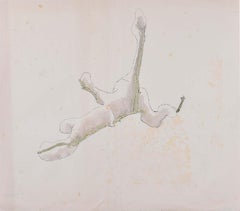
Clifford Ellis Snow Laden Branch Watercolour Modern British Art 1950s
By Clifford Ellis
Located in London, GB
From a series of works we have listed by Clifford Ellis and his wife Rosemary Ellia. To see them or our other Modern British Art, scroll down to "More from this Seller" and below it ...
Category

1950s Modern Clifford Ellis Still-life Drawings and Watercolors

Materials

Watercolor, Pen

Related Items
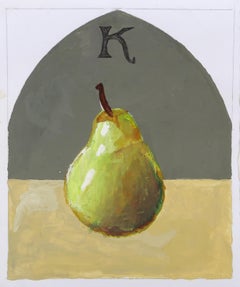
Pear Still Life, Modern Gouache Painting on paper by Robert Kulicke
By Robert Kulicke
Located in Long Island City, NY
Robert Kulicke, American (1924 - 2007) - Pear Still Life, Medium: Gouache on paper, monogramed on top in pencil, Image Size: 8 x 6.5 inches, Size: 8.5 x 7 in. (21.59 x 17.78 cm)
Category

Mid-20th Century Modern Clifford Ellis Still-life Drawings and Watercolors

Materials

Gouache

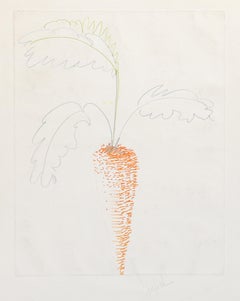
Carrot, Modern Color Marker and Pencil Drawing by Van Amerige
Located in Long Island City, NY
Van Amerige - Carrot, Year: 1969, Medium: Color Marker and Pencil Drawing, Image Size: 13.75 x 10.75 inches, Size: 22.25 x 15 in. (56.52 x 38.1 cm)
Category

1960s Modern Clifford Ellis Still-life Drawings and Watercolors

Materials

Permanent Marker, Color Pencil

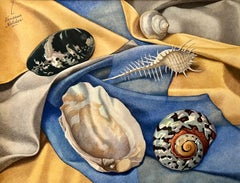
Sea Shells – Blue Gold
By Zama Vanessa Helder
Located in Los Angeles, CA
Sea Shells – Blue & Gold, c. 1940s, watercolor on paper, signed upper left, 15 x 19 ¼ inches (image); title and artist’s name and address inscribed verso, presented in a newer glazed...
Category

1940s American Modern Clifford Ellis Still-life Drawings and Watercolors

Materials

Paper, Watercolor

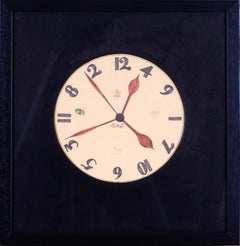
Mid Century Modern British What s the Time? by British German Kapp, 1975
Located in Petworth, West Sussex
Eduard Xavier Kapp (British, 1890 – 1978) What’s the Time? Pen and crayon, tondo Signed and dated ‘Kapp 75’ (in the centre) 8.1/2 x 8.1/2 in. (21.6 x 21.6 cm.) Edmond Kapp was born in Islington, London, on 5 November 1890, of American and German Jewish parentage. He gave himself the middle initial ‘X’ – sometimes said to stand for Xavier – to distinguish himself from his father Emil Kapp, who was a wine merchant. However, his parents called him ‘Eddie’ while his wife and friends knew him as ‘Peter’. During his early years, Kapp was continually ill and, while convalescing, entertained himself by drawing at home. As his health improved, he attended Dame Alice Owen’s School, Islington (1903-10), with periods at Berlin University (1909) and L’Institut Français pour les Etrangers, Paris (1909). He then read Languages at Christ’s College, Cambridge (1910-13), though spent most of his time writing and drawing. Kapp took a studio in London, and worked intensively until the outbreak of the First World War, contributing to the Daily News, the Onlooker and other periodicals. During the war, he served as a 2nd Lieutenant in the Royal Sussex Regiment on the Western Front, and then in Intelligence, rising to the position of Staff Captain on Haig’s Staff. Finally, he founded and directed the Neutral Press Counter-propaganda Section. In 1919, Kapp returned to London and, after abortive periods at three art schools, worked alone. In that year, he made his name with an exhibition of caricatures, held at Furst’s Gallery, London, and accompanied by a catalogue introduced by Max Beerbohm. This soon led to contracts with three London periodicals and a book of caricatures, Personalities, published by Martin Secker. Through the 1920s and 30s, his drawings of musicians and other personalities appeared in a wide variety of periodicals, most notably Time & Tide; were collected in further volumes; and were exhibited at the Leicester Galleries. He considered himself to be a ‘character-portraitist’, producing images of psychological not satirical power, and disliking the term ‘caricature’. Between the wars, Kapp developed other aspects of his artistic talents, the desire to study and the search for subject matter often taking him abroad. For instance, work at the British Academy, Rome, under Antonio Sciortino...
Category

Mid-20th Century Modern Clifford Ellis Still-life Drawings and Watercolors

Materials

Pen

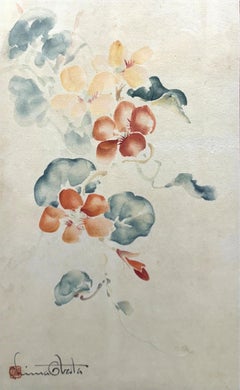
"Nasturtiums" Chiura Obata, Japanese American, Red and Blue Delicate Flowers
By Chiura Obata
Located in New York, NY
Chiura Obata Nasturtiums, circa 1940 Signed and stamped lower left Watercolor on paper 15 x 9 5/8 inches Born in the Okayama prefecture of Japan, Chiura Obata was adopted by his uncle, an artist. As a child he was trained in ink painting, and at 14 he was apprenticed to the painter Murata Tanryo in Tokyo. He also studied with Kogyo Terasaki and Goho Hasimoto. In 1903, Obata moved to San Francisco and began working as an illustrator for The New World and The Japanese American, two of the city's Japanese newspapers. He also did work as a commercial designer. Obata helped establish the East West Art Society in San Francisco in 1921, which sought to promote cross-cultural understanding through art. This goal was reflected in his embrace of the Nihonga style, which fused traditional Japanese sumi-e ink painting with the conventions of western naturalism. He spent much of the 1920s painting landscapes throughout California, and among his favorite subjects were mountain landscapes. In 1927, he visited Yosemite and the Sierra Nevada, creating over a hundred paintings and sketches of the high country. Obata stayed in the USA until the death of his father in 1928. Between 1928 and 1932, he worked in Tokyo as a painter and transformed his California landscape watercolors...
Category

1940s Modern Clifford Ellis Still-life Drawings and Watercolors

Materials

Paper, Watercolor

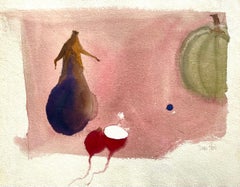
Watercolor Still life Painting Vegetables Claus Hoien Greengrocer Kitchen Series
Located in Surfside, FL
Delicate watercolor of vegetables. Japanese eggplant and radishes and a squash gourd. Framed 18 X 20 image is 11 X 13.5 Claus Hoie was a Norwegian-American...
Category

20th Century American Modern Clifford Ellis Still-life Drawings and Watercolors

Materials

Watercolor

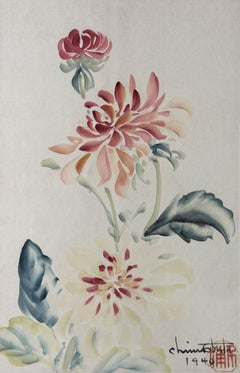
"Dahlias" Chiura Obata, Japanese American, Red and Blue Delicate Floral Work
By Chiura Obata
Located in New York, NY
Chiura Obata Dahlias, 1940 Signed, dated and stamped lower right Watercolor on paper 15 x 9 5/8 inches Born in the Okayama prefecture of Japan, Chiura Obata was adopted by his uncle, an artist. As a child he was trained in ink painting, and at 14 he was apprenticed to the painter Murata Tanryo in Tokyo. He also studied with Kogyo Terasaki and Goho Hasimoto. In 1903, Obata moved to San Francisco and began working as an illustrator for The New World and The Japanese American, two of the city's Japanese newspapers. He also did work as a commercial designer. Obata helped establish the East West Art Society in San Francisco in 1921, which sought to promote cross-cultural understanding through art. This goal was reflected in his embrace of the Nihonga style, which fused traditional Japanese sumi-e ink painting with the conventions of western naturalism. He spent much of the 1920s painting landscapes throughout California, and among his favorite subjects were mountain landscapes. In 1927, he visited Yosemite and the Sierra Nevada, creating over a hundred paintings and sketches of the high country. Obata stayed in the USA until the death of his father in 1928. Between 1928 and 1932, he worked in Tokyo as a painter and transformed his California landscape watercolors...
Category

1940s Modern Clifford Ellis Still-life Drawings and Watercolors

Materials

Paper, Watercolor

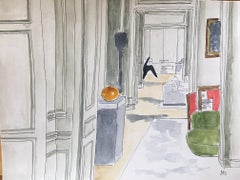
An Interior By french architect Joseph Dirand. Watercolor on paper
By Manuel Santelices
Located in Miami Beach, FL
A new series inspired by architecture, décor and stylish personalities of the world of interior design. The worlds of fashion, society and pop culture are captured in the illustrati...
Category

21st Century and Contemporary Contemporary Clifford Ellis Still-life Drawings and Watercolors

Materials

Paper, Ink, Watercolor, Gouache, Pen

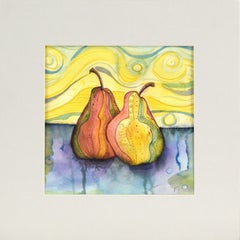
"Riffed Pears" - Watercolor Still Life
By Kathy Garvey
Located in Soquel, CA
Vibrant watercolor of pears with surreal patterning by Kathy Garvey (American, b. 1949). Initialed "KG" in the lower right corner. Notes by the artist on verso, including date and ti...
Category

2010s American Impressionist Clifford Ellis Still-life Drawings and Watercolors

Materials

Paper, Watercolor, Pen

"Riffed Pears" - Watercolor Still Life
$260 Sale Price
20% Off
H 13 in W 13 in D 0.25 in
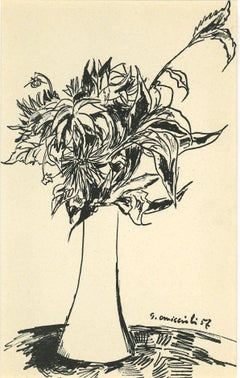
Vase of Flowers - Drawing In Pen by Giovanni Omiccioli - 1957
By Giovanni Omiccioli
Located in Roma, IT
Vase of Flowers is a beautiful drawing in pen, realized in 1957 by the Italian artist Giovanni Omiccioli (Rome, 1901-1975). Hand-signed in pencil on the lower right and dated. In v...
Category

1950s Modern Clifford Ellis Still-life Drawings and Watercolors

Materials

Pen

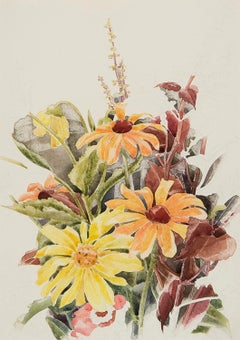
Garden Flowers
By Charles Demuth
Located in New York, NY
Charles Demuth was one of the most complex, talented, and deeply sensitive artists of the American modern period. Whether he was painting floral still lifes, industrial landscapes, or Turkish bathhouses, art was, for Demuth, fraught with personal meaning. A fixture of the vanguard art scene in New York, Demuth navigated the currents of Modernism, producing some of the most exquisite watercolors and original oil paintings in twentieth-century American art. Demuth was born in Lancaster, Pennsylvania, the only child of a well-to-do family. He had an awkward and introverted childhood shaped by a childhood illness, Perthes, a disease of the hip that not only left him permanently lame, but, as part of the “cure,” bedridden for two years in the care of his mother. This long period of incapacitation had a deep impact on Demuth, who came to see himself as an invalid, an outsider who was different from everyone else. It was perhaps during this period of indoor confinement that his keen interest in art developed. Several relatives on his father’s side had been amateur artists, and, following his convalescence, his mother encouraged his artistic pursuits by sending him to a local painter for instruction. The majority of his early pictures are of flowers, a subject for which Demuth maintained a lifelong passion. Following high school, Demuth enrolled at the Drexel Institute of Art in Philadelphia, a school renowned for its commercial arts program. He advanced through the program rapidly, and, in 1905, at the encouragement of his instructors, he began taking courses at the Pennsylvania Academy of the Fine Arts. The two leading teachers then at the Academy were William Merritt Chase and Thomas Anshutz. Anshutz, himself a former student of Thomas Eakins, was well liked by his students, and is best known as the teacher of Robert Henri, John Sloan, and several of the other artists of the Ashcan School. Demuth, too, adopted a similar idiom, working in a controlled, realistic manner while at the Academy, where he remained until 1910. In 1907, Demuth made his first trip to Europe, staying in Paris. He spent time on the periphery of the art scene composed of the numerous American artists there, including John Marin and Edward Steichen. He returned to Philadelphia five months later, and immediately resumed courses at the Academy. Despite his introduction to advanced modern styles in Europe, Demuth’s work of this period retains the academic style he practiced before the trip. It wasn’t until he had summered at New Hope, Pennsylvania, in 1908 and 1911, that his style began to evolve. New Hope was a prominent American Impressionist art colony whose members were largely affiliated with the Pennsylvania Academy. Demuth dropped the conservative tone of his style and adopted a freer and more colorful palette. Although he remained based in Philadelphia, Demuth frequently went to New York during this period. Many of the same American artists of the Parisian art scene Demuth had encountered on his earlier European trip now formed the nucleus of New York’s avant-garde, which centered around Alfred Stieglitz’s 291 gallery. It wasn’t long before Demuth began to apply modernist-inspired strategies to his work. He was particularly influenced by the watercolor work of John Marin, also a former student of Anshutz, whose bold use of color in the medium Demuth freely adapted into looser washes of color. In 1912, Demuth again left for Paris, this time studying in the Académie Moderne, Académie Colorossi, and Académie Julian. In Paris Demuth met the American modernist Marsden Hartley. Hartley, a principal figure in the expatriate art circle, acted as a mentor to Demuth, and introduced him to the wide array of modern styles currently practiced in Europe. Hartley also introduced Demuth to many of the members of the Parisian avant-garde, including Gertrude Stein. Demuth was an aspiring writer, and he spent many hours in conversation with Stein. He wrote extensively during this period, and published two works shortly after his return to America. He also developed an interest in illustrating scenes from literary texts. From 1914 to 1919, Demuth produced a series of watercolors of scenes from books such as Emile Zola’s Nana and Henry James’s The Turn of the Screw. Upon his return to America, Demuth settled in New York. In 1914, Demuth had his first one-man show at Charles Daniel’s gallery, which promoted emerging modern American artists, including Man Ray, Rockwell Kent, Yasuo Kuniyoshi, Stuart Davis, and Max Weber. Demuth drew closer to the artistic vanguard in New York, becoming friends with many in the Stieglitz and Daniel circles, including Georgia O’Keeffe, Marcel Duchamp, Carl Van Vechten, and Edward Fiske. New York’s cosmopolitan atmosphere and active nightlife appealed greatly to Demuth. In a sketchy style well suited to watercolor, he painted many vaudeville and circus themes, as well as nightclub, café, and bathhouse scenes. Often with Duchamp, Demuth took part in an urban subculture replete with nightclubs, bars, drugs, and sexual permissiveness, which, for a homosexual artist like himself, allowed room for previously unattainable personal expression. Demuth’s pictures of sailors, bathhouses, and circus performers embody a sensual and sexual undercurrent, expressing the artist’s sense of comfort and belonging in the bohemian subculture of New York. Simultaneously, Demuth deepened his interest in floral pictures, painting these almost exclusively in watercolor. His style evolved from the broad color washes of his earlier pictures to more spare, flattened, and sinuous compositions, inspired by the drawings of Aubrey Beardsley and other artists of the Aesthetic Movement. Demuth’s flower watercolors are moody and atmospheric, sensuous and elegant, introspective and yet full of expressive power. Moreover they are beautiful, and are unequivocally among the finest still lifes in American art. Despite numerous subsequent artistic undertakings that led him in a variety of directions, Demuth never stopped painting flower pictures, ultimately adding fruits and other still-life objects to his repertoire. In 1916, Demuth began to develop a style later known as Precisionism, a form of landscape painting infused with Cubism, in which space is divided into precisely drawn geometric regions of color. Demuth first began to paint the landscape in an appropriated Cubist mode while on a trip with Hartley to Bermuda. In these early landscapes, in which the curvilinear forms of trees intersect the geometrically articulated architectural forms, Demuth explored ideas that shaped the future development of modernism in America. The full realization of Demuth’s explorations came after his return to America in 1917, when he turned his attention to industrial subjects. These works derive from a “machine aesthetic,” espoused by New York artists such as Francis Picabia, Joseph Stella, Albert Gleizes, and Duchamp, by which artists viewed machines as embodying mystical, almost religious significance as symbols of the modern world. Rather than painting the skyscrapers and bridges of New York as did most of his like-minded contemporaries, Demuth returned to his home town of Lancaster, where he painted factories and warehouses in a Precisionist idiom. The titles for these pictures are often contain literary references, which serve as clues for the viewer to aid in the decoding of the artist’s meaning. In 1923, Demuth planned a series of abstract “poster portraits” of his friends and contemporaries in the New York art and literary scene. In these “portraits,” Demuth combined text and symbolic elements to evoke the essential nature of his sitters’ distinguishing characteristics. In this fashion, he painted portraits of such artists as Georgia O’Keeffe, John Marin, and Arthur Dove. His most famous poster portrait, I Saw the Figure 5 in Gold...
Category

20th Century American Modern Clifford Ellis Still-life Drawings and Watercolors

Materials

Paper, Watercolor

Garden Flowers
Garden Flowers
$375,000
H 13.88 in W 10 in
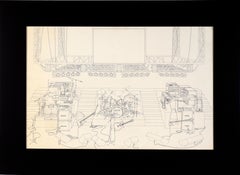
Paul Simon s Live Concert Setup - Technical Drawing in Pen on Heavy Cardstock
Located in Soquel, CA
Paul Simon's Live Concert Setup - Technical Drawing in Pen on Heavy Cardstock Detailed, accurate drawing of musical equipment for a live concert. The instruments and equipment are r...
Category

Late 20th Century American Modern Clifford Ellis Still-life Drawings and Watercolors

Materials

Postcard, Felt Pen, Laid Paper

Clifford Ellis still-life drawings and watercolors for sale on 1stDibs.

Find a wide variety of authentic Clifford Ellis still-life drawings and watercolors available for sale on 1stDibs. You can also browse by medium to find art by Clifford Ellis in paint, pen, watercolor and more. Much of the original work by this artist or collective was created during the 1950s and is mostly associated with the modern style. Not every interior allows for large Clifford Ellis still-life drawings and watercolors, so small editions measuring 21 inches across are available. Customers who are interested in this artist might also find the work of Andy Warhol, Sylvia Spicuzza, and Ian Hornak. Clifford Ellis still-life drawings and watercolors prices can differ depending upon medium, time period and other attributes. On 1stDibs, the price for these items starts at $557 and tops out at $557, while the average work can sell for $557.

Still Thinking About These?

All Recently Viewed