Cornelis Dusart Art
Dutch, 1660-1704
Cornelis Dusart was a Dutch genre painter, draftsman and printmaker. He was born in Haarlem. Dusart was a pupil of Adriaen van Ostade from about 1675–79 and was accepted into the Haarlem Guild of St. Luke in 1679. His works are similar in style and subject to those of his mentor.
to
2
1
Overall Width
to
Overall Height
to
3
3
2
1
3
3
2
2
1
1
2
1
1
1
3
10,222
2,785
2,504
1,384
1
2
1
Artist: Cornelis Dusart
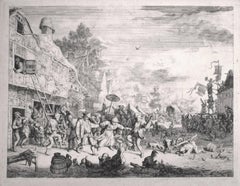
The Large Village Fair
By Cornelis Dusart
Located in Chicago, IL
The Large Village Fair, 1685
Etching
268 x 377 mm.; 10 1/2 x 13 1/4 inches
Watermark:
Arms of Amsterdam
Provenance:
H. Freiherr von und zu Aufsess (Lugt 2749)
M. Menge (Lugt 1893a).
References:
Hollstein 16
Notes:
A fine, early impression (before spots on the sky) of one of Dusart’s most powerful and fanciful works.
Concerning the provenances of this etching:
Hans von und zu Aufsess (1801-1872) was a great book lover and also a major collector of Old Master prints. He was one of the founders, in 1852, of the Germanisches Museum in Nürnberg and was that museum’s director until 1862. Mas Menge (died in 1945) was a famous violinist and also a major collector of Old Master prints and drawings.
Category
17th Century Old Masters Cornelis Dusart Art
Materials
Etching
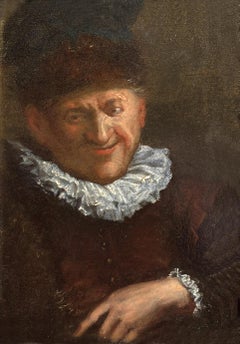
Portrait of a Man, 17th Century Dutch Oil on Panel Portrait
By Cornelis Dusart
Located in London, GB
Circle of Cornelis Dusart
Dutch 1660 - 1704
Portrait of a Man
Oil on panel
Image size: 7¾ x 5¼ inches
Giltwood frame
Cornelis Dusart
Cornelis ...
Category
17th Century Old Masters Cornelis Dusart Art
Materials
Oil, Panel
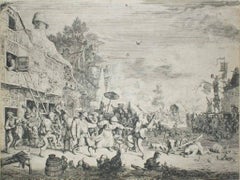
The Kermesse - Original Etching by Cornelis Dusart - 1686
By Cornelis Dusart
Located in Roma, IT
Signed and dated on the left lower margin of the plate: “Corn. Dusart fe. 1685”. On Netherlandish watermarked paper. Very good conditions.
Bartsch n.16. Beautiful etching describes a scene of ordinary peasant’s life.
Passepartout included : 47.5 x 56 cm
Cornelis Dusart (Haarlem, 1660 - 1704), Netherlandish painter and engraver, apprentice of Adriaen van Ostade, he was accepted by the Corporation of Saint Luca...
Category
17th Century Old Masters Cornelis Dusart Art
Materials
Etching
Related Items
Goddess of Love - Original Etching by Martino Rota - 17th Century
Located in Roma, IT
Goddess of Love is an original hand-colored etching on creamy-colored paper realized in the 17 century by Martino Rota.
Signed on the plate on the low...
Category
17th Century Old Masters Cornelis Dusart Art
Materials
Etching
$296
H 10.63 in W 7.49 in D 0.08 in
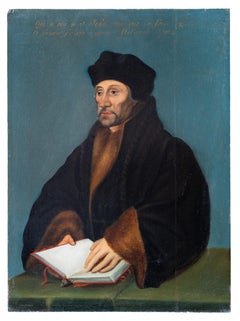
Erasmus of Rotterdam
By English School
Located in GB
Hans Holbein the Younger (1497/98 – 1543) was one of the greatest painters of the Northern Renaissance. Born in Augsburg, Germany, he was the son of Hans Holbein the Elder, also a pa...
Category
19th Century Old Masters Cornelis Dusart Art
Materials
Oil, Wood Panel

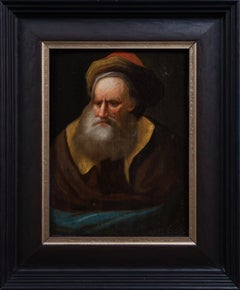
Portrait of an Old Bearded Man
Located in Stockholm, SE
We are pleased to offer a captivating portrait, most likely painted in the late 18th century, attributed to an artist within the circle of Christian Wilhelm Ernst Dietrich. This oil ...
Category
Late 18th Century Old Masters Cornelis Dusart Art
Materials
Oil, Wood Panel
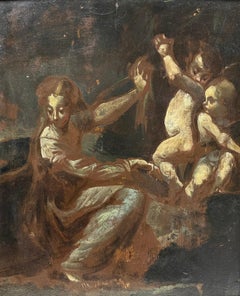
Angelic Cherubs with Classical Figure in Wilderness Finely Painted Preparatory
Located in Cirencester, Gloucestershire
Figure with Cherubim in Wilderness
Italian School, 17th century
oil painting on wood panel
framed 13 x 11 inches
condition: overall for its age very good, though the work is most likely a preparatory...
Category
17th Century Old Masters Cornelis Dusart Art
Materials
Oil, Wood Panel
$2,841 Sale Price
20% Off
H 13 in W 11 in D 1 in
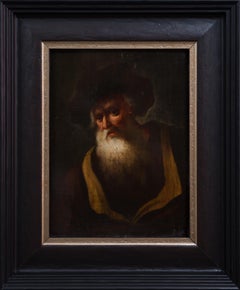
Portrait of an Old Bearded Man With a Black Cap
Located in Stockholm, SE
We are pleased to offer a captivating portrait, most likely painted in the late 18th century, attributed to an artist within the circle of Christian Wilhelm Ernst Dietrich. This oil ...
Category
Late 18th Century Old Masters Cornelis Dusart Art
Materials
Oil, Wood Panel
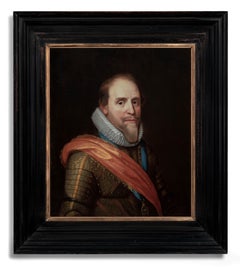
Dutch Old Master Portrait of Maurits, Prince of Orange-Nassau, Oil on Panel
Located in London, GB
In 1607, the Delft city council decided to commission a portrait of Stadholder Maurits of Nassau for the town hall, with Michiel van Mierevelt as the chosen artist due to the passing...
Category
17th Century Old Masters Cornelis Dusart Art
Materials
Oil, Wood Panel
$10,588
H 37.8 in W 33.47 in D 2.37 in
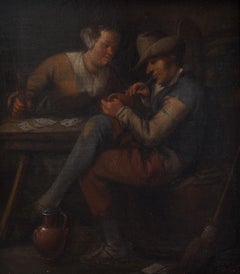
The Card Players by a Flemish 1600s Artist
By Flemish School, 17th Century
Located in Stockholm, SE
Flemish 1600s School
The Card Players
oil on oak panel
panel dimensions 22.5 x 20 cm
frame included
Provenance:
From a Swedish private collection.
Condition:
Flat and stabl...
Category
17th Century Old Masters Cornelis Dusart Art
Materials
Oak, Oil, Panel
$2,491
H 8.86 in W 7.88 in
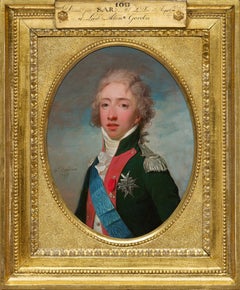
Two royal portraits (the Duc d
Angoulême and the Duc de Berry) by H.P. Danloux
Located in PARIS, FR
These two royal portraits are a major historical testimony to the stay of the Comte d'Artois (the future Charles X) and his family in Edinburgh in 1796-1797. Given by the sitters to Lord Adam Gordon, the Governor of Edinburgh, and kept by family descent to this day, these two portraits provide us with a vivid and spontaneous image of the Duc d’Angoulême and his brother the Duc de Berry. Danloux, who had emigrated to London a few years before, demonstrate his full assimilation of the art of British portrait painters in the brilliant execution of these portraits.
1. Henri-Pierre Danloux, a portraitist in the revolutionary turmoil
Born in Paris in 1753, Henri-Pierre Danloux was first a pupil of the painter Nicolas-Bernard Lépicié (1735 - 1784) and then, in 1773, of Joseph-Marie Vien (1716 - 1809), whom he followed to Rome when, at the end of 1775, Vien became Director of the Académie de France. In Rome he became friends with the painter Jacques-Louis David (1748 - 1825).
Returning to France around 1782, he settled in Lyon for a few years before returning to Paris in 1785. One of his first portraits was commissioned by the Baroness d'Etigny, the widow of the former Intendant of the Provinces of Gascony, Bearn and Navarre Antoine Mégret d'Etigny (1719 – 1767). He then became close to his two sons, Mégret de Sérilly and Mégret d'Etigny, who in turn became his patrons. In 1787, this close relationship with the d'Etigny family was further strengthened by his marriage to Antoinette de Saint-Redan, a relative of Madame d'Etigny. After his marriage, he left for Rome and did not return to France until 1789. It was during the winter of 1790-1791 that he painted one of his masterpieces, the portrait of Baron de Besenval. Set in a twilight atmosphere, this portrait of an aristocrat who knows that his death is imminent symbolizes the disappearance of an erudite and refined society which would be swept away by the French Revolution.
The Jacobin excesses led Danloux to emigrate to England in 1792; many members of his family-in-law who remained in France were guillotined on 10 May 1794. Danloux enjoyed great success as a portrait painter in England before returning to France in 1801.
During his stay in England, Danloux was deeply under the influence of English portraitists: his colors became warmer (as shown by the portrait of the Duc d'Angoulême that we are presenting), and his execution broader.
2. Description of the two portraits and biographical details of the sitters
The Duc d'Angoulême (1775-1844) was the eldest son of the Comte d'Artois, the younger brother of King Louis XVI (the future King Charles X), and his wife Marie-Thérèse of Savoie. He is shown here, in the freshness of his youth, wearing the uniform of colonel-general of the "Angoulême-Dragons" regiment.
He is wearing the blue cordon of the Order of the Holy Spirit, which was awarded to him in 1787, and two decorations: the Cross of Saint-Louis and the Maltese Cross, as he was also Grand Prior of the Order of Malta.
Born on 16 August 1775 in Versailles, Louis-Antoine d'Artois followed his parents into emigration on 16 July 1789. In 1792, he joined the émigrés’ army led by the Prince de Condé. After his stay in Edinburgh (which will be further discussed), he went to the court of the future King Louis XVIII, who was in exile at the time, and in 1799 married his first cousin Marie-Thérèse Charlotte of France, the daughter of Louis XVI and the sole survivor of the royal family. The couple had no descendants. He became Dauphin of France in 1824, upon the accession to the throne of his father but played only a minor political role, preferring his military position as Grand Admiral. Enlisted in Spain on the side of Ferdinand VII, he returned home crowned with glory after his victory at Trocadero in 1823.
He reigned for a very short time at the abdication of Charles X in 1830, before relinquishing his rights in favor of his nephew Henri d'Artois, the Duc de Bordeaux. He then followed his father into exile and died on 3 June 1844 in Gorizia (now in Italy).
His younger brother, the Duc de Berry, is shown in the uniform of the noble cavalry of the émigrés’ Army. He is wearing the blue cordon of the Order of the Holy Spirit, awarded to him in May 1789, and the Cross of Saint-Louis (partly hidden by his blue cordon).
Born on 24 January 1778 in Versailles, Charles-Ferdinand d'Artois also followed his parents into emigration and joined the émigrés’ army in 1792. After his stay in Edinburgh, he remained in Great Britain, where he had an affair with Amy Brown...
Category
1790s Old Masters Cornelis Dusart Art
Materials
Canvas, Oil, Wood Panel
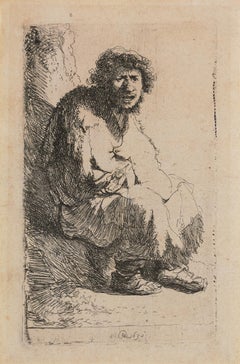
Beggar Seated on a Bank by Rembrandt Van Rijn
By Rembrandt van Rijn
Located in New Orleans, LA
Rembrandt van Rijn
1606-1669 Dutch
Beggar Seated on a Bank
Etching on paper
New Hollstein's first state of two
Signed and dated in plate "RHL 1630" (lower center)
This remarkable...
Category
17th Century Old Masters Cornelis Dusart Art
Materials
Paper, Etching
$64,500
H 20.25 in W 16.25 in D 1.25 in
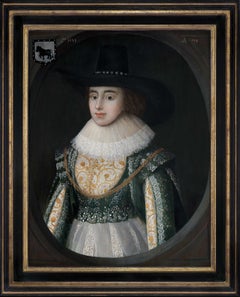
Rare Jacobean Portrait on Panel Lady Elizabeth Wheeler née Cole 1623 Historical
By Cornelius Johnson
Located in London, GB
A Rare Jacobean Portrait of Lady Elizabeth Wheeler (née Cole), 1623
Attributed to Cornelius Johnson (1593–1661)
This remarkably rare early oil on panel, presented by Titan Fine Art, has emerged as far more than an anonymous “Portrait of a Lady.” Preserved in outstanding condition—its surface retaining exceptional clarity in the lace and textiles—it has only recently been reunited with the identity of its sitter: Elizabeth Cole (1607–1670), later Lady Elizabeth Wheeler, a Westminster gentlewoman whose later life brought her into intimate royal service as laundress for His Majesty’s person. That combination—high quality, uncommon survival, a newly identified sitter, and a life that intersects directly with the last acts of Charles I—places this portrait in a category of genuine rarity. It is not simply a beautiful Jacobean likeness; it is a rediscovered historical document - legible and compelling.
The sitter is presented half-length against a dark ground, enclosed within a painted sculpted oval surround that functions like an architectural frame. This device, fashionable in the 1620s, concentrates the viewer’s attention and heightens the sense of social presentation: the sitter appears both physically and symbolically “set apart,” as if viewed through a refined aperture. The portrait’s immediate power, however, lies in the costume—an ensemble of striking modernity for c. 1623 and rendered with a precision that survives with remarkable crispness.
She wears a deep green gown—a fitted overgown with open sleeves—over a finely embroidered linen jacket (a stiffened bodice/waistcoat garment). The sleeves form pronounced “wings” at the shoulder, a structurally assertive fashion detail of the early 1620s that enlarges the silhouette and signals sophistication. Beneath the green overlayer, the white linen jacket is richly ornamented in gilt embroidery. The goldwork is arranged as scrolling foliate forms—looping, curling tendrils punctuated by seed-like stippling—organised into balanced compartments across the bodice and sleeves. The motifs read as stylised botanical forms with rounded fruit-like terminals and leaf elements: not literal naturalism, but controlled abundance. The technique is described with extraordinary intelligence, mimicking couched metallic thread through patterned, “stitched” marks, while tiny dots and short dashes create a lively tactile shimmer.
This embroidered jacket sits above a newly fashionable high-waisted, sheer apron or overskirt. The translucent fabric falls in soft vertical folds and is articulated with narrow lace-edged bands, giving the skirt a crisp rhythm of alternating sheer and patterned strips. At the neck, a fine ruff frames the face: a disciplined structure of pleated linen finished with delicate lace. Draped diagonally across the torso are long gold chains, painted to suggest weight and metallic gleam; they function both as ornament and as a further signifier of status. The cumulative effect is controlled luxury: she is not overloaded with jewels, but clothed in textiles whose cost and craftsmanship speak unmistakably.
The recent sitter’s identification rests on heraldic and genealogical analysis: the arms shown on the painting correspond to those recorded for several families in armorial sources, but when the lines of descent are tested against survival and chronology, the viable bearer by 1623 resolves to Cole, and—crucially—to the London branch. That resolution matters because it anchors the portrait to a very specific social world: London/Westminster civic gentry and Crown administration, the milieu in which portraiture served as both self-fashioning and social instrument. The recent identification of the sitter (the London Cole branch of the family) is not merely genealogical; it has direct implications for authorship. A London-based mercantile or civic-gentry family would have ready access to leading immigrant artists, familiarity with heraldic display conventions, and the means to commission oil on panel, still standard among Netherlandish-trained painters.
In that context, the portrait’s age inscription and date become especially revealing. The painting states the sitter to be nineteen years of age. Yet Elizabeth Cole’s birth in 1607 suggests she would be younger if the portrait is dated as early as 1623. The key insight is that the “incorrect” age is best understood not as a mistake but as a deliberate social adjustment, a performative statement rather than a documentary one. The most persuasive explanation is strategic. Portraits of high-status unmarried women were frequently made in connection with marriage negotiations. In the early 1620s, Elizabeth’s future husband, William Wheeler, was resident abroad at Middelburg in Zeeland in the Dutch Republic. If a portrait was intended to support or facilitate a match with an educated, ambitious man—“a man of learning and letters,” —then presenting a seventeen-year-old as nineteen would subtly reposition her as more mature and more nearly a peer in age, Wheeler being around twenty-two. The portrait thus becomes an instrument of alliance, not merely a likeness: an image designed to persuade, reassure, and elevate.
This reading aligns perfectly with the period’s wider conditions. The early 1620s in England were charged with anxiety and expectation: James I’s later reign was marked by court faction, diplomatic tension, and the pressures of European conflict. The so-called “art market” was inseparable from these dynamics. Portraiture flourished because it served multiple functions: it fixed lineage, advertised alliance, signalled readiness for marriage, and projected the stability of elite households in an uncertain world. For Westminster families whose power came through office, portraiture was also a declaration of belonging—proof that administrative elites possessed the cultural polish traditionally associated with older aristocratic rank.
Elizabeth’s later life vindicates the portrait’s impression of steadiness. Although no record survives of her marriage ceremony to William Wheeler, wills suggest she had married him by the mid-1630s, and there are strong grounds—consistent with the portrait’s implications—for a union already in place by the early 1630s, possibly earlier. Wheeler himself rose rapidly. By 1639 he held a manor at Westbury Leigh in Wiltshire and sought letters of denization due to overseas birth, enabling him to stand as Member of Parliament for Westbury. He leased the principal manor of Westbury the following year, coinciding with his election. In government service he became Remembrancer of the Exchequer and held office across regime change, a testament to administrative skill and political pragmatism.
It is Elizabeth, however, who makes this portrait exceptional. She became laundress for His Majesty’s person, responsible for the washing and oversight of the King’s personal linen—an office that, despite its domestic description, required unusual trust, discretion, and access. Her role becomes visible in 1643 when she was granted a warrant signed by the Speaker of the House of Commons to follow the King to Oxford with her servant after the outbreak of the Civil War. She continued to serve during the King’s captivity after 1646, and at Carisbrooke Castle in 1647 she and her maid were implicated in smuggling secret correspondence to and from Charles I, in service of escape plans. After the King’s failed attempt to escape in March 1648, she was removed—yet the King’s trust persisted: he was permitted to send her remaining jewels in an ivory casket...
Category
17th Century Old Masters Cornelis Dusart Art
Materials
Oil, Panel
$28,487
H 37.6 in W 30.52 in D 2.76 in
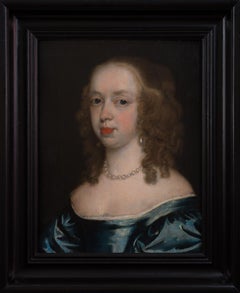
Portrait of a lady in blue dress ”Countess of Peterborough”
Located in Stockholm, SE
This exquisite portrait, with its new attribution to Theodore Russel, is believed to depict Lady Penelope O'Brien, daughter of Barnabas O'Brien, the sixth Earl of Thomond, and wife of the Earl of Peterborough, whom she married in 1644. The painting thus belongs to a historically significant period, capturing the refined elegance of the time.
The portrait has a prestigious provenance from Elleholms Hofgård, a historic estate in Mörrums socken, Blekinge, Sweden. Elleholms Hofgård, whose two-story, timber-framed main building was constructed in 1730 and expanded in 1804, has changed ownership several times since the 17th century. The ancestors of the present owners acquired the estate in 1915, and from the 20th century until 2023, this painting was prominently displayed in the estate’s main building, making it an integral part of the estate’s history.
Theodore Russel, an English portrait artist born in 1614, studied under the renowned Sir Anthony van Dyck, whose influence can be seen in Russel’s meticulous style. Russel often painted on cabinet-sized panels, such as this one, which measures approximately 39 x 31 cm. This preference for panels is a notable characteristic that sets him apart from contemporary artists like Sir Peter Lely, who exclusively used canvas. The size of the panel is a key reason for the reattribution to Russel from Peter lely, as Lely never used panels for his works. This distinctive format, along with Russel’s characteristic style, strongly supports the new attribution.
Russel, the son of Nicasius Rousseel, a goldsmith and jeweler to James I and Charles I, refined his skills under the mentorship of his uncle, the famous portrait painter Cornelis Janssen. He also worked as an assistant and copyist for van Dyck, further honing his artistic style. This captivating portrait exemplifies Russel’s craftsmanship, reflecting the elegance of the period’s fashion and the artist's refined techniques.
oil on wood panel
with indistinct inscription Countess of Peter[...] upper left.
with inscription on the reverse: ”Countess of Peterborough. P. Lely 1670. S Beatty Picture Restorer [...] Warwick”.
unframed 39 x 31 cm = 15.35 x 12.2 inches
framed 52 x 41.5 cm = 20.47 x 16.34 inches
Condition:
The portrait has just been restored by a professional art conservator in Stockholm and is now in a very good condition. The colors are vivid, and the skin tones appear more natural than before. It is a very fine painting. The frame is newly made and included.
Provenance:
Elleholms Hofgård, Mörrums socken, Blekinge, Sweden **;
Stockholms Auktionsverk, Fine Art & Antiques Autumn...
Category
17th Century Old Masters Cornelis Dusart Art
Materials
Oil, Wood Panel
$11,272
H 20.48 in W 16.34 in
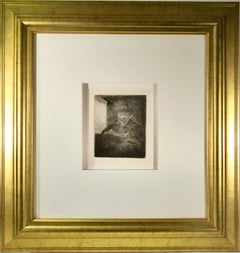
Self Portrait, Drawing at the Window
By Rembrandt van Rijn
Located in San Francisco, CA
Artist: Rembrandt Van Rijn (Dutch, 1606-1669)
Title: Self Portrait, Drawing at the Window
Year: 1648
Medium: Etching
Paper: Verge paper
Image (plate mark) size: 6.35 x 5.25 inch...
Category
Mid-17th Century Old Masters Cornelis Dusart Art
Materials
Etching
Cornelis Dusart art for sale on 1stDibs.
Find a wide variety of authentic Cornelis Dusart available for sale on 1stDibs. You can also browse by medium to find art by Cornelis Dusart in etching, oil paint, paint and more. Much of the original work by this artist or collective was created during the 18th century and earlier and is mostly associated with the Old Masters style. Not every interior allows for large Cornelis Dusart, so small editions measuring 6 inches across are available. Customers who are interested in this artist might also find the work of Flemish School, 17th Century, Giovanni Benedetto Castiglione, and Crispin de Passe II. Cornelis Dusart prices can differ depending upon medium, time period and other attributes. On 1stDibs, the price for these items starts at $7,669 and tops out at $11,500, while the average work can sell for $9,191.