Currier Ives Landscape Prints
American, 1834-1907
Currier and Ives was a prominent American printmaking establishment headquartered in New York operating from 1835 to 1907. Nathaniel Currier (1813-1888) started his business on his own, but later merged with James Merritt Ives (1824-1895), becoming "Currier and Ives" in 1857. They produced and sold hand-colored lithographs which could be produced relatively quickly and cheaply. They called themselves "the Grand Central Depot for Cheap and Popular Prints". The company published around 7,500 lithographs in its 72 years in business.to
2
4
2
1
1
Overall Width
to
Overall Height
to
20
188
169
156
147
9
1
1
10
5
4
3
3
2
1
1
1
1
1
1
1
1
1
1
1
1
1
1
1
10
4
3
10
Artist: Currier
Ives
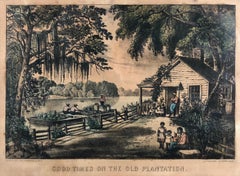
Good Times on the Old Plantation
By Currier
Ives
Located in Missouri, MO
Currier & Ives (Publishers)
"Good times on the Old Plantation" 1872
Handcolored Lithograph
Size Height 10 in.; Width 13.9 in.
Framed Size: approx 16 x 19.5
Category
1870s Victorian Currier Ives Landscape Prints
Materials
Lithograph
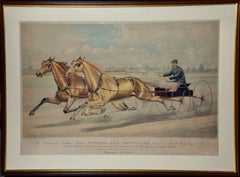
19th C. Currier
Ives lithograph "Celebrated Trotting Team Edward
Swiveller"
By Currier
Ives
Located in Alamo, CA
This is an original 19th century Currier and Ives hand-colored lithograph entitled "The Celebrated Trotting Team Edward and Swiveller, Owned by Frank Work Esq. N.Y.: Winning their ma...
Category
1880s Currier Ives Landscape Prints
Materials
Lithograph
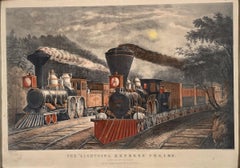
THE LIGHTNING EXPRESS TRAINS and THE AMERICAN EXPRESS TRAIN
By Currier
Ives
Located in Portland, ME
Currier and Ives. THE LIGHTNING EXPRESS TRAINS and THE AMERICAN EXPRESS TRAIN.Peters 2088 and 2103. Color lithographs, 1863 and 1864. 17 1/8 x 27 1/8 inches (images), 21 1/2 x 29 1/2...
Category
1930s Currier Ives Landscape Prints
Materials
Lithograph
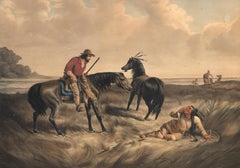
The Last War-Whoop!
By Currier
Ives
Located in Palm Desert, CA
"The Last War-Whoop!" is a lithograph by Currier & Ives. The framed size is 26 x 32.62 x 1.25 inches.
Provenance:
Private Collection
Category
Late 19th Century American Realist Currier Ives Landscape Prints
Materials
Lithograph
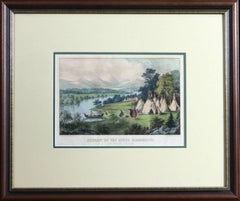
Scenery of the Upper Mississippi Indian Village Currier
Ives lithograph framed
By Currier
Ives
Located in Paonia, CO
Scenery of the Upper Mississippi Indian Village Currier & Ives lithograph is a tranquil scene of an Indian village camped in a meadow next to a be...
Category
Mid-19th Century American Realist Currier Ives Landscape Prints
Materials
Lithograph
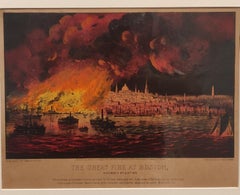
"The Great Fire of Boston" Currier
Ives, Urban landscape late 19th century
By Currier
Ives
Located in New York, NY
Currier & Ives
The Great Fire of Boston , 1872
Hand-colored lithograph
7 5/16 x 12 11/16 inches
After undertaking apprenticeships in Boston and Philadelphia, Currier set up a print...
Category
1870s Realist Currier Ives Landscape Prints
Materials
Lithograph
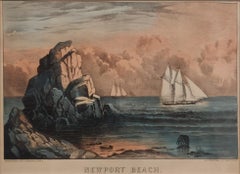
"Newport Beach" Currier
Ives, Hand-Colored Lithograph of Newport Beach
By Currier
Ives
Located in New York, NY
Currier & Ives
Newport Beach
Hand-colored lithograph
Sheet 10 x 13 1/4 inches
After undertaking apprenticeships in Boston and Philadelphia, Currier set up a print publishing compan...
Category
Late 19th Century Realist Currier Ives Landscape Prints
Materials
Lithograph
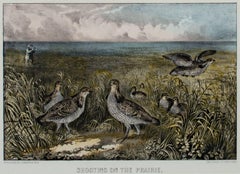
19th century color lithograph birds landscape nature grass sky water figure
By Currier
Ives
Located in Milwaukee, WI
"Shooting on the Prairie" is an original hand-colored lithograph by Currier & Ives. It depicts a hunter shooting at fowl in an open field.
8 1/2" x 12 1/2" art
20 1/4" x 23 3/4" frame
Nathaniel Currier was a tall introspective man with a melancholy nature. He could captivate people with his piercing stare or charm them with his sparkling blue eyes. Nathaniel was born in Roxbury, Massachusetts on March 27th, 1813, the second of four children. His parents, Nathaniel and Hannah Currier, were distant cousins who lived a humble yet spartan life. When Nathaniel was eight years old, tragedy struck. Nathaniel’s father unexpectedly passed away leaving Nathaniel and his eleven-year-old brother Lorenzo to provide for the family. In addition to their mother, Nathaniel and Lorenzo had to care for six-year-old sister Elizabeth and two-year-old brother Charles. Nathaniel worked a series of odd jobs to support the family, and at fifteen, he started what would become a life-long career when he apprenticed in the Boston lithography shop of William and John Pendleton.
A Bavarian gentleman named Alois Senefelder invented lithography just 30 years prior to young Nat Currier’s apprenticeship. While under the employ of the brothers Pendleton, Nat was taught the art of lithography by the firm’s chief printer, a French national named Dubois, who brought the lithography trade to America.
Lithography involves grinding a piece of limestone flat and smooth then drawing in mirror image on the stone with a special grease pencil. After the image is completed, the stone is etched with a solution of aqua fortis leaving the greased areas in slight relief. Water is then used to wet the stone and greased-ink is rolled onto the raised areas. Since grease and water do not mix, the greased-ink is repelled by the moisture on the stone and clings to the original grease pencil lines. The stone is then placed in a press and used as a printing block to impart black on white images to paper.
In 1833, now twenty-years old and an accomplished lithographer, Nat Currier left Boston and moved to Philadelphia to do contract work for M.E.D. Brown, a noted engraver and printer. With the promise of good money, Currier hired on to help Brown prepare lithographic stones of scientific images for the American Journal of Sciences and Arts. When Nat completed the contract work in 1834, he traveled to New York City to work once again for his mentor John Pendleton, who was now operating his own shop located at 137 Broadway. Soon after the reunion, Pendleton expressed an interest in returning to Boston and offered to sell his print shop to Currier. Young Nat did not have the financial resources to buy the shop, but being the resourceful type he found another local printer by the name of Stodart. Together they bought Pendleton’s business.
The firm ‘Currier & Stodart’ specialized in "job" printing. They produced many different types of printed items, most notably music manuscripts for local publishers. By 1835, Stodart was frustrated that the business was not making enough money and he ended the partnership, taking his investment with him. With little more than some lithographic stones, and a talent for his trade, twenty-two year old Nat Currier set up shop in a temporary office at 1 Wall Street in New York City. He named his new enterprise ‘N. Currier, Lithographer’
Nathaniel continued as a job printer and duplicated everything from music sheets to architectural plans. He experimented with portraits, disaster scenes and memorial prints, and any thing that he could sell to the public from tables in front of his shop. During 1835 he produced a disaster print Ruins of the Planter's Hotel, New Orleans, which fell at two O’clock on the Morning of the 15th of May 1835, burying 50 persons, 40 of whom Escaped with their Lives. The public had a thirst for newsworthy events, and newspapers of the day did not include pictures. By producing this print, Nat gave the public a new way to “see” the news. The print sold reasonably well, an important fact that was not lost on Currier.
Nat met and married Eliza Farnsworth in 1840. He also produced a print that same year titled Awful Conflagration of the Steamboat Lexington in Long Island Sound on Monday Evening, January 18, 1840, by which melancholy occurrence over One Hundred Persons Perished. This print sold out very quickly, and Currier was approached by an enterprising publication who contracted him to print a single sheet addition of their paper, the New York Sun. This single page paper is presumed to be the first illustrated newspaper ever published.
The success of the Lexington print launched his career nationally and put him in a position to finally lift his family up. In 1841, Nat and Eliza had their first child, a son they named Edward West Currier. That same year Nat hired his twenty-one year old brother Charles and taught him the lithography trade, he also hired his artistically inclined brother Lorenzo to travel out west and make sketches of the new frontier as material for future prints. Charles worked for the firm on and off over the years, and invented a new type of lithographic crayon which he patented and named the Crayola. Lorenzo continued selling sketches to Nat for the next few years.
In 1843, Nat and Eliza had a daughter, Eliza West Currier, but tragedy struck in early 1847 when their young daughter died from a prolonged illness. Nat and Eliza were grief stricken, and Eliza, driven by despair, gave up on life and passed away just four months after her daughter’s death.
The subject of Nat Currier’s artwork changed following the death of his wife and daughter, and he produced many memorial prints and sentimental prints during the late 1840s. The memorial prints generally depicted grief stricken families posed by gravestones (the stones were left blank so the purchasers could fill in the names of the dearly departed). The sentimental prints usually depicted idealized portraits of women and children, titled with popular Christian names of the day.
Late in 1847, Nat Currier married Lura Ormsbee, a friend of the family. Lura was a self-sufficient woman, and she immediately set out to help Nat raise six-year-old Edward and get their house in order. In 1849, Lura delivered a son, Walter Black Currier, but fate dealt them a blow when young Walter died one year later. While Nat and Lura were grieving the loss of their new son, word came from San Francisco that Nat’s brother Lorenzo had also passed away from a brief illness. Nat sank deeper into his natural quiet melancholy. Friends stopped by to console the couple, and Lura began to set an extra place at their table for these unexpected guests. She continued this tradition throughout their lives.
In 1852, Charles introduced a friend, James Merritt Ives, to Nat and suggested he hire him as a bookkeeper. Jim Ives was a native New Yorker born in 1824 and raised on the grounds of Bellevue Hospital where his father was employed as superintendent. Jim was a self-trained artist and professional bookkeeper. He was also a plump and jovial man, presenting the exact opposite image of his new boss.
Jim Ives met Charles Currier through Caroline Clark, the object of Jim’s affection. Caroline’s sister Elizabeth was married to Charles, and Caroline was a close friend of the Currier family. Jim eventually proposed marriage to Caroline and solicited an introduction to Nat Currier, through Charles, in hopes of securing a more stable income to support his future wife.
Ives quickly set out to improve and modernize his new employer’s bookkeeping methods. He reorganized the firm’s sizable inventory, and used his artistic skills to streamline the firm’s production methods. By 1857, Nathaniel had become so dependent on Jims’ skills and initiative that he offered him a full partnership in the firm and appointed him general manager. The two men chose the name ‘Currier & Ives’ for the new partnership, and became close friends.
Currier & Ives produced their prints in a building at 33 Spruce Street where they occupied the third, fourth and fifth floors. The third floor was devoted to the hand operated printing presses that were built by Nat's cousin, Cyrus Currier, at his shop Cyrus Currier & Sons in Newark, NJ. The fourth floor found the artists, lithographers and the stone grinders at work. The fifth floor housed the coloring department, and was one of the earliest production lines in the country. The colorists were generally immigrant girls, mostly German, who came to America with some formal artistic training. Each colorist was responsible for adding a single color to a print. As a colorist finished applying their color, the print was passed down the line to the next colorist to add their color. The colorists worked from a master print displayed above their table, which showed where the proper colors were to be placed. At the end of the table was a touch up artist who checked the prints for quality, touching-in areas that may have been missed as it passed down the line. During the Civil War, demand for prints became so great that coloring stencils were developed to speed up production.
Although most Currier & Ives prints were colored in house, some were sent out to contract artists. The rate Currier & Ives paid these artists for coloring work was one dollar per one hundred small folios (a penny a print) and one dollar per one dozen large folios. Currier & Ives also offered uncolored prints to dealers, with instructions (included on the price list) on how to 'prepare the prints for coloring.' In addition, schools could order uncolored prints from the firm’s catalogue to use in their painting classes.
Nathaniel Currier and James Merritt Ives attracted a wide circle of friends during their years in business. Some of their more famous acquaintances included Horace Greeley, Phineas T. Barnum, and the outspoken abolitionists Rev. Henry Ward, and John Greenleaf Whittier (the latter being a cousin of Mr. Currier).
Nat Currier and Jim Ives described their business as "Publishers of Cheap and Popular Pictures" and produced many categories of prints. These included Disaster Scenes, Sentimental Images, Sports, Humor, Hunting Scenes, Politics, Religion, City and Rural Scenes, Trains, Ships, Fire Fighters, Famous Race Horses, Historical Portraits, and just about any other topic that satisfied the general public's taste. In all, the firm produced in excess of 7500 different titles, totaling over one million prints produced from 1835 to 1907.
Nat Currier retired in 1880, and signed over his share of the firm to his son Edward. Nat died eight years later at his summer home 'Lion’s Gate' in Amesbury, Massachusetts. Jim Ives remained active in the firm until his death in 1895, when his share of the firm passed to his eldest son, Chauncey.
In 1902, faced will failing health from the ravages of Tuberculosis, Edward Currier sold his share of the firm to Chauncey Ives...
Category
1870s Other Art Style Currier Ives Landscape Prints
Materials
Lithograph
19th century color lithograph nature figure winter scene trees snow river
By Currier
Ives
Located in Milwaukee, WI
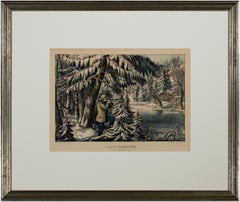
"Deer Shooting in the Northern Woods" is an original hand-colored lithograph by Currier & Ives. It depicts a landscape with a hunter aiming his gun at a deer on a winter day.
10" x 14" art
19 1/2" x 23 1/4" frame
Nathaniel Currier was a tall introspective man with a melancholy nature. He could captivate people with his piercing stare or charm them with his sparkling blue eyes. Nathaniel was born in Roxbury, Massachusetts on March 27th, 1813, the second of four children. His parents, Nathaniel and Hannah Currier, were distant cousins who lived a humble yet spartan life. When Nathaniel was eight years old, tragedy struck. Nathaniel’s father unexpectedly passed away leaving Nathaniel and his eleven-year-old brother Lorenzo to provide for the family. In addition to their mother, Nathaniel and Lorenzo had to care for six-year-old sister Elizabeth and two-year-old brother Charles. Nathaniel worked a series of odd jobs to support the family, and at fifteen, he started what would become a life-long career when he apprenticed in the Boston lithography shop of William and John Pendleton.
A Bavarian gentleman named Alois Senefelder invented lithography just 30 years prior to young Nat Currier’s apprenticeship. While under the employ of the brothers Pendleton, Nat was taught the art of lithography by the firm’s chief printer, a French national named Dubois, who brought the lithography trade to America.
Lithography involves grinding a piece of limestone flat and smooth then drawing in mirror image on the stone with a special grease pencil. After the image is completed, the stone is etched with a solution of aqua fortis leaving the greased areas in slight relief. Water is then used to wet the stone and greased-ink is rolled onto the raised areas. Since grease and water do not mix, the greased-ink is repelled by the moisture on the stone and clings to the original grease pencil lines. The stone is then placed in a press and used as a printing block to impart black on white images to paper.
In 1833, now twenty-years old and an accomplished lithographer, Nat Currier left Boston and moved to Philadelphia to do contract work for M.E.D. Brown, a noted engraver and printer. With the promise of good money, Currier hired on to help Brown prepare lithographic stones of scientific images for the American Journal of Sciences and Arts. When Nat completed the contract work in 1834, he traveled to New York City to work once again for his mentor John Pendleton, who was now operating his own shop located at 137 Broadway. Soon after the reunion, Pendleton expressed an interest in returning to Boston and offered to sell his print shop to Currier. Young Nat did not have the financial resources to buy the shop, but being the resourceful type he found another local printer by the name of Stodart. Together they bought Pendleton’s business.
The firm ‘Currier & Stodart’ specialized in "job" printing. They produced many different types of printed items, most notably music manuscripts for local publishers. By 1835, Stodart was frustrated that the business was not making enough money and he ended the partnership, taking his investment with him. With little more than some lithographic stones, and a talent for his trade, twenty-two year old Nat Currier set up shop in a temporary office at 1 Wall Street in New York City. He named his new enterprise ‘N. Currier, Lithographer’
Nathaniel continued as a job printer and duplicated everything from music sheets to architectural plans. He experimented with portraits, disaster scenes and memorial prints, and any thing that he could sell to the public from tables in front of his shop. During 1835 he produced a disaster print Ruins of the Planter's Hotel, New Orleans, which fell at two O’clock on the Morning of the 15th of May 1835, burying 50 persons, 40 of whom Escaped with their Lives. The public had a thirst for newsworthy events, and newspapers of the day did not include pictures. By producing this print, Nat gave the public a new way to “see” the news. The print sold reasonably well, an important fact that was not lost on Currier.
Nat met and married Eliza Farnsworth in 1840. He also produced a print that same year titled Awful Conflagration of the Steamboat Lexington in Long Island Sound on Monday Evening, January 18, 1840, by which melancholy occurrence over One Hundred Persons Perished. This print sold out very quickly, and Currier was approached by an enterprising publication who contracted him to print a single sheet addition of their paper, the New York Sun. This single page paper is presumed to be the first illustrated newspaper ever published.
The success of the Lexington print launched his career nationally and put him in a position to finally lift his family up. In 1841, Nat and Eliza had their first child, a son they named Edward West Currier. That same year Nat hired his twenty-one year old brother Charles and taught him the lithography trade, he also hired his artistically inclined brother Lorenzo to travel out west and make sketches of the new frontier as material for future prints. Charles worked for the firm on and off over the years, and invented a new type of lithographic crayon which he patented and named the Crayola. Lorenzo continued selling sketches to Nat for the next few years.
In 1843, Nat and Eliza had a daughter, Eliza West Currier, but tragedy struck in early 1847 when their young daughter died from a prolonged illness. Nat and Eliza were grief stricken, and Eliza, driven by despair, gave up on life and passed away just four months after her daughter’s death.
The subject of Nat Currier’s artwork changed following the death of his wife and daughter, and he produced many memorial prints and sentimental prints during the late 1840s. The memorial prints generally depicted grief stricken families posed by gravestones (the stones were left blank so the purchasers could fill in the names of the dearly departed). The sentimental prints usually depicted idealized portraits of women and children, titled with popular Christian names of the day.
Late in 1847, Nat Currier married Lura Ormsbee, a friend of the family. Lura was a self-sufficient woman, and she immediately set out to help Nat raise six-year-old Edward and get their house in order. In 1849, Lura delivered a son, Walter Black Currier, but fate dealt them a blow when young Walter died one year later. While Nat and Lura were grieving the loss of their new son, word came from San Francisco that Nat’s brother Lorenzo had also passed away from a brief illness. Nat sank deeper into his natural quiet melancholy. Friends stopped by to console the couple, and Lura began to set an extra place at their table for these unexpected guests. She continued this tradition throughout their lives.
In 1852, Charles introduced a friend, James Merritt Ives, to Nat and suggested he hire him as a bookkeeper. Jim Ives was a native New Yorker born in 1824 and raised on the grounds of Bellevue Hospital where his father was employed as superintendent. Jim was a self-trained artist and professional bookkeeper. He was also a plump and jovial man, presenting the exact opposite image of his new boss.
Jim Ives met Charles Currier through Caroline Clark, the object of Jim’s affection. Caroline’s sister Elizabeth was married to Charles, and Caroline was a close friend of the Currier family. Jim eventually proposed marriage to Caroline and solicited an introduction to Nat Currier, through Charles, in hopes of securing a more stable income to support his future wife.
Ives quickly set out to improve and modernize his new employer’s bookkeeping methods. He reorganized the firm’s sizable inventory, and used his artistic skills to streamline the firm’s production methods. By 1857, Nathaniel had become so dependent on Jims’ skills and initiative that he offered him a full partnership in the firm and appointed him general manager. The two men chose the name ‘Currier & Ives’ for the new partnership, and became close friends.
Currier & Ives produced their prints in a building at 33 Spruce Street where they occupied the third, fourth and fifth floors. The third floor was devoted to the hand operated printing presses that were built by Nat's cousin, Cyrus Currier, at his shop Cyrus Currier & Sons in Newark, NJ. The fourth floor found the artists, lithographers and the stone grinders at work. The fifth floor housed the coloring department, and was one of the earliest production lines in the country. The colorists were generally immigrant girls, mostly German, who came to America with some formal artistic training. Each colorist was responsible for adding a single color to a print. As a colorist finished applying their color, the print was passed down the line to the next colorist to add their color. The colorists worked from a master print displayed above their table, which showed where the proper colors were to be placed. At the end of the table was a touch up artist who checked the prints for quality, touching-in areas that may have been missed as it passed down the line. During the Civil War, demand for prints became so great that coloring stencils were developed to speed up production.
Although most Currier & Ives prints were colored in house, some were sent out to contract artists. The rate Currier & Ives paid these artists for coloring work was one dollar per one hundred small folios (a penny a print) and one dollar per one dozen large folios. Currier & Ives also offered uncolored prints to dealers, with instructions (included on the price list) on how to 'prepare the prints for coloring.' In addition, schools could order uncolored prints from the firm’s catalogue to use in their painting classes.
Nathaniel Currier and James Merritt Ives attracted a wide circle of friends during their years in business. Some of their more famous acquaintances included Horace Greeley, Phineas T. Barnum, and the outspoken abolitionists Rev. Henry Ward, and John Greenleaf Whittier (the latter being a cousin of Mr. Currier).
Nat Currier and Jim Ives described their business as "Publishers of Cheap and Popular Pictures" and produced many categories of prints. These included Disaster Scenes, Sentimental Images, Sports, Humor, Hunting Scenes, Politics, Religion, City and Rural Scenes, Trains, Ships, Fire Fighters, Famous Race Horses, Historical Portraits, and just about any other topic that satisfied the general public's taste. In all, the firm produced in excess of 7500 different titles, totaling over one million prints produced from 1835 to 1907.
Nat Currier retired in 1880, and signed over his share of the firm to his son Edward. Nat died eight years later at his summer home 'Lion’s Gate' in Amesbury, Massachusetts. Jim Ives remained active in the firm until his death in 1895, when his share of the firm passed to his eldest son, Chauncey.
In 1902, faced will failing health from the ravages of Tuberculosis, Edward Currier sold his share of the firm to Chauncey Ives. In 1907, faced with competitive pressures from advancements in offset printing and photo engraving, Chauncey closed the venerable lithography business and sold the printing equipment and lithographic stones to his shop foreman, Daniel W. Logan.
Nathaniel Currier and James Merritt Ives are laid to rest along with their families at the Greenwood Cemetery...
Category
1860s Other Art Style Currier Ives Landscape Prints
Materials
Lithograph
19th century color lithograph seascape boat ship waves maritime landscape
By Currier
Ives
Located in Milwaukee, WI
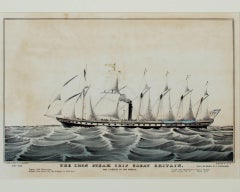
"Iron Steam Ship Great Britain" is an original hand-colored lithographed published by Currier & Ives. It depicts a large British steam ship on the water. The caption below says "3500 Tons. Engine 1000 Horse power. Weight of Iron used in the Ship and Engine is 1500 Tons. THE LARGEST IN THE WORLD. Length from Figurehead to Tafrail 322 Fe3et. Main breadth 50' 6" ... Depth 32' 6" Lieut. Jaf. Hosken R.N. Commander."
8" x 12 3/4" art
17 1/8" x 21 1/2" frame
Currier & Ives produced their prints in a building at 33 Spruce Street where they occupied the third, fourth and fifth floors. The third floor was devoted to the hand operated printing presses that were built by Nat's cousin, Cyrus Currier, at his shop Cyrus Currier & Sons in Newark, NJ. The fourth floor found the artists, lithographers and the stone...
Category
1850s Currier Ives Landscape Prints
Materials
Lithograph
Related Items
View Under The Grand Portico of The Temple, Philae
By David Roberts
Located in London, GB
David Roberts RA
View Under The Grand Portico of The Temple, Philae
1796 - 1864
First Edition lithograph
Full plate: 126
Presented in a acid free mount
One of the grander temple com...
Category
1840s Realist Currier Ives Landscape Prints
Materials
Laid Paper, Lithograph


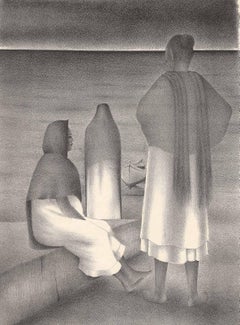
La Espera (The Wait -- Three Women by the sea)
By Francisco Dosamantes
Located in New Orleans, LA
The Wait. Three native Mexican women wait by the sea. This impression is #31/100. An impression of this lithograph is in the permanent collectio...
Category
Mid-20th Century Modern Currier Ives Landscape Prints
Materials
Lithograph
Put Fighting Blood in Your Business
Located in Spokane, WA
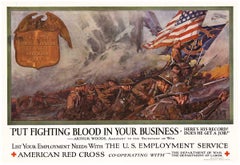
Original WW1 poster. Put Fighting Blood in Your Business. Here’s his record! Does he get a Job? Arthur Woods, Assistant to the Secretary of...
Category
1910s American Realist Currier Ives Landscape Prints
Materials
Lithograph
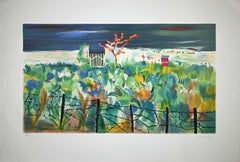
The Mediterranean Garden - Original Lithograph by Giovanni Omiccioli - 1973
By Giovanni Omiccioli
Located in Roma, IT
The Mediterranean Garden is a beautiful original lithograph on cardboard, realized by the Italian artist Giovanni Omiccioli (Rome, 1901-1975) in 1...
Category
1970s Contemporary Currier Ives Landscape Prints
Materials
Lithograph
$593
H 26.38 in W 39.57 in D 0.08 in
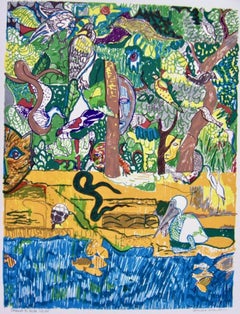
Romare Bearden, Dreams of Exile (Green Snake), 1971, by African-American, signed
By Romare Bearden
Located in New York, NY
A North Carolina native, the African-American Romare Bearden spent most of his career in New York City. For several decades he was a social worker in Harlem. But of course he traveled widely, read and studied with great care, and created a phenomenal body of work.
This 1971 lithograph is a good example of his oeuvre -- far reaching though it may be. It speaks to his skill and knowledge of contemporary printmaking while featuring a complex subject representative of his interests.
A lush jungles is packed with flora and fauna. 'Green Snake' is part of the title and there is a particularly winsome reptile showing up so well on the sand-colored border between the dense forest and the aquamarine water. There are of course many other land and sea animals showing themselves -- even a curious ginger cat...
Category
1970s Contemporary Currier Ives Landscape Prints
Materials
Lithograph
Romare BeardenRomare Bearden, Dreams of Exile (Green Snake), 1971, by African-American, signed, 1971
$4,600 Sale Price
20% Off
H 21.5 in W 16.5 in
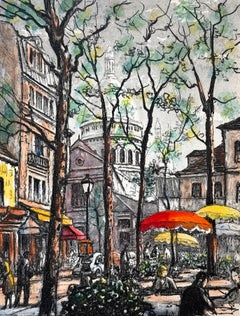
“Paris, Place du Tertre”
Located in Southampton, NY
Original hand colored lithograph by the French artist, Maurice Jacque of the Place du Tertre in Montmartre Paris, France. Signed in lower right margin. Titled in lower left margin. ...
Category
Early 1900s Academic Currier Ives Landscape Prints
Materials
Archival Paper, Lithograph
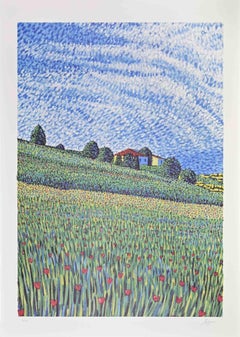
Countryside - Lithograph by Lucio Rofrano - 1990s
Located in Roma, IT
Lithograph realized by Lucio Rofrano in 1990s.
Edition of 150, numbered and hand signed.
Excellent condition.
Category
1990s Contemporary Currier Ives Landscape Prints
Materials
Lithograph
$237
H 27.56 in W 19.69 in D 0.04 in
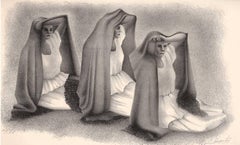
Mujeres Veracruzans (three seated women from Vera Cruz Mexico in shawls)
By Francisco Dosamantes
Located in New Orleans, LA
Three native Mexican women all similarly dressed in traditional, flowing white dresses covered in dark, fringed shawls raise their heads as if the...
Category
Mid-20th Century Modern Currier Ives Landscape Prints
Materials
Lithograph
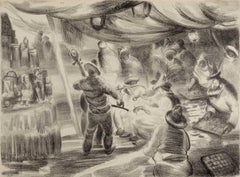
Mexican Orchestra (joy of the people is captured in this celebratory festival)
By George Overbury Hart
Located in New Orleans, LA
"Mexican Orchestra" is one of the George Overbury Hart's largest pieces. It is #14 from a limited edition of 50. The image captures a festive event with hanging lanterns, an orches...
Category
1920s American Modern Currier Ives Landscape Prints
Materials
Lithograph
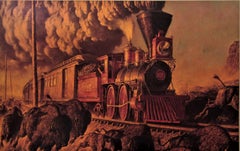
Yelding the Right of Way
Located in San Francisco, CA
This artwork titled "Yelding the Right of Way" c.1975 is a color offset lithograph by renown western artist Arnold Friberg, 1913-2010. It is hand signed...
Category
Late 20th Century American Realist Currier Ives Landscape Prints
Materials
Lithograph
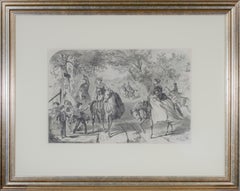
19th century woodcut engraving print figurative American forest trees scene
By Winslow Homer
Located in Milwaukee, WI
The present woodcut engraving is an original print designed by Winslow Homer, originally published in Harper's Weekly on April 30, 1859. It is an excellent example of the many prints Homer produced of fashionable people engaged in leisurely activities, in this case along a picturesque countryside lane. The sign reading 'Belmont' on the left indicates this is probably near his home in Belmont Massachusetts. The image presents multiple figures, both men and women, riding horseback: Some in the distance gallop away, toward a town marked by a church steeple beyond. Three others in the foreground, including two equestrian women, gather around a group of children who have been gathering flowers and trapping birds...
Category
1850s Victorian Currier Ives Landscape Prints
Materials
Engraving, Woodcut
$2,450
H 18.5 in W 23.25 in
Original Chamonix Mont-Blanc vintage travel poster
Located in Spokane, WA
Original vintage travel poster Chamonix Mont-Blanc PLM French travel poster. Very good condition, archival linen backed. Ready to frame. ...
Category
1930s American Realist Currier Ives Landscape Prints
Materials
Lithograph

$8,500
H 39.38 in W 24.5 in D 0.07 in
Previously Available Items
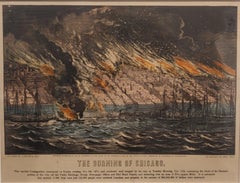
"The Burning of Chicago" Currier and Ives, Water and Urban Landscape Print
By Currier
Ives
Located in New York, NY
Currier & Ives
The Burning of Chicago, 1871
Hand-colored lithograph
7 5/16 x 12 11/16 inches
After undertaking apprenticeships in Boston and Philadelphia, Currier set up a print pu...
Category
1870s Realist Currier Ives Landscape Prints
Materials
Lithograph
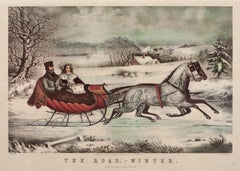
The Road, Winter
By Currier
Ives
Located in Columbia, MO
Currier N.Y.
The Road, Winter
Lithograph
14 x 18.5 inches
Category
19th Century Folk Art Currier Ives Landscape Prints
Materials
Lithograph
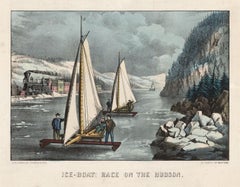
Ice-Boat Race on the Hudson.
By Currier
Ives
Located in New York, NY
This small folio lithograph “ICE-BOAT RACE ON THE HUDSON” was published in the early 1870s by Currier & Ives. It is listed in the Original Best Fifty (1930...
Category
Late 19th Century American Realist Currier Ives Landscape Prints
Materials
Lithograph
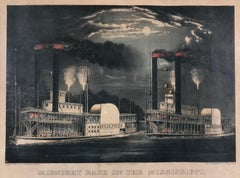
Midnight Race on the Mississippi
By Currier
Ives
Located in Missouri, MO
CURRIER & IVES, New York
"A Midnight Race on the Mississippi" 1875
Lithograph with hand-coloring.
Site Size: approx 10 x 13 inches...
Category
1870s Victorian Currier Ives Landscape Prints
Materials
Lithograph
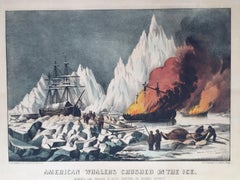
American Whalers Crushed in the Ice.
By Currier
Ives
Located in Santa Monica, CA
CURRIER AND IVES
AMERICAN WHALERS CRUSHED IN THE ICE - "Burning the Wreck to Avoid Danger to Others".
c. 1874 (Conn. 205) Lithograph with early coloring. 8 ½” x...
Category
1870s Realist Currier Ives Landscape Prints
Materials
Lithograph
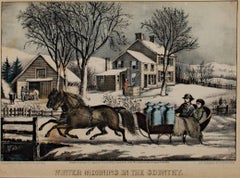
"Winter Morning in the Country, " Hand-Colored Lithograph by Currier
Ives
By Currier
Ives
Located in Milwaukee, WI
"Winter Morning in the Country" is an original hand-colored lithograph by Currier & Ives. It depicts two people and four containers of milk in a horse-drawn carriage on a winter morn...
Category
1870s Currier Ives Landscape Prints
Materials
Lithograph
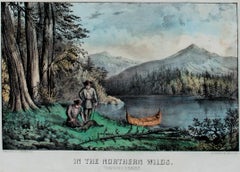
"In the Northern Wilds Trapping Beaver, " Hand-Colored Litho. by Currier
Ives
By Currier
Ives
Located in Milwaukee, WI
"In the Northern Wilds Trapping Beaver" is an original hand-colored lithograph by Currier & Ives. It depicts two hunters capturing a beaver in front of a lake landscape.
10" x 14" art
19 1/2" x 23 1/2" frame
Nathaniel Currier was a tall introspective man with a melancholy nature. He could captivate people with his piercing stare or charm them with his sparkling blue eyes. Nathaniel was born in Roxbury, Massachusetts on March 27th, 1813, the second of four children. His parents, Nathaniel and Hannah Currier, were distant cousins who lived a humble yet spartan life. When Nathaniel was eight years old, tragedy struck. Nathaniel’s father unexpectedly passed away leaving Nathaniel and his eleven-year-old brother Lorenzo to provide for the family. In addition to their mother, Nathaniel and Lorenzo had to care for six-year-old sister Elizabeth and two-year-old brother Charles. Nathaniel worked a series of odd jobs to support the family, and at fifteen, he started what would become a life-long career when he apprenticed in the Boston lithography shop of William and John Pendleton.
A Bavarian gentleman named Alois Senefelder invented lithography just 30 years prior to young Nat Currier’s apprenticeship. While under the employ of the brothers Pendleton, Nat was taught the art of lithography by the firm’s chief printer, a French national named Dubois, who brought the lithography trade to America.
Lithography involves grinding a piece of limestone flat and smooth then drawing in mirror image on the stone with a special grease pencil. After the image is completed, the stone is etched with a solution of aqua fortis leaving the greased areas in slight relief. Water is then used to wet the stone and greased-ink is rolled onto the raised areas. Since grease and water do not mix, the greased-ink is repelled by the moisture on the stone and clings to the original grease pencil lines. The stone is then placed in a press and used as a printing block to impart black on white images to paper.
In 1833, now twenty-years old and an accomplished lithographer, Nat Currier left Boston and moved to Philadelphia to do contract work for M.E.D. Brown, a noted engraver and printer. With the promise of good money, Currier hired on to help Brown prepare lithographic stones of scientific images for the American Journal of Sciences and Arts. When Nat completed the contract work in 1834, he traveled to New York City to work once again for his mentor John Pendleton, who was now operating his own shop located at 137 Broadway. Soon after the reunion, Pendleton expressed an interest in returning to Boston and offered to sell his print shop to Currier. Young Nat did not have the financial resources to buy the shop, but being the resourceful type he found another local printer by the name of Stodart. Together they bought Pendleton’s business.
The firm ‘Currier & Stodart’ specialized in "job" printing. They produced many different types of printed items, most notably music manuscripts for local publishers. By 1835, Stodart was frustrated that the business was not making enough money and he ended the partnership, taking his investment with him. With little more than some lithographic stones, and a talent for his trade, twenty-two year old Nat Currier set up shop in a temporary office at 1 Wall Street in New York City. He named his new enterprise ‘N. Currier, Lithographer’
Nathaniel continued as a job printer and duplicated everything from music sheets to architectural plans. He experimented with portraits, disaster scenes and memorial prints, and any thing that he could sell to the public from tables in front of his shop. During 1835 he produced a disaster print Ruins of the Planter's Hotel, New Orleans, which fell at two O’clock on the Morning of the 15th of May 1835, burying 50 persons, 40 of whom Escaped with their Lives. The public had a thirst for newsworthy events, and newspapers of the day did not include pictures. By producing this print, Nat gave the public a new way to “see” the news. The print sold reasonably well, an important fact that was not lost on Currier.
Nat met and married Eliza Farnsworth in 1840. He also produced a print that same year titled Awful Conflagration of the Steamboat Lexington in Long Island Sound on Monday Evening, January 18, 1840, by which melancholy occurrence over One Hundred Persons Perished. This print sold out very quickly, and Currier was approached by an enterprising publication who contracted him to print a single sheet addition of their paper, the New York Sun. This single page paper is presumed to be the first illustrated newspaper ever published.
The success of the Lexington print launched his career nationally and put him in a position to finally lift his family up. In 1841, Nat and Eliza had their first child, a son they named Edward West Currier. That same year Nat hired his twenty-one year old brother Charles and taught him the lithography trade, he also hired his artistically inclined brother Lorenzo to travel out west and make sketches of the new frontier as material for future prints. Charles worked for the firm on and off over the years, and invented a new type of lithographic crayon which he patented and named the Crayola. Lorenzo continued selling sketches to Nat for the next few years.
In 1843, Nat and Eliza had a daughter, Eliza West Currier, but tragedy struck in early 1847 when their young daughter died from a prolonged illness. Nat and Eliza were grief stricken, and Eliza, driven by despair, gave up on life and passed away just four months after her daughter’s death.
The subject of Nat Currier’s artwork changed following the death of his wife and daughter, and he produced many memorial prints and sentimental prints during the late 1840s. The memorial prints generally depicted grief stricken families posed by gravestones (the stones were left blank so the purchasers could fill in the names of the dearly departed). The sentimental prints usually depicted idealized portraits of women and children, titled with popular Christian names of the day.
Late in 1847, Nat Currier married Lura Ormsbee, a friend of the family. Lura was a self-sufficient woman, and she immediately set out to help Nat raise six-year-old Edward and get their house in order. In 1849, Lura delivered a son, Walter Black Currier, but fate dealt them a blow when young Walter died one year later. While Nat and Lura were grieving the loss of their new son, word came from San Francisco that Nat’s brother Lorenzo had also passed away from a brief illness. Nat sank deeper into his natural quiet melancholy. Friends stopped by to console the couple, and Lura began to set an extra place at their table for these unexpected guests. She continued this tradition throughout their lives.
In 1852, Charles introduced a friend, James Merritt Ives, to Nat and suggested he hire him as a bookkeeper. Jim Ives was a native New Yorker born in 1824 and raised on the grounds of Bellevue Hospital where his father was employed as superintendent. Jim was a self-trained artist and professional bookkeeper. He was also a plump and jovial man, presenting the exact opposite image of his new boss.
Jim Ives met Charles Currier through Caroline Clark, the object of Jim’s affection. Caroline’s sister Elizabeth was married to Charles, and Caroline was a close friend of the Currier family. Jim eventually proposed marriage to Caroline and solicited an introduction to Nat Currier, through Charles, in hopes of securing a more stable income to support his future wife.
Ives quickly set out to improve and modernize his new employer’s bookkeeping methods. He reorganized the firm’s sizable inventory, and used his artistic skills to streamline the firm’s production methods. By 1857, Nathaniel had become so dependent on Jims’ skills and initiative that he offered him a full partnership in the firm and appointed him general manager. The two men chose the name ‘Currier & Ives’ for the new partnership, and became close friends.
Currier & Ives produced their prints in a building at 33 Spruce Street where they occupied the third, fourth and fifth floors. The third floor was devoted to the hand operated printing presses that were built by Nat's cousin, Cyrus Currier, at his shop Cyrus Currier & Sons in Newark, NJ. The fourth floor found the artists, lithographers and the stone grinders at work. The fifth floor housed the coloring department, and was one of the earliest production lines in the country. The colorists were generally immigrant girls, mostly German, who came to America with some formal artistic training. Each colorist was responsible for adding a single color to a print. As a colorist finished applying their color, the print was passed down the line to the next colorist to add their color. The colorists worked from a master print displayed above their table, which showed where the proper colors were to be placed. At the end of the table was a touch up artist who checked the prints for quality, touching-in areas that may have been missed as it passed down the line. During the Civil War, demand for prints became so great that coloring stencils were developed to speed up production.
Although most Currier & Ives prints were colored in house, some were sent out to contract artists. The rate Currier & Ives paid these artists for coloring work was one dollar per one hundred small folios (a penny a print) and one dollar per one dozen large folios. Currier & Ives also offered uncolored prints to dealers, with instructions (included on the price list) on how to 'prepare the prints for coloring.' In addition, schools could order uncolored prints from the firm’s catalogue to use in their painting classes.
Nathaniel Currier and James Merritt Ives attracted a wide circle of friends during their years in business. Some of their more famous acquaintances included Horace Greeley, Phineas T. Barnum, and the outspoken abolitionists Rev. Henry Ward, and John Greenleaf Whittier (the latter being a cousin of Mr. Currier).
Nat Currier and Jim Ives described their business as "Publishers of Cheap and Popular Pictures" and produced many categories of prints. These included Disaster Scenes, Sentimental Images, Sports, Humor, Hunting Scenes, Politics, Religion, City and Rural Scenes, Trains, Ships, Fire Fighters, Famous Race Horses, Historical Portraits, and just about any other topic that satisfied the general public's taste. In all, the firm produced in excess of 7500 different titles, totaling over one million prints produced from 1835 to 1907.
Nat Currier retired in 1880, and signed over his share of the firm to his son Edward. Nat died eight years later at his summer home 'Lion’s Gate' in Amesbury, Massachusetts. Jim Ives remained active in the firm until his death in 1895, when his share of the firm passed to his eldest son, Chauncey.
In 1902, faced will failing health from the ravages of Tuberculosis, Edward Currier sold his share of the firm to Chauncey Ives...
Category
1860s Other Art Style Currier Ives Landscape Prints
Materials
Lithograph
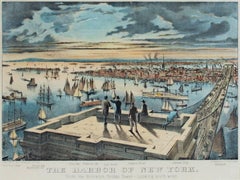
"The Harbor of New York, From the Brooklyn Bridge Looking Southwest, " lithograph
By Currier
Ives
Located in Milwaukee, WI
"The Harbor of New York From the Brooklyn Bridge Tower Looking Southwest" is an original hand-colored lithograph by Currier & Ives. It depicts five figures overlooking the ships in t...
Category
1880s Currier Ives Landscape Prints
Materials
Lithograph
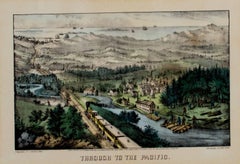
"Through to the Pacific, " Original Hand-Colored Lithograph by Currier
Ives
By Currier
Ives
Located in Milwaukee, WI
"Through to the Pacific" is an original hand-colored lithograph by Currier & Ives. It depicts a train moving through the countryside to the ocean.
8" x 12 1/2" art
20 1/8" x 24 3/8...
Category
1870s Other Art Style Currier Ives Landscape Prints
Materials
Lithograph
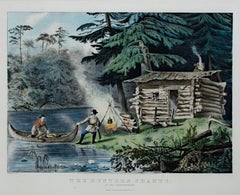
"The Hunter
s Shanty in the Adirondacks, " Hand-Colored Litho. by Currier
Ives
By Currier
Ives
Located in Milwaukee, WI
"The Hunter's Shanty in the Adirondacks" is an original hand-colored lithograph by Currier & Ives. It depicts two hunters pulling up to their shanty in a forested landscape.
15" x ...
Category
1860s Other Art Style Currier Ives Landscape Prints
Materials
Lithograph
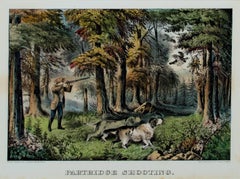
"Partridge Shooting, " Original Color Lithograph Landscape by Currier
Ives
By Currier
Ives
Located in Milwaukee, WI
"Partridge Shooting" is an original color lithograph by Currier & Ives. It depicts a hunter shooting a partridge and his dogs rushing to retrieve it. The figure and animals are in a dense forest.
11" x 14" art
19 3/4" x 23" frame
Nathaniel Currier was a tall introspective man with a melancholy nature. He could captivate people with his piercing stare or charm them with his sparkling blue eyes. Nathaniel was born in Roxbury, Massachusetts on March 27th, 1813, the second of four children. His parents, Nathaniel and Hannah Currier, were distant cousins who lived a humble yet spartan life. When Nathaniel was eight years old, tragedy struck. Nathaniel’s father unexpectedly passed away leaving Nathaniel and his eleven-year-old brother Lorenzo to provide for the family. In addition to their mother, Nathaniel and Lorenzo had to care for six-year-old sister Elizabeth and two-year-old brother Charles. Nathaniel worked a series of odd jobs to support the family, and at fifteen, he started what would become a life-long career when he apprenticed in the Boston lithography shop of William and John Pendleton.
A Bavarian gentleman named Alois Senefelder invented lithography just 30 years prior to young Nat Currier’s apprenticeship. While under the employ of the brothers Pendleton, Nat was taught the art of lithography by the firm’s chief printer, a French national named Dubois, who brought the lithography trade to America.
Lithography involves grinding a piece of limestone flat and smooth then drawing in mirror image on the stone with a special grease pencil. After the image is completed, the stone is etched with a solution of aqua fortis leaving the greased areas in slight relief. Water is then used to wet the stone and greased-ink is rolled onto the raised areas. Since grease and water do not mix, the greased-ink is repelled by the moisture on the stone and clings to the original grease pencil lines. The stone is then placed in a press and used as a printing block to impart black on white images to paper.
In 1833, now twenty-years old and an accomplished lithographer, Nat Currier left Boston and moved to Philadelphia to do contract work for M.E.D. Brown, a noted engraver and printer. With the promise of good money, Currier hired on to help Brown prepare lithographic stones of scientific images for the American Journal of Sciences and Arts. When Nat completed the contract work in 1834, he traveled to New York City to work once again for his mentor John Pendleton, who was now operating his own shop located at 137 Broadway. Soon after the reunion, Pendleton expressed an interest in returning to Boston and offered to sell his print shop to Currier. Young Nat did not have the financial resources to buy the shop, but being the resourceful type he found another local printer by the name of Stodart. Together they bought Pendleton’s business.
The firm ‘Currier & Stodart’ specialized in "job" printing. They produced many different types of printed items, most notably music manuscripts for local publishers. By 1835, Stodart was frustrated that the business was not making enough money and he ended the partnership, taking his investment with him. With little more than some lithographic stones, and a talent for his trade, twenty-two year old Nat Currier set up shop in a temporary office at 1 Wall Street in New York City. He named his new enterprise ‘N. Currier, Lithographer’
Nathaniel continued as a job printer and duplicated everything from music sheets to architectural plans. He experimented with portraits, disaster scenes and memorial prints, and any thing that he could sell to the public from tables in front of his shop. During 1835 he produced a disaster print Ruins of the Planter's Hotel, New Orleans, which fell at two O’clock on the Morning of the 15th of May 1835, burying 50 persons, 40 of whom Escaped with their Lives. The public had a thirst for newsworthy events, and newspapers of the day did not include pictures. By producing this print, Nat gave the public a new way to “see” the news. The print sold reasonably well, an important fact that was not lost on Currier.
Nat met and married Eliza Farnsworth in 1840. He also produced a print that same year titled Awful Conflagration of the Steamboat Lexington in Long Island Sound on Monday Evening, January 18, 1840, by which melancholy occurrence over One Hundred Persons Perished. This print sold out very quickly, and Currier was approached by an enterprising publication who contracted him to print a single sheet addition of their paper, the New York Sun. This single page paper is presumed to be the first illustrated newspaper ever published.
The success of the Lexington print launched his career nationally and put him in a position to finally lift his family up. In 1841, Nat and Eliza had their first child, a son they named Edward West Currier. That same year Nat hired his twenty-one year old brother Charles and taught him the lithography trade, he also hired his artistically inclined brother Lorenzo to travel out west and make sketches of the new frontier as material for future prints. Charles worked for the firm on and off over the years, and invented a new type of lithographic crayon which he patented and named the Crayola. Lorenzo continued selling sketches to Nat for the next few years.
In 1843, Nat and Eliza had a daughter, Eliza West Currier, but tragedy struck in early 1847 when their young daughter died from a prolonged illness. Nat and Eliza were grief stricken, and Eliza, driven by despair, gave up on life and passed away just four months after her daughter’s death.
The subject of Nat Currier’s artwork changed following the death of his wife and daughter, and he produced many memorial prints and sentimental prints during the late 1840s. The memorial prints generally depicted grief stricken families posed by gravestones (the stones were left blank so the purchasers could fill in the names of the dearly departed). The sentimental prints usually depicted idealized portraits of women and children, titled with popular Christian names of the day.
Late in 1847, Nat Currier married Lura Ormsbee, a friend of the family. Lura was a self-sufficient woman, and she immediately set out to help Nat raise six-year-old Edward and get their house in order. In 1849, Lura delivered a son, Walter Black Currier, but fate dealt them a blow when young Walter died one year later. While Nat and Lura were grieving the loss of their new son, word came from San Francisco that Nat’s brother Lorenzo had also passed away from a brief illness. Nat sank deeper into his natural quiet melancholy. Friends stopped by to console the couple, and Lura began to set an extra place at their table for these unexpected guests. She continued this tradition throughout their lives.
In 1852, Charles introduced a friend, James Merritt Ives, to Nat and suggested he hire him as a bookkeeper. Jim Ives was a native New Yorker born in 1824 and raised on the grounds of Bellevue Hospital where his father was employed as superintendent. Jim was a self-trained artist and professional bookkeeper. He was also a plump and jovial man, presenting the exact opposite image of his new boss.
Jim Ives met Charles Currier through Caroline Clark, the object of Jim’s affection. Caroline’s sister Elizabeth was married to Charles, and Caroline was a close friend of the Currier family. Jim eventually proposed marriage to Caroline and solicited an introduction to Nat Currier, through Charles, in hopes of securing a more stable income to support his future wife.
Ives quickly set out to improve and modernize his new employer’s bookkeeping methods. He reorganized the firm’s sizable inventory, and used his artistic skills to streamline the firm’s production methods. By 1857, Nathaniel had become so dependent on Jims’ skills and initiative that he offered him a full partnership in the firm and appointed him general manager. The two men chose the name ‘Currier & Ives’ for the new partnership, and became close friends.
Currier & Ives produced their prints in a building at 33 Spruce Street where they occupied the third, fourth and fifth floors. The third floor was devoted to the hand operated printing presses that were built by Nat's cousin, Cyrus Currier, at his shop Cyrus Currier & Sons in Newark, NJ. The fourth floor found the artists, lithographers and the stone grinders at work. The fifth floor housed the coloring department, and was one of the earliest production lines in the country. The colorists were generally immigrant girls, mostly German, who came to America with some formal artistic training. Each colorist was responsible for adding a single color to a print. As a colorist finished applying their color, the print was passed down the line to the next colorist to add their color. The colorists worked from a master print displayed above their table, which showed where the proper colors were to be placed. At the end of the table was a touch up artist who checked the prints for quality, touching-in areas that may have been missed as it passed down the line. During the Civil War, demand for prints became so great that coloring stencils were developed to speed up production.
Although most Currier & Ives prints were colored in house, some were sent out to contract artists. The rate Currier & Ives paid these artists for coloring work was one dollar per one hundred small folios (a penny a print) and one dollar per one dozen large folios. Currier & Ives also offered uncolored prints to dealers, with instructions (included on the price list) on how to 'prepare the prints for coloring.' In addition, schools could order uncolored prints from the firm’s catalogue to use in their painting classes.
Nathaniel Currier and James Merritt Ives attracted a wide circle of friends during their years in business. Some of their more famous acquaintances included Horace Greeley, Phineas T. Barnum, and the outspoken abolitionists Rev. Henry Ward, and John Greenleaf Whittier (the latter being a cousin of Mr. Currier).
Nat Currier and Jim Ives described their business as "Publishers of Cheap and Popular Pictures" and produced many categories of prints. These included Disaster Scenes, Sentimental Images, Sports, Humor, Hunting Scenes, Politics, Religion, City and Rural Scenes, Trains, Ships, Fire Fighters, Famous Race Horses, Historical Portraits, and just about any other topic that satisfied the general public's taste. In all, the firm produced in excess of 7500 different titles, totaling over one million prints produced from 1835 to 1907.
Nat Currier retired in 1880, and signed over his share of the firm to his son Edward. Nat died eight years later at his summer home 'Lion’s Gate' in Amesbury, Massachusetts. Jim Ives remained active in the firm until his death in 1895, when his share of the firm passed to his eldest son, Chauncey.
In 1902, faced will failing health from the ravages of Tuberculosis, Edward Currier sold his share of the firm to Chauncey Ives...
Category
1870s Other Art Style Currier Ives Landscape Prints
Materials
Lithograph
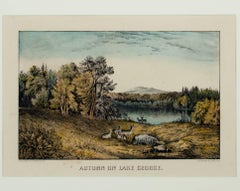
"Autumn on Lake George (Deer), " an Original Lithograph by Currier
Ives
By Currier
Ives
Located in Milwaukee, WI
"Autumn on Lake George (Deer)" is an original hand-colored lithograph published by Currier & Ives. It depicts multiple deer in an idyllic landscape with trees and a lake.
8" x 12 1/2" art
17 5/8" x 22" frame
Currier & Ives produced their prints in a building at 33 Spruce Street where they occupied the third, fourth and fifth floors. The third floor was devoted to the hand operated printing presses that were built by Nat's cousin, Cyrus Currier, at his shop Cyrus Currier & Sons in Newark, NJ. The fourth floor found the artists, lithographers and the stone grinders...
Category
1850s Currier Ives Landscape Prints
Materials
Lithograph
Currier Ives landscape prints for sale on 1stDibs.
Find a wide variety of authentic Currier
Ives landscape prints available for sale on 1stDibs. You can also browse by medium to find art by Currier
Ives in lithograph and more. Not every interior allows for large Currier
Ives landscape prints, so small editions measuring 13 inches across are available. Customers who are interested in this artist might also find the work of Neil Welliver, Adolf Arthur Dehn, and John Sloan. Currier
Ives landscape prints prices can differ depending upon medium, time period and other attributes. On 1stDibs, the price for these items starts at $240 and tops out at $12,800, while the average work can sell for $2,200.
Artists Similar to Currier Ives
Questions About Currier
Ives Landscape Prints
- How old is Currier and Ives?1 Answer1stDibs ExpertFebruary 13, 2024Currier and Ives is more than 175 years old. The prominent American printmaking business, headquartered in New York, operated from 1835 to 1907. Nathaniel Currier started his business on his own but later merged with James Merritt Ives, becoming "Currier and Ives" in 1857. They produced and sold hand-colored lithographs, which could be produced relatively quickly and cheaply. Explore a collection of Currier and Ives prints on 1stDibs.
- 1stDibs ExpertAugust 29, 2024To tell if it’s an original Currier Ives print, get a magnifying glass and study the image up close. If you notice a regular pattern of dots, the piece is likely a reproduction, as the printing techniques used to make originals usually resulted in irregular, non-symmetrical dashes and dots. Next, look at your piece from the side with the naked eye. If the paper appears perfectly smooth and uniform, the print is unlikely to be an original Currier Ives, which will typically show off variations in luster and texture. When in doubt, have a certified appraiser or knowledgeable art dealer help you with the authentication process. On 1stDibs, shop a selection of Currier Ives prints.
- 1stDibs ExpertOctober 30, 2024Yes, some Currier and Ives pieces are worth something. The company published around 7,500 lithographs in its 72 years in business, and some, such as The American National Game of Base Ball, have sold for more than $75,000 in the past. Generally, the historical significance, image quality, age and condition of the publisher's prints will determine their worth. A certified appraiser or experienced art dealer can evaluate any prints you own using these criteria and give you an idea of how much they may be worth. Find an assortment of Currier Ives prints on 1stDibs.
- 1stDibs ExpertSeptember 9, 2024Yes, some Currier and Ives dishes are worth something. Limited edition pieces are most likely to be valuable, and sets often fetch higher prices than individual pieces. Generally, the age, style, type and condition will all play a role in determining the value. A certified appraiser or knowledgeable antique dealer can help you with the valuation process. Find a selection of Currier and Ives art and tableware on 1stDibs.
- 1stDibs ExpertMarch 22, 2022To tell if your Currier and Ives print is real, make sure that the print has the proper information. A genuine print will show the title and the publisher name as either "N. Currier" or "Currier Ives". You may also find a publication address, a copyright notice and a catalog number on some pieces. You'll find a selection of expertly vetted Currier and Ives print prints on 1stDibs.
- 1stDibs ExpertSeptember 9, 2024How much original Currier Ives prints are worth depends on their age, image quality, overall condition and other factors. In 2004, a hand-colored version of the 1866 lithograph The American National Game of Base Ball sold for $76,375. The Currier Ives company published around 7,500 lithographs in its 72 years in business. Pieces that commemorate historical events are often the most highly sought-after among collectors. If you own a Currier Ives lithograph, a certified appraiser or knowledgeable art dealer can aid you with the valuation process. On 1stDibs, shop a range of Currier Ives prints.