Daum Figurines and Sculptures

For collectors, Daum is a name in the first rank of the French makers of art glass, along with those of Émile Gallé and René Lalique. Led in its early decades by the brothers Auguste (1853–1909) and Antonin Daum (1864–1931), the company, based in the city of Nancy, established its reputation in the Art Nouveau period, and later successfully adopted the Art Deco style.

In 1878, lawyer Jean Daum took over the ownership of a glassworks as payment for a debt and installed his sons as proprietors. Initially, Daum made glass for everyday purposes such as windows, watches and tableware, but the success that Gallé enjoyed at the 1889 Universal Exposition in Paris — the international showcase for which the Eiffel Tower was built — inspired the Daum brothers to begin making art-glass pieces. They produced popular works of cameo glass, a decorative technique in which an outer layer of glass is acid-etched or carved off to reveal the layer below, but Daum became best known for vessels and sculptures in pâte de verre — a painstaking method in which finely ground colored glass is mixed with a binder, placed in a mold and then fired in a kiln. 

Though early Daum glass was never signed by individual artists, the firm employed some of the masters of the naturalistic, asymmetrical Art Nouveau style, including Jacques Grüber, Henri Bergé and Amalric Walter (whose first name is frequently misspelled). Daum also collaborated with furniture and metalware designer Louis Majorelle, who created wrought-iron and brass mounts for vases and table lamps. In the 1960s, Daum commissioned fine artists, most notably Salvador Dalí and sculptor César Baldaccini, to design glass pieces. As you see from the works offered on 1stDibs, Daum has been home to an astonishingly rich roster of creative spirits and is today a state-owned enterprise making pâte de verre figurines. 

to
1
1
1
1
1
1
1
1
1
2
1
224
35
12
11
8
1
1
2
2
Creator: Daum
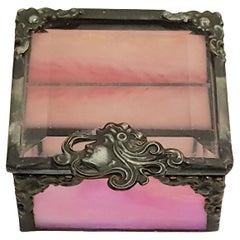
Antique French NancySigned ArtNouveau MuchaMajorelleGruberStyle SilveredGlassBox
By Daum
Located in Chicago, IL
Influenced by the Art Nouveau illustrations of Alphonse Mucha, this Nancy-signed antique French enameled glass jewelry box display case is decora...
Category

1890s French Art Nouveau Antique Daum Figurines and Sculptures

Materials

Gilt Metal, Mixed Metal, Silver Plate, Brass, Bronze
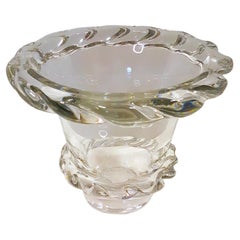
DaumNancyFrance ArtDeco Signed Glass Applications LeadCrystal Sculptural Vase
By Daum
Located in Chicago, IL
Art glass vase sign: Daum Nancy France. Evidenced by this Daum sculptural colorless blown and hot-shaped lead-crystal heavy vessel vase, the finest irreproducible artistic works in the history of the iconic French decorative-glass maker feature ornamental thick glass applications. Its most in-demand pieces today were made between 1925 and 1935, with very few major ArtDeco-period pieces remaining in private hands and even less without damage. As a significant gift acquired from Don Jacques Daum in 1950, a similarly shaped, constructed and sized circa-1925 vase with "stylized foliage" motif is in the collection of the French Museum of Decorative Arts in Paris as Inventory #36309. A later-produced vase with a similar application-motif at just the rim, but in a "Champagne" bubbled style, is among the photos in the published book about the Leo and Irina Esterkin acquisitions from 1910-1940 titled Daum Art Deco Glass--A Private Collection. On our prime-condition antique vase, applied transparent glass is styled in high relief into a flowing undulating motif that evolved from Daum's Art Nouveau foliage designs. The angular and curvilinear shapes of this vessel epitomize the bold vases, bowls and sculptures for which Daum is best known. Its tiny pencil-etched signature on the side near the bottom reads "Daum (plus the Lorraine-cross symbol) Nancy France", which resembles some published signatures since 1925. Revealing how ahead of its time this particular design was--after WWII in 1945 coinciding with the revitalization of the French glass industry--Daum used...
Category

1920s French Art Deco Vintage Daum Figurines and Sculptures

Materials

Crystal

Related Items
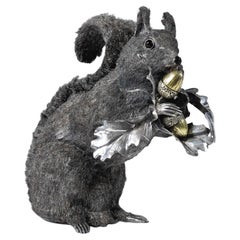
Mario Buccellati Silver Squirrel
By Mario Buccellati
Located in New York, NY
Mario Buccellati Silver Squirrel, silver texted fur with glass eyes, enamel nose and gilt acorns. Signed on one leaf Mario Buccellati, 925, and 15-MI M...
Category

1980s Vintage Daum Figurines and Sculptures

Materials

Silver

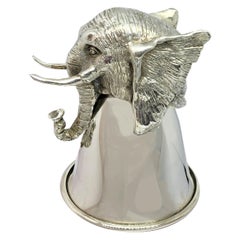
Sterling Silver Wine Glass Elephant, One of a Set of 12 Different Animals
Located in Roma, IT
This elephant is one of 12 exclusive Serra's sterling silver "stirrup glasses", (weight 360 gr ) models date back to around the mid-1900s, and represent 12 animals that can be placed on the table to serve wine. Our 12 glasses are now used to be added to other crystal glasses, maybe to serve a special wine! In this difficult historical period for our health, drinking from silver glasses is really a great help: silver is rich in antibacterial and antimicrobial properties that eradicate the bacteria and antibiotic-resistant pathogens. It can be used as a natural disinfectant of any liquid. Silver is a natural immunity booster . Its nanoparticles create an immunomodulatory activity that gives you a healthy immune system. Popular since the late 18th and 19th century, antique silver stirrup cups...
Category

2010s Italian Daum Figurines and Sculptures

Materials

Vermeil, Sterling Silver

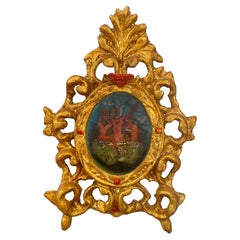
Antique Style Christmas Nativity Frame
Located in Cattolica, IT
Christmas panel with Mediterranean coral characters . The case is entirely made of hand painted wood . The Nativity scene is handmade in Sicily from coral masters who made this real ...
Category

2010s Italian Artisan Daum Figurines and Sculptures

Materials

Coral

Object d’Art Brass Pomellato King
By Pomellato
Located in Neguri, Vizcaya
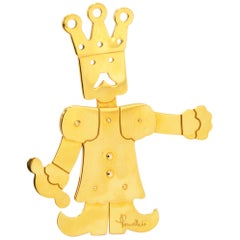
A window display Pomellato King Original and authentical a 13mm Brass King from Pomellato merchandising and window display actually 4 in stock Established 43 years ago in the Italian city of Milan, Pomellato has been forging its own meticulous path in jewelry making for many years. Having started life as a chain maker, the distinctive chain design still appears in every collection, albeit in ever more luxurious and bejeweled forms. From the iconic Nudo collection and its almost infinite combination of stackable rings to the colorful Capri collection, Pomellato jewelry...
Category

20th Century Italian Contemporary Daum Figurines and Sculptures

Materials

Brass

Chinese Hand-Carved Coral Sculpture Guanyin and Dragon
Located in New York, NY
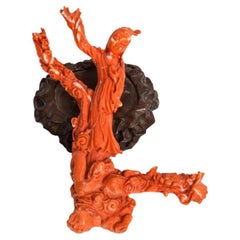
Chinese Gwandian carved coral sculpture Guanyin and Dragon Very finely hand-carved. Circa Late 20th century, China Weight: With stand: 360.6 grams Without stand: 280.7 grams Dime...
Category

Late 20th Century Chinese Daum Figurines and Sculptures

Materials

Coral

Schlumberger Gold Poodle Lighter
By Jean Schlumberger for Tiffany Co.
Located in New York, NY
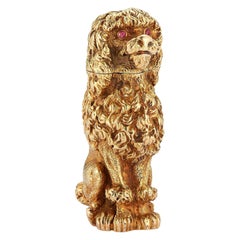
Schlumberger Gold Poodle Lighter , 18k carved gold with ruby eyes .Circa 1950 Measurements: 5.5 x 3.3 x 2.1 cm Gram Weight: 47.3 grams Gold Type: 1...
Category

1950s French Vintage Daum Figurines and Sculptures

Materials

Ruby, Gold, 14k Gold

Marble Statuette of Cybele Enthroned, Roman Empire, circa 3rd Century A.D.
Located in London, GB
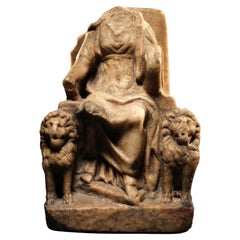
Roman Marble Statuette of Cybele Enthroned Roman Empire, circa 3rd Century A.D. Measurements: 21.5 × 14 × 9 cm. A finely carved marble statuette depicting the goddess Cybele, e...
Category

15th Century and Earlier Antique Daum Figurines and Sculptures
Antique 14K Corallium Rubrum Grape Vine Gold Brooch Italy
Located in Munich, Bavaria
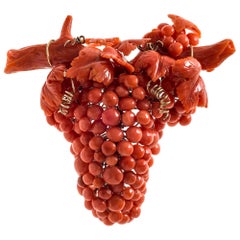
This wonderful large grape brooch was made out of corallium rubrum, a Mediterranean coral, in an Italian workshop between 1850-1860. The grape is made out of different size boutons, vine leaves and 14K golden twines - with the help of golden wires...
Category

1850s Italian Antique Daum Figurines and Sculptures

Materials

Coral, 14k Gold

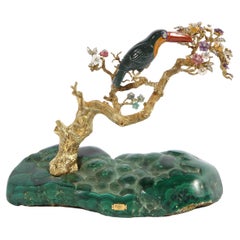
18K Gold, Diamonds, Amethyst, Tourmaline, Bloodstone, and Jasper Toucan Bird
By Gianfranco Frattini
Located in Long Island City, NY
An 18K gold, diamonds, amethyst, tourmaline, bloodstone, carved emerald, opal and jasper toucan bird resting on a gold tree branch, mounted on a carved malachite base. A very rare and unique gold-mounted jeweled object...
Category

20th Century Italian Daum Figurines and Sculptures

Materials

Amethyst, Diamond, Tourmaline, Jasper, 18k Gold
Jadeite Jade Unset Carved Palm Stone
Located in Stamford, CT
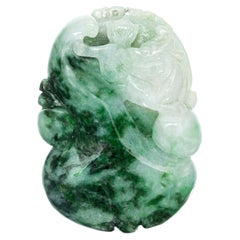
Jadeite Jade carved palm stone. Dark to white green. GIA certified natural. 1 carved jade approx. 163.97cts. GIA Certified# 6224307578 Top to bottom: 43....
Category

Early 20th Century Daum Figurines and Sculptures

Materials

Jade

A Rare Buccellati Italy Sterling Silver Model of a Bull
By Buccellati
Located in Long Island City, NY
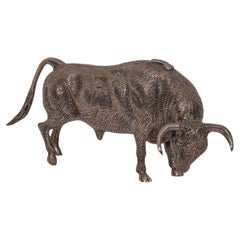
A Rare Buccellati Italy Sterling Silver Model of a Bull, Numbered 7 An impressive and finely detailed sterling silver model of a bull by Buccellati, Italy, numbered 7. Exquisitely h...
Category

20th Century Italian Daum Figurines and Sculptures

Materials

Sterling Silver

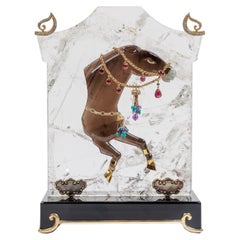
Mellerio Paris, a French Gold, Diamonds, Silver, and Smoky Quartz Carved Horse
By Mellerio dits Meller
Located in Long Island City, NY
Mellerio Paris, A French Gold, Diamonds, Silver-Gilt, Rock-Crystal, Jade, Mother-Of-Pearl and Smoky Quartz, Carved Horse Sculpture, Jeweled Mounted Object. An extremely rare and unique, one of a kind French gold, diamonds, Silver-gilt, rock-crystal, jade, obsidian, mother-of-pearl, and smoky quartz carved jeweled sculpture "CHEVAUX DE LEGENDE", "A Legendary Horse" by Mellerio, Paris, circa 1991. Sitting on black obsidian base, the solid rock-crystal slab is finely applied with a carved smoky -quartz and jade horse with a harness mounted in 18k gold, brilliant -cut diamonds, rubies, turquoise, and amethyst chains and pendants. The top columns adorned with 18k gold and brilliant cut diamond pendants, the bottom with gold and mother of pearl plaques. The obsidian base with a plaque engraved: CHEVAUX DE LEGENDE" / N° 05 / MELLERIO DITS MELLER / PARIS / 5003 D The piece is in excellent condition and comes with a custom made wood case made for transport. It's very elegant and has French hallmarks throughout. A truly magnificent piece. Measures 10.5" high x 8.5" wide x 4" deep Founded in France in 1613 by the descendants of Italian immigrants from the Vigezzo Valley in the north of Italy, Mellerio is one of the oldest jewellery houses in Europe. The family business soon attracted the attention of the Royal Court and Marie Antoinette herself reportedly purchased a precious bracelet featuring 7 cameos surrounded by rubies in 1780. Later on, in the 19th century, Mellerio became the official supplier of the French Royal family and the Court of Netherland. Mellerio creates many jewellery items, all set with rare gems such as peridots, amethysts, aquamarines, citrines and topaz, applying for a patent, the flexible stem, a very supple and light jewellery mechanism. Mellerio remains also well known for their spectacular series of Art Nouveau jewels, created at the beginning of the 20th century, as well as for the creation of trophies rewarding some of the greatest footfall and tennis players of history. In 1993, the jewellery house launched their first watch collection. Today, Mellerio has stores in Paris, Japan and Hong Kong. July 14, 1789: this date is known throughout the world as the beginning of the French Revolution. According to a ledger belonging to House of Mellerio, this was also the day that the jeweler sold a golden key to the Comte de Coutance for 10 livres. This ledger, as well as inventories dating as far back as 1768, are the jeweler’s oldest archives. These archives have continued to grow over the years, as the House, established on rue de la Paix in Paris, still lives on today, still in the hands of the same family from Craveggia, in the North of Italy. The tumultuous history of the Mellerio family in France probably goes as far back as the Italian wars of the Renaissance, but the first official document proving their commercial activity in Paris dates back to 1613. This document is the famous royal warrant awarded by Marie de Medici to a number of Italian families established along the rue des Lombards, including the Mellerios, allowing them to sell “small jewelery items”, therefore granting them a small exception to the traditional monopoly enjoyed by Parisian jewelers. At that time, powerful corporations regulated the operations and customs of Parisian business, but thanks to this exceptional warrant, the Mellerios managed to escape the confines of this framework. Today, this wax-sealed document is kept at the city hall of Craveggia. From 1613 to the Revolution, the Mellerios lived between France and Italy. The corporations tried many times to put an end to their trade privileges, but all in vain, as a dynasty of sovereigns renewed the warrant. Always marrying and often retiring in Craveggia, the Mellerios continued to maintain their jewelry business in Paris. At first, they did this without a shop. Wearing backpacks (wooden boxes divided into small compartments where jewels were kept), they would tour town fairs around Paris and royal castles. This is how Jean-Baptiste Mellerio (1765-1850) is said to have sold a bracelet set with rubies and Antique cameos to Marie-Antoinette, which still exists today. Many elements seem to prove the veracity of this anecdote. The queen was particularly fond of cameos, which cover the entire background of her famous jewelry cabinet, and ruby was her favorite stone after diamond. The famous bracelet, reacquired a few years ago by the House of Mellerio, is indeed an 18th century jewel, set with antique cameos representing the profiles of Roman emperors. Two branches of the family were operating in Paris during this time, under the reign of Louis XVI: that of Jean-François (1746-1828), the paternal ancestor of the current Mellerios, and that of Jean-Baptiste (1765-1850). The French Revolution forced them to return to Italy. However, both Jean-Baptiste and François Mellerio (1772-1843), who was the son of Jean-François, were eventually able to return to Paris after the founding of the Consulate. Jean-Baptiste opened a shop at the Iron Crown of rue Vivienne, and François opened his at the Palais des Tuileries, rue du Coq Saint-Honoré. His well-organized order books give an idea of his high-ranking clientele during the “Old Regime”, among which were the Comte and Comtesse Octave de Segur, the Marquise (later Duchess) de Tourzel, former governess of the royal children, and her daughter, the Comtesse de Bearn, the Craufurds -who organized the flight to Varennes, the Duc and Duchess de Gramont, the Comtesse de Boigne, and Madame de Souza, Talleyrand’s mistress. We also see the names of the imperial family: Empress Josephine, the Queen of Holland, Princess Elisa, Caroline and Pauline. At that time, the House of Mellerio specialized, among other things, in the trade of antique cameos, a newly fashionable genre of jewel that captured the imagination of all the princesses and noble women of the time. The years of the Restauration and July Monarchy were among the most glorious. The Bourbons were back on the throne, and the clientele of the House of Mellerio had regained its former wealth. Mellerio supplied Louis-Philippe, Duke of Orléans, as well as his mother, wife and sister, with sumptuous jewels, including a set of emeralds made piece by piece, while the Duke of Bourbon, last prince of the House of Condé, offered diamonds to his mistress, the scheming Baronne de Feucheres, and Monsieur de LaFayette also bought cameos for one of his granddaughters. For the first time, Mellerio ventured into the world of arts in 1815, when Carlotta Grisi, a famous dancer who created Giselle, as well as an actress named Rachel, bought jewels at the Mellerio store on rue de la Paix. 1848 marked a new turning point. France once again became a Republic. François Mellerio handed the company over to his son, Jean, and the latter decided to travel to Spain to build a new clientele. He later became one of the jewelers of the royal family, and met Eugénie de Montijo, who remained a faithful client when she became empress of the French people. The Imperial years were lavish. During the Second Empire, Paris was a pageant of crinoline dresses designed by Worth, while jewels by Mellerio, Worth’s neighbour on the rue de la Paix, adorned the noble women of the Tuileries court. The Empress bought pearls. Mathilde Bonaparte...
Category

20th Century French Daum Figurines and Sculptures

Materials

Amethyst, Diamond, Jade, Quartz, Rock Crystal, Ruby, Turquoise, Gold, Si...
Daum figurines and sculptures for sale on 1stDibs.

Find a range of Daum figurines and sculptures available on 1stDibs. Each of these unique items was designed with extraordinary care, often using silver. While looking for the most stylish antique or vintage Daum jewelry to pair with your ensemble, you’ll find that Daum crystal figurines and sculptures, from our inventory of 1, can add a particularly distinctive touch to your look. We have 3 pieces in this collection as well as a number of other designs by this jeweler. art deco and Art Nouveau are among the most popular styles of Daum figurines and sculptures available on 1stDibs. While this collection reflects work that originated over various time periods, most of these items were designed during the 1920s. Prices for Daum figurines and sculptures can differ depending upon gemstone, time period and other attributes. On 1stDibs, the price for these items starts at $2,825 and tops out at $24,975, while pieces like these, on average, can sell for $3,350.
Questions About Daum Figurines and Sculptures
  • 1stDibs ExpertApril 5, 2022
    How Daum glass is made involves a process unique to the manufacturer, called pâte de verre. It involves filling a refractory mold with finely crushed glass and then baking the piece in a kiln. Shop a collection of Daum glassware on 1stDibs.
  • 1stDibs ExpertApril 5, 2022
    Yes, all Daum vases are signed. Authentic Daum glass work will have the signature “Daum Nancy” and incorporate the cross of Lorraine. Looking for a signature is one of the best ways to ensure authenticity. Browse a range of authentic Daum vases and other glassware on 1stDibs.
  • 1stDibs ExpertMarch 22, 2022
    Yes, Daum glass is normally signed. The location of the company's mark varies, but it usually says "Daum Nancy" above, below or beside the cross of Lorraine, a cross with two crossbars. Find a variety of Daum glass on 1stDibs.
  • 1stDibs ExpertMarch 15, 2024
    Yes, Daum crystal is typically marked. The French maker usually adds the word "Daum Nancy" and its logo, a double cross called the Cross of Lorraine, to its pieces. You can locate the mark in a discreet area, such as on the bottom of stemware and decorative objects. Find a selection of Daum Nancy crystal wares on 1stDibs.
  • 1stDibs ExpertJune 6, 2024
    To identify Daum crystal, look for the maker's mark, usually found at the bottom of the piece. Most crystal ware produced by the luxury maker will feature the brand's logo or a hand-applied artist's signature. You can compare the markings on your piece with images featured on trusted online resources to learn more about them. Alternatively, you can consult a certified appraiser or knowledgeable antiques dealer for assistance with identification. On 1stDibs, explore a selection of Daum crystal.

Still Thinking About These?

All Recently Viewed