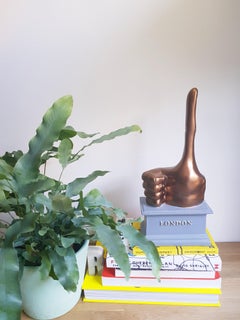
David Shrigley Figurative Sculptures

English, b. 1968

David Shrigley was born on September 17th, 1968, in Macclesfield, Cheshire, and grew up in Oadby, Leicestershire. He took the Art and Design Foundation course at Leicester Polytechnic in 1987, moving on to study environmental art at Glasgow School of Art in 1988, where he remained until 1991. During his studies, Shrigley worked as a gallery guide at the Centre for Contemporary Arts in Glasgow.

Shrigley has had several notable solo exhibitions for his iconic visual art, including "David Shrigley" at Dundee Contemporary Arts (2006), "Everything Must Have a Name" at the Malmo Konsthall in Sweden (2007), an exhibition at the Baltic Centre for Contemporary Art in Gateshead (2008), the Museum Ludwig in Cologne (2008), "New Powers" at the Kunsthalle Mainz in Germany (2009), the Kelvingrove Museum in Glasgow (2010) and "Animate" at the Turku Art Museum in Finland (2011).

In 2016, Shrigley’s work was part of a British Council touring exhibition. In the same month, he was showcased in the Liverpool Provocations event. Shrigley was nominated for the 2013 Turner Prize and awarded an OBE in the Queen’s New Years Honours List 2020. Shrigley is collected by the Stephen Friedman Gallery (London), Anton Kern Gallery (New York), the Museum of Modern Art (New York), the Tate (London) and the Royal Academy of Arts (London) among other institutions.

Find David Shrigley prints, sculptures and other art on 1stDIbs.

to
3
Overall Width
to
Overall Height
to
3
1
1
1
1
1
3
146
125
112
100
88
2
Artist: David Shrigley
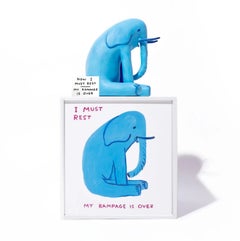
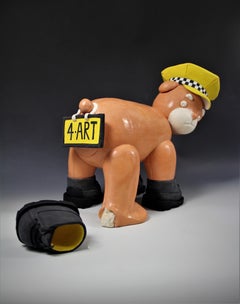
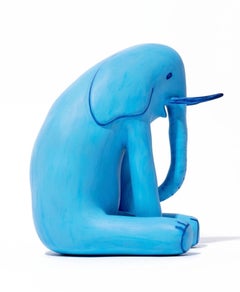
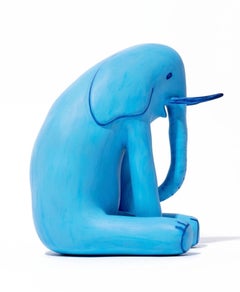
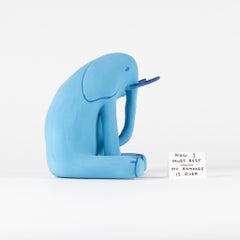
David Shrigley - I Must Rest My Rampage Is Over, 2022
By David Shrigley
Located in Central, HK
David Shrigley I Must Rest My Rampage Is Over, 2022 Ceramic 8 1/2 × 6 1/2 × 7 9/10 in 21.6 × 16.5 × 20.1 cm Edition of 75 Published by DDT Signed and numbered on the COA The seller...
Category

2010s David Shrigley Figurative Sculptures

Materials

Ceramic

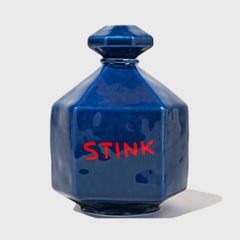
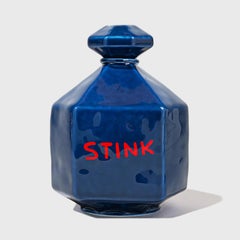
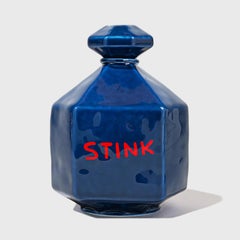
STINK Limited Edition Ceramic Sculpture British Design Modern Conceptualism
By David Shrigley
Located in Madrid, Madrid
DAVID SHRIGLEY - STINK Date of creation: 2023 Medium: Ceramic Edition: 75 Size: 16.5 x 12 x 12 cm Condition: New, in mint conditions and never displayed Description: Ceramic sculptu...
Category

2010s Modern David Shrigley Figurative Sculptures

Materials

Ceramic

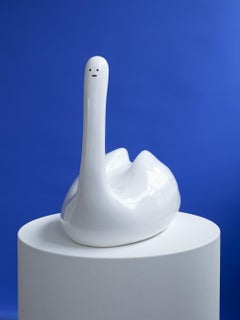
Swan Thing
By David Shrigley
Located in London, GB
David Swan Thing, 2023 Glazed ceramic sculpture with hand-drawn face 38 × 36 × 23 cm ( 15 × 14 1/5 × 9 1/10 in ) Edition of 40 Signed, numbered and dated on the base. Sold in the or...
Category

2010s Contemporary David Shrigley Figurative Sculptures

Materials

Ceramic

Related Items
Shifting Migrations (14 Blue Birds)
Located in Dallas, TX
(14) Blue Bird Sculptures (nails on back for installation).
Category

2010s Modern David Shrigley Figurative Sculptures

Materials

Clay, Pigment

Service Poisson Plate R (“Fish” Service Plate)
By Pablo Picasso
Located in Palo Alto, CA
A whimsical fish sits placidly in the center of Pablo Picasso ceramic Service Poisson Plate R (“Fish” Service Plate), 1947 A.R. 3. A sweeping blue back and a orange belly make up the...
Category

1940s Modern David Shrigley Figurative Sculptures

Materials

Ceramic, Clay, Glaze

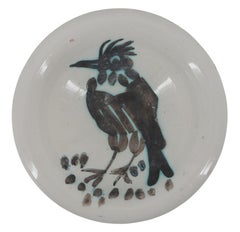
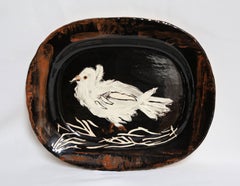
Colombe sur lit de paille, Ceramic Plate by Pablo Picasso 1949
By Pablo Picasso
Located in Long Island City, NY
Artist: Pablo Picasso, Spanish (1881 - 1973) Title: Colombe sur lit de paille, (Dove on a Straw Bed) [Ramie 79 variant] Year: 1949 Medium: White earthenware clay, white enamel brushe...
Category

1940s Modern David Shrigley Figurative Sculptures

Materials

Ceramic

"Woman Figure" Ceramic Abstract Sculpture 10" x 4" inch by Lika Brutyan
By Lika Brutyan
Located in Culver City, CA
"Woman Figure" Ceramic Abstract Sculpture 10" x 4" inch by Lika Brutyan Medium: Clay, underglaze Lika Brutyan is American photographer, was born in a family of scientists and artis...
Category

21st Century and Contemporary Contemporary David Shrigley Figurative Sculptures

Materials

Clay, Underglaze

Abstraction Male - Unique Handmade Modern Glazed Ceramics Wall Sculpture
By Monika Zadurska-Bielak
Located in Salzburg, AT
Weigt of the sculpture 2,15 kg Monika Zadurska-Bielak, Graduated from the studio of Prof. Franciszek Duszeńko at the Faculty of Sculpture of the Acade...
Category

2010s Contemporary David Shrigley Figurative Sculptures

Materials

Ceramic

Hundertwasser s St. Barbara Church Ceramic Miniature Including Certificate
By Friedensreich Hundertwasser
Located in Palm Desert, CA
St. Barbara Church Baernbach by Friedensreich Hundertwasser Ceramic miniature in the scale 1:140 size 12 x 9 x 12 cm Each ceramic object is individually handmade, hand-painted and b...
Category

Early 2000s Post-Modern David Shrigley Figurative Sculptures

Materials

Porcelain

Pase de cape, from Service Scènes de Corrida
By Pablo Picasso
Located in Palo Alto, CA
Pablo Picasso was an avid fan of bullfighting his entire life, attending his first corridas when he was a child in Spain and gaining a renewed interest in the events when he settled ...
Category

1950s Modern David Shrigley Figurative Sculptures

Materials

Ceramic, Clay, Earthenware, Glaze

Pase de cape, from Service Scènes de Corrida
$24,000 Sale Price
20% Off
H 16.75 in Dm 16.75 in
Quatre Poissons Polychromes (Four Polychrome Fishes)
By Pablo Picasso
Located in Palo Alto, CA
Picasso Quatre Poissons Polychromes (Four Polychrome Fishes), 1947 is a wondrous mixture of color and charm. In the center of the dish are three fish, e...
Category

1940s Modern David Shrigley Figurative Sculptures

Materials

Ceramic, Clay, Earthenware, Glaze

Danseurs et Joueur de Diaule (Dancers and Diaulos Player), 1956
By Pablo Picasso
Located in Palo Alto, CA
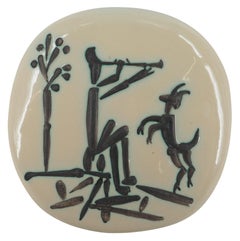
Danseurs et Joueur de Diaule (Dancers and Diaulos Player), A.R. 341 can be compared to several other white earthenware pieces created by Picasso in 1956. Each depicts the carefree imagery of dancers, musicians, and fauns to which the artist returns time and again. Framed under a sloping mountain, two figures dance with arms raised above their heads, hands clasped in a spontaneous gesture. Leafy trees and flowers mark...
Category

1950s Modern David Shrigley Figurative Sculptures

Materials

Ceramic, Earthenware

Mini-monde, père et fils
Located in LE HAVRE, FR
Ceramics and resin figurines. Unique piece Height: 9,5 cm, 3,54 in Length: 10 cm, 3,94 in Signed on the base. Work sold with invoice and certificate o...
Category

2010s Modern David Shrigley Figurative Sculptures

Materials

Ceramic, Synthetic Resin

Mini-monde, père et fils
$142
H 3.75 in W 3.94 in D 3.94 in
Early 20th Century Ceramic Sculpture of a Polo Player and Horse
By Waylande Gregory
Located in Beachwood, OH
Waylande Gregory (American, 1905-1971) Polo Player, c. 1930s Ceramic Inscribed signature on bottom 11 x 8.5 inches Waylande Gregory was considered a major American sculptor during the 1930's, although he worked in ceramics, rather than in the more traditional bronze or marble. Exhibiting his ceramic works at such significant American venues for sculpture as the Whitney Museum of American Art in New York City and at the venerable Pennsylvania Academy of the Fine Arts in Philadelphia, he also showed his ceramic sculptures at leading New York City galleries. Gregory was the first modern ceramist to create large scale ceramic sculptures, some measuring more than 70 inches in height. Similar to the technique developed by the ancient Etruscans, he fired his monumental ceramic sculptures only once. Gregory was born in 1905 in Baxter Springs, Kansas and was something of a prodigy. Growing up on a ranch near a Cherokee reservation, Gregory first became interested in ceramics as a child during a native American burial that he had witnessed. He was also musically inclined. In fact, his mother had been a concert pianist and had given her son lessons. At eleven, he was enrolled as a student at the Kansas State Teacher's College, where he studied carpentry and crafts, including ceramics. Gregory's early development as a sculptor was shaped by the encouragement and instruction of Lorado Taft, who was considered both a major American sculptor as well as a leading American sculpture instructor. In fact, Taft's earlier students included such significant sculptors as Bessie Potter Vonnoh and Janet Scudder. But, Taft and his students had primarily worked in bronze or stone, not in clay; and, Gregory's earliest sculptural works were also not in ceramics. In 1924, Gregory moved to Chicago where he caught the attention of Taft. Gregory was invited by Taft to study with him privately for 18 months and to live and work with him at his famed "Midway Studios." The elegant studio was a complex of 13 rooms that overlooked a courtyard. Taft may have been responsible for getting the young man interested in creating large scale sculpture. However, by the 1920's, Taft's brand of academic sculpture was no longer considered progressive. Instead, Gregory was attracted to the latest trends appearing in the United States and Europe. In 1928 he visited Europe with Taft and other students. "Kid Gregory," as he was called, was soon hired by Guy Cowan, the founder of the Cowan Pottery in Cleveland, Ohio, to become the company's only full time employee. From 1928 to 1932, Gregory served as the chief designer and sculptor at the Cowan Pottery. Just as Gregory learned about the process of creating sculpture from Taft, he literally learned about ceramics from Cowan. Cowan was one of the first graduates of Alfred, the New York School of Clayworking and Ceramics. Alfred had one of the first programs in production pottery. Cowan may have known about pottery production, but he had limited sculptural skills, as he was lacking training in sculpture. The focus of the Cowan Pottery would be on limited edition, table top or mantle sculptures. Two of the most successful of these were Gregory's "Nautch Dancer," (fig. 1) and his "Burlesque Dancer," (fig. 2). He based both sculptures on the dancing of Gilda Gray, a Ziegfield Follies girl. Gilda Gray was of Polish origin and came to the United States as a child. By 1922, she would become one of the most popular stars in the Follies. After losing her assets in the stock market crash of 1929, she accepted other bookings outside of New York, including Cleveland, which was where Gregory first saw her onstage. She allowed Gregory to make sketches of her performances from the wings of the theatre. She explained to Gregory, "I'm too restless to pose." Gray became noted for her nautch dance, an East Indian folk dance. A nautch is a tight, fitted dress that would curl at the bottom and act like a hoop. This sculpture does not focus on Gray's face at all, but is more of a portrait of her nautch dance. It is very curvilinear, really made of a series of arches that connect in a most feminine way. Gregory created his "Burlesque Dancer" at about the same time as "Nautch Dancer." As with the "Nautch Dancer," he focused on the movements of the body rather than on a facial portrait of Gray. Although Gregory never revealed the identity of his model for "Burlesque Dancer," a clue to her identity is revealed in the sculpture's earlier title, "Shimmy Dance." The dancer who was credited for creating the shimmy dance was also Gilda Gray. According to dance legend, Gray introduced the shimmy when she sang the "Star Spangled Banner" and forgot some of the lyrics, so, in her embarrassment, started shaking her shoulders and hips but she did not move her legs. Such movement seems to relate to the "Burlesque Dancer" sculpture, where repeated triangular forms extend from the upper torso and hips. This rapid movement suggests the influence of Italian Futurism, as well as the planar motion of Alexander Archipenko, a sculptor whom Gregory much admired. The Cowan Pottery was a victim of the great depression, and in 1932, Gregory changed careers as a sculptor in the ceramics industry to that of an instructor at the Cranbrook Academy in Bloomfield Hills, Michigan. Cranbrook was perhaps the most prestigious place to study modern design in America. Its faculty included the architect Eliel Saarinen and sculptor Carl Milles. Although Gregory was only at Cranbrook for one and one half years, he created some of his finest works there, including his "Kansas Madonna" (fig. 3). But, after arriving at Cranbrook, the Gregory's had to face emerging financial pressures. Although Gregory and his wife were provided with complimentary lodgings, all other income had to stem from the sale of artworks and tuition from students that he, himself, had to solicit. Gregory had many people assisting him with production methods at the Cowan Pottery, but now worked largely by himself. And although he still used molds, especially in creating porcelain works, many of his major new sculptures would be unique and sculpted by hand, as is true of "Kansas Madonna." The scale of Gregory's works were getting notably larger at Cranbrook than at Cowan. Gregory left the surface of "Kansas Madonna" totally unglazed. Although some might object to using a religious title to depict a horse nursing its colt, it was considered one of Gregory's most successful works. In fact, it had a whole color page illustration in an article about ceramic sculpture titled, "The Art with the Inferiority Complex," Fortune Magazine, December, 1937. The article notes the sculpture was romantic and expressive and the sculpture was priced at $1,500.00; the most expensive sculpture in the article. Gregory was from Kansas, and "Kansas Madonna" should be considered a major sculptural document of Regionalism. Gregory and his wife Yolande moved to New Jersey in the summer of 1933. And the artist began construction on his new home in the Watchung Mountains of Bound Brook (Warren today) in 1938. His enormous, custom kiln was probably constructed at the start of 1938. Gregory's new sculptures were the largest ceramic sculptures in western art, in modern times. To create these works of ceramic virtuosity, the artist developed a "honeycomb" technique, in which an infrastructure of compartments was covered by a ceramic "skin." Science and atomic energy were a theme in Gregory's most significant work, the "Fountain of the Atom" (fig. 4), at the 1939 New York's World Fair. This major work included twelve monumental ceramic figures at the fairground entrance from the newly constructed railway entrance, giving the work great visibility and prominence. The framework of the fountain itself was of steel and glass bricks. It consisted of a bluish green pool which was sixty five feet in diameter. Above it were two concentric circular tiers, or terraces, as Gregory called them; the first wider than the second. On the first terrace were eight "Electrons," comprised of four male and four female terra cotta figures, each approximately 48 inches high. These relate to the valance shell of the atom. Above them on a narrower terrace, were the much larger and heavier terra cotta figures depicting the four elements, each averaging about 78 inches in height and weighing about a ton and a half. Of the four, "Water" and "Air" were male, while "Earth" and "Fire" were female. This terrace represents the nucleus of the atom. In the center of the fountain, above the "Elements," was a central shaft comprised of sixteen glass tubes from which water tumbled down from tier to tier. At the top, a colorful flame burned constantly. The glass block tiers were lit from within, the whole creating a glowing and gurgling effect. Since the fair was temporary, the figures could be removed after its closing. But the credit for the design of the structure of the fountain belongs to collaborator Nembhard Culin, who was responsible for several other structures on the fair grounds as well. Although Gregory created a figure of "Fire" for the "Fountain of the Atom," he also executed a second, slightly smaller but more defined version which he exhibited at various locations (including Cranbrook, Baltimore Museum, etc.) in 1940-1941, during the second year of the fair (fig.5). Measuring 61 inches in height, "Fire" may be a metaphor for sexual energy, as well as atomic energy. Gregory stated, "Fire is represented by an aquiline female figure being consumed in endless arabesques of flame." Portraiture was also a significant focus of Gregory's sculpture. Gregory produced many commissioned portraits of local people as well as celebrities. He created Albert Einstein's portrait from life (fig. 6, ca. 1940) after Einstein had seen Gregory's "Fountain of the Atom." He also sculpted some of the leading figures in entertainment, including 2 sculptures of Henry Fonda, who became a personal friend. Gregory also sculpted a series of idealized female heads, both in terra cotta and in porcelain. These include "Girl with Olive" (ca. 1932) and "Cretan Girl;"(ca. 1937) both are very reductive and almost abstract works that call to mind Constantine Brancusi's "Mademoiselle Pogany" (1912, Philadelphia Museum of Art). But perhaps one of his most original female heads is "Head of a Child" (fig. 7, ca. 1933), a sensitive white glazed terra cotta portrayal with elaborately crafted braded hair, was originally created as one of a pair. Gregory also produced sculptural works for the Works Progress Administration. The WPA was a work relief project that greatly helped artists during the great depression. Founded by the Federal Government in 1935, an estimated 2500 murals were produced. Among these public works were the iconic post office murals. But, among the painted murals were also sculptural relief murals including Gregory's "R.F.D.," 1938, for the Columbus, Kansas Post Office. But, Gregory's largest WPA relief...
Category

1930s David Shrigley Figurative Sculptures

Materials

Ceramic

"Zuza" Ceramic Sculpture 22" x 6" inch by Lika Brutyan
By Lika Brutyan
Located in Culver City, CA
"Zuza" Ceramic Sculpture 22" x 6" inch by Lika Brutyan Medium: Clay, underglaze Lika Brutyan is American photographer, was born in a family of scientists and artists in Yerevan, Ar...
Category

21st Century and Contemporary Contemporary David Shrigley Figurative Sculptures

Materials

Clay, Underglaze

Previously Available Items
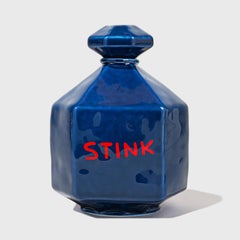
STINK Limited Edition Ceramic Sculpture British Design Modern Conceptualism
By David Shrigley
Located in Madrid, Madrid
DAVID SHRIGLEY - STINK Date of creation: 2023 Medium: Ceramic Edition: 75 Size: 16.5 x 12 x 12 cm Condition: New, in mint conditions and never displayed Description: Ceramic sculptu...
Category

2010s Modern David Shrigley Figurative Sculptures

Materials

Ceramic

STINK Limited Edition Ceramic Sculpture British Design Modern Conceptualism
By David Shrigley
Located in Madrid, Madrid
DAVID SHRIGLEY - STINK Date of creation: 2023 Medium: Ceramic Edition: 75 Size: 16.5 x 12 x 12 cm Condition: New, in mint conditions and never displayed Description: Ceramic sculptu...
Category

2010s Modern David Shrigley Figurative Sculptures

Materials

Ceramic

I Must Rest Now, My Rampage Is Over (Sculpture) By David Shrigley
By David Shrigley
Located in Dubai, Dubai
Must Rest My Rampage Is Over (Sculpture) By David Shrigley David Shrigley is a British artist known for his darkly humorous and satirical drawings...
Category

2010s Contemporary David Shrigley Figurative Sculptures

Materials

Ceramic

I Must Rest Now, My Rampage Is Over (Sculpture) By David Shrigley
By David Shrigley
Located in Dubai, Dubai
Must Rest My Rampage Is Over (Sculpture) By David Shrigley David Shrigley is a British artist known for his darkly humorous and satirical drawings...
Category

2010s Contemporary David Shrigley Figurative Sculptures

Materials

Ceramic

STINK Limited Edition Ceramic Sculpture British Design Modern Conceptualism
By David Shrigley
Located in Madrid, Madrid
Date of creation: 2023 Medium: Ceramic Edition: 75 Size: 16.5 x 12 x 12 cm Condition: New, in mint conditions and never displayed Ceramic sculpture part of a limited edition of only...
Category

2010s Modern David Shrigley Figurative Sculptures

Materials

Ceramic

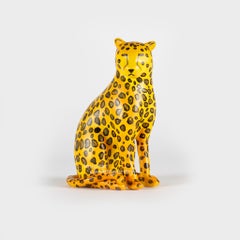
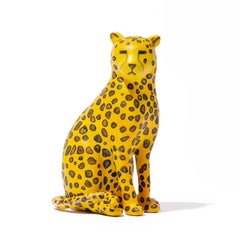
I Cannot Change My Spots But I Have No Desire To Change My Spots
By David Shrigley
Located in Bristol, GB
Ceramic Edition of 75 Signed and numbered on COA New, as issued. Due to the hand finished nature of this artwork each sculpture in this edition differs slightly. The specific sculptu...
Category

21st Century and Contemporary Contemporary David Shrigley Figurative Sculptures

Materials

Ceramic

I Must Rest My Rampage Is Over
By David Shrigley
Located in Bristol, GB
Ceramic Edition of 75 Signed and numbered on COA New, as issued. Due to the hand finished nature of this artwork each sculpture in this edition differs slightly. The specific sculptu...
Category

21st Century and Contemporary Contemporary David Shrigley Figurative Sculptures

Materials

Ceramic

I Cannot Change My Spots But I Have No Desire To Change My Spots -- Print
By David Shrigley
Located in London, GB
I Cannot Change My Spots But I Have No Desire To Change My Spots, 2022 David Shrigley Ceramic multiple Signed on an accompanying COA Numbered from the edition of 75 Multiple: 19 × 1...
Category

2010s Contemporary David Shrigley Figurative Sculptures

Materials

Ceramic

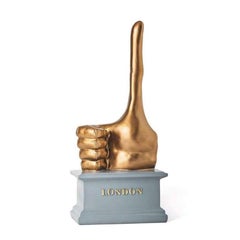
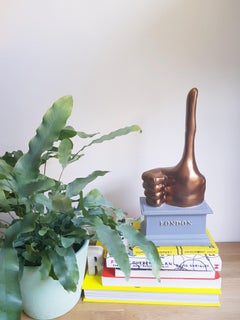
Really Good (Fourth Plinth)
By David Shrigley
Located in Bristol, GB
Edition of 3000 This work is signed under the base in black marker New, as issued. Some minor imperfections may exist given the nature of the material Sold in the original packaging...
Category

21st Century and Contemporary Contemporary David Shrigley Figurative Sculptures

Materials

Mixed Media

Really Good -- Sculpture, Polystone, Contemporary Art by David Shrigley
By David Shrigley
Located in London, GB
DAVID SHRIGLEY Really Good, 2016 Polystone multiple Signed and numbered from the edition of 3000 on the base Multiple: 29.0 x 12.5 x 7.5 cm (11.4 x 4.9 x 3.0 in)
Category

2010s Contemporary David Shrigley Figurative Sculptures

Materials

Resin, Polyurethane

Really Good -- Sculpture, Polystone, Contemporary Art by David Shrigley
By David Shrigley
Located in London, GB
DAVID SHRIGLEY Really Good, 2016 Polystone multiple Signed and numbered from the edition of 3000 on the base Multiple: 29.0 x 12.5 x 7.5 cm (11.4 x 4.9 x 3.0 in)
Category

2010s Contemporary David Shrigley Figurative Sculptures

Materials

Resin, Polyurethane

David Shrigley figurative sculptures for sale on 1stDibs.

Find a wide variety of authentic David Shrigley figurative sculptures available for sale on 1stDibs. You can also browse by medium to find art by David Shrigley in ceramic, stone, cast stone and more. Much of the original work by this artist or collective was created during the 21st century and contemporary and is mostly associated with the contemporary style. Not every interior allows for large David Shrigley figurative sculptures, so small editions measuring 4 inches across are available. Customers who are interested in this artist might also find the work of Lucy Sparrow, Daniel Arsham, and Lucy Kinsella. David Shrigley figurative sculptures prices can differ depending upon medium, time period and other attributes. On 1stDibs, the price for these items starts at $600 and tops out at $9,669, while the average work can sell for $4,506.
Questions About David Shrigley Figurative Sculptures
  • 1stDibs ExpertApril 5, 2022
    To create his drawings, David Shrigley uses either ink and a brush, or a water-based marker pen. He is known for his comedic take, combining handwritten text with child-like images of animals, people and everyday still life. Shop a selection of David Shrigley’s pieces from some of the world’s top art dealers on 1stDibs.

Recently Viewed

View All